


Solar for UK retail parks and shops: UK business guide
Published: 2026-09-28 18:48:34
Updated: 2026-09-29 03:52:07
Solar for UK retail parks and shops suits sites with roof control, lease consent and daytime use that matches the array. The grid supply still remains.
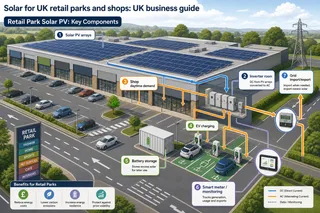
Solar for UK retail parks and shops - UK business guide
UK business guide B Solar retail daytime load match
Solar for UK retail parks and shops: when it is a good fit
Solar for UK retail parks and shops means on-site photovoltaic generation, most often on the roof and sometimes on a car-park canopy, sized to offset electricity the building would otherwise import while it is open. It is not a standalone power station, and it does not remove the grid supply. The useful cases are sites with someone who can authorise the works, a roof or canopy that can take the design, a supply that can be connected within the network operator’s limits, and daytime use that is large relative to the proposed array.
A retail park is a group of larger stores with shared parking and low-rise buildings. A shop may be a high-street unit, a centre unit or a retail warehouse. Tenure, roof control and metering differ across those formats, so the same array size is not equally practical in each. Owner-occupied warehouses and larger food stores are often the clearer starting point, but only after survey. Short leases, roofs due for renewal, and units with little daytime import are the usual reasons a scheme should stop.
The first conversation is not about module brand. It is about who owns the roof, who pays the electricity bill, and whether those are the same party. If they are not, consent and benefit-sharing have to be agreed before design is frozen. A large roof on a plan is not evidence that the structure, the membrane warranty or the local network will accept the job.
How opening hours change the technical case
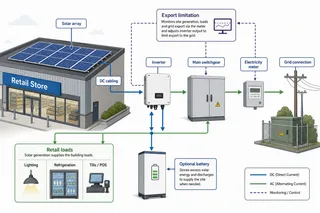
Retail demand often overlaps daylight, which is the main technical reason photovoltaic generation is discussed for shops and retail parks. Lighting, ventilation, tills and, in grocery, refrigeration and food preparation sit in the same part of the day as solar output. That overlap is a reason to investigate. It is not proof that most of the generation will be used on site.
Night import remains. Chilling often runs after the store has closed, and security and some ventilation still draw from the grid when the array has stopped. Standing charges do not disappear because modules are on the roof. Dull weather and short winter days increase import as well. Avoided import, valued at the site’s supply rate, is not the same figure as export. A weak daytime match is not repaired by assuming exported units will be worth the same as units the shop would have bought.
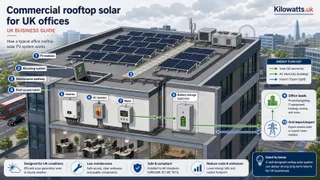
Food retail tends to have a higher and flatter electrical load than many non-food shops, so self-consumption can be easier to argue, subject to the actual meter data. A fashion or homewares unit may have a large roof relative to modest daytime demand, which pushes a big array toward export or argues for a smaller system. Commercial rooftop solar for UK offices is a related question, but offices usually have a different roof-plant layout and a load that follows occupancy rather than continuous refrigeration. Copying an office layout onto a retail warehouse, or the reverse, is a common way to miss both the structure and the load. Array size in kilowatts is not annual generation in kilowatt-hours, and neither figure is the share used on site. Half-hourly metered supplies, which larger retail sites often have, make that distinction visible. A year of import data is more useful than a floor-area guess. An array sized only to summer roof area, without winter demand or any export limit, is how projects get overbuilt.
Roof control, canopies and the lease
The constraints are often legal and physical rather than about sunshine. A leased unit needs consent to alter the building. The lease may say who owns roof plant, who receives bill savings, and what must be removed at the end of the term. On a retail park or in a centre, the roof, the car park and the electrical supply may sit with different parties. A tenant who pays the bill cannot assume a right to use the roof.
Retail warehouse roofs are often large, flat or low-pitch, and relatively lightweight. That can look ideal and still fail. Spare structural capacity, drainage falls, existing plant and the date of the next roof replacement often matter more than floor area. A membrane warranty that forbids penetrations, or a ballast layout that compresses insulation and blocks outlets, can stop a scheme that looked straightforward on a satellite image. Wind uplift at exposed park edges needs engineering, not a glance from the car park. Edge zones and access corridors around air-handling plant routinely reduce the usable area once the drawing is honest.
A car-park canopy is not a simpler default. It brings vehicle clearance, delivery routes, lighting, drainage and planning questions of its own. Columns that clash with goods-in or with pedestrian routes will not be solved by a roof layout. Customer parking and trading hours also limit when either roof or canopy work can proceed. Crane lifts, scaffold and cable routes have to work around a live store, and those programme limits change the job even when the electrical design is simple. Small high-street shops often fail on roof area and on who controls the structure above a shared building. Multi-let parks can still proceed if metering and the split of benefit are agreed first. If the remaining occupation is shorter than the period the paying party needs, the sensible outcome is often to wait, or to leave the roof until a planned renewal.
What the survey has to prove before kit is ordered
A domestic-style roof glance does not carry a shop or a retail park. The warranty holder has to accept ballast or penetrative fixings, and the fixing design has to protect both the membrane and the drainage layout. Structural sign-off should cover uplift and ballast, not panel weight alone. Shading from rooftop plant and from neighbouring units should be modelled, because a clear patch on a photograph can be shaded for much of the trading day.
Asbestos may still be present on older retail buildings and has to be surveyed before intrusive work. Inverter location, isolation for the store’s own electricians, fire-service access and insurer conditions should be settled before equipment is ordered. Landlord and tenant supplies are sometimes separate, so the array has to land on the supply that actually carries the load you intend to offset. Cable routes through a trading floor, above a chilled ceiling or across a landlord’s demise are design items, not discoveries for installation week.
A sensible sequence is to confirm tenure and roof control, obtain import data and the existing connection position, inspect the roof build-up and warranty limits, then commission structure and speak to the distribution network operator with a defined equipment list. Reversing that order, and buying modules before consent, structure and connection are clear, is how retail projects stall with equipment in storage and no agreed date to install. Module and inverter life should be taken from the manufacturer data for the products specified, not from a generic retail average. Output still depends on orientation, tilt, shading and regional irradiance.
Connection limits and the supply that remains
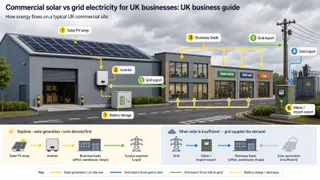
Photovoltaic generation does not replace grid electricity. Commercial solar versus grid electricity for UK businesses is a comparison of avoided import, any export, and the supply that remains, not a choice to disconnect. The site still imports at night and in poor light. Capacity charges, standing charges and the terms of the supply contract continue, and they need to be read against the proposal rather than assumed away.
Connection class depends on capacity. A small shop array may sit in a different process from a retail-park array. Larger commercial connections are commonly handled under the Energy Networks Association G99 process rather than the small-scale G98 route. Thresholds, forms and timescales have to come from current guidance for the distribution network operator that serves that site. They are not uniform, and they should not be copied from a neighbouring park on another network. For anything beyond a very small system, treat the commercial solar G99 DNO connection as a site application: equipment list, protection settings and any export limit must match what that operator has accepted.
If the inverter, the capacity or the export limit changes after acceptance, the operator may treat the job as a different proposal. Metering should be designed with the existing supply, particularly where the site is half-hourly settled. Export value is not the retail import rate, so a design that needs export income to justify itself should be tested against the actual contract. If one array is meant to supply other tenants on the park, that raises licensing and metering questions which need a proper legal source before they are treated as a wiring detail. This guide does not set out that licensing position. Battery storage is a separate decision. It can shift some daytime surplus into the evening, but it adds space, cost, fire considerations and conversion losses, and it does not remove the grid supply. It should not be added by default to make an oversized retail array look better on a spreadsheet.
Why cost and yield cannot be taken from another site
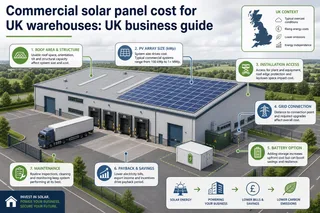
No credible UK-wide price, annual yield, self-consumption share or payback can be stated for retail solar from the building type alone. Commercial solar panel cost for UK warehouses is the same kind of question, and it is equally site-specific. Roof condition, trading-hour access, structural strengthening, electrical upgrades, network works and the landlord-tenant split all move the figure. A price per kilowatt borrowed from another sector will mislead.
Yield is unknown without orientation, tilt, shading and irradiance for that roof. A performance figure quoted without a monitoring specification and a defined period is not a decision tool. Operation and maintenance cost depends on who attends, how often, and what roof-access rules the centre will allow. Do not treat a payback year from a headline as evidence. The honest next step is supply data, a roof and structure survey, and a quote that states what it has not yet checked.
Grants, business rates treatment, VAT on commercial installations, and permitted development limits for roofs and canopies are changeable legal and fiscal points. None of them is confirmed here, and none of them should be relied on without current official guidance and the site’s own advisers. A scheme that cannot be consented, connected or maintained does not become viable because a fiscal rule might apply.
Which format is the clearer candidate?
The clearer cases share a long occupation or ownership horizon, a party who can authorise the works, a roof or canopy that can take the design load, and daytime electricity use that is large relative to the array. Owner-occupied retail warehouses and larger food stores often fall into that group after survey, not before it. A leased retail-park unit can still work if the landlord, the tenant and whoever controls the supply agree reinstatement and the split of benefit before equipment is ordered. High-street and small centre units are more often constrained by roof area, shared structure and split control. That does not make every high-street shop impossible. It means the survey should start with control and area, not with a default array size copied from a retail warehouse. The comparison below is a screen for what to check first. It is not a savings forecast and it does not score a park from a photograph.
Overview
If roof control is unresolved, generation modelling is premature. If the load is small and mostly overnight, a large roof is not an argument for a large array. Measure the constraint that can kill the job, then spend money on design.
Operation, maintenance and who must respond
Questions about commercial solar operation and maintenance, and about performance guarantees, should be answered before the order, not after the first alarm. Someone has to be contracted to respond. Monitoring is of little use if no agreement says who attends, within what time, and who may access a trading roof. On a retail park that person may not be the store manager, and access may need a landlord permit and a method that keeps customers clear.
Performance wording should be read against the specified products and the monitoring setup. Market terms are not standardised here, and this guide does not state a guaranteed output, a degradation rate or an uptime figure. Insurer conditions and fire access agreed at design stage should appear in the operating manual, or the store inherits a system it is not allowed to maintain as installed. Fall protection for later roof work is part of that manual, not an afterthought once the array blocks the old access route.
Removal at lease end, membrane reinstatement, and who owns the plant if the tenant leaves are operating issues as well as legal ones. Freeze them before equipment is ordered. A system that cannot be maintained, or that must be stripped out before it has served the party who paid for it, is a poor use of a sound roof.
When to stop, and what to take to an installer
Solar is a poor fit where the lease is short and the landlord will not agree, the roof needs replacement first, shading or structure is poor, or the unit has little daytime import. It is also a poor fit if the only party keen to proceed does not control the roof or the supply. Interest from several tenants is not the same as a consented project. Waiting for the roof renewal, and fitting generation as part of that later work, is often the better sequence.
Before design is frozen, ask who can sign for the roof and the warranty, what occupation remains, and whether the covering is due for replacement inside that period. Ask for import data rather than floor area. Ask which network operator serves the site, whether the supply is half-hourly, and whether an export limit is already expected. Ask where inverters can sit, how fire access is kept, and who will hold the maintenance contract. Ask how craneage and isolations will avoid peak trading, because that constraint changes both method and programme.
If the question has moved from “is the roof even available?” to “which installation route fits this supply and this tenure?”, compare the options against the survey rather than against a brochure. A practical place to do that is commercial solar panel installation options. Take the roof report, the supply data and the consent position into that conversation. A competent proposal will say what it has not yet surveyed, and it will not promise a payback the site data cannot support.
Plan, Compare & Buy Renewable Energy Solutions
AI does the thinking.
You get the perfect solar match.
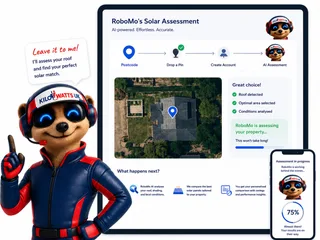
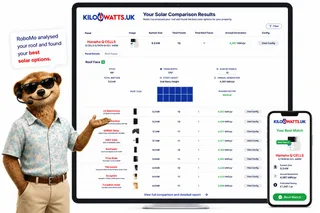
Use RoboMo™ to assess your property, compare available technologies and connect with trusted UK installers, suppliers and manufacturers.
Simply enter your postcode, drop a pin on your roof, create your free account and let RoboMo™ analyse your property to find the best solar panels for your home.

You don't have to think
RoboMo™'s AI analyses your roof and does all the hard work.

Accurate & tailored
AI-powered assessment based on your roof, location, and conditions.

Best options, maximum savings
Compare top solar panels for the best performance and value.

Simple, fast & effortless
Provide a few details, sit back and watch your results unfold.
STEP 1
Choose Home, Business or Industrial
Enter your postcode to start your assessment.
STEP 2
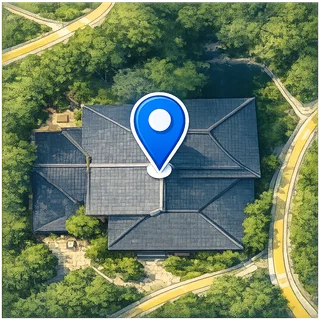
Drop a pin on your roof
STEP 3

Create your free account
STEP 4

Sit back and watch RoboMo™ work
RoboMo™ analyses your roof and builds your personalised solar comparison.

Kilowatts UK is an authorised representative
Flower Turbines
Compact vertical-axis turbines built for real UK sites, not just open farmland.
They start in light wind, sit in a small footprint, and are bird-safe by design. Cluster them as a bouquet and the group performs better together than the same turbines standing alone. Enter your postcode for a location-based generation estimate. Figures use area weather data and will differ if buildings, trees or hills sit in the way.
Starts in light UK wind
Built to generate in typical UK wind, not only open farmland.
Small rooftop or ground footprint
Compact towers for roofs, yards and tight sites.
Bird-safe slow rotation
Slow vertical-axis spin, bird-safe by design.
Bouquet clusters raise output
Grouped turbines outperform the same units standing alone.
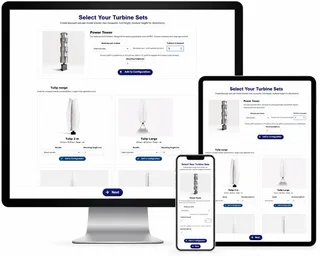
Step 1
Enter your postcode
Start designing your wind energy system in seconds.
STEP 2

Choose a location
STEP 3

Place your cluster
Tap the map where you want the turbine cluster to go.
STEP 4

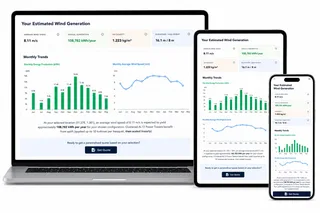
Instant generation forecasts
Compare different turbine layouts and see annual generation forecasts instantly.
STEP 5

No commitment required
Explore different configurations before deciding whether to request a quotation.
Related articles
Solar panels
Mo's Mission Nominations
FAQ
Need Help? RoboMo's Got Answers
When is solar a good fit for a UK retail park or shop?
It is worth investigating where someone can authorise the works, a roof or canopy can take the design, the supply can be connected within the network operator's limits, and daytime electricity use is large relative to the proposed array. The aim is to offset import while the building is open. It is not a standalone power station, and it does not remove the grid supply. Owner-occupied retail warehouses and larger food stores are often a clearer starting point than a short-lease high-street unit, but only after survey. A car-park canopy is not automatically simpler, because clearance, delivery routes, drainage and planning all have to be checked for that site.
Do shop opening hours mean most of the generation will be used on site?
Daytime opening is a reason to look at solar, not proof that most of the generation will be used on site. Lighting, tills, ventilation and, in grocery, refrigeration can overlap with solar output, but night chilling, security and some ventilation still import from the grid. Dull weather and short winter days increase import, and standing charges do not disappear because modules are on the roof. Avoided import, valued at the site's supply rate, is not the same figure as export. A year of meter data is more useful than a floor-area guess.
Who must agree if the tenant pays the bill but does not control the roof?
The first question is who owns the roof, who pays the electricity bill, and whether those are the same party. If they are not, consent and how any savings are shared have to be agreed before the design is frozen. The lease may say who owns roof plant, who receives bill savings, and what must be removed at the end of the term. On a retail park or in a centre, the roof, the car park and the supply may sit with different parties, so a tenant cannot assume a right to use the roof. If the remaining occupation is shorter than the period the paying party needs, the sensible outcome is often to wait.
What should be checked before solar equipment is ordered?
A domestic-style roof glance does not carry a shop or a retail park. Confirm tenure and roof control, obtain import data and the existing connection position, and inspect the roof build-up and warranty limits before a structural check or an approach to the distribution network operator. Structural sign-off should cover wind uplift and ballast, not panel weight alone, and the warranty holder has to accept the fixing method. Shading, possible asbestos on older buildings, inverter location, isolation, fire-service access, insurer conditions and cable routes through a live store should be settled first. Buying modules before consent, structure and connection are clear is how projects stall with equipment in storage.
Does commercial solar replace the shop's grid supply?
No. The comparison is avoided import, any export, and the supply that remains, not a choice to disconnect. The site still imports at night and in poor light, and capacity charges, standing charges and the supply contract continue. A small shop array may sit in a different connection process from a retail-park array. Larger commercial connections are commonly handled under the G99 process rather than the small-scale G98 route, but thresholds, forms and timescales must come from current guidance for the distribution network operator that serves that site.
Should battery storage be added to make a large retail array viable?
Battery storage is a separate decision from the solar array. It can shift some daytime surplus into the evening, but it adds space, cost, fire considerations and conversion losses. It does not remove the grid supply. It should not be added by default to make an oversized retail array look better on a spreadsheet.
Can price, yield, payback or grant rules be taken from another site?
No credible UK-wide price, annual yield, self-consumption share or payback can be stated from the building type alone. Roof condition, trading-hour access, structural work, electrical upgrades, network works and the landlord-tenant split all move the figure. A price per kilowatt or a payback year borrowed from another sector, or from a headline, will mislead. Grants, business rates treatment, VAT and permitted development limits are changeable and are not confirmed here, so they should not be relied on without current official guidance and the site's own advisers.
What should be agreed about maintenance and performance?
Operation, maintenance and any performance expectation should be agreed before the order, not after the first alarm. Cost depends on who attends, how often, and what roof-access rules the centre will allow during trading hours. Module and inverter life should be taken from the manufacturer data for the products specified, not from a generic retail average. Output still depends on orientation, tilt, shading and regional irradiance, so a figure quoted without a monitoring specification and a defined period is not a decision tool.