


Commercial solar panel cost for UK warehouses: UK business
Published: 2026-09-28 17:05:35
Updated: 2026-09-28 15:51:35
Commercial solar panel cost for UK warehouses is the full installed price, not a module quote. Weigh it against yield and on-site daytime use.
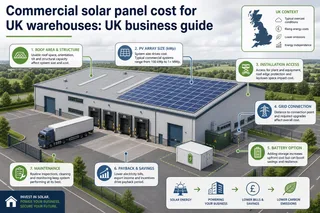
Commercial solar panel cost for UK warehouses - UK business guide
UK business guide B Solar CAPEX vs generation for warehouses
What commercial solar panel cost for UK warehouses includes
Commercial solar panel cost for UK warehouses is the installed project capital cost of a commercial solar installation, not the trade price of the modules. A credible figure normally covers the photovoltaic array, inverters, mounting, cabling, protection, monitoring, design, safe access and the electrical works needed to connect the system to the site supply. That sum only makes sense against expected annual generation in kilowatt-hours, and against how much of that energy the warehouse can use on site or is allowed to export.
The lines that move a warehouse quote are often the ones left outside a panel price. Roof repairs, structural reinforcement, asbestos remediation, edge protection on a tall elevation, long cable containment and distribution network operator works can each matter more than the module line. If a proposal does not say whether those items are included, excluded or not yet surveyed, it is not yet a project cost.
Nameplate capacity, in kilowatts-peak, is the module rating under standard test conditions. It is not annual energy. The inverter's alternating-current rating is often lower than the direct-current array rating, so a cost per kilowatt-peak compares build intensity only. It does not predict how many imported units the site will avoid.
How to read capital cost against generation
A warehouse solar price should be read against modelled annual output, not against panel wattage. Generation is the expected kilowatt-hours after orientation, shading, temperature, inverter and cable losses, and soiling. Without that model, a lower capital cost can simply be a smaller array, a more shaded roof, or a connection that will not accept the energy the roof could produce. Commercial solar versus grid electricity for UK businesses is not a swap of the whole bill. Daytime generation can displace imported units while the site is using power. Night load, winter output, standing charges and any capacity-based network charges remain. Where export is allowed, it is usually worth a different amount from the import tariff it replaces. The same kilowatt-hour is not equally valuable in every hour. Sizing starts from half-hourly import data and the roof build-up, then stops at the tightest constraint among structure, usable roof, daytime load and export limit. East–west layouts on flat roofs often give a flatter daytime profile and can cover more roof than a south-only layout. They do not automatically produce more energy per installed kilowatt. A sunnier southern site is not the same resource as northern Scotland. Local shading can erase that difference. A national yield figure should not be dropped into a payback sum.
What the roof and access do to the installed price
Usable roof area is set by structure, rooflights, plant and safe access, not by the footprint on a plan. A desktop take-off almost always overstates capacity. Smoke vents, drainage paths, edge zones and plant exclusions remove a large share of an industrial roof before a module layout is honest.
On a first visit, the checks that change the quote are usually on the roof and in the switchroom. Installers look at the build-up, purlin or deck condition, fragile rooflights, drainage falls, and whether the roof-warranty holder must approve the fixing. Electrically, they look at the incomer, spare capacity, any existing generation, an inverter location that stays within the equipment's temperature range, and a cable route that does not rely on an improvised drop down the elevation.
Trapezoidal metal, standing seam and membrane roofs need different fixings. Clips on standing seam, purlin fixings through trapezoidal sheet, and ballasted frames on membranes each change point loads, drainage and warranty conditions. Wind exposure, coastal location and building height belong in that design. Wind uplift and snow load are a structural calculation, not a domestic mounting table copied onto a warehouse. Older industrial sheets may contain asbestos cement. Where that is suspected, penetrative fixing is often ruled out until the roof is dealt with under the relevant asbestos rules. On tall warehouses, temporary edge protection, fragile-roof working rules and cable containment often move programme and cost more than the panels.
How the DNO connection limits the scheme worth building
A commercial solar G99 DNO connection in the UK is often the gating item at warehouse scale. The correct route is confirmed with the local distribution network operator, not assumed from roof area. Sites may be on a low-voltage supply or a high-voltage supply, commonly with half-hourly metering and limited spare capacity. Which engineering recommendation applies, what export is allowed, and whether reinforcement is charged, are site-specific.
Current thresholds, fees and timescales should be taken from that distribution network operator and from the published Energy Networks Association connection documents. They should not be copied from a domestic notification guide. If the export limit is tight, building to the full roof adds capital without adding usable energy. A very large roof on a weak import connection can fail for the same reason.
Before equipment is ordered, fix the proposed export limit, the inverter location, and whether any reinforcement sits inside the solar quote. Long direct-current runs and roof-level isolation need to be maintainable. They also need to meet what the insurer and the fire service expect on that building. Insurers sometimes ask for design features beyond a minimum electrical install. Those requirements are a project constraint. They are not a reason to assume a domestic certification route applies unchanged to a warehouse.
Why daytime load decides the value of the same array
How much generation offsets grid electricity depends on the daytime load, not on roof area. A cold store or a busy fulfilment building often has a steadier daytime demand than an ambient warehouse with little plant. Two buildings with the same kilowatt-peak can diverge sharply if one uses most of its output and the other would export most of it onto a constrained network.
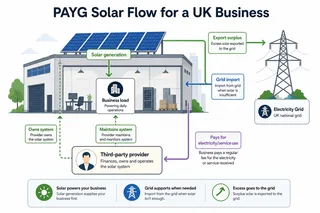
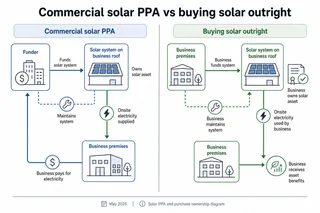
Landlord and tenant structure can matter as much as the load. If the occupier pays the electricity bill but does not control the roof, or the landlord would own the array but cannot recover the power, the capital case and the generation case sit with different parties. Remaining lease length should be set against how long the array is expected to stay. A power purchase agreement or a roof lease is a different product from a turnkey capital purchase. It is priced in the energy supplied, not as the occupier's installed cost. Those contract rates are not a substitute for a capital quote.
Metering has to separate generation, import and export in a way the supplier and any tenant billing can use. Without that split, neither party can tell whether the model is being delivered. A battery is not part of the solar capital figure unless the quote says so. It can move surplus into later hours, but it adds equipment, space, a fire-safety review and its own losses. It should be judged as a separate battery storage decision.
Why offices and retail parks need a different cost case
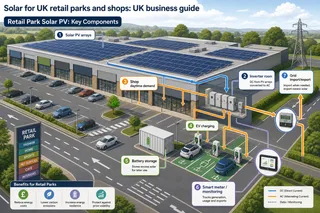
Commercial rooftop solar for offices, and solar for UK retail parks and shops, should not be costed from a warehouse example. The modules may be the same technology. The roof, the hours and the metering usually are not.
Offices often carry more roof plant, more shading from risers and a load that follows occupancy rather than process plant. Retail parks and shops add shared roofs, service-charge structures and opening hours that may not match the solar day. A warehouse assumption of a clear metal deck and a single half-hourly supply will mis-state those jobs. The method still holds: installed cost against modelled yield and against on-site use. The roof exclusions, the lease and the load profile have to be rebuilt for the building in front of you.
What operation and performance terms add after handover
Commercial solar operation and maintenance, and any performance guarantee, sit in the lifetime cost even though they are absent from the day-one capital figure. Modules are commonly discussed over multiple decades. Inverters are often replaced sooner. Warranty years and degradation rates differ by product. They are not, by themselves, a promise of annual kilowatt-hours.
A performance claim is only checkable if monitoring compares output with on-site irradiance, and if as-built drawings and shutdown procedures match the array that was built. Soiling, a failed string or extended downtime can erase a paper yield advantage. There is no single UK warehouse operation and maintenance cost per kilowatt-peak that can be applied to every roof. Ask what inspections, inverter response, cleaning and monitoring are included, and what is excluded, rather than accepting a headline percentage.
Commissioning for a commercial connection is not a domestic notification. Handover documents and a monitoring view that someone on site can read are part of whether the generation case is still visible in year two. If those items are vague, the capital price is easier to compare and harder to trust.
When a warehouse solar project is a poor fit
The usual fit for solar on warehouses is a sound, largely unshaded roof, a building life that matches the array, and a daytime load large enough to use a meaningful share of output. Owner-occupiers, or landlords and tenants who have already agreed who pays and who benefits, can compare a capital purchase on that basis. An organisation that cannot fund the system should treat a third-party roof arrangement as a separate procurement, not as a discount on the same quote.
It is a poor fit where the roof needs replacement, where asbestos will not be remediated, or where a structural check fails. Short leases without landlord consent, buildings due for redevelopment, and heavily shaded roofs are also poor fits. A large roof on a low-load store can look attractive on area and still be capped by export capacity. Listed status, a conservation area, or another planning constraint can stop or resize a scheme before module price does. Planning, building control and non-domestic rates treatment are not identical in England, Scotland, Wales and Northern Ireland. They are not the same as a domestic installation. Confirm them for the nation and the building. Do not take an outcome from a general guide.
How to compare warehouse solar quotes
Before you compare quotes, put every price on the same scope. Roof zones left out, structural sign-off, edge protection, and distribution network operator works should each be marked as included, excluded or still unsurveyed. A lower headline that omits reinforcement is not a cheaper project.
The generation schedule should state the layout, the main loss assumptions, and the share assumed to be used on site rather than exported. If one bidder models unlimited export and another models a capped connection, the kilowatt-peak figures are not the same scheme. Half-hourly import data, not a typical warehouse profile, should sit behind that split.
There is no single payback year for warehouse solar. It depends on the import tariff displaced, the share used on site, any export value, degradation, downtime, maintenance, insurance and the cost of capital. None of those should be filled with a national average to force an answer. The practical next step is a yield model tied to the site's half-hourly load, a connection position from the distribution network operator, and quotes that price the same roof exclusions and the same export limit.
Plan, Compare & Buy Renewable Energy Solutions
AI does the thinking.
You get the perfect solar match.
Use RoboMo™ to assess your property, compare available technologies and connect with trusted UK installers, suppliers and manufacturers.
Simply enter your postcode, drop a pin on your roof, create your free account and let RoboMo™ analyse your property to find the best solar panels for your home.

You don't have to think
RoboMo™'s AI analyses your roof and does all the hard work.

Accurate & tailored
AI-powered assessment based on your roof, location, and conditions.

Best options, maximum savings
Compare top solar panels for the best performance and value.

Simple, fast & effortless
Provide a few details, sit back and watch your results unfold.
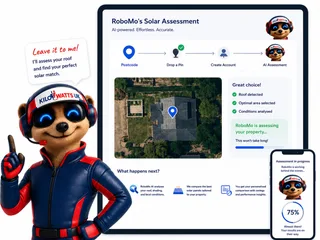

STEP 1
Choose Home, Business or Industrial
Enter your postcode to start your assessment.
STEP 2

Drop a pin on your roof
STEP 3

Create your free account
STEP 4

Sit back and watch RoboMo™ work
RoboMo™ analyses your roof and builds your personalised solar comparison.

Kilowatts UK is an authorised representative
Flower Turbines
Compact vertical-axis turbines built for real UK sites, not just open farmland.
They start in light wind, sit in a small footprint, and are bird-safe by design. Cluster them as a bouquet and the group performs better together than the same turbines standing alone. Enter your postcode for a location-based generation estimate. Figures use area weather data and will differ if buildings, trees or hills sit in the way.
Starts in light UK wind
Built to generate in typical UK wind, not only open farmland.
Small rooftop or ground footprint
Compact towers for roofs, yards and tight sites.
Bird-safe slow rotation
Slow vertical-axis spin, bird-safe by design.
Bouquet clusters raise output
Grouped turbines outperform the same units standing alone.
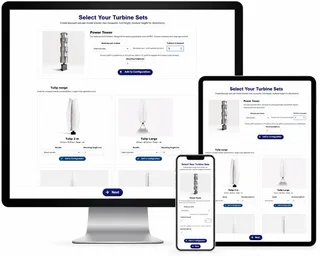
Step 1
Enter your postcode
Start designing your wind energy system in seconds.
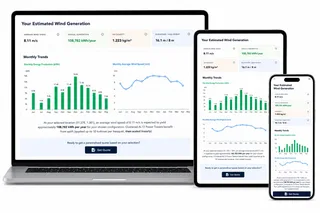
STEP 2

Choose a location
STEP 3

Place your cluster
Tap the map where you want the turbine cluster to go.
STEP 4

Instant generation forecasts
Compare different turbine layouts and see annual generation forecasts instantly.
STEP 5

No commitment required
Explore different configurations before deciding whether to request a quotation.
Related articles
Mo's Mission Nominations
FAQ
Need Help? RoboMo's Got Answers
What does a commercial solar panel cost for a UK warehouse include?
It is the installed project capital cost, not the trade price of the modules. A credible figure normally covers the photovoltaic array, inverters, mounting, cabling, protection, monitoring, design, safe access and the electrical works needed to connect the system to the site supply. Roof repairs, structural reinforcement, asbestos remediation, edge protection, long cable containment and distribution network operator works can each matter more than the module line. If a proposal does not say whether those items are included, excluded or not yet surveyed, it is not yet a project cost.
Why is a cost per kilowatt-peak a poor way to judge a warehouse quote?
Nameplate capacity, in kilowatts-peak, is the module rating under standard test conditions. It is not annual energy, and the inverter's alternating-current rating is often lower than the direct-current array rating. A cost per kilowatt-peak compares build intensity only. It does not show modelled yield after losses, or how many imported units the site will avoid.
How do the roof and access change the installed price?
Usable roof area is set by structure, rooflights, plant, drainage, edge zones and safe access, not by the footprint on a plan. Trapezoidal metal, standing seam and membrane roofs need different fixings, and wind uplift and snow load are a structural calculation, not a domestic mounting table copied onto a warehouse. On tall buildings, temporary edge protection, fragile-roof working rules and cable containment often move programme and cost more than the panels. Where asbestos cement is suspected, penetrative fixing is often ruled out until the roof is dealt with under the relevant asbestos rules.
How does the distribution network operator connection limit what is worth building?
At warehouse scale the connection is often the gating item. The correct route is confirmed with the local distribution network operator, not assumed from roof area. Which engineering recommendation applies, what export is allowed, and whether reinforcement is charged, are site-specific, so current thresholds, fees and timescales should be taken from that operator and from published Energy Networks Association connection documents rather than a domestic guide. If the export limit is tight, building to the full roof adds capital without adding usable energy.
Why does daytime load decide the value of the same array?
Daytime generation can displace imported electricity while the site is using power, but it does not remove night load, winter shortfalls, standing charges or any capacity-based network charges. Where export is allowed, it is usually worth a different amount from the import tariff it replaces. A cold store or busy fulfilment building often has a steadier daytime demand than an ambient warehouse with little plant, so two roofs with the same kilowatt-peak can have very different value. Sizing should start from half-hourly import data and stop at the tightest constraint among structure, usable roof, daytime load and export limit.
Do landlord, tenant and third-party arrangements change the cost case?
If the occupier pays the electricity bill but does not control the roof, or the landlord would own the array but cannot recover the power, the capital case and the generation case sit with different parties. Remaining lease length should be set against how long the array is expected to stay. A power purchase agreement or a roof lease is priced in the energy supplied, not as the occupier's installed cost, so those rates are not a substitute for a capital quote. Metering needs to separate generation, import and export in a way the supplier and any tenant billing can use.
What costs sit outside the day-one capital figure?
Operation, maintenance and any performance terms sit in the lifetime cost even though they are absent from the installation price. Modules are commonly discussed over multiple decades, while inverters are often replaced sooner, and warranty years are not by themselves a promise of annual kilowatt-hours. There is no single UK warehouse operation and maintenance cost per kilowatt-peak that applies to every roof, so ask what inspections, response, cleaning and monitoring are included. A battery is not part of the solar capital figure unless the quote says so, and it should be judged separately because it adds equipment, space, losses and a fire-safety review.
How should warehouse solar quotes be compared, and when is a project a poor fit?
Put every price on the same scope, with roof exclusions, structural sign-off, edge protection and distribution network operator works marked as included, excluded or still unsurveyed. Ask for annual kilowatt-hours after losses, the assumed on-site share, and a model based on the site's half-hourly import data rather than a typical warehouse profile. A project is a poor fit where the roof needs replacement, asbestos will not be remediated, a structural check fails, the lease is short without consent, or export capacity caps a low-load building. Planning, building control and non-domestic rates treatment differ across England, Scotland, Wales and Northern Ireland, so confirm them for the nation and the building rather than taking an outcome from a general guide.