


Lithium-Sulphur Battery and Perovskite Solar Drone Completes Two-Hour Flight
Published: 2026-10-01 11:58:28
Updated: 2026-10-01 11:33:40
A lithium-sulphur battery drone with perovskite solar cells flew almost two hours. What the test does and does not prove for UK energy sites.
Lithium-Sulphur Battery and Perovskite Solar Drone Completes Two-Hour Flight
How yesterday work, typical output, costs and limits, and whether they have a future for UK homes, balconies and businesses.
Has the lithium sulphur battery drone proved it can fly?
A lithium sulphur battery drone has flown as a complete aircraft system, not only as a laboratory cell. On 30 September 2026 Li-S Energy reported that Australia’s Pegasus completed an almost two-hour, 75 km flight on one lithium-sulphur pack, with Halocell Energy perovskite cells also fitted. Pack, management system, power electronics and solar array operated together. It is not a commercial battery, a home product or a UK tool: solar share, cycle life and pack energy density were unpublished, and a five-to-eight-hour target was not flown.
That is the right size of claim for a lithium sulphur battery flight test. The battery, its management system, the aircraft electrics and the solar array are reported to have worked at the same time during an actual cruise. That is more substantial than a materials headline or a fundraising slide. It remains an experimental demonstration in Australia. No British operator, airfield or site is named, and nothing in the announcement authorises a flight in UK airspace.
One successful outing shows that a configured pack can support that airframe for roughly two hours in the conditions of the day. It does not show that the chemistry can be repeated, transported, charged and retired as a product. Commercial production and sales of the platform were still being assessed. Anyone reading the result for a UK energy site should separate “it flew” from “it is ready to specify”.
How the Pegasus pack, array and airframe were set up
Pegasus is described as a five-metre experimental aircraft. The announcement does not say whether that measurement is wingspan or overall length. It does not give all-up mass, payload, speed or wind. Several flights were completed. The longest reported used one Li-S Energy lithium-sulphur pack. The cells on that flight were stated at 382 watt-hours and 1.1 kilograms. Dividing those two company figures gives about 347 watt-hours per kilogram. That is arithmetic on stated cell numbers, not an independent test. It is not the energy density of the installed pack.
What flies is the pack, not the bare cell. Watt-hours are stored energy. Kilograms are mass. Watt-hours per kilogram describe only what was weighed and measured. Housing, connectors, protection, the battery-management system and any heating or cooling still have to be carried. The company has not published pack mass or pack watt-hours per kilogram, so the cell arithmetic should not be repeated as the rating of the battery that was bolted in. Power capability, in kilowatts rather than watt-hours, was not published either. A pack can store a lot of energy and still be a poor fit if it cannot supply the current a different flight demands.
The perovskite array sits on the same electrical system. Flexible cells can be light enough for a wing in a way glass-framed rooftop silicon usually is not. They are not the modules used on British roofs, and a flight does not turn them into a building product. Solar-assisted means the array may have added energy while the aircraft was airborne. It does not mean Pegasus flew on sunlight alone. It is not proof of solar-powered drone technology that can ignore the battery.
Why lithium-sulphur can be lighter than lithium-ion
A lithium-sulphur battery stores charge with a sulphur cathode. In the usual design the anode is metallic lithium, not the graphite anode used in most lithium-ion cells. The interest is mass. Sulphur can, in principle, hold more charge per kilogram than the metal-oxide cathodes in typical lithium-ion cells. For a long cruise, mass is the constraint that matters: every kilogram of battery is a kilogram that is not structure, reserve or sensor.
That advantage is a materials point. It is not a cycle-life result, a safety case, a price or a product a UK household can buy. Lithium-sulphur work has often stalled on problems a single cruise does not reveal. Soluble polysulphides can shuttle between the electrodes and degrade the cell. A lithium-metal anode is also harder to cycle repeatedly than graphite. This flight published no data on either mechanism. Headlines may reach for “next-generation aviation batteries”. The accurate description is narrower: an experimental pack completed a cruise in one aircraft.
Lithium-polymer packs already used on professional drones are the practical comparator, because they are what operators know how to fly, ship and insure. They may be heavier for a given cell energy. They also have a manufacturing base and handling practice that lithium-sulphur does not automatically inherit. Charging limits, storage, fire response and end-of-life rules written for lithium-ion should not be copied across. The announcement does not confirm this pack’s anode, electrolyte, state-of-charge window or abuse tests, so no handling method should be inferred from the fact that it flew.
What the 80 per cent range claim leaves out
Li-S Energy has said these cells would provide about 80 per cent more range and flight time than an equivalent professional lithium-polymer battery, on a same-cell-weight basis. The comparison excludes housing and the battery-management system. It also assumes endurance rises in a straight line with stored energy. The comparator was not identified in the published account, so the percentage cannot be audited from the announcement alone. It is not a head-to-head flight of two packs in the same aircraft. An improvement at cell level is diluted as soon as the case, protection, connectors and management electronics are counted. Assuming flight time scales directly with watt-hours also ignores drag, reserves, wind, avionics and payload. “80 per cent more” should not be rewritten as “80 per cent more range in service”. Leaving the case and the management system out of the sum favours the lithium-sulphur side of the comparison. A specifier should ask for pack-level watt-hours and pack mass before repeating the figure.
Overview
Any later UK comparison has the same limit. There is no published aircraft mass, no published solar watt-hours and no identified lithium-polymer baseline. Without those, the percentage is a company calculation with stated exclusions, not a service rating.
What the flexible perovskite solar cells did not prove
The aircraft carried lightweight flexible perovskite solar cells made by Halocell Energy. A perovskite cell uses a perovskite-structured semiconductor as the absorber. Flexible versions can be thin enough for a wing, which is why they appear on experimental airframes. Their measured contribution to this flight was not disclosed. The two hours cannot be credited wholly to the lithium-sulphur pack. They cannot be credited wholly to the array. Calling Pegasus a perovskite solar drone overstates the solar role.
That missing split blocks any honest scaling. Solar input changes with irradiance, cloud, dirt, temperature, season and the angle of the wing. Nameplate cell performance is not energy delivered. A contribution that was not published for an Australian flight cannot be adjusted into a British endurance figure. Much of the UK is cloudier than the sunnier parts of Australia, and winter days are short. Any later solar-assisted duty here would need its own measured energy balance.
The five-to-eight-hour figure depends on two packs and improved solar modules. It is a plan, not a result. Encapsulation and long-term perovskite degradation were not released either. A film that survives one outing does not have a known outdoor life. That gap is wider still if someone treats a drone-mounted sheet as a clue to roofing. A short, low-mass aviation duty is a different specification from a wet British roof expected to last for decades. This flight is the wrong evidence for a perovskite-on-roof decision.
Could this help inspection of UK energy sites?
The only serious near-term question in Britain is authorised inspection of assets the operator already manages: large solar farms, wind farms, overhead-line corridors and remote plant. A longer cruise, if it were later shown to be repeatable and lawful to fly here, might cut launches and battery swaps on a large or linear site. A 75 km transit in Australia does not establish that. Time on the defect often matters more than distance flown. Payload, downlink, wind limit and the ability to loiter were not stated, so the flight cannot be converted into fewer UK visits or a lower inspection cost.
A long-range fixed-wing airframe is a poor first fit for hovering beside a turbine blade or holding over one inverter. Close visual work is usually a multirotor job, and hover current is a different demand from a gentle cruise. Linear survey of a solar farm, a cable route or a remote spur is the clearer later use. Even then it needs permission, a suitable sensor and demonstrated imaging performance. None of that was part of this announcement. Airspace, flight-restriction zones, land access and weather often bind harder than cell chemistry.
Unmanned aircraft in the UK are regulated by the Civil Aviation Authority. A flight of about 75 km is not a routine visual-line-of-sight inspection. Beyond-visual-line-of-sight flying needs a specific authorisation for that operation. A five-metre experimental aircraft should not be assumed to sit in the same category as a small shop-bought drone. All-up mass was not stated, so a UK class cannot be deduced from the Australian report. Current CAA guidance has to be checked for the actual route. This article is not a statement of the law. MCS certification and distribution-network connection rules do not govern this aircraft, and no UK grant, installer, warranty or product listing is identified. Imagery of people or private homes raises data-protection duties as well as aviation rules. Casual or covert overflight of other people’s property is out of scope.
Until those answers exist, the Australian cruise cannot be turned into a saving on British site visits. The result is evidence about a battery in flight, not an inspection service that can be booked.
What still blocks a repeatable product
Durability is the gap a single cruise does not close. No cycle life, depth of discharge, charge rate or temperature window was released. No pack-level energy density was released. No long-term perovskite degradation result was released. Those are the figures a specifier would want before comparing lithium-sulphur with a lithium-polymer pack already in service. Without them, “lighter cell” and “about two hours once” are not a procurement specification.
A temperature window matters in Britain even if it did not dominate the test day. There is no published basis for assuming the same cruise on a cold winter morning, on a hot ramp, or after the pack has been stored. Charge rate matters too, because an inspection rota is set by how the aircraft is turned around, not only by how far it flew once. Neither figure is in the announcement.
Manufacturing repeatability is the other half of the problem. Experimental hardware can be hand-built, closely watched and flown in chosen weather. A product has to be made again, transported, stored, charged under a written procedure and retired under rules that fit the chemistry. Where the anode is lithium metal, transport is a dangerous-goods question for the rules in force at the time. This flight does not settle that question, and it does not describe a handling method. There is no price in the source. Inventing a cost, a payback or a subsidy would mislead. A UK operator can treat the outing as a sign that an integrated pack can cruise, then wait for pack data, cycle data and an operational path before writing it into a plan.
What the patent applications do not change
Two patent applications have been filed, covering developments in the battery pack and the battery-management system. An application is not a granted patent, not a published set of claims, and not a UK right. Application numbers and jurisdictions were not stated in the account used here. Filing can signal that the company sees value in the pack engineering, not only in the cell chemistry. It does not show that any claim will be granted, or that another developer is blocked.
The commercial next step is more ordinary than the headline. The longer endurance uses two packs and improved solar modules, and it has not been flown. Until that configuration is demonstrated, and until solar watt-hours are logged, five to eight hours stays a proposal. A later buyer, including any UK inspection contractor, would also want a named comparator for the 80 per cent wording, pack-level mass and energy, a cycle-life test, and a clear statement of what the array contributed on the day. None of those are in the announcement.
For a home battery, rooftop solar or an electric vehicle, this flight is the wrong evidence. There is no domestic product and no UK installer attached to it. If you operate a large energy site and you are curious about longer unmanned surveys, ask what is actually authorised today. Treat lithium-sulphur as a chemistry to watch rather than a battery to order. Measure the job first: distance, hover time, sensor and season. A cell headline should not rewrite the method. For a building you already occupy, start from measured electricity use, the roof and the connection, not from an experimental aircraft.
Plan, Compare & Buy Renewable Energy Solutions
AI does the thinking.
You get the perfect solar match.
Use RoboMo™ to assess your property, compare available technologies and connect with trusted UK installers, suppliers and manufacturers.
Simply enter your postcode, drop a pin on your roof, create your free account and let RoboMo™ analyse your property to find the best solar panels for your home.

You don't have to think
RoboMo™'s AI analyses your roof and does all the hard work.

Accurate & tailored
AI-powered assessment based on your roof, location, and conditions.

Best options, maximum savings
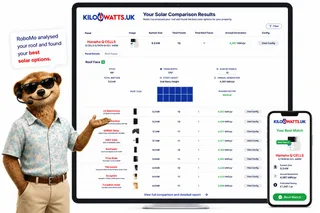
Compare top solar panels for the best performance and value.

Simple, fast & effortless
Provide a few details, sit back and watch your results unfold.
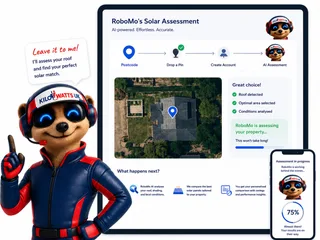
STEP 1
Choose Home, Business or Industrial
Enter your postcode to start your assessment.
STEP 2

Drop a pin on your roof
STEP 3

Create your free account
STEP 4

Sit back and watch RoboMo™ work
RoboMo™ analyses your roof and builds your personalised solar comparison.

BATTERY ROI TOOL
See what a battery saves on your bill
Enter the day rate, off-peak rate and export rate. The calculator ranks batteries in the Kilowatts shop over 10 years.
Home batteries also suit offices and small commercial sites. Industrial batteries are listed on their own calculator.

Step 1
Enter your postcode
Start designing your wind energy system in seconds.
Are you an installer, distributor or renewable energy business?
Kilowatts UK is expanding the Flower Turbines partner network across the UK.
Become A Flower Turbines PartnerKilowatts UK is an authorised representative
Flower Turbines
Compact vertical-axis turbines built for real UK sites, not just open farmland.
They start in light wind, sit in a small footprint, and are bird-safe by design. Cluster them as a bouquet and the group performs better together than the same turbines standing alone. Enter your postcode for a location-based generation estimate. Figures use area weather data and will differ if buildings, trees or hills sit in the way.
Starts in light UK wind
Built to generate in typical UK wind, not only open farmland.
Small rooftop or ground footprint
Compact towers for roofs, yards and tight sites.
Bird-safe slow rotation
Slow vertical-axis spin, bird-safe by design.
Bouquet clusters raise output
Grouped turbines outperform the same units standing alone.
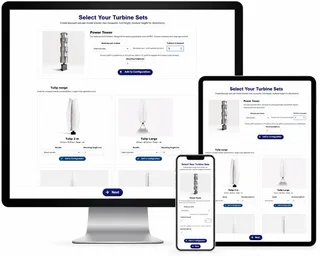

STEP 2

Choose a location
STEP 3

Place your cluster
Tap the map where you want the turbine cluster to go.
STEP 4

Instant generation forecasts
Compare different turbine layouts and see annual generation forecasts instantly.
STEP 5

No commitment required
Explore different configurations before deciding whether to request a quotation.
Related articles

Mo's Mission Nominations
FAQ
Need Help? RoboMo's Got Answers
Can a UK household buy this lithium-sulphur battery or fit it at home?
No. The September 2026 report describes an experimental aircraft flight in Australia, not a commercial battery, a home storage product or a UK tool. Commercial production and sales were still being assessed, and no UK installer, warranty or product listing is identified. Cycle life, pack energy density and a temperature window were not published, so the outing is not a procurement specification. A completed cruise should be kept separate from a product that is ready to specify.
Did the drone fly for nearly two hours on sunlight alone?
No. Pegasus completed an almost two-hour, 75 kilometre flight on one lithium-sulphur pack, with flexible perovskite cells also fitted. The pack, management system, power electronics and solar array are reported to have operated together, but the split between battery energy and solar energy was not published. Solar-assisted does not mean the aircraft flew on sunlight alone. The two hours cannot be credited wholly to the battery or wholly to the array.
Does this result mean perovskite solar panels are ready for a British roof?
No. The Halocell Energy cells on this aircraft are lightweight flexible perovskite films for an experimental wing, not the modules used on British roofs. Encapsulation and long-term degradation were not released, so one outing does not show an outdoor life. Much of the UK is cloudier than sunnier parts of Australia, and winter days are short, so the flight cannot be adjusted into a British roof yield. A short aviation duty is the wrong evidence for a perovskite-on-roof decision.
What does the claim of about 80 per cent more range leave out?
Li-S Energy has said these cells would give about 80 per cent more range and flight time than an equivalent professional lithium-polymer battery, on a same-cell-weight basis. The comparison excludes housing and the battery-management system, assumes flight time rises in a straight line with stored energy, and does not name the comparator. It was not a head-to-head flight of two packs in the same aircraft. The percentage should not be rewritten as 80 per cent more range in service.
Is about 347 watt-hours per kilogram the rating of the battery that flew?
No. The company stated the cells on that flight at 382 watt-hours and 1.1 kilograms, and dividing those figures gives about 347 watt-hours per kilogram. That is arithmetic on stated cell numbers, not an independent test, and it is not the energy density of the installed pack. Housing, connectors, protection, the management system and any heating or cooling still have to be carried, and pack mass was not published. Power in kilowatts was not published either.
Could this aircraft cut the cost of inspecting UK solar farms or other energy sites?
Not on this evidence. A longer cruise might later reduce launches on a large or linear site, but only if it were shown to be repeatable and lawful to fly here, and a 75 kilometre transit in Australia does not establish fewer visits or a lower cost. Payload, wind limit, downlink and time on the asset were not stated, and a fixed-wing cruise is a poor match for hovering beside a turbine blade. Unmanned aircraft in the UK are regulated by the Civil Aviation Authority, and a flight of this length is not routine visual-line-of-sight work.
Does the announcement change UK solar grants, MCS certification or grid connection?
No. The source identifies no UK grant, installer, warranty or product listing, and no cost, payback or subsidy should be inferred. MCS certification and distribution-network connection rules do not govern this aircraft. This article is not a statement of aviation law. All-up mass was not stated, so a UK drone class cannot be deduced, and any later beyond-visual-line-of-sight flight would need the specific authorisation for that operation.
What still blocks treating lithium-sulphur as a repeatable product?
A single cruise does not show cycle life, depth of discharge, charge rate, temperature window or pack-level energy density, and none of those figures was released. Lithium-sulphur work has often been limited by polysulphide shuttle and by cycling a lithium-metal anode, and this flight published no data on either, so lithium-ion charging, storage and fire rules should not be copied across. The five-to-eight-hour figure needs two packs and improved solar modules, and it was not flown. Two patent applications do not close that gap: an application is not a granted patent and not a UK right.