


Are larger watt solar panels worth it?
Published: 2026-06-27 13:35:34
Updated: 2026-08-12 03:07:03
Are larger watt solar panels worth it in the UK? Larger watt solar panels can be worth it in the UK when they increase the total system size that fits.
Are larger watt solar panels worth it?
Larger watt solar panels are worth it when they improve the finished system on your actual roof, not just because the datasheet number is higher. In the UK, the best choice depends on usable roof area, shading, module dimensions, inverter compatibility, DNO connection requirements, installation practicality and the installed cost per useful kWp.
A higher-watt panel can help you fit more solar capacity onto a simple, unshaded roof. It can also reduce the number of panels needed for a target system size. But if the module is physically larger, awkward to place, more exposed to shade or harder to install safely, a lower-watt panel can be the better option.
The right comparison is not “450 W versus 400 W” on its own. It is the whole design: total kWp, expected annual kWh, how much electricity you can use on site, export assumptions, roof fit, inverter choice, structural suitability and total installed cost.
What a higher watt solar panel rating actually means
A solar panel’s watt rating is its rated output under standard test conditions. These laboratory conditions are useful for comparing panels, but they are not the same as real operation on a UK roof through changing seasons, temperatures, cloud cover and shading.
Standard test conditions are commonly based on fixed light intensity, cell temperature and air mass assumptions. In practice, panels often run hotter or receive less consistent sunlight than the laboratory test, so the rated wattage should be treated as a comparison figure rather than a promise of everyday output.
Panel wattage is also different from panel efficiency. A module may have a higher wattage because it is physically larger, because it is more efficient, or because of both. For a space-constrained roof, watts per square metre and final layout can matter more than the headline rating.
Panel wattage, efficiency and total kWp are not the same thing
Installers usually design domestic solar PV systems around total array size, expressed in kWp. A system made from ten 450 W panels is 4.5 kWp. A system made from twelve 375 W panels is also 4.5 kWp. On paper, both have the same peak capacity, even though the individual panel ratings are different.
That distinction is central to whether larger panels are worthwhile. If the larger modules let you increase the total kWp on a good roof plane, they may improve generation. If they simply replace smaller panels and leave the total kWp unchanged, the benefit may be limited unless they reduce installation complexity or improve the layout.
Manufacturer datasheets should be checked for more than wattage. Dimensions, weight, voltage, current, temperature coefficients, mechanical loading ratings and warranty conditions all affect whether a module is suitable for a particular roof and inverter design.
A worked UK example comparing larger and smaller panels
Consider two possible layouts for the same roof plane. One uses ten 450 W panels, giving a 4.5 kWp array. The other uses twelve 375 W panels, also giving a 4.5 kWp array. If both layouts face the same direction, have the same tilt and avoid shading equally well, the starting point for estimated generation is broadly similar because the total kWp is the same.
Using the broad UK discussion range of roughly 850 to 1,100 kWh per kWp per year, either 4.5 kWp design might be discussed in the approximate range of 3,825 to 4,950 kWh per year before site-specific modelling. A proper estimate should come from a recognised method such as PVGIS, MCS irradiance data or installer design software using the property’s location, orientation, tilt and shading assumptions. For more context, see how solar panels generate electricity across UK homes.
The winning design is the one that performs better on the actual roof. If the ten larger panels fit in one clean rectangle away from a chimney, they may be the better design. If the twelve smaller panels fit around a roof window and avoid a shaded section, the smaller-panel option may generate more usable energy even though each individual module has a lower watt rating.
Same kWp outcome
If both arrays are genuinely 4.5 kWp and similarly positioned, panel wattage alone is not the deciding factor.Real-world winner
The better option is the layout with the stronger site-specific yield, safer installation and better value.Larger-panel layout
Ten 450 W panels can be simpler if they fit cleanly and keep cable routes, strings and access straightforward.Smaller-panel layout
Twelve 375 W panels can be better if their dimensions unlock more roof space or avoid shaded areas.
This is why a quote should show the roof layout as well as the panel model. Without the layout, shading assumptions and system estimate, a higher-watt panel can look better on paper while offering little practical advantage.
When larger watt panels usually make sense
Higher-wattage panels are most useful on large, simple roof planes with few interruptions. A broad pitched roof with limited shading gives the designer room to use larger modules efficiently without losing space around dormers, valleys, roof windows or chimneys.
They can also make sense where the homeowner has strong reasons to maximise annual generation. Examples include higher daytime electricity use, EV charging, a battery, a heat pump or a future plan to electrify more of the home. The extra generation still needs to be usable, storable or exportable under a suitable export arrangement.
Larger panels are more likely to be worthwhile when these conditions line up:
Value
The installed cost per useful kWp is competitive against a smaller-panel alternative.Shading
The best roof areas stay clear of shading during important generation hours.Roof fit
The larger modules fit neatly without wasting usable roof space.Electrical design
The inverter, optimiser or microinverter is compatible with the module voltage and current.Installation access
The scaffold, lifting route and roof access allow safe handling.
A good design should not treat all panels as interchangeable rectangles. The few centimetres between module formats can decide whether a row fits, whether an obstruction causes a compromise, or whether a clean string design is possible.
When smaller panels can be the better choice
Smaller or lower-watt panels can be better on complicated UK roofs. Many homes have roof windows, chimneys, hips, valleys, dormers, soil vent pipes, uneven roof sections or limited clearances around edges. Smaller modules may allow a tidier layout and, in some cases, a higher total installed capacity. They can also help when shading is uneven. A high-watt panel partly shaded by a chimney is not automatically better than a lower-watt panel placed in a cleaner part of the roof. The effect depends on the module’s bypass diode arrangement, the string design, inverter behaviour and whether module-level electronics are used.
| Decision area | Larger watt panels may suit | Smaller panels may suit |
|---|---|---|
| Roof layout | Broad, simple roof planes with few interruptions | Broken-up roofs with roof windows, chimneys or narrow sections |
| Space constraint | When they increase total kWp on the same good roof area | When smaller dimensions allow a neater or larger finished array |
| Shading | Open roof planes with limited shading | Roofs where modules need to avoid localised shade |
| Handling and access | Straightforward scaffold access and lifting routes | Tight sites, awkward roof edges or difficult lifting conditions |
| Electrical design | Compatible inverter voltage and current limits | Layouts needing more flexible strings or panel positioning |
| Value comparison | Better installed cost per useful kWp | Better annual yield from a less compromised layout |
Overview
This is where installer judgement matters. A lower-watt system designed around the real roof can outperform a higher-watt proposal that ignores awkward geometry, shade or buildability.
How to compare cost and value properly
The fair way to compare solar quotes is to look at value per useful system outcome, not just panel wattage. A higher-watt panel may cost more, less or about the same per kWp depending on the product, availability, installation complexity and the rest of the system design. Without the full quote details, wattage alone tells you very little about value.
Start with installed cost per kWp, but do not stop there. A cheaper system per kWp may be poor value if it places panels in shade, uses an unsuitable inverter design or produces electricity at times when you cannot use it. A more expensive design may be justified if it improves usable generation, reduces shading losses, supports a battery or avoids future rework. If you are at the quote stage, it is worth using a like-for-like way to compare solar quotes.
When comparing options, ask the installer to show the same assumptions for each design. The comparison should include total kWp, estimated annual kWh, likely self-consumption, export assumptions, inverter sizing, battery interaction if relevant, scaffolding differences and any optimiser or microinverter costs.
Export assumptions
Check whether the design assumes export income and whether any DNO export limits affect the proposal.Extra design costs
Include scaffolding changes, optimisers, microinverters, battery compatibility, roof works and any electrical upgrades needed.Usable electricity
Consider when the household uses power, because self-consumed electricity is often more valuable than excess generation that must be exported.Estimated kWh per year
Use a site-specific estimate rather than assuming a higher panel wattage always means higher annual generation.Installed cost per kWp
Divide the total installed price by the array size in kWp so different panel counts can be compared fairly.
This approach is more reliable than choosing the panel with the highest rating. It also makes it easier to challenge quotes that rely on impressive module wattage without explaining the actual system performance.
UK roof, structural and safety checks
Solar panels are long-term roof-mounted equipment, so the roof condition should be checked before installation. If tiles, battens, felt, flat roof coverings or access points are already near the end of their useful life, it is usually better to deal with those issues before fitting an array.
Larger modules may change the fixing design, wind loading considerations and handling method. A competent installer should assess roof covering type, rafter structure, fixing positions, edge zones, exposure, access and safe lifting. Where structural uncertainty exists, the design should be checked by an appropriately qualified professional rather than guessed.
MCS installation standards and manufacturer instructions are important reference points for a compliant installation. They do not make one panel wattage universally right, but they help ensure the chosen module, mounting system and electrical design are suitable for the property.
Inverter compatibility and DNO connection considerations
Higher-watt panels can have different electrical characteristics from lower-watt panels. Voltage, current and string length must be compatible with the inverter or module-level electronics. A panel with a higher current rating, for example, may not be suitable for every inverter input even if the total system size looks reasonable.
The inverter also affects how much of the array’s output can be converted at any moment. Some systems are deliberately designed with a DC array larger than the inverter’s AC rating, but that decision should be modelled and explained. It should not be hidden behind a simple panel wattage comparison.
In the UK, installers should also consider the relevant DNO process. Smaller domestic systems may fall under G98 notification arrangements, while larger or more complex systems may require G99 application or approval depending on the design and connection circumstances. The correct route depends on the inverter capacity, export arrangement and network requirements, so it should be confirmed for the specific installation.
Are 500 W panels suitable for UK homes?
Some 500 W panels are suitable for some UK homes, but they are not automatically the best domestic option. Many higher-watt modules are physically larger, and some are better suited to commercial roofs, agricultural buildings, ground-mounted systems or homes with generous roof space and straightforward access. If you are comparing larger formats, check the wider context around the highest watt solar panel rather than assuming the biggest label is best.
On a standard house roof, a 500 W module may reduce the number of panels needed for a target kWp. That can be useful if it simplifies the layout. It can also be a poor trade-off if the larger panel leaves unusable gaps, sits too close to an obstruction, creates lifting difficulties or pushes the electrical design towards a less suitable inverter arrangement.
The key is to check the actual module datasheet and roof drawing. Dimensions, weight, clamp zones, loading ratings, cable position and electrical values all matter. A responsible proposal should explain why the 500 W option fits this property rather than presenting it as newer or automatically superior.
What to ask before choosing higher-wattage panels
The quote stage is where most of the value decision is made. A good installer should measure usable roof areas, account for edge zones and obstructions, review shading, assess the consumer unit and meter position, and explain the inverter and export assumptions.
Ask for two comparable options if you are unsure: one using the proposed larger panels and one using a realistic smaller-panel alternative. Both should be judged using the same assumptions, not different shading models, different export assumptions or incomplete cost comparisons.
Before accepting a higher-wattage option, ask these questions:
Value
What is the installed cost per kWp and the expected useful generation from each design?Yield
What is the estimated annual kWh for each option, and what method was used to calculate it?Layout
How many panels fit on each roof plane, and what obstructions or clearances shaped the design?Inverter
Does the panel choice change the inverter, optimiser, microinverter or battery design?Datasheet
What are the dimensions, weight, voltage and current of the proposed module?Roof and DNO
Has roof loading, wind exposure and fixing design been checked, and does the design fall under the expected G98 or G99 route for this property?
If the answers are vague, ask for the proposal to be clarified before committing. A professional design should stand up to simple questions about fit, yield, safety and value.
Common mistakes to avoid
The most common mistake is assuming that the highest watt panel is automatically the most efficient choice. It may be larger rather than more efficient, and it may not create a better layout on your roof.
Another mistake is comparing panel-only prices rather than installed system value. Solar PV is a designed system involving roof mounting, electrical compatibility, inverter behaviour, DNO requirements, scaffolding, commissioning and long-term maintainability.
Avoid these decision traps when reviewing quotes:
A well-designed system should be specific to the property. If a quote could apply to almost any home, it probably does not contain enough information to judge whether larger panels are genuinely worth it.
The bottom line for UK homeowners
Larger watt solar panels are worth it when they produce a better finished system: more useful kWp on suitable roof space, sensible annual generation, safe installation, compatible electrical design and good value per useful kWh. They are not worth it simply because the panel label shows a bigger number.
They are usually most compelling on large, simple, lightly shaded roofs. They are less convincing on small, interrupted or shaded roofs where smaller modules may fit more neatly and avoid compromises. The best answer depends on the property, not on a universal wattage target.
The sensible next step is to compare two properly designed options on the same roof. Judge them by total kWp, estimated annual kWh, usable generation, roof fit, inverter compatibility, DNO assumptions, structural suitability and overall installed value.
Plan, Compare & Buy Renewable Energy Solutions
AI does the thinking.
You get the perfect solar match.
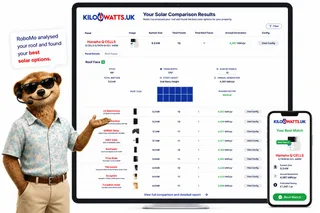
Use RoboMo™ to assess your property, compare available technologies and connect with trusted UK installers, suppliers and manufacturers.
Simply enter your postcode, drop a pin on your roof, create your free account and let RoboMo™ analyse your property to find the best solar panels for your home.

You don't have to think
RoboMo™'s AI analyses your roof and does all the hard work.

Accurate & tailored
AI-powered assessment based on your roof, location, and conditions.

Best options, maximum savings
Compare top solar panels for the best performance and value.

Simple, fast & effortless
Provide a few details, sit back and watch your results unfold.

STEP 1
Choose Home, Business or Industrial
Enter your postcode to start your assessment.
STEP 2

Drop a pin on your roof
STEP 3

Create your free account
STEP 4

Sit back and watch RoboMo™ work
RoboMo™ analyses your roof and builds your personalised solar comparison.

Kilowatts UK is an authorised representative
Flower Turbines
Compact vertical-axis turbines built for real UK sites, not just open farmland.
They start in light wind, sit in a small footprint, and are bird-safe by design. Cluster them as a bouquet and the group performs better together than the same turbines standing alone. Enter your postcode for a location-based generation estimate. Figures use area weather data and will differ if buildings, trees or hills sit in the way.
Starts in light UK wind
Built to generate in typical UK wind, not only open farmland.
Small rooftop or ground footprint
Compact towers for roofs, yards and tight sites.
Bird-safe slow rotation
Slow vertical-axis spin, bird-safe by design.
Bouquet clusters raise output
Grouped turbines outperform the same units standing alone.

Step 1
Enter your postcode
Start designing your wind energy system in seconds.

STEP 2

Choose a location
STEP 3

Place your cluster
Tap the map where you want the turbine cluster to go.
STEP 4

Instant generation forecasts
Compare different turbine layouts and see annual generation forecasts instantly.
STEP 5

No commitment required
Explore different configurations before deciding whether to request a quotation.
Related articles



Mo's Mission Nominations
FAQ
Need Help? RoboMo's Got Answers
Are larger watt solar panels worth it in the UK?
Larger watt solar panels can be worth it if they increase the total system size that fits your roof, produce more useful annual electricity, and work properly with your inverter, export limit, and household demand. They are not automatically better, because a higher watt panel may simply be physically larger. The best option is the one that gives the strongest whole-system result, including roof fit, expected kWh generation, cost per kWp, warranty, and safe installation.
Is a 500 W solar panel better than a 430 W solar panel?
A 500 W solar panel is only better if it improves the final system design. If the 500 W panel is larger and fits the roof less efficiently, a 430 W panel could allow a neater layout and similar or better annual output. Compare the total installed kWp, expected yearly kWh, panel efficiency, roof layout, inverter design, and installed cost rather than choosing by wattage alone.
What does solar panel wattage mean?
Solar panel wattage is the panel’s rated peak output under standard test conditions. For example, a 450 W panel is rated to produce up to 450 watts in ideal laboratory conditions, but real UK output varies with daylight, roof angle, orientation, shading, temperature, inverter losses, and system design. Your electricity bill is measured in kWh, so expected annual generation is more important than the wattage printed on each panel.
What is the difference between kWp and kWh?
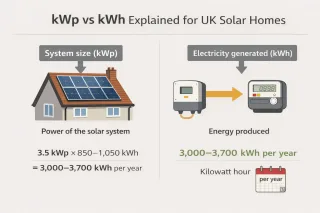
kWp means kilowatt peak and describes the rated size of the solar PV array. kWh means kilowatt-hour and measures the amount of electricity generated, used, imported, or exported. A quote may show a 4 kWp solar system, but the useful figure for savings is how many kWh it is expected to generate each year and how much of that electricity you can use in the property.
Are high watt solar panels more efficient?
Not always. Wattage measures the rated output of the whole panel, while efficiency measures how much sunlight the panel converts into electricity per square metre. A high watt panel may be more efficient, but it may also just be larger. For UK homes, watts per square metre and roof fit are often more useful comparison points than headline panel wattage.
What wattage are most UK residential solar panels?
Modern UK residential solar panels are commonly around 400 W to 450 W, with higher watt residential panels often around 450 W to 500 W. Larger commercial-style panels can be 550 W to 700 W or more, but they are not always suitable for domestic pitched roofs because of their size, weight, handling requirements, wind loading, and fit around roof features.
When do larger watt solar panels work best?
Larger watt panels tend to work best on simple, unshaded roofs where they increase the total system capacity without creating awkward gaps. They can also suit homes with high daytime electricity use, electric vehicle charging, battery storage, good export tariffs, or future plans for higher electricity demand. They are most useful when they improve the actual system output, not just the panel count.
When are larger solar panels a poor choice?
Larger panels can be a poor choice on complex roofs with dormers, roof windows, chimneys, hips, valleys, vents, flues, shading, or tight edge zones. They may leave unusable roof space where smaller panels would fit better. Very large panels can also be harder to lift, clamp, and install safely on domestic roofs, so the roof layout and installer’s mounting plan matter.
Do high watt panels help with shading?
High watt panels do not remove the effect of shading. Shade can still reduce output, especially if it affects a string of panels. A good design should avoid shaded areas where possible or use suitable string design, optimisers, microinverters, or alternative roof faces where justified. Higher wattage alone is not a solution to poor shading conditions.
How does inverter sizing affect high watt solar panels?
Solar panels produce DC electricity, while the inverter converts it to AC electricity for the home and grid. A solar array can be larger than the inverter, which is called DC oversizing, and this is common in the UK. Some oversizing can be sensible, but too much can cause clipping, where the inverter limits output during strong generation periods. The installer should check voltage, current, string length, export limits, and DNO requirements before specifying high watt panels.
Do larger watt panels need DNO approval?
Grid-connected solar systems need the correct DNO notification or approval. Smaller systems up to 3.68 kW per phase are generally handled under G98, while larger inverter capacities usually involve G99. A larger panel system may also need export limiting depending on the local network and inverter size. Your installer should explain whether the system is G98, G99, or export-limited before installation.
How much electricity can a larger solar system generate in the UK?
A well-sited UK solar PV system often generates around 800 to 1,100 kWh per kWp per year, depending on location, orientation, shading, pitch, and system losses. A 4 kWp system commonly generates around 3,200 to 4,400 kWh per year, while a 5 kWp system may generate around 4,000 to 5,500 kWh per year. The important question is whether larger panels increase the total system kWp and whether the extra generation is useful to you.
Do high watt solar panels improve winter generation?
High watt panels can increase total generation if they allow a larger array, but they do not remove UK seasonality. Solar output is much higher in spring and summer than in winter, and most annual solar generation happens between April and September. A larger array can still help annual savings, but it should not be sold as a way to cover most winter heating demand without realistic modelling.
How much do larger watt solar panels cost?
A domestic solar PV system without a battery often costs around £5,000 to £9,000, with 4 kWp systems commonly around £5,500 to £8,000 and 5 kWp to 6 kWp systems often around £7,000 to £11,000. High watt panels may cost more per panel, but not always more per kWp. Compare the full installed cost, expected annual kWh, scaffolding, inverter, bird protection, monitoring, electrical work, and warranty support.
Are larger watt panels cheaper because fewer panels are needed?
Sometimes, but not always. Larger panels can reduce the number of modules, clamps, and roof components needed for a given system size, but they may also be harder to handle and less flexible on awkward roofs. The best comparison is not cost per panel, but installed cost per kWp and cost per expected annual kWh.
Should I get a battery with high watt solar panels?
A battery can make a larger solar array more useful if you export a lot during the day and import electricity in the evening or overnight. It can increase self-consumption, but it adds cost and needs to be sized carefully. High watt panels do not automatically require a battery; the decision should depend on your usage pattern, tariff, export rate, and whether the battery will be used enough throughout the year.
Are high watt solar panels good for electric vehicle charging?
High watt panels can help with electric vehicle charging if the car is often at home during sunny hours or if you use smart charging to match solar generation. If the car is usually away during the day, much of the extra solar may be exported unless you have a battery or a suitable tariff arrangement. The value depends on when you charge and how much solar electricity you can use directly.
What should I check when comparing high watt solar panel quotes?
Ask each installer for the roof layout, total kWp, expected annual kWh, panel efficiency, inverter size, shading assumptions, export limit, DNO route, warranty terms, and full installed cost. A good quote should explain why the selected panel suits your roof. Be cautious if the main selling point is only that the panel has a higher wattage.
Are very large 550 W to 700 W panels suitable for homes?
Very large panels can be suitable for some homes, outbuildings, flat roofs, ground mounts, or commercial-style roofs, but they are often less practical on complex domestic pitched roofs. Their size and handling requirements can make installation harder, and they may not fit neatly around roof features. For many homes, a well-designed array using 400 W to 500 W residential panels is more practical.
What is the main mistake to avoid when choosing solar panels?
The main mistake is choosing panels by wattage alone. A higher watt panel is not automatically the most efficient, best value, or best fit for your roof. The better decision is based on total system capacity, expected annual generation, usable electricity, roof layout, shading, inverter design, export value, warranties, and installed cost.