


Commercial solar case studies in the UK
Published: 2026-07-18 19:49:12
Updated: 2026-07-26 18:23:24
Find out commercial solar case studies uk in the UK, including costs, what affects price, and how to choose an installer.
Commercial solar case studies in the UK.
Commercial solar case studies in the UK are most useful when they show the site type, system size, annual generation, self-consumption, export, installed cost, payback, and practical constraints. For a business buyer, the value is not just seeing that solar panels were installed. The value is understanding whether a similar result is realistic on your own building, with your own electricity demand, roof condition, tariff, lease position, and grid connection.
The strongest UK commercial solar examples usually involve businesses with high daytime electricity use, a suitable roof, a workable grid connection, and a long-term plan for the site. Warehouses, manufacturers, cold stores, farms, schools, offices, depots, healthcare buildings, and hospitality sites can all be good candidates, but each sector has different risks and design priorities.
A case study should never be treated as a guaranteed outcome. Roof condition, half-hourly electricity use, import rates, export rates, DNO requirements, planning constraints, access costs, shutdown windows, insurance requirements, and future demand can all materially change the financial case. Businesses comparing routes can start by using Compare commercial solar options. Commercial solar is weaker where a building has low daytime consumption, a roof nearing replacement, uncertain occupancy, heavy shading, landlord restrictions, or grid costs that make the project uneconomic. A transparent case study should make those limitations clear rather than presenting solar as suitable for every site.
What a good UK commercial solar case study should include.
A strong commercial solar case study gives enough information for another business to understand why the system was designed, sized, and installed in a particular way. It should separate measured results from forecast results and make clear which figures are commercially sensitive, estimated, or based on a full year of operation.
The core details to look for are the business type, UK location, roof type, roof age, system size in kWp, annual generation in kWh, the share of electricity used on site, the amount exported, the installed cost, annual savings, and payback period. For larger systems, the DNO application route, export capacity, and any export limitation are also important.
A useful case study should include:
Energy data
Half-hourly electricity data where available, not just annual consumption from bills.Site context
Building use, operating hours, roof type, roof age, ownership or lease position, and any planned changes to the site.Grid position
Whether the project needed DNO approval, whether export was unrestricted, limited, or not allowed, and whether the DNO required works.Roof findings
Usable roof area, loading capacity, condition, shading, access, fragile materials, roof lights, plant, and maintenance routes.Design reasoning
Why the selected system size was chosen and why a larger or smaller system was not preferred.Electrical findings
Main switchgear capacity, inverter location, cable routes, metering, isolation, earthing and bonding, and any required upgrades.
For B Solar case studies, and for any future Kilowatts case study features, the same discipline matters. Completed projects should use measured generation where available. Recent installs can show early performance, but should not overstate annual results before a full year has passed. Planned installs should be clearly labelled as forecasts, not achieved outcomes. Delivery constraints — Access equipment, scaffolding, edge protection, craneage, shutdown windows, out-of-hours work, planning checks, and insurance requirements. Financial assumptions — Installed cost, export income, maintenance costs, inverter replacement assumptions, VAT treatment where relevant, and whether finance costs are included. Performance evidence — Measured generation after installation where possible, with forecast figures clearly labelled as forecasts.
Typical UK case study patterns.
Most commercial solar case studies fall into a few recognisable patterns. The numbers vary, but the reason the projects work is usually the same: the site can use a meaningful amount of solar electricity during daylight hours.
A warehouse or logistics building often has a large roof and daytime electricity demand from lighting, conveyors, refrigeration, office areas, security systems, or vehicle charging. Systems of around 50 to 300 kWp are common in this type of case study, with annual generation ranging from around 40,000 to 300,000 kWh depending on system size, location, orientation, pitch, shading, and equipment quality. The limiting factors are often roof load capacity, roof plant, parapet shading, roof lights, safe access, and grid export limits.
A manufacturer can be an even stronger fit because machinery, compressed air, process loads, extraction, cooling, pumps, and three-phase equipment may run during daylight hours. Systems of around 100 to 1,000 kWp can be suitable where roof area and electrical infrastructure allow. Larger production sites may also want to Compare industrial solar options before deciding whether a commercial or industrial design route is more appropriate. These projects often need careful planning around shutdown windows, main switchgear capacity, cable routes, fire safety, operational disruption, and three-phase balancing. Schools and colleges can work well because weekday daytime demand often overlaps with solar generation. Lighting, IT, kitchens, ventilation, heating controls, and sports facilities can all contribute to on-site use. However, summer holidays can increase export, safeguarding requirements may affect site access, and works often need to be planned around term dates. Academy trusts, local authorities, and independent schools may also have different approval processes. Healthcare buildings can be attractive solar sites where there is steady daytime demand from lighting, ventilation, IT, refrigeration, medical equipment, kitchens, laundry, or administrative areas. The challenge is that critical environments need careful planning. Installers may need to work around clinical operations, backup power systems, infection-control requirements, fire strategy, safe access, and strict shutdown controls. A healthcare case study should explain how disruption and electrical safety were managed. Offices can use solar well where air conditioning, lighting, lifts, servers, reception areas, and daytime occupancy are significant. Multi-tenant offices are more complicated because the party funding the system may not be the same party benefiting from lower electricity bills. A useful office case study should state whether the building is owner-occupied, single-tenant, multi-tenant, or landlord-controlled. Farms and cold storage sites can be excellent or awkward depending on the details. Dairy, poultry, refrigeration, grain drying, irrigation, packing lines, and cold rooms can create strong electricity demand. However, older agricultural buildings may have fragile roofs, asbestos cement sheets, limited structural capacity, or constrained rural grid connections. A good farm case study should say why the chosen roof was suitable and whether any roof replacement or strengthening was needed. Retail, hospitality, leisure, and food-service sites can also benefit where refrigeration, air conditioning, kitchens, lighting, laundry, gyms, pools, or daytime trading create consistent demand. The challenges are usually access, public safety, working around trading hours, landlord consent, roof plant, and ensuring the financial model reflects seasonal variation.
Example outcomes by site type.
The following case study patterns use typical UK ranges and practical examples rather than unpublished client-specific figures. They are useful for understanding what to ask an installer, but they are not a substitute for modelling your own roof and electricity data.
High daytime manufacturer
A manufacturing site with weekday production loads may achieve high self-consumption because solar generation overlaps with operating hours. The case study should confirm whether any shutdown was needed for connection works, whether production was affected, and whether the system was sized around current demand or future electrification.School with summer export
A school may use solar well during term time but export more during summer holidays. The case study should show whether export income is included in the payback and whether the system was sized to avoid excessive holiday export.Farm with roof constraints
A farm may have strong demand but unsuitable older roofs. The best project may start with roof replacement or use a different building rather than forcing panels onto a weak or fragile structure.Office with weekend export
An office may use much of the solar power during weekdays but export more at weekends. The case study should show whether export income is included, whether tenant billing is affected, and whether common-area or tenant loads are connected.Warehouse with export limitation
A warehouse may have enough roof space for a large array, but the DNO offer may restrict export. In this situation, the best financial design may be smaller than the largest physical layout, or may use export limitation equipment to prevent excess power being sent to the grid.Healthcare building with critical operations
A clinic, care home, or medical facility may have strong daytime electricity use, but electrical shutdowns and fire-safety requirements need careful management. The case study should explain how installation was phased and how essential services were protected.
These patterns show why simple headline figures can be misleading. Two 100 kWp systems can have very different paybacks if one site uses most of the generation on site and the other exports a large share at a lower value. Cold store with steady refrigeration load — A cold store can be a strong match for solar because refrigeration often runs throughout the day. The case study should still check roof condition, grid capacity, and whether temperature-control risk affects installation planning. Depot planning EV charging — A depot may size solar partly around future electric vehicles. Daytime charging improves solar use, but night-time fleet charging usually still depends on grid import or battery storage. Sites planning fleet charging should also assess commercial EV charger installation alongside solar sizing.
Costs shown in UK commercial solar case studies.
Commercial solar costs should be shown with enough detail to reveal what is included. A headline installed price is useful only if it states whether it includes access equipment, structural works, grid connection work, monitoring, design, operations and maintenance, VAT treatment, and inverter replacement assumptions.
Typical UK commercial solar cost ranges are often around £900 to £1,400 per kWp for small 10 to 30 kWp systems, around £700 to £1,100 per kWp for 30 to 100 kWp systems, and around £550 to £900 per kWp for 100 to 500 kWp systems. Very large rooftop systems above 500 kWp may fall below £700 per kWp where roof access and grid costs are straightforward.
These ranges should be treated as broad benchmarks, not quotations. Real costs depend on roof type, system size, access, structural work, electrical infrastructure, DNO requirements, monitoring specification, and installation complexity. Case studies that quote a cost per kWp without explaining exclusions should be read with caution. Commercial battery systems can add materially to the project and often cost around £300 to £700 per usable kWh installed, with payback depending heavily on tariffs, peak demand, export limits, and the control strategy. Businesses considering storage should model commercial solar battery storage separately rather than assuming it always improves the return. The biggest cost surprises in real projects are usually not the panels themselves. Structural strengthening, asbestos management, scaffolding, edge protection, craneage, long cable runs, switchgear upgrades, DNO works, out-of-hours installation, fire-stopping, monitoring, and future maintenance access can all change the final cost.
Generation, payback, and what affects the result.
A well-sited UK commercial rooftop system often generates about 800 to 1,000 kWh per kWp per year. Southern England sites may be around 900 to 1,050 kWh per kWp, the Midlands often around 850 to 980 kWh per kWp, and northern England, Scotland, and Northern Ireland often around 750 to 900 kWh per kWp. These are broad ranges and still depend on roof orientation, pitch, shading, panel specification, inverter design, losses, maintenance, and installation quality.
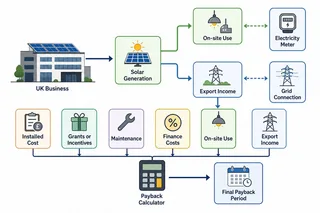
Commercial solar payback is commonly around 4 to 8 years, but the range can move either way. High daytime users paying high import electricity prices can see stronger returns. Sites that export a lot of electricity, have low import rates, face expensive grid works, need roof strengthening, or have short occupancy plans usually see longer paybacks.
Export income is normally less valuable than using solar electricity on site, so self-consumption matters. Annual self-consumption above 70% is often strong for commercial solar. Export above 50% usually weakens the payback unless export rates are attractive, demand is expected to grow, or the system has another strategic purpose such as supporting EV charging or carbon reporting. A proper case study should say whether maintenance costs, export income, inverter replacement, finance costs, and VAT are included in the payback calculation. Without those assumptions, the payback figure is not very comparable. It should also state whether savings are based on current electricity prices only or on assumptions about future price rises. A credible case study should avoid implying precision where the inputs are uncertain. For example, a forecast payback of 5.2 years can look authoritative, but it may change if import prices, export rates, demand patterns, or maintenance costs change. Ranges and assumptions are often more useful than a single headline number.
The process behind a reliable case study.
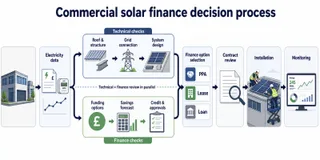
A good commercial solar result starts before panels are ordered. The design should be based on measured demand, not a generic roof estimate. Half-hourly electricity data is especially valuable because it shows when the business uses power and whether solar generation will match that demand.
Half-hourly data is usually available for larger business electricity meters and shows consumption in 30-minute intervals. This matters because a business using 500,000 kWh a year may still be a poor solar match if most of that demand is at night. Conversely, a smaller site with steady daytime use may have a stronger financial case than its annual bill suggests.
The roof survey then checks usable area, condition, loading capacity, access, fall protection, shading, roof penetrations, roof lights, plant, drainage, and maintenance routes. A roof with 15 to 20 years of remaining life is usually a better candidate than one likely to need replacement soon. If the roof is old, fragile, or close to renewal, it may be better to coordinate roof works before installing solar. The electrical survey checks main switchgear, distribution boards, cable routes, inverter location, metering, earthing and bonding, isolation points, surge protection, fire safety requirements, and whether the existing infrastructure can accept the proposed generation. Where existing electrical infrastructure is uncertain, commercial electrical inspections can help identify issues before the solar design is finalised. Grid connection work needs clear explanation in any serious commercial solar case study. The DNO, or Distribution Network Operator, is the company responsible for the local electricity network. DNO approval is not the same as planning permission. It is the grid-side permission or notification process that determines whether a solar system can connect to the local network and how much electricity, if any, it may export. Smaller systems may fall under G98 rules, while larger commercial systems usually require a G99 application before installation or commissioning. In simple terms, G98 is generally used for smaller generation connections, and G99 is used where the system is larger or could have a greater effect on the local network. The DNO may approve the system as designed, require export limitation, request network studies, or identify reinforcement works. Export limitation means equipment is used to prevent the system exporting more than the agreed amount to the grid. Planning and regulation should not be treated as an afterthought. Many UK commercial rooftop solar installations can be permitted development, but rules differ across England, Scotland, Wales, and Northern Ireland. Listed buildings, conservation areas, ground-mounted systems, sensitive sites, airports, heritage buildings, and some agricultural or public-sector sites need more careful checks. Planning consent, building control considerations, fire safety, insurance requirements, and DNO approval are separate issues and should not be confused.
B Solar and future install case studies.
B Solar case studies should be presented with a clear distinction between completed installations, recent installations, and planned future installs. This is important because measured generation and forecast generation are not the same thing.
A completed B Solar case study should ideally include installation date, system size, roof type, annual generation after 12 months, self-consumption, export, any grid limitation, maintenance issues, and whether performance matched the design model. If exact electricity costs or client savings are commercially sensitive, ranges can be used, but the basis of the calculation should still be explained.
A recent installation can be useful, but it should avoid implying that early months represent full-year performance. Seasonal variation is significant in the UK, so summer output cannot be simply multiplied across the year. A recent case study is strongest when it focuses on the survey findings, installation constraints, monitoring setup, commissioning checks, and early operational lessons. Future installs should be labelled as planned or forecast. They can still be valuable where they show how the design accounts for EV charging, heat pumps, electrified process heat, future battery storage, spare cable containment, inverter expansion limits, and DNO constraints. The most useful future install examples show more than one modelled option and explain why one was selected. Where a case study includes projected carbon savings, the calculation method should be clear. Carbon figures can be helpful for ESG reporting, tenders, and internal sustainability goals, but they should not distract from the core commercial questions: how much electricity will be generated, how much will be used on site, what will be exported, what is the installed cost, and what assumptions support the payback.
When commercial solar may not be suitable.
Commercial solar is not automatically right for every UK business. A case study from a similar sector can be encouraging, but it does not remove the need to check the building, lease, grid, and financial assumptions.
Solar may be unsuitable where the roof needs imminent replacement, cannot take additional load, has heavy shading across most of the usable area, or contains materials that make installation difficult or expensive. It may also be unsuitable where the business plans to leave the site soon, cannot obtain landlord consent, or cannot agree how savings will be shared between landlord and tenant.
Low daytime electricity use is another common issue. A business that operates mainly at night may export too much solar unless there is a strong export agreement, battery case, or future daytime demand such as EV charging. A battery is not automatically the answer, because commercial battery payback is more dependent on tariff structure, peak charges, export restrictions, and operating strategy than solar PV payback. Grid constraints can also make an otherwise attractive project more difficult. If the DNO allows little or no export, the system may need to be smaller, use export limitation, or be paired with demand that can absorb more generation. If the DNO requires costly network reinforcement, the payback may lengthen significantly. The cheapest quote can also be the riskiest if it excludes grid work, access equipment, structural allowances, monitoring, operations and maintenance, realistic cable routes, fire-safety items, or commissioning support. A good installer should explain what has been included, what remains provisional, and what could change after survey or DNO response.
How to choose an installer from case study evidence.
Case studies are useful for shortlisting installers, but they should be read critically. Look for evidence that the installer understands commercial roofs, grid applications, safe access, electrical integration, business disruption, monitoring, maintenance, and long-term performance. A polished case study with no constraints mentioned is often less useful than a practical one that explains what changed after survey.
Ask the installer for examples that match your site type, not just any large installation. A cold store, school, healthcare building, farm, depot, factory, and multi-tenant office can all need different design decisions. The installer should be comfortable discussing half-hourly data, export assumptions, structural survey outcomes, DNO timescales, insurance requirements, fire safety, and maintenance access.
Use this checklist when reviewing installer case studies:
Similar sites
Has the installer delivered projects for businesses with similar roofs, load profiles, access constraints, or operating hours?Grid competence
Does the installer explain the DNO process, G98 or G99 route, export limits, and any network constraints?Roof competence
Does the case study mention structural checks, roof condition, safe access, roof lights, fragile materials, and maintenance routes?Evidence quality
Does the case study show measured generation, or is it only a forecast?Clear assumptions
Are electricity prices, export rates, maintenance costs, finance costs, and payback assumptions explained?Electrical competence
Does it cover switchgear, cable routes, inverter locations, metering, shutdowns, and commissioning?
Before appointing an installer, ask for the proposed system size in kWp, expected annual generation in kWh, expected self-consumption, export assumptions, DNO status, roof survey position, access requirements, exclusions, warranties, maintenance plan, and payback calculation. If you are at the quotation stage, use Compare commercial solar options to review suitable routes before committing. The best commercial solar case studies do not promise that every business will get the same result. They show how the decision was made, what was difficult, what was excluded, what was forecast, and what performance was actually achieved. That is the evidence a UK business needs before committing to a commercial solar project. Operational planning — Does the installer explain how disruption was reduced for staff, tenants, customers, patients, pupils, or production teams? Transparency — Does the case study mention problems, exclusions, provisional sums, or lessons learned? Monitoring — Is there a clear plan for monitoring generation, identifying faults, and checking performance after installation? Aftercare — Are operations and maintenance, warranties, inverter replacement, and response times explained? Sector understanding — Can the installer discuss sector-specific issues, such as school holidays, healthcare shutdowns, cold-store refrigeration, farm roof condition, or manufacturing production windows? Commercial fit — Does the recommendation match the buyer’s tariff, usage pattern, lease term, and future plans rather than simply maximising the number of panels?
Plan, Compare & Buy Renewable Energy Solutions
AI does the thinking.
You get the perfect solar match.
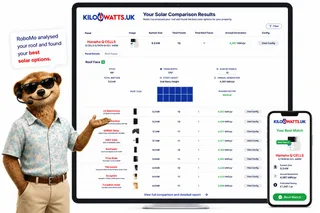
Use RoboMo™ to assess your property, compare available technologies and connect with trusted UK installers, suppliers and manufacturers.
Simply enter your postcode, drop a pin on your roof, create your free account and let RoboMo™ analyse your property to find the best solar panels for your home.

You don't have to think
RoboMo™'s AI analyses your roof and does all the hard work.

Accurate & tailored
AI-powered assessment based on your roof, location, and conditions.

Best options, maximum savings
Compare top solar panels for the best performance and value.

Simple, fast & effortless
Provide a few details, sit back and watch your results unfold.
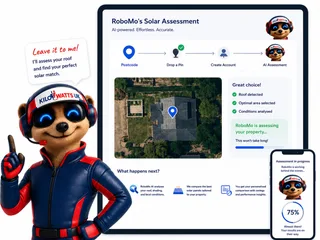
STEP 1
Choose Home, Business or Industrial
Enter your postcode to start your assessment.
STEP 2

Drop a pin on your roof
STEP 3

Create your free account
STEP 4

Sit back and watch RoboMo™ work
RoboMo™ analyses your roof and builds your personalised solar comparison.

Kilowatts UK is an authorised representative
Flower Turbines
Compact vertical-axis turbines built for real UK sites, not just open farmland.
They start in light wind, sit in a small footprint, and are bird-safe by design. Cluster them as a bouquet and the group performs better together than the same turbines standing alone. Enter your postcode for a location-based generation estimate. Figures use area weather data and will differ if buildings, trees or hills sit in the way.
Starts in light UK wind
Built to generate in typical UK wind, not only open farmland.
Small rooftop or ground footprint
Compact towers for roofs, yards and tight sites.
Bird-safe slow rotation
Slow vertical-axis spin, bird-safe by design.
Bouquet clusters raise output
Grouped turbines outperform the same units standing alone.
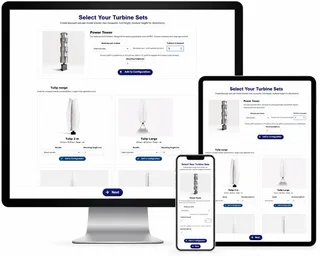
Step 1
Enter your postcode
Start designing your wind energy system in seconds.
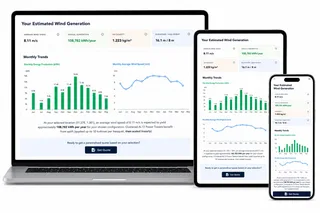
STEP 2

Choose a location
STEP 3

Place your cluster
Tap the map where you want the turbine cluster to go.
STEP 4

Instant generation forecasts
Compare different turbine layouts and see annual generation forecasts instantly.
STEP 5

No commitment required
Explore different configurations before deciding whether to request a quotation.
Related articles
Mo's Mission Nominations
FAQ
Need Help? RoboMo's Got Answers
What should a good UK commercial solar case study include?
A good commercial solar case study should show the site type, UK location, roof type, system size in kWp, annual generation in kWh, self-consumption, export, installed cost, payback period, and any practical constraints. It should also explain whether the figures are measured after installation or forecast before installation. The most useful case studies include roof condition, half-hourly electricity data, DNO position, access requirements, electrical works, maintenance assumptions, and the basis for the financial return.
Why are commercial solar case studies useful for businesses?
Commercial solar case studies help businesses understand what may be realistic on a similar site. They show how system size, roof area, daytime electricity use, grid connection, export limits, and installation constraints affect the outcome. They should not be treated as a guarantee, because every building has different electricity demand, roof condition, tariff, lease position, and grid requirements.
Which UK businesses are usually best suited to commercial solar?
Commercial solar often works best for businesses with high daytime electricity use, suitable roof space, and a long-term plan to remain at the site. Warehouses, manufacturers, cold stores, farms, schools, offices, depots, healthcare buildings, leisure sites, and hospitality businesses can all be suitable. The strongest cases usually involve sites that can use a large share of the solar electricity on site rather than exporting most of it to the grid.
What makes a commercial solar case study less reliable?
A case study is less reliable if it only gives headline savings without explaining the assumptions. Weak case studies may omit export rates, maintenance costs, DNO restrictions, roof survey findings, access costs, VAT treatment, finance costs, or whether the results are measured or forecast. A credible case study should make clear what was included, what was excluded, and what could change on another site.
What is a typical commercial solar system size in UK case studies?
Commercial solar system sizes vary widely. Smaller commercial systems may be around 10 to 30 kWp, while warehouses, schools, farms, and offices often fall somewhere between 50 and 300 kWp. Larger manufacturing, logistics, cold storage, or industrial sites may use systems from 100 kWp to 1,000 kWp or more where roof space, electrical infrastructure, and grid connection allow.
How much electricity does commercial solar generate in the UK?
A well-sited UK commercial rooftop solar system often generates around 800 to 1,000 kWh per kWp per year. Southern England may achieve around 900 to 1,050 kWh per kWp, the Midlands around 850 to 980 kWh per kWp, and northern England, Scotland, and Northern Ireland around 750 to 900 kWh per kWp. Actual generation depends on roof orientation, pitch, shading, panel specification, inverter design, maintenance, losses, and installation quality.
What is a typical payback period for commercial solar in the UK?
Commercial solar payback is commonly around 4 to 8 years, but it can be shorter or longer depending on the site. Payback is usually stronger where the business uses most of the solar electricity on site and pays high import electricity rates. Payback may be longer where the system exports a high share of generation, the roof needs work, the DNO requires grid upgrades, or the business has low daytime demand.
Why does self-consumption matter in a commercial solar case study?
Self-consumption is the share of solar electricity used directly by the business on site. It matters because using solar power on site usually saves more money than exporting it to the grid. A commercial solar case study with high self-consumption, often above 70%, is usually financially stronger than one where much of the generation is exported at a lower value.
What role does the DNO play in commercial solar projects?
The DNO, or Distribution Network Operator, manages the local electricity network. Commercial solar projects may need DNO approval before installation or commissioning, especially where the system is larger or may export electricity to the grid. The DNO may approve the project, restrict export, require export limitation equipment, request studies, or identify reinforcement works. DNO approval is separate from planning permission.
What is the difference between G98 and G99 in commercial solar?
G98 is generally used for smaller generation connections, while G99 applies to larger systems or installations that may have a greater effect on the local grid. Many commercial solar projects require a G99 application. A useful case study should state which route applied, whether export was approved, and whether any DNO conditions affected the final system design.
How much does commercial solar cost in the UK?
Typical UK commercial solar costs are often around £900 to £1,400 per kWp for smaller 10 to 30 kWp systems, around £700 to £1,100 per kWp for 30 to 100 kWp systems, and around £550 to £900 per kWp for 100 to 500 kWp systems. Larger rooftop systems above 500 kWp may be lower where access and grid costs are straightforward. These are broad benchmarks, not quotations, because roof condition, access, structural work, electrical upgrades, and DNO requirements can materially affect cost.
Should commercial solar case studies include battery storage?
Battery storage should be included only where it has been properly modelled. Commercial batteries can help where there is excess solar generation, peak demand, tariff opportunities, or export limits, but they do not automatically improve payback. A case study should show battery size, usable capacity, control strategy, cost, tariff assumptions, and whether the battery is reducing import, managing peaks, supporting resilience, or limiting export.
When might commercial solar not be suitable?
Commercial solar may not be suitable where the roof needs imminent replacement, cannot take additional load, has heavy shading, or contains fragile or difficult materials. It may also be unsuitable where the business has low daytime electricity use, plans to leave the site soon, cannot obtain landlord consent, or faces expensive grid reinforcement. In these cases, the project may need resizing, roof works, export limitation, battery modelling, or a different investment route.
Why is half-hourly electricity data important for commercial solar?
Half-hourly electricity data shows when a business uses power in 30-minute intervals. This is important because solar generation is produced during daylight hours, so annual electricity consumption alone is not enough. A site with high daytime demand may be a strong fit, while a site with similar annual consumption but mostly night-time demand may export too much solar electricity for the same financial return.
What should schools look for in commercial solar case studies?
Schools should look for case studies that show how term-time demand, summer holiday export, safeguarding, site access, and installation timing were managed. A good school solar case study should explain whether works were completed during holidays, how much electricity was used on site, how export was treated, and whether the approval route involved a local authority, academy trust, or independent governing body.
What should manufacturers look for in commercial solar case studies?
Manufacturers should look for evidence that the installer understood production loads, three-phase equipment, shutdown windows, switchgear capacity, cable routes, fire safety, and operational disruption. A strong manufacturing case study should show whether the system was sized around current demand, future electrification, or both, and whether the installation affected production.
What should farms and cold stores look for in solar case studies?
Farms and cold stores should look closely at roof condition, structural capacity, asbestos risks, fragile materials, refrigeration demand, and rural grid constraints. Cold stores can be a strong fit because refrigeration often creates steady daytime demand. Farms can also work well, but older agricultural buildings may need roof replacement or strengthening before solar is suitable.
How can I compare commercial solar installers using case studies?
Use case studies to check whether the installer has worked on similar buildings, load profiles, and operational constraints. Look for clear evidence of measured generation, roof survey findings, DNO handling, access planning, electrical integration, monitoring, maintenance, warranties, and transparent payback assumptions. A useful installer case study should explain the problems solved, not just show photographs of panels on a roof.
Should a case study use measured results or forecasts?
Completed projects should ideally use measured results after at least 12 months of operation. Recent installations can include early performance, but they should not imply that a few months of data represents a full year. Planned projects should be clearly labelled as forecasts. A good case study separates measured generation from modelled generation so the reader can judge the evidence properly.
What questions should I ask after reading a commercial solar case study?
Ask what system size was installed, how much electricity it generates annually, how much is used on site, how much is exported, what tariff assumptions were used, whether DNO approval was required, what roof and electrical surveys found, what costs were excluded, and whether maintenance, inverter replacement, VAT, export income, and finance costs were included in the payback. These details make it easier to compare the case study with your own site.