


Unlock the Power of Commercial Solar PPAs: A UK Guide
Published: 2026-07-18 15:56:58
Updated: 2026-07-26 18:35:58
The host business then buys the solar electricity it uses at an agreed pence-per-kWh rate, normally with little or no upfront solar panel cost.
What is a commercial solar PPA?
A commercial solar PPA in the UK is a Power Purchase Agreement where a third party funds, owns, installs and usually maintains a solar PV system at a business site. The host business then buys the solar electricity it uses at an agreed pence-per-kWh rate, normally with little or no upfront solar panel cost.
In simple terms, a solar PPA is not free solar. It is a long-term electricity purchase contract linked to an on-site solar installation. The PPA provider invests in the system and recovers its cost by selling the generated electricity to the host business over the contract term.
The solar PV system is usually installed on the customer’s roof, car park canopy or nearby private land. The business keeps its normal grid electricity supply for night-time demand, winter demand, poor weather and any electricity use above the solar system’s output. A commercial solar PPA is most likely to work where the site has:
- High and predictable daytime electricity consumption.
- A roof or land area suitable for solar PV.
- A long-term plan to stay at the site.
- Clear property rights or landlord consent.
- A grid connection that can accommodate the system.
- A credit profile that supports a long-term payment contract.
The main buyer question is not simply “can solar panels fit on the roof?” It is: will the site use enough solar electricity, for long enough, under contract terms that still make commercial sense?
Short summary for UK businesses.
A commercial solar PPA can work well where a business has a suitable roof and uses a meaningful amount of electricity during daylight hours. The main attraction is that the business can reduce grid imports without funding the solar system upfront.
The main trade-off is flexibility. PPA terms often run for many years, and the contract can affect roof works, property sales, leases, landlord consent, refinancing, insurance and future energy decisions. The headline unit rate matters, but so do indexation, export treatment, buyout rights, maintenance duties, roof access, assignment rights and termination costs.
A good PPA proposal should show the system size, expected generation, expected on-site use, likely export, PPA price, contract term, indexation, responsibilities, assumptions and exclusions. If a proposal assumes the site will use all solar generation without checking half-hourly demand data, it should be treated cautiously. A practical way to think about a commercial solar PPA is: A strong PPA is transparent about assumptions and risk. A weak PPA may focus on “no upfront cost” while leaving unclear who pays for roof works, what happens on export, how prices rise, or what the customer owes if it leaves the site early.
How a commercial solar PPA works.
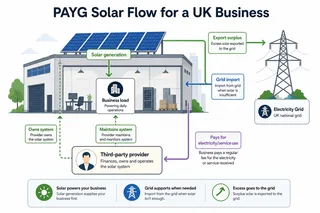
The structure is usually straightforward, even though the contract detail can be technical. The PPA provider pays for the solar installation and remains responsible for operating it. The host business provides the site, uses the electricity and pays for metered solar energy under the agreed contract.
The basic arrangement normally includes these roles.
- PPA provider: Funds the project, owns the solar PV equipment, arranges installation, monitors performance and manages maintenance.
- Host business: Provides access to the roof or land, consumes the solar electricity and pays for electricity under the PPA.
- Installer and designers: Survey the site, design the system, complete the electrical works and provide installation documentation.
- Grid and electricity supplier: Continue to supply imported electricity when solar output is not enough and may be involved in export or connection approvals.
- Landlord or freeholder: May need to approve roof access, cable routes, lease variations, licences or wayleaves where the host business does not own the property.
- The solar PV system generates electricity during daylight hours.
The usual energy flow is: Solar electricity is usually measured by dedicated metering. The business may receive a PPA invoice for solar electricity consumed on site, alongside its normal electricity supplier invoice for grid imports. The contract should clearly define whether the business pays only for consumed solar electricity or for all generation, including any exported electricity. Surplus electricity can be exported to the grid if the connection allows it. Export value is often lower than the value of using solar on site, because on-site use avoids buying imported electricity. The contract should say who receives export income, how export volumes are measured, and what happens if export is restricted by the Distribution Network Operator. The site uses that electricity where demand exists at the same time. The host business pays the PPA provider for the metered solar electricity under the contract. If solar output is not enough, the business imports the balance from its normal electricity supplier. If solar output exceeds site demand, surplus electricity may be exported, curtailed or managed through export limitation, depending on the design and contract.
How it differs from buying solar panels.
A PPA is mainly a finance, ownership and risk allocation model. The solar panels, inverters, cabling and metering may be similar to a customer-owned commercial solar PV system, but the commercial arrangement is different.
Under an outright purchase, the business pays the capital cost and owns the asset. It usually receives the full benefit of reduced grid imports and any export income, but it also takes responsibility for funding, maintenance, inverter replacement, insurance coordination and operational risk.
Under a PPA, the provider normally owns the system and sells electricity to the business. This reduces upfront capital requirements, but the provider keeps part of the project value in return for taking the investment and operating risk. A PPA is also different from a lease. A lease may involve fixed rental payments for equipment, while a PPA is normally linked to metered electricity generated and consumed. That distinction matters because a site with low daytime demand may not buy enough solar electricity to support attractive PPA pricing. The best choice depends on capital availability, tax position, risk appetite, property plans, electricity usage and how much control the business wants over the solar asset.
Why businesses use solar PPAs.
The main benefit is avoiding upfront capital expenditure. A business can access on-site solar electricity without using cash that may be needed for operations, plant, stock, property works or other investments.
A PPA can also give more predictable electricity costs if the PPA rate is fixed, capped or has clearly defined indexation. This does not remove all energy price risk because the business still imports electricity from the grid, but it can reduce exposure for the portion of demand met by solar.
Other practical benefits can include these outcomes.
- Lower grid imports during solar generation hours.
- Reduced need to manage solar maintenance directly.
- A route to on-site renewable electricity without owning the equipment.
- Potential support for carbon reporting where the contract allows it.
- Less operational burden than owning and maintaining the system.
- Possible alignment with ESG, customer procurement or net zero objectives.
The carbon and reporting position should not be assumed. The contract should state who owns any environmental attributes and whether the host business can claim the benefit of the on-site generation for its reporting method. Businesses with formal reporting obligations should check the treatment with their sustainability adviser or auditor. A PPA can be particularly attractive where the business wants solar but prefers not to take responsibility for: However, a PPA is still a commercial commitment. The business is not avoiding cost altogether; it is swapping upfront capital cost for a long-term electricity purchase obligation. A way to use otherwise unproductive roof space, where the roof is suitable. Procuring the system directly. Managing long-term monitoring and maintenance. Funding inverter replacement. Taking performance risk on the installed system. Allocating capital to a non-core asset.
When a commercial solar PPA is a good fit.
The strongest candidates usually have high and predictable daytime electricity consumption. Manufacturing sites, cold stores, food processing, offices, retail, leisure centres, schools, farms with daytime loads and logistics sites can all be suitable, but only if their demand profile matches solar output well enough.
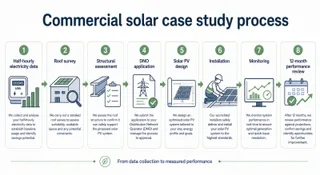
Half-hourly electricity data is important. At least 12 months of consumption data helps show how much generated solar electricity is likely to be used on site rather than exported or curtailed. Annual consumption alone is not enough because a business may use plenty of electricity at night but little during solar hours.
Roof quality is just as important as electricity demand. A large roof is not useful if it is weak, shaded, near the end of its life, covered in obstructions or difficult to access safely. A PPA provider will usually want confidence that the roof can support the system for the contract term. A good fit normally has several of the following features. Strong daytime electricity use. A sound roof with adequate remaining life. Clear ownership or lease rights. Acceptable grid connection conditions. A credit profile that supports long-term payments. Limited shading from plant, parapets, trees or neighbouring buildings. A simple suitability screen should consider four areas. Freehold sites are often simpler than leasehold sites, but tenants can still use PPAs where roof rights, landlord consent and lease terms are clear. Multi-let buildings can be more complex because metering, roof access and electricity resale arrangements may need legal review. A PPA may be especially worth exploring where the business has a good technical case for solar but does not want to use capital expenditure. If the business has available capital and wants maximum long-term savings, outright purchase should be compared carefully. A realistic plan to stay at the site for the PPA term. Electrical infrastructure that can accept the connection without disproportionate upgrade cost. A management team willing to coordinate surveys, legal documents, access and operational constraints.
When a PPA may not be suitable.
A commercial solar PPA is not the right answer for every business. It can be a poor fit where electricity consumption is low, where the site mostly uses power outside daylight hours, or where future occupancy is uncertain.
It can also be unsuitable where the roof needs replacement soon. Removing and reinstalling panels during roof works can be expensive and disruptive. The PPA should state who pays for temporary removal, reinstatement, access delays and any damage or warranty issues.
Common reasons a project may fail include these issues.
- The roof is too weak or too close to replacement.
- The business plans to move before the contract ends.
- The landlord will not grant consent.
- The site has low daytime electricity demand.
- Grid export capacity is limited or unavailable.
- The customer cannot support the required credit assessment.
A PPA may also be less attractive than outright purchase where the business has available capital, wants full control and is willing to manage asset performance. Buying the system can produce stronger lifetime savings in some cases, because the customer keeps more of the value. A cautious business should pause if any of the following apply. In these cases, the project may still be possible, but the risks need to be resolved before signing. The contract creates unacceptable property sale or lease complications. The electrical connection requires upgrades that make the project uneconomic. Shading, roof obstructions or fire access requirements reduce the usable area too much. The business cannot provide reliable consumption data for modelling. The proposal does not use half-hourly data. The quoted savings rely on aggressive future grid price assumptions. The provider cannot explain export treatment clearly. The term is longer than the lease or expected site occupation. Roof removal and reinstatement costs are unclear. Early termination liabilities are not explained. The contract prevents reasonable future roof, property or electrical works. There is no clear process for underperformance, outages or maintenance response.
Key contract points to check.
PPA contracts vary, so the details matter. The pence-per-kWh rate is only one part of the decision. A low starting rate can become less attractive if indexation is high, termination costs are severe or the business must pay for electricity it cannot use.
Important contract points include the following.
Price and indexation: Check whether the rate is fixed, linked to an index, subject to annual increases or reviewed during the term. Billing basis: Confirm whether payments apply to consumed solar electricity only or to all generated electricity. Export treatment: Check who receives export income and what happens if export is constrained. Term length: Understand whether the term fits the lease, property strategy and business plan. Buyout rights: Review any option to buy the system and how the buyout price is calculated. Roof works: Confirm who pays for removal and reinstatement if roof repairs are needed. Early termination costs can be substantial because they often reflect the provider’s unrecovered investment. Any business signing a PPA should understand its exit options before treating projected savings as certain. A useful distinction is between a good PPA contract and a bad one. The contract should also separate guaranteed obligations from forecasts. Savings projections are usually estimates, not promises. A provider should be able to explain which assumptions are fixed, which may change after survey, and which depend on future electricity prices. Assignment rights — Check what happens if the building is sold, leased or occupied by another business. Maintenance duties — Confirm what is included, including monitoring, inspections, cleaning assessment and inverter replacement. Performance obligations — Check whether the provider gives availability or performance commitments and what happens if they are not met. Insurance — Confirm who insures the equipment, how roof insurance is affected and what the insurer requires. Access rights — Understand when the provider can access the site and how this interacts with security, production and safety rules. Change in law — Review how regulatory, tax, grid or compliance changes are handled. Metering disputes — Check how meter faults, estimated readings and billing disputes are resolved. End-of-term position — Confirm whether the system is removed, transferred, extended or bought out.
Technical and property checks.
A commercial solar PPA still needs the same practical discipline as any commercial solar PV project. The provider may fund the system, but the host business will live with the installation on its roof for years.
A structural survey is normally a key early step. It should consider roof load capacity, wind loading, fixing method, edge zones, roof condition, access arrangements and any fragile or asbestos-containing materials. Flat-roof ballasted systems can add different loading considerations from mechanically fixed systems.
Electrical design also matters. The main switchboard, cable routes, metering, earthing, inverter locations and shutdown requirements should be assessed before final pricing. Some sites may need switchgear upgrades, export limitation equipment or careful coordination with existing generators, batteries, power factor correction equipment or critical loads. Grid connection requirements can affect programme and design. Larger commercial systems commonly need Distribution Network Operator approval, and export capacity is not always available. A zero-export system may be possible where export is restricted, but it can waste generation when site demand is low. Planning and compliance should be checked for the specific site. Many commercial rooftop installations may fall within permitted development rights, but limits and conditions apply, and listed buildings, conservation areas, large ground-mounted systems or unusual layouts may need additional review. Building safety, electrical safety, fire safety, insurance requirements and CDM duties should also be considered. Property checks are particularly important for PPAs because the system is usually owned by someone other than the occupier. The legal documents may need to deal with: Roof licence or lease rights. Landlord consent. Mortgagee or lender consent. Rights of access for maintenance and emergency works. Cable routes and metering locations. Removal obligations at the end of the term. For leasehold sites, the PPA term should be compared against the lease term, break clauses and renewal strategy. A tenant should not assume it can grant roof rights or long-term access without checking the lease. What happens if the building is sold or the tenant leaves. Responsibility for damage to the roof or solar equipment. Interaction with roof warranties and insurance conditions.
How pricing and savings are assessed.
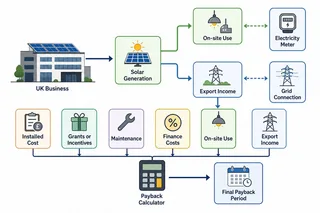
Commercial solar PPA pricing is site-specific. It depends on system size, installation cost, expected generation, self-consumption, export value, maintenance costs, finance costs, credit risk, contract length and the complexity of the roof and electrical connection.
Larger systems often have better economies of scale, but only if the site can use or export the electricity sensibly. A large warehouse roof may look ideal, yet the economics may be weak if the building has low daytime consumption and limited export capacity.
Savings estimates should compare the PPA cost against realistic grid electricity costs. They should account for seasonal solar output, the site’s half-hourly demand profile, PPA indexation, export treatment and any assumptions about future electricity prices. The most common modelling mistakes are practical rather than mathematical. These include assuming all generated electricity will be used on site, ignoring winter output reduction, underestimating roof costs, overlooking grid constraints and treating estimated savings as guaranteed. A robust PPA savings model should show: Annual generation estimate. Monthly or seasonal generation profile. Expected self-consumption percentage. Expected export or curtailed electricity. Current and assumed future grid import costs. PPA rate and indexation method. The most important comparison is not only the first-year saving. A buyer should review the whole contract term. A PPA that looks attractive in year one may become weaker if indexation outpaces the value of avoided grid electricity. Conversely, a higher starting rate may be acceptable if the contract has stronger protections, better maintenance obligations and clearer buyout rights. A practical evaluation should include at least three cases. This helps the business understand whether the PPA remains reasonable if reality differs from the proposal. Standing charges and non-energy charges that will not be avoided by solar. Maintenance and replacement responsibilities. Sensitivity to lower generation, lower site demand or lower grid prices. Any cost for enabling works, metering, grid works or legal documentation.
How solar PPAs interact with batteries, EV charging and heat pumps.
A solar PPA can be combined with other energy technologies, but each addition changes the commercial case. Battery storage can increase on-site use of solar electricity, but it adds cost, control complexity and additional contract terms.
Batteries tend to make more sense where there are time-of-use tariffs, peak demand charges, export constraints, resilience needs or a strong opportunity to shift energy from solar hours to more expensive periods. They should not be added automatically without modelling.
If a battery is included in or alongside a PPA, the contract should state: Who owns the battery. How charging and discharging are controlled. Whether the battery can charge from the grid. Who receives value from tariff optimisation or grid services. How degradation, replacement and performance are handled. What happens if the solar PPA ends before the battery arrangement. EV charging can pair well with solar if vehicles are parked and charging during the day. Fleet depots, staff car parks and destination charging sites may benefit, but the value depends on charging schedules and available electrical capacity. Heat pumps can also improve daytime electricity use where heating or hot water demand aligns with solar generation. The combined design should consider seasonal mismatch, because solar output is lower in winter when heating demand is often higher. Future electrification should be included in the modelling, but it should not be overstated. Planned EV charging, heat pumps, process electrification or expansion may improve PPA suitability, but providers should distinguish committed projects from possible future demand.
What information to gather before asking for a PPA offer.
A better feasibility process produces a more reliable PPA offer. The provider needs enough data to understand whether the site can host solar and whether the business will use enough of the electricity.
Useful information includes these documents and details.
At least 12 months of half-hourly electricity data. Recent electricity bills and tariff information. MPAN details for the site. Roof plans and structural information if available. Electrical drawings and switchboard details if available. Lease, landlord and property ownership information. A desktop design should be followed by a site survey before any final commitment. The survey should check roof type, shading, access, cable routes, switchgear, metering, fire risks and working-at-height requirements. Before asking for final pricing, a business should be ready to answer these questions. The more accurate the input data, the less likely the offer is to change after survey, grid review or legal due diligence. Details of planned roof works or site changes. Information about future EV charging, electrification or operational changes. Site opening hours and shutdown periods. Known shading, roof leaks, asbestos, fragile roof areas or access restrictions. Insurance requirements or previous insurer comments on rooftop solar. Any existing generation, batteries, standby generators or power quality equipment.
Practical next steps.
Start by deciding whether a PPA is the right finance route, not just whether solar panels are technically possible. Compare a PPA with outright purchase and asset finance using the same generation assumptions, demand data and roof constraints.
Ask any PPA provider to separate firm contract terms from estimated savings. The proposal should make clear what is guaranteed, what is assumed and what could change after survey, grid review or legal negotiation.
Before signing, take legal and property advice where the site is leased, mortgaged, multi-let or likely to be sold. Also involve insurers early, especially for larger commercial roofs or sites with fire safety sensitivities. A sensible procurement process is: Gather half-hourly data, bills, MPANs and site information. Screen the site for daytime demand, roof condition, property rights and future occupancy. Request a proposal showing generation, self-consumption, export, price, term and indexation. Compare the PPA against outright purchase and finance options. Test cautious scenarios rather than relying only on the headline savings case. Review the contract for pricing, termination, roof works, maintenance, export and assignment. A commercial solar PPA can be a strong option for a UK business with a sound roof, high daytime demand and a long-term site plan. It is best treated as a long-term energy contract with property, legal and operational consequences, not simply as a way to get solar panels with no upfront cost. Complete technical survey, structural review, grid checks and legal review before signing.
Plan, Compare & Buy Renewable Energy Solutions
AI does the thinking.
You get the perfect solar match.
Use RoboMo™ to assess your property, compare available technologies and connect with trusted UK installers, suppliers and manufacturers.
Simply enter your postcode, drop a pin on your roof, create your free account and let RoboMo™ analyse your property to find the best solar panels for your home.

You don't have to think
RoboMo™'s AI analyses your roof and does all the hard work.

Accurate & tailored
AI-powered assessment based on your roof, location, and conditions.

Best options, maximum savings
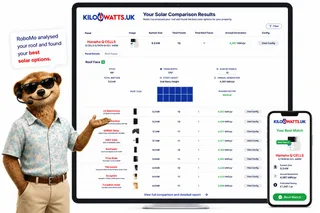
Compare top solar panels for the best performance and value.

Simple, fast & effortless
Provide a few details, sit back and watch your results unfold.
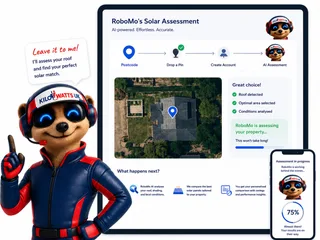
STEP 1
Choose Home, Business or Industrial
Enter your postcode to start your assessment.
STEP 2

Drop a pin on your roof
STEP 3

Create your free account
STEP 4

Sit back and watch RoboMo™ work
RoboMo™ analyses your roof and builds your personalised solar comparison.

Step 1
Enter your postcode
Start designing your wind energy system in seconds.
Are you an installer, distributor or renewable energy business?
Kilowatts UK is expanding the Flower Turbines partner network across the UK.
Become A Flower Turbines PartnerKilowatts UK is an authorised representative
Flower Turbines
Compact vertical-axis turbines built for real UK sites, not just open farmland.
They start in light wind, sit in a small footprint, and are bird-safe by design. Cluster them as a bouquet and the group performs better together than the same turbines standing alone. Enter your postcode for a location-based generation estimate. Figures use area weather data and will differ if buildings, trees or hills sit in the way.
Starts in light UK wind
Built to generate in typical UK wind, not only open farmland.
Small rooftop or ground footprint
Compact towers for roofs, yards and tight sites.
Bird-safe slow rotation
Slow vertical-axis spin, bird-safe by design.
Bouquet clusters raise output
Grouped turbines outperform the same units standing alone.
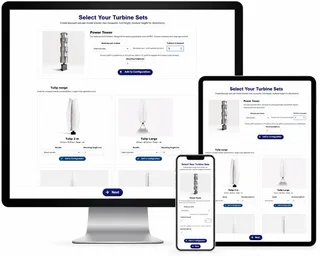
STEP 2

Choose a location
STEP 3

Place your cluster
Tap the map where you want the turbine cluster to go.
STEP 4

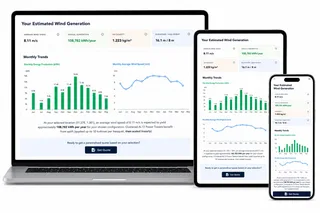
Instant generation forecasts
Compare different turbine layouts and see annual generation forecasts instantly.
STEP 5

No commitment required
Explore different configurations before deciding whether to request a quotation.
Related articles
Mo's Mission Nominations
FAQ
Need Help? RoboMo's Got Answers
What is a commercial solar PPA?
A commercial solar PPA is a Power Purchase Agreement where a third-party provider funds, owns, installs and usually maintains a solar PV system at a business site. The business then buys the solar electricity it uses at an agreed pence-per-kWh rate, usually with little or no upfront cost for the panels. The business keeps its normal grid supply for electricity needed when solar output is not enough.
Is a solar PPA the same as free solar panels?
No. A solar PPA is not free solar. The provider pays for the system upfront and recovers its investment by selling the generated electricity to the business over a long-term contract. The business avoids the initial capital cost, but it takes on an electricity purchase commitment for the agreed term.
How does a commercial solar PPA work?
The PPA provider installs and owns the solar PV system, usually on the customer’s roof, car park canopy or nearby land. The system generates electricity during daylight hours, which the site uses where there is demand at the same time. The business pays the provider for metered solar electricity under the PPA, while continuing to buy any additional electricity it needs from its normal supplier.
Who owns the solar panels under a PPA?
The PPA provider normally owns the solar panels, inverters, cabling and associated equipment for the duration of the agreement. The host business provides the site and buys the electricity generated. The contract should explain what happens at the end of the term, including whether the system is removed, transferred, extended or bought by the customer.
How is a solar PPA different from buying solar panels outright?
With an outright purchase, the business pays for and owns the solar PV system, keeps the full value of reduced grid imports and usually receives any export income. With a PPA, the provider funds and owns the system, and the business buys the electricity it uses. A PPA reduces upfront cost and operational responsibility, but usually gives the customer less control and lower lifetime value than owning the system.
What type of business is best suited to a solar PPA?
A solar PPA is usually best suited to businesses with strong and predictable daytime electricity use, a suitable roof or land area, a long-term plan to stay at the site, clear property rights and an acceptable credit profile. Manufacturing sites, cold stores, food processors, offices, retail buildings, leisure centres, schools, logistics sites and farms can all be suitable if their electricity demand matches solar generation well.
When might a solar PPA not be suitable?
A PPA may not be suitable if the site has low daytime electricity use, the roof is weak or due for replacement, the business may move soon, landlord consent is uncertain, or grid connection issues make the project uneconomic. It may also be less attractive where the business has capital available and wants maximum long-term savings from owning the system directly.
Why is half-hourly electricity data important for a PPA?
Half-hourly electricity data shows when a site uses electricity, not just how much it uses in a year. This matters because solar generation only has maximum value when it is used on site at the same time it is generated. At least 12 months of half-hourly data helps estimate self-consumption, export, curtailment and likely savings more accurately.
What happens to surplus solar electricity?
If the solar system generates more electricity than the site is using, the surplus may be exported to the grid, curtailed, stored in a battery or limited by export controls, depending on the design and grid connection. The PPA contract should clearly state who receives any export income, how export is measured and what happens if export capacity is restricted.
How long does a commercial solar PPA last?
Commercial solar PPAs are usually long-term agreements, often running for many years. The exact term depends on the provider, system size, project economics and customer circumstances. The term should be checked against the lease length, site occupation plans, roof condition and any likely property sale or refinancing plans.
What contract terms should a business check before signing a PPA?
A business should review the PPA rate, indexation, contract length, billing basis, export treatment, maintenance responsibilities, roof access rights, insurance requirements, early termination costs, buyout options, assignment rights and end-of-term arrangements. The contract should also explain what happens if roof works are needed, the building is sold, the tenant leaves or the system underperforms.
Can a tenant use a solar PPA on a leased property?
Yes, but leasehold sites often need extra legal and property checks. The tenant may need landlord consent, roof access rights, cable route permissions and possibly lender or freeholder approval. The PPA term should also be compared with the lease term, break clauses and renewal plans so the tenant is not locked into obligations it cannot fulfil.
Who maintains the solar panels under a PPA?
The PPA provider usually monitors and maintains the solar PV system, including performance checks and arranging repairs. The contract should confirm exactly what is included, such as inverter replacement, inspections, cleaning assessment, response times, fault resolution and responsibility for access. The host business may still have duties relating to safe access, site rules and avoiding damage to the equipment.
Can a solar PPA be combined with batteries or EV charging?
Yes. Batteries can help increase on-site use of solar electricity, especially where there are export limits, time-of-use tariffs or peak demand charges. EV charging can also work well with solar where vehicles charge during the day. These technologies should be modelled carefully because they add cost, control complexity and additional contract terms.
What information is needed to get a solar PPA quote?
A provider will usually need at least 12 months of half-hourly electricity data, recent electricity bills, MPAN details, roof information, site plans if available, electrical drawings, lease or ownership details, opening hours, planned site changes and details of any future EV charging, heat pumps or electrification. Better data leads to more reliable modelling and reduces the chance of major changes after survey.
Are the savings from a commercial solar PPA guaranteed?
Savings projections are usually estimates, not guarantees. Actual savings depend on solar generation, site electricity use, grid prices, PPA indexation, export treatment and operational changes at the site. A good proposal should separate fixed contract terms from assumptions and show cautious scenarios as well as the headline savings case.