


Vertical axis wind turbines for UK commercial rooftops: UK
Published: 2026-09-29 03:12:34
Updated: 2026-10-01 23:51:16
Vertical axis wind turbines suit UK commercial rooftops only where measured hub-height wind, structure, planning and a DNO connection all stack up.
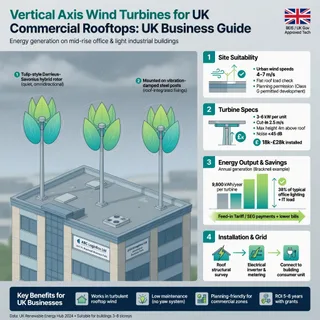
Vertical axis wind turbines for UK commercial rooftops - UK business guide
UK business guide Flower Turbines VAWT rooftop
Are vertical axis wind turbines suitable for UK commercial rooftops?
Vertical axis wind turbines for UK commercial rooftops are a narrow option, not a standard way to cut a business electricity bill. They can be worth a proper study where the building is exposed, a measurement at hub height shows a usable wind resource, the structure can accept cyclic loads, planning is realistic, and the local distribution network operator will connect the generation. On many low, sheltered warehouses, offices and retail units the flow over the roof is too weak and too disturbed for a useful annual yield. Commercial rooftop solar is usually the comparison to make first.
A vertical-axis wind turbine has an upright shaft. The blades turn around that vertical axis, so the machine does not yaw to face the wind. That geometry is a design choice. It is not evidence that the turbine will produce useful energy in the messy wind above a UK commercial building.
Treat any rooftop turbine as part of the building, not as a free-standing generator dropped onto a membrane. Output depends on the wind that remains after the building, the parapet, rooftop plant and neighbouring blocks have already stirred the flow. Nameplate power on a data sheet is not annual energy, and a brochure power curve is not a bill saving.
What a commercial roof does to the machine
On an office, warehouse, retail unit or similar non-domestic building, the turbine has to live with the roof that is already there. Prevailing UK flow is often from the south-west, but at roof level the direction is unreliable. Edges can accelerate the wind, then a recirculation zone behind a parapet can leave a low hub sitting in disturbed air for much of the year. A tall coastal or hilltop commercial building is a different resource from a low inland warehouse screened by units of similar height.
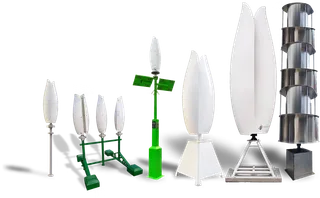
Common vertical-axis families include drag-based rotors, such as Savonius types, and lift-based rotors, such as Darrieus, H-rotor and helical forms. Tulip or flower-style machines sold for built-up sites sit in that small-turbine category. They are offered for appearance and for a claimed tolerance of changing wind direction. Those are intentions. Annual energy still has to be shown for the roof in question.
A horizontal-axis turbine is the familiar propeller that faces the wind. Buyers sometimes prefer a vertical-axis form because the visual sweep is different and the rotor does not need a yaw drive. Tolerance of direction changes is not the same thing as high energy capture in weak, turbulent flow. Many urban roofs have mean speeds at which a small turbine spends long periods near or below its cut-in. Cut-in is model-specific and should be read from the supplier's documents, not assumed.
Why brochure wind speeds mislead on UK roofs
Energy from wind rises steeply with speed. A modest error in the mean speed at hub height, or an underestimate of turbulence, changes annual output sharply. That is why a national wind map or a desktop screening tool can only rule sites out or flag them for measurement. It is a weak basis for spending money on equipment.
The assessment that matters is wind measured at or near the proposed hub height, for long enough to represent seasonal variation, with turbulence recorded as well as the mean. A short spot reading on a windy day will flatter the site. Winter windiness can complement summer-weighted solar generation on the same estate, but that seasonal pattern does not mean a rooftop turbine will cover a useful share of a warehouse or office load.
Site-specific annual energy, capacity factor and the effect on running cost are unknown for a generic UK commercial roof. They stay unknown until there is a measured wind-speed distribution and a power curve that applies to the model, including how the controller behaves in gusty flow. Anyone quoting a kilowatt-hour figure without that chain is guessing.
Which commercial buildings are realistic candidates
This route is for occupiers or landlords who can obtain a credible hub-height wind measurement, structural sign-off, planning advice and a grid-connection position before anyone orders plant. Better physical candidates are taller or highly exposed buildings, including some coastal, estuarine or elevated sites, where a taller neighbour does not shelter the roof and where maintenance access can be designed in from the start.
A wish for visible on-site generation is not a substitute for measurement. A product described as suitable for rooftops does not, by itself, carry a particular certification, a deemed planning consent, or a standing approval from the distribution network operator. Those points have to be checked for the product and the site.
The poorer fits are familiar on UK commercial estates. Low, sheltered warehouses, urban courtyards and retail units surrounded by buildings of similar height rarely justify a turbine unless measurement unexpectedly shows otherwise. The same is true where the frame cannot accept dynamic loads, the roofing warranty forbids the proposed penetrations, or occupiers and neighbours are sensitive to noise and vibration. If the business needs nearer-term bill reduction with a yield that can be estimated from roof area and orientation, start with commercial rooftop solar rather than wind.
How rooftop wind compares with solar or doing nothing
The honest comparison is three-way: leave the supply as it is, generate with photovoltaics on the same roof, or add a vertical-axis turbine where the wind case supports it. Wind and solar are not interchangeable. Solar output is driven by irradiance, orientation, shading and available area. Wind output is driven by the speed in the flow that actually reaches the rotor, and that relationship is steep. On many low-rise UK commercial buildings, roof area and a more predictable solar resource make photovoltaics the clearer generation option. Wind remains relevant where measurement shows a strong resource and solar area is constrained, for example by plant, smoke vents or a roof that is already full. Costs in pounds, grant availability and typical payback are not stated here, because they are not known for a generic rooftop turbine and must not be implied. Any commercial case needs a current quotation, an independent energy assessment and a stated year. Connection cost and programme depend on the distribution network operator's study for that site, not on a figure copied from another project.
Overview
A claim of lower aerodynamic noise than a comparable horizontal-axis machine, where a test actually shows that, does not remove structure-borne vibration or tonal noise in the rooms below. Acoustic claims need a stated distance and a test method. They are not a planning outcome.
Planning, structure and the grid connection
Consent and connection sit beside the wind resource. Either can stop the job after the turbine has already been chosen. Rooftop turbines on commercial buildings should be assumed to need planning permission unless a qualified adviser confirms otherwise for that site and nation. Conservation areas, listed buildings and neighbour amenity make refusal or conditions more likely. England, Wales, Scotland and Northern Ireland do not share one permitted-development rulebook for non-domestic wind, so a domestic solar assumption must not be copied across.
The building often decides the project before the planner does. A structural engineer should assess extreme wind load and fatigue, including how vibration passes into the frame and into occupied floors. Fixings should land on structure agreed with the building owner and the roofing warranty holder. A detail that looks watertight on a sketch can still void a guarantee if the membrane manufacturer has not accepted the penetration. Insurance should be asked in writing, not assumed.
Connecting generation is a distribution network operator matter. Whether the project is a notification or a full application depends on capacity, the number of phases and the export arrangement, and on any generation already on the site. G98 and G99 are engineering recommendations applied by the local operator. Current forms and thresholds should be confirmed with that operator. They should not be copied from a domestic solar job or from an old application pack. Export limitation, if required, changes both the electrical design and the energy the business can actually use or be paid for.
What to settle before equipment is ordered
The checks that decide these projects are easy to miss if the conversation starts with a product render. Landlord consent, insurer acceptance and the roof-warranty holder's written position should exist before a purchase order. Existing photovoltaic arrays, lightning protection, smoke vents and walkways compete for the same zones as turbine bases, cable routes and maintenance standing areas. A layout that ignores them will be redesigned late, usually at a cost to programme.
Maintenance access, rescue provision and the lifting method should be agreed under working-at-height rules before the positions are frozen. A turbine that cannot be reached safely will not be maintained. Bearings, controllers and inverters are wear items even when the design life of the rotor looks long on paper. Lifespan is model-specific. Replacement intervals should come from supplier documents and the warranty, not from a generic claim about wind turbines in general.
Removal and roof reinstatement belong in the same conversation as installation. A commercial roof is a maintained asset. A turbine that cannot be taken off without destroying the covering is a liability at the next lease event.
Flower-type turbines and grouped layouts
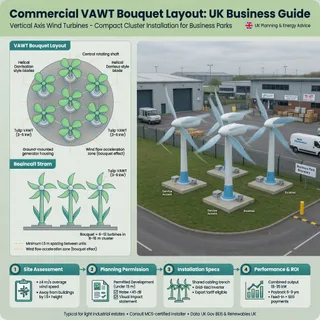
Flower-style vertical-axis machines are one design within that narrower set of sites. They are not a default product for UK offices, warehouses or retail parks. Where several rotors are grouped in a bouquet or cluster, and sometimes presented as mutually boosting output, treat the boost as a manufacturer claim until an independent assessment covers the proposed spacing and the actual roof flow. Grouping also increases structural demand, cabling complexity and visual impact, so planning and the grid application should be for the whole group, not for a single machine copied several times.
The practical service reference for this class of machine, rather than a performance claim, is the Kilowatts page on Flower Turbines for commercial sites. A page that explains the product does not establish annual yield, noise at the façade, or a certification. Those still have to be evidenced for the building.
Independent UK performance data for commercial rooftop vertical-axis turbines, including flower-type machines, are not established as a national rule of thumb. Before any number is used in a board paper, ask for current data sheets, any third-party power-curve or energy test, acoustic data at stated distances, and UK cases that pair measured wind with metered kilowatt-hours. A sales simulation that starts from an unmeasured mean speed is not that evidence.
What to ask for before you spend design fees
A useful first conversation is short and specific. Ask whether anyone will measure the wind at the real hub height, who the structural engineer is, which distribution network operator covers the site, and whether planning advice has been given for that nation and that building. If those four answers are vague, the project is still a brochure, not a scheme.
If the roof is low, inland and surrounded by similar buildings, spend the first assessment budget on whether commercial rooftop solar fits the load and the structure. Wind can stay on the list only if a screening study does not already show a sheltered roof. If the building is exposed and solar area is tight, commission the wind measurement and the structural opinion together, and keep the distribution network operator in the loop so connection time does not arrive as a surprise after planning.
Do not expect a rooftop turbine to provide backup power in an outage unless the electrical design explicitly includes that function. Ordinary grid-connected generation disconnects when the network is down. Do not expect a cluster to behave like several copies of a single-turbine brochure curve. Do not treat a grant, a tax relief or a tariff as available unless the live government or devolved scheme page, read in the year you are deciding, says the product and the applicant qualify. Nothing in a product brochure creates that eligibility.
Plan, Compare & Buy Renewable Energy Solutions
AI does the thinking.
You get the perfect solar match.
Use RoboMo™ to assess your property, compare available technologies and connect with trusted UK installers, suppliers and manufacturers.
Simply enter your postcode, drop a pin on your roof, create your free account and let RoboMo™ analyse your property to find the best solar panels for your home.

You don't have to think
RoboMo™'s AI analyses your roof and does all the hard work.

Accurate & tailored
AI-powered assessment based on your roof, location, and conditions.

Best options, maximum savings
Compare top solar panels for the best performance and value.

Simple, fast & effortless
Provide a few details, sit back and watch your results unfold.
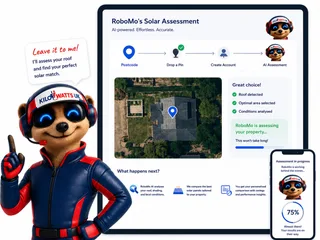

STEP 1
Choose Home, Business or Industrial
Enter your postcode to start your assessment.
STEP 2

Drop a pin on your roof
STEP 3

Create your free account
STEP 4

Sit back and watch RoboMo™ work
RoboMo™ analyses your roof and builds your personalised solar comparison.

Kilowatts UK is an authorised representative
Flower Turbines
Compact vertical-axis turbines built for real UK sites, not just open farmland.
They start in light wind, sit in a small footprint, and are bird-safe by design. Cluster them as a bouquet and the group performs better together than the same turbines standing alone. Enter your postcode for a location-based generation estimate. Figures use area weather data and will differ if buildings, trees or hills sit in the way.
Starts in light UK wind
Built to generate in typical UK wind, not only open farmland.
Small rooftop or ground footprint
Compact towers for roofs, yards and tight sites.
Bird-safe slow rotation
Slow vertical-axis spin, bird-safe by design.
Bouquet clusters raise output
Grouped turbines outperform the same units standing alone.

Step 1
Enter your postcode
Start designing your wind energy system in seconds.

STEP 2

Choose a location
STEP 3

Place your cluster
Tap the map where you want the turbine cluster to go.
STEP 4

Instant generation forecasts
Compare different turbine layouts and see annual generation forecasts instantly.
STEP 5

No commitment required
Explore different configurations before deciding whether to request a quotation.
Related articles
Mo's Mission Nominations
FAQ
Need Help? RoboMo's Got Answers
Are vertical axis wind turbines suitable for UK commercial rooftops?
They are a narrow option, not a standard way to cut a business electricity bill. They can be worth a proper study where the building is exposed, a measurement at hub height shows a usable wind resource, the structure can accept cyclic loads, planning is realistic, and the local distribution network operator will connect the generation. On many low, sheltered warehouses, offices and retail units the flow over the roof is too weak and too disturbed for a useful annual yield. An upright shaft means the machine does not yaw into the wind, but that design choice is not evidence of useful energy in disturbed roof flow.
Does this commercial rooftop guide apply to a house?
No. This guide is about non-domestic buildings such as offices, warehouses and retail units. A domestic solar or wind assumption must not be copied across, because planning, structure and grid connection are assessed for the building and nation in question. A house roof is a different case and needs its own advice.
Can a wind map or brochure power curve show the bill saving?
No. Nameplate power is not annual energy, and energy from wind rises steeply with speed, so a modest error in hub-height speed or turbulence changes output sharply. A national wind map or desktop tool can only rule a site out or flag it for measurement. Annual energy and the effect on running cost stay unknown until there is a measured wind-speed distribution and a power curve for that model, including how the controller behaves in gusty flow.
Which commercial buildings are more realistic candidates?
Better physical candidates are taller or highly exposed buildings, including some coastal, estuarine or elevated sites, where a taller neighbour does not shelter the roof and maintenance access can be designed in. Low, sheltered warehouses, urban courtyards and retail units surrounded by buildings of similar height rarely justify a turbine unless measurement unexpectedly shows otherwise. A product described as suitable for rooftops does not, by itself, carry a particular certification, a deemed planning consent, or a standing approval from the distribution network operator.
Should commercial rooftop solar be compared first?
On many low-rise UK commercial buildings, yes. Solar yield depends on irradiance, orientation, shading and usable area, and is often more predictable before purchase than wind on the same roof. Wind remains relevant where measurement shows a strong resource and solar area is constrained, for example by plant, smoke vents or a roof that is already full. Costs, grant availability and typical payback are not known for a generic rooftop turbine and should not be implied from another project.
Will a turbine on a commercial roof need planning permission?
Assume that it will, unless a qualified adviser confirms otherwise for that site and nation. England, Wales, Scotland and Northern Ireland do not share one permitted-development rulebook for non-domestic wind. Conservation areas, listed buildings and neighbour amenity make refusal or conditions more likely. A claim of lower noise is not a planning outcome, and acoustic information needs a stated distance and a test method.
What should be agreed before a turbine is ordered?
Obtain written landlord consent, insurer acceptance and the roof-warranty holder's position, including who reinstates the roof at the end of life. A structural engineer should assess extreme wind load, fatigue and vibration into the frame and occupied floors, with fixings on structure the owner and warranty holder have agreed. Engage the distribution network operator early, because connection depends on capacity, phases, export and any generation already on site. Also agree safe maintenance access before positions are frozen, and do not treat a short spot reading on a windy day as a purchase case.
Are flower-type or grouped turbines a better choice for UK commercial roofs?
Flower-style vertical-axis machines are one design within a narrower set of sites, not a default product for offices, warehouses or retail parks. Where several rotors are grouped and presented as boosting one another's output, treat that boost as a manufacturer claim until an independent assessment covers the proposed spacing and the actual roof flow. Grouping increases structural demand, cabling complexity and visual impact, so planning and the grid application should cover the whole group. Independent UK performance data for this class of rooftop turbine are not established as a national rule of thumb.