


Commercial solar plus battery for UK factories: UK business
Published: 2026-09-28 22:08:13
Updated: 2026-09-30 03:51:22
See when commercial solar plus a battery fits a UK factory: shift timing, export caps and connection headroom. A standard battery is not backup power.
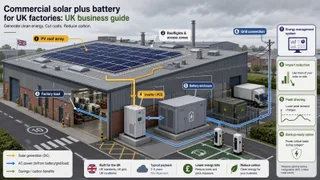
Commercial solar plus battery for UK factories - UK business guide
UK business guide B Solar factory load and shift
Commercial solar plus battery for UK factories: when the pairing fits
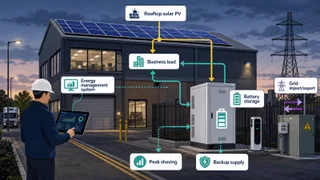
Commercial solar plus battery for UK factories suits a site only when daytime electrical load, shift timing and connection headroom line up. Solar on its own often covers a weekday day shift with a steady baseload. A battery is worth modelling when a later shift, an export cap or a costly daytime peak would leave surplus generation wasted, or sold for less than the import it could have avoided. Roof life, tenure and a network application still have to pass before that model is a buildable scheme.
The array is photovoltaic plant connected behind the meter, on the roof, on land inside the site, or on canopies over yards and parking. It is sized against the site's electrical demand and its agreed connection, not against a domestic consumption figure. Most manufacturing supplies are three-phase. Many sites are fed at high voltage through the customer's own transformer. The landing point is an industrial board, not a household consumer unit.
The battery in this pairing is a commercial storage system run with the array. In ordinary grid-parallel use it charges from surplus solar or from the grid, then discharges later to cut import, within the power and energy limits set at design. Power, in kilowatts, is how fast it can charge or discharge. Usable energy, in kilowatt-hours, is how much it can actually move in time. A high power rating with a short duration will not carry a night shift. Round-trip efficiency, cycle limits and warranty years belong on the datasheet. They are not a national average. Installed price, battery price, payback, grants and tax treatment are not stated here. They depend on roof works, electrical upgrades, export limits, battery duration and the commercial terms on that meter. A national midpoint would be an invention. Official tax, VAT, business-rates and incentive rules should be read at the time of the decision, not carried forward from an old scheme.
How shift timing changes the share of solar used on site
Factory load and shift means the timing of electrical demand across the day, the week and the year. Two plants with the same annual kilowatt-hours can be different projects if one runs a weekday day shift and the other runs nights, weekends or a summer shutdown. The calendar usually dominates the energy case more than the outline area of the roof.
A weekday shift through late morning and early afternoon overlaps the solar peak, so much of the generation can be used as it is produced. An early finish, a dark weekend or a summer shutdown leaves surplus. That surplus can only be exported up to the agreed maximum export capacity, or it is curtailed. A night shift, or a second shift after sunset, sees that solar only if a battery has stored it, and only up to the battery's usable energy.
UK output is seasonal. An unshaded array produces much more from late spring into summer than in December and January. Arrays do generate under cloud, but winter output is much lower. A factory that is shut when generation is highest will not use that energy on site. The opposite error is to treat a large roof as a large bill effect. If the electrical load is small, or falls mostly at night, much of the generation will be exported or limited. Export value is not the same as avoided import. Factory roofs often fix the orientation. Low-pitch metal or membrane coverings, rooflights, flues and plant break up the usable area. Dust, oil mist and bird fouling reduce yield more on a manufacturing roof than on a clean office roof. The usable area is what remains after those exclusions and after a structural check, not the building outline on a satellite image. Early screening should use a location-specific irradiance model for orientation, pitch and shading. A measured national factory yield is not established here, and a screening figure is not a guarantee. Continuous processes with a high daytime baseload often absorb midday solar without storage. The battery question then becomes peaks, export caps and tariff periods, rather than whether generation is usable at all. Comparing solar with grid electricity means keeping those parts separate. Avoided import, exported units and charges that do not move with every kilowatt-hour are not one saving.
Which factory load patterns justify storage
Solar-only should be the baseline on every factory job so storage is not treated as automatic. The comparison below is a decision frame, not a yield forecast. It contains no prices and no self-consumption percentages, because those are unknown without half-hourly data and a connection offer.
Overview
A row that looks favourable still fails if the roof cannot take the array, the lease is short, or the network will not accept the export or the charging load. Two-shift sites that run into the evening, and continuous sites with costly daytime peaks, are the usual reasons to model a battery beside solar rather than solar alone. Night-only production is a weak match for solar on its own. Storage helps that pattern only when daytime surplus is large enough to fill a battery that covers a meaningful part of the night load. That is a modelling result, not a default.
Why a standard battery will not keep production running
A grid-parallel inverter must disconnect when the public supply fails, so the site does not energise a dead network. A standard commercial battery operated with the array is not backup power. Keeping any part of the factory supplied in a power cut needs a separate design, a defined critical board, and switching that cannot back-feed the network.
Full-factory islanding is rarely realistic. Motor starts and process loads are large relative to a typical commercial storage system. If resilience is the aim, it is usually a small critical board, with a written list of what stays on and what does not. Assuming the battery will hold production through an outage is a common reason a proposal disappoints after the first power cut.
Older cases built on a particular peak network charge, or on a particular grid-services product, should not be repeated as current fact. Those markets and charging arrangements have changed. Some batteries were previously justified that way. The present position has to be checked for the site and for the products actually on offer. A historic income figure would mislead, so none is quoted here. Flexibility revenue is unknown until a current route is confirmed.
What the network offer has to settle before the size is real
Factory-scale generation in Great Britain normally needs an application under Engineering Recommendation G99 to the distribution network operator, or to the independent distribution network operator where the estate network is private. Northern Ireland has its own network operator and process. The small microgeneration route is the exception, not the usual factory case. The current engineering recommendation should be read rather than assumed from a domestic guide. A page that sets out how a commercial array is specified and installed can clarify design scope. It cannot confirm a connection offer, an export limit or a reinforcement cost.
The network application is often longer than the roof works. Age of switchgear, spare ways, transformer rating and fault level decide whether the array can land on the existing board. What changes the quotation is often this electrical work, not the module count. Controls must keep solar, the battery and any combined heat and power or standby diesel inside the maximum import capacity and the maximum export capacity. That includes the moment when the battery charges from the grid at the same time as the factory is drawing load. A cheap charging window is not usable if it breaches the import limit.
Assuming full export, or assuming the battery can charge at nameplate whenever a tariff looks attractive, is a common cause of redesign after the offer comes back. Whether the battery shares inverter capacity with the array or sits on its own inverter, the combined behaviour still has to stay inside those limits. Timescales, export caps and any reinforcement cost are unknown until the relevant network operator responds for that site. A neighbour's offer, or an estate brochure, is not your limit.
Roof life, tenure and planning before the energy case
Connection, tenure and planning are separate gates from the energy model. Landlord consent, remaining roof life and roof-warranty conditions often decide the project before the network does. Fixings can conflict with the warranty, so clamps, ballast and penetrations each need a structural and wind check, including edge zones on a low-pitch metal or membrane roof. An asbestos refurbishment survey comes before any fixing. Crane time, edge protection and the final electrical shutdown have to be planned around production.
Permitted development should not be assumed. Planning differs by nation and between roof-mounted and ground-mounted plant. The rules should be read for the factory's location at the date of the application. A short lease is a poor fit even when the roof looks clear, because the occupier may not hold the site long enough to justify the works. If most site energy is gas, oil or steam for process heat, and the electrical load is minor, solar will not move the energy bill in the way a large roof suggests. It offsets imported electricity only, unless those heat loads are electrified and then included in the electrical model.
Insurer conditions for rooftop photovoltaic plant and for lithium batteries vary. Fire separation, ventilation and firefighter access for a battery room or external enclosure go beyond a domestic installation note. Confirm them with the insurer for that building. One trade document does not bind every factory. In Great Britain the commercial client has construction-design duties under the Construction (Design and Management) Regulations 2015. Northern Ireland's own regulations should be checked rather than copied across.
What changes the design once half-hourly data is on the table
Sizing needs at least twelve months of half-hourly import, the shift and shutdown calendar, and any committed new electrical load such as heat pumps, electric process heat or vehicle charging. An annual total hides weekend export, summer shutdowns and the evening peak a battery would have to cover. The designer also needs maximum demand, power factor, and a view of harmonics from drives. Those conditions affect protection settings and how inverters behave on an industrial board that is already noisy.
Start with data and a roof screen, then a solar-only model, then a battery case only if surplus, peaks or an export cap justify it. Structural sign-off, insurer conditions and the network application run alongside that model, not after a price has been treated as final. Generation, import and export metering should be specified so the model can be checked after handover. Set-points should be documented rather than left on defaults, and someone should be named to own monitoring.
Module warranties are commonly offered at around 25 years, with an end-of-warranty output that varies by product. That is not a promise of a particular annual yield on a soiled factory roof. Battery warranty years and cycle caps should be read against the duty you actually intend. What changes the design late is usually a load the model never saw: a new line, a charger bank, or a heat pump that lifts both daytime energy and maximum demand. Add those before the connection application, not after the offer.
When solar plus storage is a poor fit
The pairing is a poor fit where the roof needs replacement within the life of the array, asbestos is unmanaged, or shading from adjacent bays is severe. It is a poor fit where the lease is too short, where landlord consent will not be given, or where electricity is a small fraction of a heat-led site. Night-only production is a weak match unless daytime surplus is large enough to matter. If solar-only already uses most of the generation, storage has to earn its place on peaks, export limits or tariff periods. It is not automatic because the roof is large.
A factory also differs from the questions that come up for warehouse roofs, office rooftops and retail parks or shops. Those sites often follow occupancy or trading hours. A factory follows process, often through its own transformer, with drives, harmonics and a shift calendar a shop does not have. A warehouse cost figure, an office rooftop case or a retail scheme is not a factory answer. None of those should be taken from a national price midpoint. Commercial solar versus grid electricity is the same distinction everywhere: avoided import is not export value, and not every charge on the supply moves with generation.
Before you treat a proposal as firm, ask for the evidence the model used and the constraints it has not yet cleared. A competent designer will show the half-hourly profile against the shift calendar, state the export limit as provisional until the network responds, and separate solar-only from solar plus storage so the battery is not hidden inside a single outcome. They will also say what the system will not do in a power cut.
If those answers are vague, the proposal is still a brochure. Measure the load, confirm the roof and the lease, and let the network application set the export and charging limits before quotations are compared.
Plan, Compare & Buy Renewable Energy Solutions
AI does the thinking.
You get the perfect solar match.
Use RoboMo™ to assess your property, compare available technologies and connect with trusted UK installers, suppliers and manufacturers.
Simply enter your postcode, drop a pin on your roof, create your free account and let RoboMo™ analyse your property to find the best solar panels for your home.

You don't have to think
RoboMo™'s AI analyses your roof and does all the hard work.

Accurate & tailored
AI-powered assessment based on your roof, location, and conditions.

Best options, maximum savings
Compare top solar panels for the best performance and value.

Simple, fast & effortless
Provide a few details, sit back and watch your results unfold.
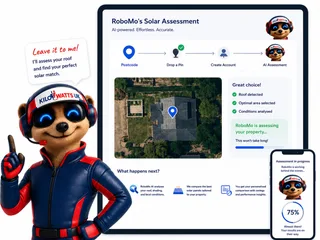
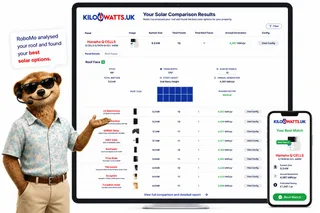
STEP 1
Choose Home, Business or Industrial
Enter your postcode to start your assessment.
STEP 2

Drop a pin on your roof
STEP 3

Create your free account
STEP 4

Sit back and watch RoboMo™ work
RoboMo™ analyses your roof and builds your personalised solar comparison.

Kilowatts UK is an authorised representative
Flower Turbines
Compact vertical-axis turbines built for real UK sites, not just open farmland.
They start in light wind, sit in a small footprint, and are bird-safe by design. Cluster them as a bouquet and the group performs better together than the same turbines standing alone. Enter your postcode for a location-based generation estimate. Figures use area weather data and will differ if buildings, trees or hills sit in the way.
Starts in light UK wind
Built to generate in typical UK wind, not only open farmland.
Small rooftop or ground footprint
Compact towers for roofs, yards and tight sites.
Bird-safe slow rotation
Slow vertical-axis spin, bird-safe by design.
Bouquet clusters raise output
Grouped turbines outperform the same units standing alone.
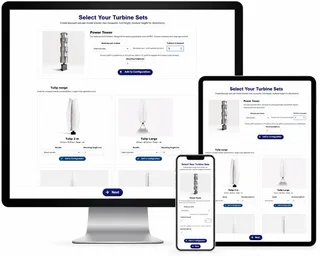
Step 1
Enter your postcode
Start designing your wind energy system in seconds.
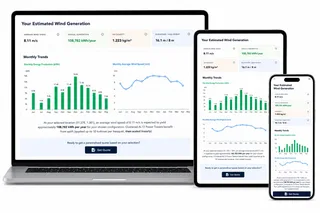
STEP 2

Choose a location
STEP 3

Place your cluster
Tap the map where you want the turbine cluster to go.
STEP 4

Instant generation forecasts
Compare different turbine layouts and see annual generation forecasts instantly.
STEP 5

No commitment required
Explore different configurations before deciding whether to request a quotation.
Related articles
Mo's Mission Nominations
FAQ
Need Help? RoboMo's Got Answers
When is commercial solar plus a battery worth considering for a UK factory?
The pairing suits a site only when daytime electrical load, shift timing and connection headroom line up. Solar on its own often covers a weekday day shift with a steady baseload. A battery is worth modelling when a later shift, an export cap or a costly daytime peak would leave surplus unused, or sold for less than the import it could have avoided. Roof life, tenure and a network application still have to pass before that model is a buildable scheme.
Will a standard commercial battery keep production running in a power cut?
No. A grid-parallel inverter must disconnect when the public supply fails, so the site does not energise a dead network. A standard commercial battery operated with the array is not backup power. Keeping any part of the factory supplied needs a separate design, a defined critical board, and switching that cannot back-feed the network. Full-factory islanding is rarely realistic, because motor starts and process loads are large relative to a typical storage system.
How do shift patterns change whether storage is justified?
Solar-only should be the baseline, so storage is not treated as automatic. A weekday day shift overlaps the solar peak, while an evening shift, a night shift, dark weekends or a summer shutdown leave surplus that can only be exported up to the agreed limit or curtailed. Two-shift sites and continuous sites with costly daytime peaks are the usual reasons to model a battery. Night-only production is a weak match unless daytime surplus is large enough to cover a meaningful part of the night load, and that is a modelling result, not a default.
What must the network offer settle before the system size is real?
In Great Britain, factory-scale generation normally needs an application under Engineering Recommendation G99 to the distribution network operator, or to the independent operator where the estate network is private. Northern Ireland has its own operator and process, and the current recommendation should be read rather than taken from a domestic guide. Timescales, export caps and any reinforcement cost are unknown until that operator responds for the site. Controls must keep solar, the battery and any other generation inside the maximum import and export capacities, including when the battery charges from the grid while the factory is drawing load.
Why does a high battery power rating not mean a night shift can be covered?
Power, in kilowatts, is how fast the battery can charge or discharge. Usable energy, in kilowatt-hours, is how much it can actually move over time. A high power rating with a short duration will not carry a night shift. Round-trip efficiency, cycle limits and warranty years belong on the datasheet for the duty you intend, and they are not a national average. The combined behaviour of the array and the battery still has to stay inside the agreed import and export limits.
What can stop a factory scheme before the energy case matters?
Landlord consent, remaining roof life and roof-warranty conditions often decide the project before the network does. An asbestos refurbishment survey comes before any fixing, and clamps, ballast and penetrations each need a structural and wind check. Planning differs by nation and between roof-mounted and ground-mounted plant, so permitted development should not be assumed. A short lease is a poor fit even when the roof looks clear. If most site energy is gas, oil or steam, solar offsets imported electricity only, unless those heat loads are electrified and included in the model.
What information is needed before a battery is sized?
Sizing needs at least twelve months of half-hourly import, the shift and shutdown calendar, and any committed new electrical load such as heat pumps, electric process heat or vehicle charging. An annual total hides weekend export, summer shutdowns and the evening peak a battery would have to cover. Maximum demand, power factor and harmonics from drives also affect how inverters behave on an industrial board. Start with a solar-only model, and add storage only if surplus, peaks or an export cap justify it. Add those new loads before the connection application, not after the offer.
Are price, grants and payback the same for every UK factory?
No. Installed cost, battery cost, payback, grants and tax treatment depend on roof works, electrical upgrades, export limits, battery duration and the commercial terms on that meter. A national midpoint would be misleading, so none is stated here. Official tax, VAT, business-rates and incentive rules should be read at the time of the decision, not carried forward from an old scheme. Flexibility income is also unknown until a current route is confirmed, and a historic network charge or grid-services product should not be treated as current fact.