


ESG-linked finance for UK solar projects: UK business guide
Published: 2026-09-29 01:52:51
Updated: 2026-10-01 11:51:05
UK ESG-linked finance for solar is not one product or a cheaper rate. A green loan tracks eligible spend; sustainability-linked loans can raise the margin.
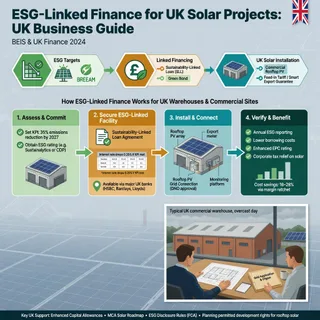
ESG-linked finance for UK solar projects - UK business guide
UK business guide B Solar ESG loan framing
ESG-linked finance for UK solar projects in plain terms
ESG-linked finance for UK solar projects means debt whose eligibility, covenants or price is tied to environmental, social or governance criteria, used to fund or accompany a commercial array. It is not a single UK-regulated solar product. The label does not remove ordinary credit tests or guarantee a cheaper rate. A green loan reserves proceeds for projects the lender treats as eligible and requires reporting on use. A sustainability-linked loan is priced or covenanted against targets, and the money need not be spent only on solar. The site still decides the outcome: structure, daytime load, and whether the network will connect the system. The phrase is a market description, not a product set out in a dedicated UK solar statute. These structures are commonly aligned to voluntary principles associated with the Loan Market Association and partner bodies. They sit apart from cash purchase, asset finance, hire purchase, lease and power purchase agreements. A payment plan that an installer calls ESG finance is not, by that wording alone, either a green loan or a sustainability-linked loan. A facilities, finance or energy manager can use this when comparing how to pay for on-site solar, and whether an ESG label changes eligibility, price or reporting. This is not a household grant question. The practical test is whether the business can show a bankable site and, where the facility requires it, an energy or carbon baseline that still makes sense after commissioning.
How a green loan differs from a sustainability-linked loan
A green loan is a use-of-proceeds facility. The lender treats specified projects as eligible. Drawings are meant to stay inside that purpose, and later reporting shows how the money was spent. A sustainability-linked loan can fund wider business purposes. Its price or covenants track sustainability performance targets. Solar may be how a target is met, but it does not have to be the only use of the funds.
Pricing is not a published solar rate. Margins, any step up or down, arrangement fees and legal costs depend on credit, tenor and whether the loan is bilateral or syndicated. Those figures are not knowable from the project type alone, so a saving should not be assumed from the label. On a sustainability-linked facility the margin can rise if targets are missed, as well as fall if they are met. That two-way movement is the point many term-sheet summaries skip.
The reporting burden is what changes the job. A green loan needs a trail from drawdown to eligible spend, including a clean split if the same contractor is also doing roof works the lender will not treat as eligible. A sustainability-linked loan needs a baseline, a target measured on the same basis each year, and an agreement on what happens if the estate or the meters change. Without that evidence, the ESG clause is decoration on an ordinary credit.
Which commercial buildings can carry this debt
A warehouse, office, shop or retail park can use either structure only if the business can own or refinance the plant, or can meet targets without treating a third-party system as its own asset. The building type does not create eligibility. The lender is underwriting a borrower and a project that can be surveyed, connected and, where the documents require it, reported.
Leased property is the constraint that most often changes the proposal. Many warehouses, offices and shops do not put the roof in the tenant demise, or they do so on terms that still need landlord consent for alterations, cabling and long-lived plant. The unexpired lease, any break and dilapidations need to sit sensibly against the finance term. Consent to leave the system in place after a sale or lease expiry matters as much as the module specification. Security is the plant and the right to keep it there.
A multi-site operator may want one facility across several meter points. That can be sensible where the reporting cost would be heavy for a single small array. It does not collapse the technical work. Each site can still need its own structural survey, yield assumptions and connection application. One constrained meter point can weaken a portfolio cashflow that looked even on paper. This route is not for households. Household assumptions do not travel with the panels. A domestic property is a different job, and a home energy survey is the right starting point there. MCS is not a universal gateway for commercial facilities, and the Smart Export Guarantee is not the default income case for a business connection.
Why roof, load and connection still gate the facility
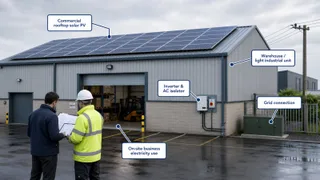
An ESG label does not repair a weak site. Technical and credit due diligence can still stop the loan if the roof cannot take the load, daytime demand is too small for the proposed array, or the network constrains export. The finance conversation should start from those tests, not from an emissions narrative.
Larger commercial connections are commonly dealt with under ENA Engineering Recommendation G99 rather than the small-scale G98 route. That is a process point, not a promise of capacity. Export limits, reinforcement and programme delay can change the cashflows a lender will underwrite. Thresholds, charges and timescales should be taken from current Energy Networks Association guidance and from the distribution network operator for the site. Depending on location that may be UK Power Networks, National Grid Electricity Distribution, Scottish and Southern Electricity Networks, Northern Powergrid, SP Energy Networks or NIE Networks. A model that assumes unconstrained export is the wrong input for a covenant.
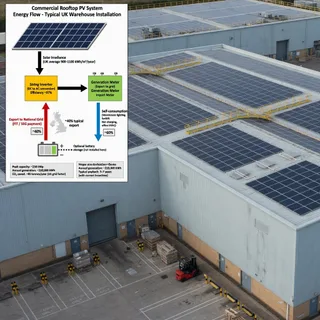
Any comparison of commercial solar with grid electricity for a UK business depends on tariff, load shape, orientation, shading and those export constraints. A limitation scheme can cut exported energy relative to an unconstrained brochure case. That changes both the grid-cost comparison and any revenue covenant. Output and self-consumption are site results. They are not a national figure that can be dropped into a warehouse, office or retail park paper. Other costs of owning the plant sit beside the loan and are easy to blur with the ESG story. VAT on commercial solar supplies, capital allowances and business rates on solar plant can differ by ownership and by UK nation. They are not the same as domestic solar rules. None of those treatments should be written as a fixed saving until a current official source, or a qualified adviser, has confirmed them for the actual supply and the actual owner. Permitted development limits for non-domestic solar also differ across England, Scotland, Wales and Northern Ireland, so a design that is acceptable on one estate is not automatically acceptable on another.
What lenders expect beyond the sales proposal
Lenders and their advisers usually look past the sales proposal. They expect stated design assumptions, equipment that can be identified, and a paper trail that still works if the installer changes before the loan is repaid. Drawdown is often staged. Commissioning records, as-built drawings and network-operator acceptance are typical conditions for final payment, not optional extras after the array is on the roof.
Whether those documents can be relied on, and whether the operating assumption matches the connected system, is what changes the file. An export limit agreed late in the programme can make an earlier generation case, and any performance target built on it, look overstated.
Renewable electricity should not be written into a target until REGOs and any landlord and tenant metering split are agreed. If the occupier does not own the generation, a use-of-proceeds claim and a Scope 2 claim can point at different parties. Market-based accounting, and any additionality test the lender applies, will decide what can be said. An install does not by itself improve an ESG score, a science-based target or a Scope 2 inventory.
When an ESG-linked loan is the wrong way to pay
This is a poor fit where the business wants a simple installer payment plan and no ongoing reporting of spend or targets. A lease, hire purchase or installer plan can still be a rational way to pay for an array. Calling it ESG finance does not make it a green loan or a sustainability-linked loan. The contracts allocate ownership differently, and they support different claims.
It is also a poor fit if landlord consent cannot be obtained, if there is no usable baseline for energy or emissions, or if the site fails structural, planning or connection tests. Solar is not an eligible project for every lender. Some will only treat defined technologies, evidence packs or project boundaries as green, and that list belongs to the lender. It is not a national entitlement that arrives with the modules.
Reporting duties do not fall on every UK business in the same way. Some large companies and LLPs already report energy and carbon, including under Streamlined Energy and Carbon Reporting where they are in scope. Size tests, and the in-force position of newer UK sustainability reporting standards, need a current official source before they are treated as a reason to choose a particular loan. Firms authorised by the Financial Conduct Authority are constrained in how they market sustainability claims. A borrower that is not an authorised firm is not automatically under that rule, but the facility still has to be supportable if a lender, auditor or counterparty relies on it. An occupier on a third-party power purchase agreement may still describe purchased renewable electricity, within whatever the contract and the accounting rules allow. That contract is not a green loan to buy the array. If the goal is to buy power without owning plant, forcing the project into ESG-linked debt adds reporting without adding ownership.
How the main payment routes compare
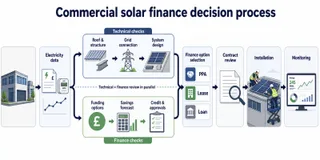
Sort by ownership, reporting burden and site bankability before price. Price is unknown until credit, tenor and security are assessed. A green loan fits when the business will buy or refinance the plant, can ring-fence eligible spend and can report that use. A sustainability-linked loan fits when the business wants broader debt and can live with targets that may tighten the margin if missed. A power purchase agreement or lease fits when a third party should own the system. An ordinary business loan or asset finance fits when the ESG reporting cost is not justified and the credit stands on the borrower and the asset alone.
Overview
A portfolio of warehouses, offices or retail units is more likely to justify the reporting cost than one very small array, but only if each site can still pass structural and connection checks. Commercial rooftop solar for UK offices can fail the ownership test before irradiance becomes the issue, because the roof and the lease may sit with the landlord. Solar for UK retail parks and shops raises the same consent and term issues, and daytime load may be peaky enough that a large export assumption will not survive a G99 offer. Commercial solar panel cost for UK warehouses is a surveyed result for the specified design, the connection terms and the fees actually quoted. It is not a national rate that can be covenanted in advance.
What to fix before you approach a lender
Confirm who owns the roof, who will own the plant, and whether the unexpired lease covers the proposed term. Ask the designer for the yield assumptions, the structural position, and whether the connection is being treated under G98 or G99, including any export limit already signalled. Ask the lender, in writing, whether the offer is a use-of-proceeds green loan or a sustainability-linked facility, what evidence counts as eligible, and what happens to margin or covenants if a target is missed.
Measure daytime load, and the share that can be used on site, before anyone compares the array with grid electricity. Keep that yield case separate from any claim about scores, science-based targets or Scope 2. If VAT, capital allowances or business rates are part of the investment case, have them checked for this ownership structure and this nation rather than copied from a domestic guide. If those answers are thin, an ordinary asset route or a third-party power purchase agreement may be the cleaner contract. There is no advantage in forcing an ESG label onto a site that cannot support the evidence. If it can, review commercial solar routes against the ownership and connection facts already gathered.
Plan, Compare & Buy Renewable Energy Solutions
AI does the thinking.
You get the perfect solar match.
Use RoboMo™ to assess your property, compare available technologies and connect with trusted UK installers, suppliers and manufacturers.
Simply enter your postcode, drop a pin on your roof, create your free account and let RoboMo™ analyse your property to find the best solar panels for your home.

You don't have to think
RoboMo™'s AI analyses your roof and does all the hard work.

Accurate & tailored
AI-powered assessment based on your roof, location, and conditions.

Best options, maximum savings
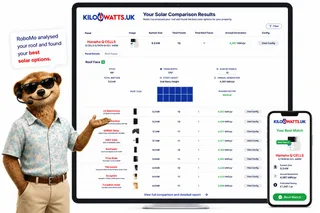
Compare top solar panels for the best performance and value.

Simple, fast & effortless
Provide a few details, sit back and watch your results unfold.
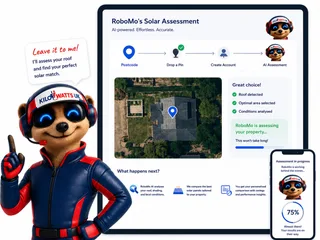
STEP 1
Choose Home, Business or Industrial
Enter your postcode to start your assessment.
STEP 2

Drop a pin on your roof
STEP 3

Create your free account
STEP 4

Sit back and watch RoboMo™ work
RoboMo™ analyses your roof and builds your personalised solar comparison.

Kilowatts UK is an authorised representative
Flower Turbines
Compact vertical-axis turbines built for real UK sites, not just open farmland.
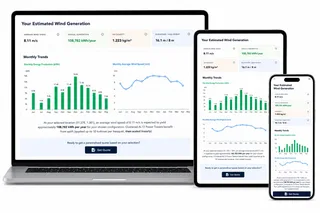
They start in light wind, sit in a small footprint, and are bird-safe by design. Cluster them as a bouquet and the group performs better together than the same turbines standing alone. Enter your postcode for a location-based generation estimate. Figures use area weather data and will differ if buildings, trees or hills sit in the way.
Starts in light UK wind
Built to generate in typical UK wind, not only open farmland.
Small rooftop or ground footprint
Compact towers for roofs, yards and tight sites.
Bird-safe slow rotation
Slow vertical-axis spin, bird-safe by design.
Bouquet clusters raise output
Grouped turbines outperform the same units standing alone.
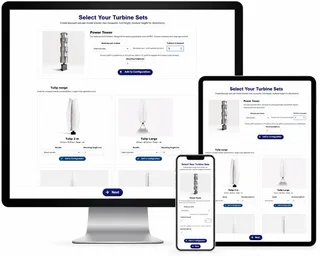
Step 1
Enter your postcode
Start designing your wind energy system in seconds.
STEP 2

Choose a location
STEP 3

Place your cluster
Tap the map where you want the turbine cluster to go.
STEP 4

Instant generation forecasts
Compare different turbine layouts and see annual generation forecasts instantly.
STEP 5

No commitment required
Explore different configurations before deciding whether to request a quotation.
Related articles
Mo's Mission Nominations
FAQ
Need Help? RoboMo's Got Answers
What is ESG-linked finance for a UK solar project?
ESG-linked finance for UK solar means debt whose eligibility, covenants or price is tied to environmental, social or governance criteria, used to fund or accompany a commercial array. It is a market description, not a single product set out in a dedicated UK solar statute. These structures are commonly aligned to voluntary principles associated with the Loan Market Association and partner bodies. They sit apart from cash purchase, asset finance, hire purchase, lease and power purchase agreements.
How does a green loan differ from a sustainability-linked loan?
A green loan reserves proceeds for projects the lender treats as eligible and requires reporting on how the money was spent. Drawings are meant to stay inside that purpose, including a clean split if the same contractor is also doing roof works the lender will not treat as eligible. A sustainability-linked loan is priced or covenanted against targets, and the money need not be spent only on solar. The margin on that facility can rise if targets are missed, as well as fall if they are met.
Does an ESG label guarantee a cheaper rate or a grant?
No. The label does not remove ordinary credit tests, and it does not guarantee a cheaper rate. Margins, any step up or down, arrangement fees and legal costs depend on credit, tenor and whether the loan is bilateral or syndicated, so a saving should not be assumed from the project type alone. This is not a household grant, and an installer payment plan is not a green loan or a sustainability-linked loan merely because it is described as ESG finance.
Can a homeowner use ESG-linked solar finance?
This route is for commercial sites, not households. A domestic property is a different job, and household assumptions do not travel with the panels. MCS is not a universal gateway for commercial facilities, and the Smart Export Guarantee is not the default income case for a business connection. A homeowner comparing options should start with a home energy survey rather than a commercial ESG facility.
Which commercial buildings can carry this debt?
A warehouse, office, shop or retail park can use either structure only if the business can own or refinance the plant, or can meet targets without treating a third-party system as its own asset. The building type does not create eligibility. Leased property often needs landlord consent for alterations, cabling and long-lived plant, and the unexpired lease, any break and dilapidations need to sit sensibly against the finance term. A multi-site facility does not remove the need for a structural survey, yield assumptions and a connection application at each meter point.
Why do roof, load and grid connection still decide the loan?
An ESG label does not repair a weak site. Due diligence can still stop the loan if the roof cannot take the load, daytime demand is too small for the proposed array, or the network constrains export. Larger commercial connections are commonly dealt with under ENA Engineering Recommendation G99 rather than the small-scale G98 route, but that is a process point, not a promise of capacity. Export limits, reinforcement and timescales should be taken from current Energy Networks Association guidance and the distribution network operator for the site, not from an unconstrained brochure case.
What should a business not assume about tax, planning or ESG scores?
VAT on commercial solar supplies, capital allowances and business rates on solar plant can differ by ownership and by UK nation, and they are not the same as domestic solar rules. None of those treatments should be written as a fixed saving until a current official source, or a qualified adviser, has confirmed them for the actual supply and the actual owner. Permitted development limits for non-domestic solar also differ across England, Scotland, Wales and Northern Ireland. An install does not by itself improve an ESG score, a science-based target or a Scope 2 inventory, and renewable electricity should not be written into a target until REGOs and any landlord and tenant metering split are agreed.
When is an ESG-linked loan the wrong way to pay?
It is a poor fit where the business wants a simple payment plan and no ongoing reporting of spend or targets, or where landlord consent, a usable baseline, or structural, planning or connection tests cannot be met. Solar is not an eligible project for every lender, and some will only treat defined technologies or evidence packs as green. A power purchase agreement or lease fits when a third party should own the system, and that contract is not a green loan to buy the array. An ordinary business loan or asset finance fits when the ESG reporting cost is not justified and the credit stands on the borrower and the asset alone.