


What Does a Home Battery Actually Do? | Kilowatts UK
Published: 2026-08-18 11:44:59
Updated: 2026-08-23 09:37:17
A home battery stores daytime solar and releases it in the evening. Here's how time-shifting works, what happens when it empties, and how to size one properly.

What Does a Home Battery Actually Do? | Kilowatts UK
A home battery stores daytime solar and releases it in the evening. Here's how time-shifting works, what happens when it empties, and how to size one properly.
What Does a Home Battery Actually Do?
The short answer: a home battery moves electricity through time. Your solar panels generate most of their power in the middle of the day, when the house is often quiet - nobody home, nothing switched on, the kettle cold. Your household, meanwhile, does most of its consuming after sunset: cooking, lighting, laundry, hot water, television, an EV on charge. A home battery closes that gap. It captures the solar you would otherwise export, holds it for a few hours, and gives it back when the house actually wants it. That's it. No magic, no perpetual motion, no free energy - just a very well-timed storage tank. In this episode of Solar, Clearly, Mo asks the four questions almost everyone asks about batteries, and RoboMo answers them in ten seconds. Below, we've unpacked each answer into the practical UK detail you'd want before spending money on one.
Solar isn't finished at sunset - it's just finished generating
Mo's opening question is the one every homeowner asks in their first winter with panels: the sun's gone down, so solar's done for the day, surely? Generation is, yes. Panels produce nothing in darkness. But the electricity your roof made at half past one is still perfectly good electricity at half past seven - provided something kept hold of it.
Without battery storage, surplus solar has exactly one place to go: back down the wire to the grid. That's not a disaster. Exported energy is used by someone, and export arrangements exist. But it does mean you generate cheaply in the afternoon and then buy that same commodity back at retail rates a few hours later. A battery interrupts that round trip. It keeps the surplus on your side of the meter so the evening draws on your own generation first, and the grid second.
This is why batteries are best understood as a timing device rather than a generation device. They don't create a single extra kilowatt-hour. They change when your existing kilowatt-hours are available - and in a UK home, when matters enormously.
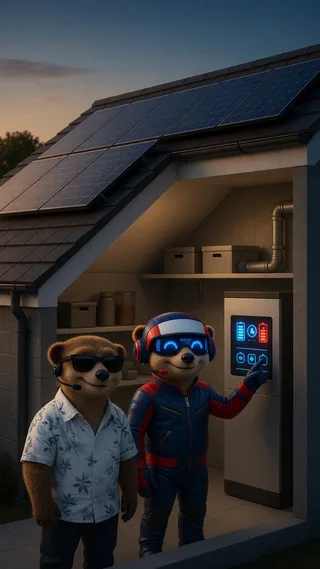
So it's just a big power bank? Almost - but the timing is the point
The phone power bank analogy is a decent starting point and RoboMo doesn't reject it outright. Both store energy and release it later. The difference is that a power bank exists for emergencies, while a home battery is a scheduled, daily part of how the house runs.
A home battery sits between your solar array, your consumer unit and the grid, with a system controller deciding second by second where energy should go. When the roof is producing more than the house is using, the surplus charges the battery. When the house needs more than the roof is producing, the battery discharges. When the battery is full and the sun is still shining, the surplus exports. When the battery is empty and it's dark, you draw from the grid as normal. Nothing dramatic happens at any point - that's rather the appeal.
The reason this matters is the shape of British household demand. UK homes are famously evening-heavy. The National Grid even plans around a phenomenon called 'TV pickup' - the surge that happens when millions of kettles switch on at the same moment, at the end of a popular broadcast. That's an extreme example, but the underlying pattern is real in individual homes too: we cluster our energy use into a few hours after work. A battery is designed around that cluster.
What happens when the battery runs empty?
Nothing alarming. The lights don't flicker and the house doesn't stop. When stored energy runs out, the system simply falls back to the grid, exactly as an unbatteried home would. Then, at first light, the cycle begins again.
This daily rhythm is the part people underestimate. A home battery isn't a one-off reserve you use and then mourn - it's a loop that runs every single day of the year, charging in daylight and discharging in the evening. Over a year that's hundreds of cycles, which is why battery chemistry, warranty terms and cycle life are worth reading carefully rather than skimming.
It's also worth knowing that the refill doesn't require a cloudless day. UK homes still generate useful solar power on overcast days - diffuse light through cloud absolutely produces output, just less of it. Winter charging is slower and shallower, and in the darkest months many batteries will not fill from solar alone. That's normal and expected. A battery earns most of its keep in spring, summer and autumn, and does a more modest job in December and January.
Size it to your evening use, not your roof
This is the single most useful line in the episode, and the one most often ignored. There's an instinct to match battery capacity to array size - big roof, big battery. But the battery's job is not to swallow everything the roof can make. Its job is to carry the house from sunset to sunrise.
If your household typically uses a modest amount of electricity between the evening meal and bedtime, a battery sized far beyond that will spend much of the year part-charged, doing nothing useful with the extra capacity you paid for. Oversizing is the most common and most expensive mistake in domestic storage. RoboMo's observation is deliberate: most homes need less than they expect.
The honest way to find your number is to measure rather than guess. Your smart meter in-home display, your energy supplier's app, or your solar monitoring platform will show consumption by half-hour. Look at what the house actually draws between roughly late afternoon and bedtime across a normal week - not a Christmas week, not a heatwave - and that figure is the realistic starting point for sizing. Then adjust for the things that will change: an EV arriving, a heat pump going in, a home office, a growing family. If you want a deeper guide, start with battery sizing before comparing products. The other half of the equation is charge and discharge power, not just capacity. A battery with plenty of stored energy but limited output power may not cover a high-demand moment such as an oven, kettle and immersion heater all at once. A good designer looks at both.
A practical battery sizing checklist
Work through these before you talk to anyone about capacity. Answering them honestly puts you in a far stronger position than any brochure.
- Measure your evening consumption. Pull a week of half-hourly data and identify what the house genuinely uses from late afternoon to bedtime.
- Separate the baseload from the peaks. Fridges, routers and standby draw run continuously; cooking and laundry are short spikes. Both matter, but they size different things.
- Audit your standby load. Idle appliances on standby waste a meaningful amount of household energy across a year. Reducing that costs nothing and shrinks the battery you need.
- Check your daytime surplus. If your household uses most of its solar as it's generated, there may be less surplus to store than you assume.
- Think about future loads. An EV or heat pump changes the picture significantly - plan for the house you'll have in five years, not just today's.
- Ask about usable capacity, not headline capacity. Not all of a battery's nameplate figure is available for daily cycling.
- Ask about physical siting. Location, ventilation, temperature and access all affect what can actually be installed, and where.
- Read the warranty properly. Look for cycle counts, retained capacity over time and what conditions apply.
- Confirm what happens in a power cut. Not every battery installation provides backup supply - if that matters to you, say so at the design stage.
- Get the design in writing. Capacity, power output, expected behaviour in summer and winter, and the assumptions behind the numbers.
Common follow-up questions
Do I need solar panels to have a battery? Not necessarily - a battery can be charged from the grid - but in this episode's context the battery exists to time-shift your own solar generation. Pairing the two is what makes the daily cycle work as described. If you're considering a battery without solar, the economics and use case are different.
Will a battery make me independent of the grid? No, and any claim otherwise deserves scepticism. A domestic battery covers a portion of a normal evening. It is a shift in where your evening energy comes from, not a disconnection from the network.
Does a battery help in winter? Less than in summer, and that's simply physics. Shorter days and lower light mean less surplus to store. Some homes use their battery differently in winter, but the solar-driven cycle described here is at its strongest in the lighter months. Isn't heat better for batteries? Not particularly, and while we're on the subject, a related and counterintuitive fact: solar panels actually generate more efficiently in cold weather than in hot weather. Bright, cold spring days are excellent producers. Sunshine is what panels need - not warmth. For the wider picture, read more about solar panel efficiency. What if my evening use is tiny? Then you may need a smaller battery than you were quoted, or you may find your money works harder elsewhere in the system. Knowing that before you buy is the entire point of measuring first. How long does it last? Manufacturers publish cycle life and capacity retention figures. Because a home battery cycles daily, these are among the most important numbers on the datasheet - ask for them and compare them across products rather than relying on a headline capacity figure. Our guide to battery lifespan explains what to look for.
Video transcript
Mo: The sun's gone down. So solar's finished? RoboMo: Not if you stored today's energy for tonight.
Mo: So it's just a big power bank? RoboMo: It moves your daytime solar into the evening, when the house actually wants it.
Mo: And when it's empty? RoboMo: Tomorrow's sunrise refills it. The same cycle, every single day. Mo: So how big should it be? RoboMo: Size it to your evening use, not your roof. Most homes need less than they expect. Mo: The sun's gone down. So solar's finished? RoboMo: Not if you stored today's energy for tonight. / Mo: So it's just a big power bank? RoboMo: It moves your daytime solar into the evening, when the house actually wants it. / Mo: And when it's empty? RoboMo: Tomorrow's sunrise refills it. The same cycle, every single day. / Mo: So how big should it be? RoboMo: Size it to your evening use, not your roof. Most homes need less than they expect. A home battery does one thing, and does it every day: it takes electricity your roof made when the house was empty, and hands it back when the house is full. That's a timing solution to a timing problem. Understand it that way and the important questions become obvious - how much do we use in the evening, how much surplus is there to capture, and what happens in the darker months. Understand it as a magic box that eliminates bills, and disappointment is more or less guaranteed. Measure your evening consumption, size the battery to that, ask hard questions about usable capacity and warranty, and you'll end up with a system that quietly does its job for years. Knowledge beats marketing, every time. If you'd like to know what a battery would realistically do in your home, the honest first step is a proper look at your roof, your usage pattern and your evening demand. You can compare home solar options, read more about how we approach residential solar design, or arrange a survey when you're ready - no pressure, and no assumptions about what you need until we've seen the numbers.
Plan, Compare & Buy Renewable Energy Solutions
AI does the thinking.
You get the perfect solar match.
Use RoboMo™ to assess your property, compare available technologies and connect with trusted UK installers, suppliers and manufacturers.
Simply enter your postcode, drop a pin on your roof, create your free account and let RoboMo™ analyse your property to find the best solar panels for your home.

You don't have to think
RoboMo™'s AI analyses your roof and does all the hard work.

Accurate & tailored
AI-powered assessment based on your roof, location, and conditions.

Best options, maximum savings
Compare top solar panels for the best performance and value.

Simple, fast & effortless
Provide a few details, sit back and watch your results unfold.
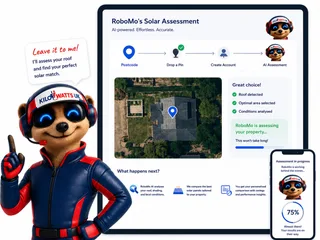
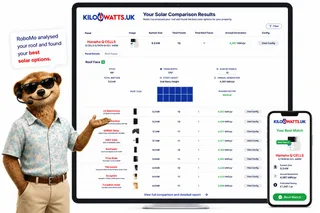
STEP 1
Choose Home, Business or Industrial
Enter your postcode to start your assessment.
STEP 2

Drop a pin on your roof
STEP 3

Create your free account
STEP 4

Sit back and watch RoboMo™ work
RoboMo™ analyses your roof and builds your personalised solar comparison.

Step 1
Enter your postcode
Start designing your wind energy system in seconds.
Are you an installer, distributor or renewable energy business?
Kilowatts UK is expanding the Flower Turbines partner network across the UK.
Become A Flower Turbines PartnerKilowatts UK is an authorised representative
Flower Turbines
Compact vertical-axis turbines built for real UK sites, not just open farmland.
They start in light wind, sit in a small footprint, and are bird-safe by design. Cluster them as a bouquet and the group performs better together than the same turbines standing alone. Enter your postcode for a location-based generation estimate. Figures use area weather data and will differ if buildings, trees or hills sit in the way.
Starts in light UK wind
Built to generate in typical UK wind, not only open farmland.
Small rooftop or ground footprint
Compact towers for roofs, yards and tight sites.
Bird-safe slow rotation
Slow vertical-axis spin, bird-safe by design.
Bouquet clusters raise output
Grouped turbines outperform the same units standing alone.
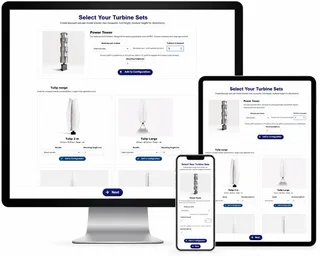
STEP 2

Choose a location
STEP 3
Place your cluster
Tap the map where you want the turbine cluster to go.
STEP 4

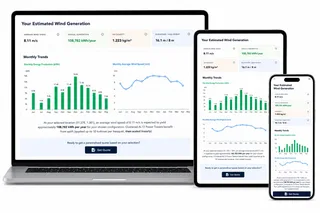
Instant generation forecasts
Compare different turbine layouts and see annual generation forecasts instantly.
STEP 5

No commitment required
Explore different configurations before deciding whether to request a quotation.
FAQ
Need Help? RoboMo's Got Answers
What does a home battery actually do?
A home battery stores electricity so you can use it later. In a solar home, it usually captures surplus daytime generation and releases it in the evening when the house is using more power. It does not create extra electricity; it changes when your electricity is available.
Will a battery let me use solar power after sunset?
Yes, if the battery has charged during the day. Your panels stop generating in darkness, but stored solar electricity can still be used later. Once the battery is empty, the home simply draws from the grid as normal.
How big should a home battery be?
A battery should usually be sized around your evening and overnight electricity use, not just the size of your solar panel system. A battery that is too large may spend much of the year underused. Check your smart meter or energy app for half-hourly usage before deciding on capacity.
Do I need solar panels to have a home battery?
Not necessarily. Some batteries can be charged from the grid, but the economics and purpose are different from storing your own solar power. If you do have solar panels, the battery’s main job is to keep more of your generated electricity in the home.
Will a home battery make me independent from the grid?
Usually, no. A typical domestic battery can cover part of your normal household demand, especially in the evening, but it is not the same as being off-grid. Most homes will still need the grid at times, particularly in winter or during high-use periods.
Does a home battery work in winter?
Yes, but it may have less solar energy to store. Shorter days and lower light levels mean many UK solar systems generate less surplus electricity in winter. The battery can still be useful, but the strongest solar-driven performance is often in spring, summer and autumn.
Will a home battery keep the power on during a power cut?
Not always. Some battery systems are installed only for normal self-consumption and will shut down during a power cut for safety reasons. If backup power matters to you, raise it at the design stage and ask exactly which circuits, if any, would be supported.
What should I check before buying a home battery?
Ask about usable capacity, charge and discharge power, warranty terms, expected cycle life and where the battery will be installed. Check whether the system suits your actual usage pattern rather than relying on a headline capacity figure. A good design should explain expected behaviour in summer and winter.