LinkedIn profile for David Coleman David Coleman
Founder & Renewable Energy Author, kilowatts.uk


LinkedIn profile for David Coleman David Coleman
Founder & Renewable Energy Author, kilowatts.uk
Article
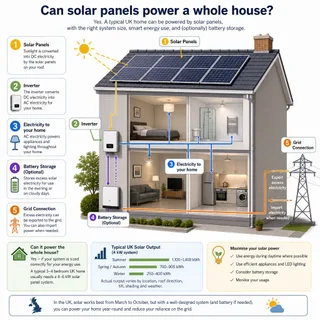
Discover the reality behind solar panels powering an entire house in the UK.
Discover the reality behind solar panels powering an entire house in the UK.
The short answer is unchanged. Solar panels can supply a useful share of a UK home's electricity, but they do not, on their own, power a whole house through the year. Daytime use in brighter months is where they do most of their work. Nights, dark winter weeks, and large loads still need the grid, or a battery that was charged earlier.
Late October is a useful moment to test that claim. Days are already short, and output is falling towards the winter low. Heating, cooking, and evening use often sit outside the hours when the array is producing. A battery can move some surplus from the middle of the day into the evening. It does not turn a typical roof into a year-round supply for the entire house.
What "whole house" means in a quote should be an annual figure, not a sunny afternoon. It depends on how much electricity you use, when you use it, how much unshaded roof you have, and whether storage is part of the design. An honest model shows summer, winter, and the share that still comes from the grid. If you are comparing designs, ask what share of your yearly electricity the system is expected to cover, and what December and January still look like. That is a clearer check than a headline promise of entire house coverage.
The update above is what has changed since then.
The following points are worth checking carefully.
Solar comparison
Enter your postcode to assess your roof, compare solar options and get quotes from UK installers.
Choose home, business or industrial, then enter your postcode. RoboMo maps the roof and ranks panel brands by fit.
1. Postcode Start the assessment for your property.
2. Pin the roof Mark the array on the map.
3. Compare RoboMo™ builds your options.
Battery ROI tool
Enter the day rate, off-peak rate and export rate. The calculator ranks batteries in the Kilowatts shop over 10 years. Home batteries also suit offices and small commercial sites.
Reading
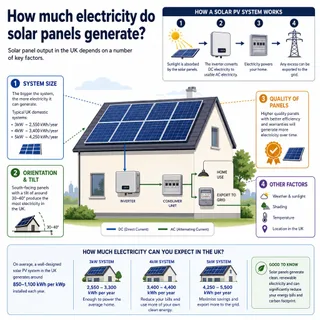
Discover how much electricity your solar panels can generate, and what factors affect their performance.
Read article
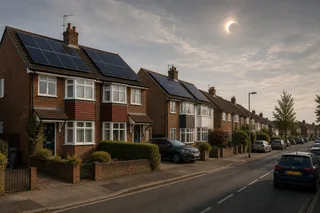
The solar eclipse will cause a sharp but temporary drop in solar generation across Great Britain as the Moon blocks sunlight from reaching solar panels.
Read article
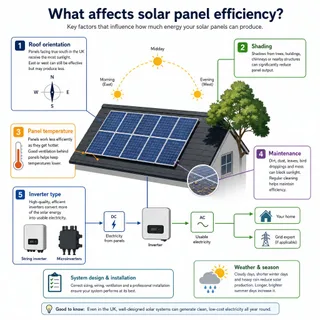
Discover what affects solar panel efficiency, from roof orientation to maintenance, and learn how to maximise your energy output with our expert guide.
Read article
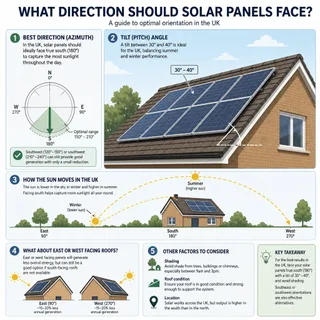
Discover why solar panel orientation matters in the UK and how to maximize your energy production with the right tilt angle and azimuth angle.
Read article
Write for Kilowatts.uk
Write it here under your own name. Sign in, put a profile up, and start a guide. Pay only if you want more links from your articles out to your own site.
Create a Kilowatts.uk account, or sign in if you already have one.
Put your name, photo and experience on a public author page.
Write a guide or a blog. Free authors can put one followed link to their own site in articles each month.
FAQ
Live help
Talk to RoboMo™ and get instant answers.
Live chat