


UCL's Four-Electron Iodine Battery Stores More Charge in Water Without Corrosive Halogens
Published: 2026-11-23 18:34:29
Updated: 2026-11-23 10:35:01
See how UCL's four-electron zinc–iodine battery delivered 1.1 Ah in a water-based pouch cell and what remains unknown for UK home storage.
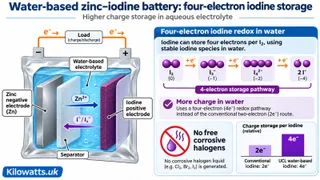
UCL’s four-electron iodine battery uses a halogen-free electrolyte
A UCL-led team demonstrated a rechargeable zinc–iodine battery with a water-based electrolyte made without added halogen compounds. The four-electron reaction doubles the theoretical charge iodine can store compared with the conventional two-electron reaction. A laboratory pouch cell delivered 1.1 ampere-hours (Ah) of charge. The positive electrode still contains iodine. How much usable energy and power an installed system could deliver, how long it would last and what it would cost in the UK remain open questions. UCL research announcement
How an iodine battery stores more charge in water
The electrolyte carries ions between the electrodes. In the conventional reaction, two electrons are transferred as a pair of iodine atoms moves between iodide and elemental iodine. The four-electron route adds a reversible step between elemental iodine and a positively charged form. Across both steps, four electrons are transferred per pair of iodine atoms, doubling the theoretical charge capacity per gram of iodine. The energy density of the whole cell also depends on its discharge voltage and the mass of the zinc, electrolyte, separator and packaging.
Positively charged iodine is difficult to stabilise in water. Earlier experiments used electrolytes containing concentrated chloride or bromide salts to keep it stable. The new formulation changes how water interacts with the molecules that bind positively charged iodine, so the reaction can reverse without those concentrated salts. Figure 1 of the paper compares the two approaches. Nature paper on the electrolyte mechanism
What the 1.1 Ah pouch cell tells us about output and lifespan
The pouch cell demonstrated the chemistry in a larger format. The 1.1 Ah figure measures the charge delivered under the test conditions. Calculating energy in watt-hours also requires knowing how the voltage changes during discharge. For an installed battery, usable kilowatt-hours (kWh) tell you how much energy it can supply, while continuous kilowatts (kW) tell you how much demand it can meet at once. Both figures matter when sizing a home battery. The team also demonstrated the chemistry in separate aluminium–iodine coin cells with an aluminium–zinc alloy negative electrode.
In separate zinc–iodine tests, cells retained 96% of their capacity after 1,000 cycles at 1 ampere per gram of iodine and 94% after 2,000 cycles at 2 amperes per gram. The Methods describe a fixture that restrained the pouch cell during testing, with no applied pressure reported. The team also found greater irreversible iodine loss at higher iodine loadings. A larger module would need to accommodate cell expansion and preserve capacity at practical iodine loadings. The cycling results are in Supplementary Figures 53–55 and the pouch-cell work is in Supplementary Figure 58. Nature paper and supplementary data
Could iodine batteries make stationary storage safer or cheaper?
A water-based electrolyte can reduce hazards associated with flammable solvents. Safety at pack level also depends on how the cells, enclosure and protection systems respond to faults such as an internal short circuit. UCL identifies larger-scale testing under realistic operating conditions as a next step. UCL announcement on safety and scale-up
The paper models potential savings from avoiding concentrated halogen-containing electrolytes and expensive current collectors. The authors set out their standardised assumptions in Supplementary Figure 58d–f and Supplementary Tables 3 and 4. A UK installed price would also depend on manufacturing, module assembly, power conversion, installation and servicing. Running costs would depend on measured round-trip efficiency, the share of charging energy the system returns, and how usable capacity changes with temperature and age. A verified UK installed price, warranty and launch date remain unknown. Nature supplementary cost analysis
What the research means for UK homes, balconies and businesses
Stationary storage is a plausible use because a fixed installation can often accommodate more weight and volume than a vehicle. At grid scale, batteries could store surplus wind and solar generation for later use. For a household or business, the economics depend on when electricity is generated and used, what imported electricity costs and how much the site earns for surplus exports. Homeowners can use these figures to estimate battery payback for systems available today. UCL announcement on stationary storage applications
If you already have solar panels, compare daytime exports with evening imports using half-hourly data where available. When adding storage to existing solar, ask whether your inverter supports a compatible battery and whether the retrofit quote includes a separate battery inverter. If you need backup during a power cut, ask which circuits the system can supply and what continuous output it can deliver in that mode.
For balcony solar, check shading and usable panel area before estimating how much surplus electricity could charge a battery. Ask your landlord or freeholder about consent and check the proposed mounting and location with your local planning authority. In England, Schedule 2, Part 14 of the Town and Country Planning (General Permitted Development) (England) Order 2015 sets out conditions for permitted development. Check the relevant local rules elsewhere in the UK. Ask the installer or supplier how the equipment can be secured and where it can be safely located. For a farm or business, review the site’s load profile before sizing storage. Starting machinery can require a brief surge in power. Covering several hours of overnight demand takes enough usable energy to last through that period. If you’re also planning to generate electricity on site, you can use the same load profile to compare solar installations for businesses. Give each installer the same demand data and ask them to specify usable kWh, continuous and short-duration output in kW, how round-trip efficiency was measured and any limits on energy throughput in the warranty.
Solar comparison
Compare solar for your property
Enter your postcode to assess your roof, compare solar options and get quotes from UK installers.
- Free postcode start
- Home, business and industrial
- RoboMo™ maps your roof
See which panels fit your roof
Choose home, business or industrial, then enter your postcode. RoboMo maps the roof and ranks panel brands by fit.
1. Postcode Start the assessment for your property.
2. Pin the roof Mark the array on the map.
3. Compare RoboMo™ builds your options.

Battery ROI tool
See what a battery saves on your bill
Enter the day rate, off-peak rate and export rate. The calculator ranks batteries in the Kilowatts shop over 10 years. Home batteries also suit offices and small commercial sites.
Reading
Sources and further reading
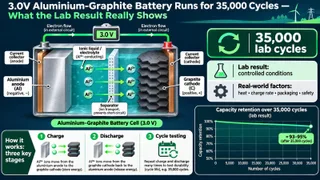
See why 3.0 V is the charge cut-off, how aluminium-graphite battery capacity fell over 35,000 lab cycles and what UK storage buyers still need to know.
Read article
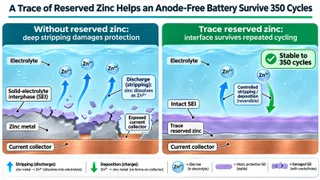
An anode-free zinc pouch cell retained 90.47% of its capacity after 350 lab cycles. See how the zinc reserve helps and what UK solar storage buyers need.
Read article
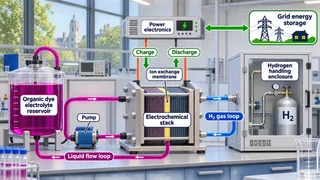
See how Imperial’s hydrogen–organic flow battery uses a dissolved compound to store energy and what UK grid pilots still need to prove about efficiency.
Read article
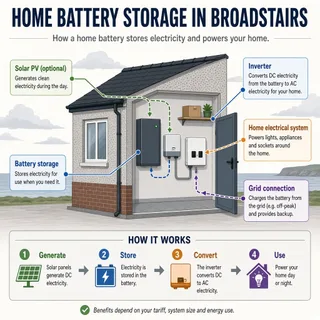
Home battery storage in Broadstairs depends on usable kWh, salt-air siting and UK Power Networks paperwork. Backup is not automatic in a power cut.
Read article



Mo's Solar Mission
Mo's Mission Nominations
Garlinge Primary School and Nursery
Garlinge Primary School and Nursery is a foundation primary school on Westfield Road in Margate, Kent, for children aged 3 to 11. It is m...
St Luke's Church of England Primary SchoolSt Luke's Church of England Primary School is a voluntary controlled Church of England primary school on Jubilee Road in Formby, Merseysi...
Comberbach Nursery and Primary SchoolComberbach Nursery and Primary School is a primary academy on Mather Drive in the village of Comberbach, near Northwich in Cheshire, for...
Locations
Solar installation near you
Write for Kilowatts.uk
Got a trade and something worth saying?
Write it here under your own name. Sign in, put a profile up, and start a guide. Pay only if you want more links from your articles out to your own site.
Register
Create a Kilowatts.uk account, or sign in if you already have one.
Author profile
Put your name, photo and experience on a public author page.
Start creating
Write a guide or a blog. Free authors can put one followed link to their own site in articles each month.
FAQ
Need Help? RoboMo's Got Answers
Can I buy UCL’s zinc–iodine battery for my home in the UK?
The UCL team demonstrated the technology in laboratory cells. A UK launch date, installed price and warranty remain unconfirmed. If you’re buying storage now, compare quotes for systems you can actually have installed.
Does the four-electron reaction mean the battery stores twice as much energy?
The reaction doubles the theoretical charge that each gram of iodine can store compared with the conventional two-electron reaction. The energy stored by a complete battery also depends on its discharge voltage and how much of the battery’s weight comes from zinc, electrolyte and other components.
What does the 1.1 Ah result tell me about powering my home?
The 1.1 Ah figure measures the electrical charge delivered by a laboratory pouch cell under test conditions. Calculating energy in watt-hours also requires knowing the voltage during discharge. When comparing home batteries, check usable capacity in kWh for how long your appliances could run and continuous output in kW for how much demand the battery can meet at once.
Does a water-based electrolyte make this battery safer?
A water-based electrolyte can reduce hazards associated with flammable solvents. The electrolyte was made without added halogen compounds, while the positive electrode still contains iodine. The safety of a complete battery pack depends on how its cells, enclosure and protection systems respond to faults.
What do the cycling tests tell us about how long it might last?
In one laboratory test, zinc–iodine cells retained 94% of their capacity after 2,000 cycles. The result applies to those cells at the tested current and leaves the service life of a home battery system uncertain. When comparing products, check the warranted capacity after a specified period and any limits on total energy delivered under the warranty.
Could zinc–iodine batteries make home storage cheaper?
The researchers modelled potential savings on electrolyte and other cell materials. A UK installed price would also depend on manufacturing, the inverter and installation. Any savings on electricity bills would depend on system efficiency, when you charge and discharge, and the difference between your import and export rates.
What should I check before adding a battery to my existing solar panels?
Compare your daytime solar exports with your evening electricity imports, using half-hourly data if available. Ask whether your existing inverter supports a compatible battery and whether the quote includes a separate battery inverter if needed. If you want backup during a power cut, ask which circuits the battery can power and how much continuous output it can deliver in backup mode.
Live help
Need help right now?
Talk to RoboMo™ and get instant answers.