
LinkedIn profile for David Coleman David Coleman
Founder & Renewable Energy Author, kilowatts.uk

LinkedIn profile for David Coleman David Coleman
Founder & Renewable Energy Author, kilowatts.uk
Article
Great Britain has confirmed Phase 1a tariff API rules. See the November code change, planned February 2027 launch and what appliance owners should check.
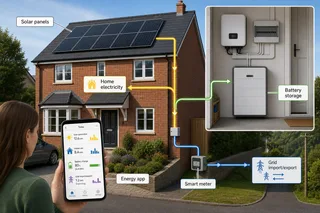
Illustration of a home energy system; it does not depict a product or installation announced in this article.
Published 5 November 2026. The announcement was published by DESNZ on 30 October; dates below distinguish the code change from the planned service launch.
Great Britain has confirmed the technical rules for sharing electricity tariff prices in a consistent digital format. The aim is to help services such as smart EV charging and heat-pump controls respond to prices without each supplier and appliance maker having to invent a different connection.
That is useful groundwork for home energy automation. It does not mean every charger or heat pump will automatically start following every tariff this month.
The DESNZ decision notice, published on 30 October 2026, says the Retail Energy Code modifications take effect on 6 November 2026. The planned Phase 1a go-live date is 18 February 2027. These arrangements apply to England, Scotland and Wales.
The earlier date incorporates the final technical requirements into the industry code. The later date is the planned implementation milestone. Neither date should be used on its own to promise that a particular product, supplier or household account will be ready.
An API is a defined way for one piece of software to request information from another. In this case, the information is tariff pricing. A consistent format helps an energy service interpret prices and pass them to a compatible control system.
Phase 1a concerns public tariff information. It should not be confused with permission to read a customer's private account or with a command that remotely controls an appliance. A useful household service still has to combine the right price data with the chosen equipment, settings and permissions.
The Retail Energy Code Company's update, dated 29 October, describes compressed responses, checks for changed data without downloading it again, corrections to data definitions and permanent references replacing temporary ones. These are implementation details, but they help reduce avoidable differences between systems.
For a homeowner, the useful question is whether the service works reliably with the actual tariff and appliance, including after a supplier change. A standards announcement is a reason to ask that question; it is not evidence that every manufacturer's integration has passed testing.
A charger can potentially move a flexible charging session into cheaper periods. A heating control has a different constraint: comfort and hot-water needs still matter. The cheapest price interval is not automatically the right time for every household activity.
Battery owners also need to consider the value of exporting electricity, charging losses and the limits of their equipment. A price-data standard does not calculate those trade-offs on its own, and it cannot guarantee a saving for a particular home.
Keep a copy of the compatibility information supplied with a quote. When comparing systems, judge the service that is available and documented today, then treat future integration plans separately. An advertised roadmap can be useful, but it should not carry the same weight as a working feature with clear support terms.
Solar comparison
Enter your postcode to assess your roof, compare solar options and get quotes from UK installers.
Choose home, business or industrial, then enter your postcode. RoboMo maps the roof and ranks panel brands by fit.
1. Postcode Start the assessment for your property.
2. Pin the roof Mark the array on the map.
3. Compare RoboMo™ builds your options.

Battery ROI tool
Enter the day rate, off-peak rate and export rate. The calculator ranks batteries in the Kilowatts shop over 10 years. Home batteries also suit offices and small commercial sites.
Reading

Navien and Passiv's PEM750 package claims a 17% COP gain from smart control. It is not a guaranteed bill cut, and software cannot fix poor commissioning.
Read article

Home battery prices vary by kWh, chemistry and whether install is included. Compare live shop prices rather than a single headline figure.
Read article
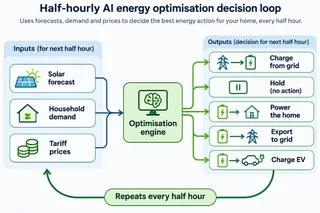
Discover how SolarMind uses AI to optimise solar panels, home batteries and EV charging, and whether it could help reduce your energy bills.
Read article
Read article
Write for Kilowatts.uk
Write it here under your own name. Sign in, put a profile up, and start a guide. Pay only if you want more links from your articles out to your own site.
Create a Kilowatts.uk account, or sign in if you already have one.
Put your name, photo and experience on a public author page.
Write a guide or a blog. Free authors can put one followed link to their own site in articles each month.
FAQ
Live help
Talk to RoboMo™ and get instant answers.
Live chat