


Can West Midlands Factories Share a Grid Connection? National Grid's Cradley Heath Pilot Explained
Published: 2026-11-23 17:37:27
Updated: 2026-11-23 09:38:07
See how West Midlands factories could share grid connection costs and what flexible import limits could mean for production at Cradley Heath.
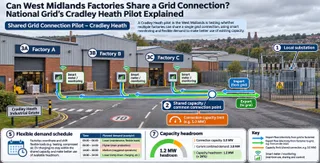
Can West Midlands factories share a grid connection?
Neighbouring West Midlands factories could share the cost of grid works needed to meet extra electricity demand. National Grid Electricity Distribution (NGED) is exploring this in Cradley Heath. Whether the factories use one physical connection or keep separate connections depends on the design NGED assesses. Each factory needs to know what it would pay, how much power it could rely on during production and what would happen if another participant changed its plans. NGED partnership announcement, 16 November 2026
Cradley Heath is the first project in a multi-year programme involving NGED, the West Midlands Combined Authority, Worcestershire County Council and Black Country Industrial Cluster. The wider programme will explore flexible connections, storage and ways to share locally generated electricity. Further work is planned in areas including Warndon in Worcester. As of 23 November 2026, public announcements had given no connection design, confirmed additional capacity, price per factory or energisation date for Cradley Heath. NGED partnership announcement
What could manufacturers share at Cradley Heath?
NGED will look at expected growth and electricity demand to see where nearby businesses could share the cost of connecting new demand. How they split the bill is a commercial decision. The electrical design would show where each site connects, where its import is measured, who owns and maintains common equipment and what controls each factory needs. If the factories share a supply point, ask how each site’s use would be metered and billed. NGED partnership announcement
Start with each factory’s agreed import capacity. Line up the factories’ half-hourly readings by date and time, then add the expected loads from new equipment and shifts. For example, if Factory A averages 400 kW and Factory B averages 300 kW in the same half-hour, their combined demand is 700 kW. If they stagger those loads, Factory A might average 400 kW while Factory B averages 100 kW, then drop to 200 kW in a later half-hour when Factory B averages 300 kW. Combined demand is then 500 kW in each period. If all other intervals are lower, staggering the loads cuts the combined half-hourly peak from 700 kW to 500 kW. NGED would still need to assess the actual load profile and available capacity on the local network.
Half-hourly data shows when sustained loads overlap. Shorter-interval readings and equipment specifications help an electrical designer assess brief events, such as motor starts, that half-hourly averages can hide. If the meter records energy in kWh per half-hour, double the reading to get the average demand in kW for that period. Where connection capacity is given in kVA or MVA, the designer also needs power-factor data to assess how much apparent power the proposed loads would draw.
How would flexible grid access affect a production shift?
A flexible import connection can allow NGED to limit how much electricity a factory draws under the terms of its connection offer. This is called curtailment. Limits can be fixed or dynamic, depending on the offer. Ask how much power would remain available during a restriction, how much notice the site would get and how often and for how long limits could apply. NGED guidance on alternative connections
For dynamic limits, ask where import would be measured, how the site would receive a new limit, which energy management controls would respond and what would happen if communications failed. Fleet charging may be easy to pause if vehicles have time before departure. A heat-treatment line may need to finish a cycle or shut down in stages. Add the demand from essential services to the power needed for a controlled shutdown and check whether the total fits within the proposed import limit.
A battery can cover a temporary shortfall if it can deliver enough power in kW and has enough usable energy in kWh to last through the restriction. Check how much charge the battery is likely to have when a restriction begins and when it could recharge without creating another peak. Rooftop solar can reduce imports when generation coincides with production. Assess both against actual shift patterns and the proposed restriction windows.
How do shared costs compare with a firm or flexible connection?
An individual firm connection gives each factory a benchmark for cost, timing and agreed import capacity. A cost-sharing agreement sets out who pays for the works. A flexible connection offer sets out how much power a site can draw and when limits apply. A joint proposal could include flexible access, so check the cost split and import terms separately.
What could the pilot cost, and how much capacity could it add?
The Network Innovation Allowance funds the Cradley Heath project. NGED also said it would seek Strategic Innovation Fund support with Black Country Industrial Cluster to develop and test ideas with industry. A factory’s contribution to the connection works would depend on the design and commercial terms it is offered. Businesses still need those details to budget for the works and schedule an expansion. NGED partnership announcement
Ask for separate estimates for network works and changes within the factory boundary, such as switchgear, metering, communications and controls. If several businesses are involved, check how they would divide costs and capacity if one delays its expansion, withdraws after design work starts or needs more power later. Ask which milestones depend on everyone committing and how a change could affect the energisation date.
What should a factory prepare before approaching NGED?
Prepare a demand brief with your agreed import capacity, half-hourly readings, proposed equipment, commissioning dates and the loads you can defer or reduce. Give your electrical designer the equipment specifications and any readings that capture brief peaks. Ask them to check transformer and switchgear ratings, space for new equipment and possible cable routes. If you lease the site or cables could cross a neighbour’s land, establish who can grant access and who would maintain any shared equipment. If you plan to add solar, ask the designer whether a G99 application for generation would be needed.
Use the same brief when asking NGED about an individual upgrade, a joint proposal and flexible import. Compare how much power each option would give you during your busiest shift, when it would be available, what it would cost and what you would be responsible for if plans changed. If the proposal includes solar or battery storage, ask a commercial specialist to model it against your measured demand and proposed import limits before including it in the business case. Use the same demand data when comparing factory solar installations.
Solar comparison
Compare solar for your property
Enter your postcode to assess your roof, compare solar options and get quotes from UK installers.
- Free postcode start
- Home, business and industrial
- RoboMo™ maps your roof
See which panels fit your roof
Choose home, business or industrial, then enter your postcode. RoboMo maps the roof and ranks panel brands by fit.
1. Postcode Start the assessment for your property.
2. Pin the roof Mark the array on the map.
3. Compare RoboMo™ builds your options.

Battery ROI tool
See what a battery saves on your bill
Enter the day rate, off-peak rate and export rate. The calculator ranks batteries in the Kilowatts shop over 10 years. Home batteries also suit offices and small commercial sites.
Reading
Sources and further reading
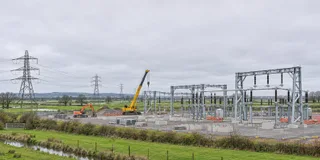
Main works are underway on the 400 kV grid connection for Agratas’s Somerset battery gigafactory. See how it will meet 350 MW of campus demand.
Read article
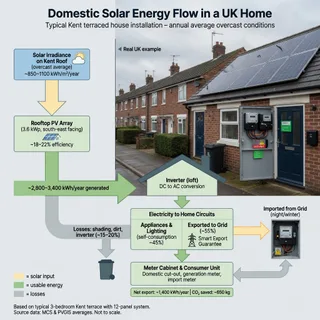
A UKPN grid connection for Kent solar is G98 or G99 permission to run in parallel, not a tariff or planning decision. Check the DNO, MPAN and export cap.
Read article
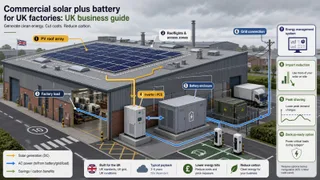
See when commercial solar plus a battery fits a UK factory: shift timing, export caps and connection headroom. A standard battery is not backup power.
Read article
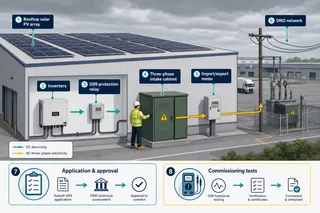
UK business guide · B Solar · G99 / export limitation
Read article


Mo's Solar Mission
Mo's Mission Nominations
Garlinge Primary School and Nursery
Garlinge Primary School and Nursery is a foundation primary school on Westfield Road in Margate, Kent, for children aged 3 to 11. It is m...
St Luke's Church of England Primary SchoolSt Luke's Church of England Primary School is a voluntary controlled Church of England primary school on Jubilee Road in Formby, Merseysi...
Comberbach Nursery and Primary SchoolComberbach Nursery and Primary School is a primary academy on Mather Drive in the village of Comberbach, near Northwich in Cheshire, for...
Locations
Solar installation near you
Write for Kilowatts.uk
Got a trade and something worth saying?
Write it here under your own name. Sign in, put a profile up, and start a guide. Pay only if you want more links from your articles out to your own site.
Register
Create a Kilowatts.uk account, or sign in if you already have one.
Author profile
Put your name, photo and experience on a public author page.
Start creating
Write a guide or a blog. Free authors can put one followed link to their own site in articles each month.
FAQ
Need Help? RoboMo's Got Answers
Does the Cradley Heath pilot mean factories will use a single grid connection?
National Grid Electricity Distribution (NGED) is exploring whether nearby factories could share the cost of grid works needed to meet extra demand. Whether they use one physical connection or keep separate connections depends on the design NGED assesses. If they use a common supply point, each business should check how its electricity use would be metered and billed.
How much extra capacity could the pilot provide, and when could factories use it?
As of 23 November 2026, the public announcements gave no confirmed connection design, additional capacity or date for energising the connection. Each factory would need to know how much import capacity it could rely on during its busiest shifts before planning an expansion around the pilot.
Who would pay for shared grid works?
The Network Innovation Allowance funds the pilot project. Each factory’s contribution to connection works would depend on the design and commercial terms, and no price per factory had been announced as of 23 November 2026. Ask how costs would be split, who would cover overruns and what would happen if a participant withdrew.
Could staggering production shifts reduce the grid capacity factories need?
Yes, if the factories can move some of their largest electrical loads so they run at different times. Comparing half-hourly meter readings for the same dates and times shows where demand overlaps. An electrical designer should also check brief peaks, such as motor starts, which half-hourly averages can hide.
How could a flexible grid connection affect a production shift?
A flexible connection can allow NGED to limit how much electricity the factory draws under the terms of its offer. Ask how much power would remain available, how much notice you would get and how long restrictions could last. Check whether the remaining capacity can cover essential services and allow production equipment to finish a cycle or shut down safely.
Can rooftop solar or a battery reduce the need for extra grid capacity?
Rooftop solar can reduce grid imports when it generates at the same time the factory needs power. A battery can cover a temporary shortfall if it can deliver enough power and has enough usable charge for the full restriction. Assess both against measured demand, shift patterns and any proposed import limits.
What should a factory prepare before asking NGED about an upgrade?
Gather your agreed import capacity, half-hourly meter readings, details of new equipment and expected commissioning dates. Identify which loads you can move or reduce and which must keep running. Use the same information to compare an individual upgrade, a joint proposal with neighbours and a flexible connection offer.
Live help
Need help right now?
Talk to RoboMo™ and get instant answers.