


Why a Bigger Solar System Often Makes Sense in the UK
Published: 2026-08-22 23:57:30
Updated: 2026-10-06 12:55:57
If twenty panels fit, why fit ten? A practical UK guide to sizing solar for decades of generation, plus the limits that decide how big you can go.
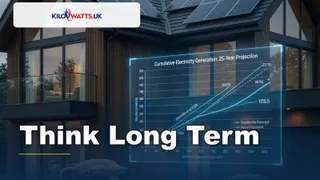
Why a Bigger Solar System Often Makes Sense in the UK
If twenty panels fit, why fit ten? A practical UK guide to sizing solar for decades of generation, plus the limits that decide how big you can go.
Why a Bigger Solar System Can Make Sense
Most people arrive at solar with a number already in their head, ten panels, or whatever the neighbour had. The more useful question is the one Mo asks in this episode: if twenty panels fit the roof, why fit ten? Empty but suitable roof space isn't neutral. It's generation that never happens, every day, for as long as the rest of the array is working. That's the honest search intent behind "should I get a bigger solar system": you're not asking whether more panels produce more power (obviously they do), you're asking whether the extra panels are worth it once you account for how much of that energy you'd actually use, what it costs to add them at the same time as everything else, and what physically limits the size of a domestic array in the UK. This article works through all of that, sizing logic, the real constraints, where surplus generation goes, and a decision checklist you can take into a survey conversation. No pressure, no promises, just the engineering.
What "bigger" actually means on a British roof
A bigger system doesn't mean covering every tile. It means filling the roof space that is genuinely suitable, the planes with reasonable orientation, sensible pitch, no persistent shading, and enough structural headroom. South-facing is the classic ideal, but east and west planes are widely used in the UK because they spread generation across the morning and evening rather than concentrating it at midday, which can suit household demand patterns rather well. North-facing planes are usually left alone. The distinction matters because "twenty panels will fit" and "twenty panels are worth fitting" aren't the same statement. A good survey separates the two: total roof area, then usable roof area, then the array that can actually be installed with proper spacing, access and fixings. Once you know the usable figure, leaving half of it bare should be a deliberate decision, not an accident of the first quote you happened to receive.
The marginal panel is rarely the expensive one
This is the part most homeowners don't see from a headline quote. A solar installation isn't a stack of identical costs that scale neatly with panel count. A significant share of the work is fixed regardless of size: the site survey and design, scaffolding erection and hire, the roof access itself, running cabling to the inverter position, the inverter and isolation equipment, the electrical connection at the consumer unit, testing, certification and paperwork. Those happen once. Adding panels on the same roof plane, on the same day, with the scaffold already up, adds mounting rails, modules, a little more cabling and a little more labour. That's why the twentieth panel typically carries a very different cost profile from the first, and why coming back in three years to extend an array is usually the more expensive route, because you pay the fixed costs a second time and inherit whatever compatibility constraints the original inverter imposes. None of this makes a bigger system automatically right. It simply means the comparison should be like-for-like across a full lifetime, not a straight comparison of two up-front numbers.
Decades, not seasons: why lifetime value is the right lens
RoboMo's line is the whole argument in one sentence: the extra panels can keep generating value for decades. Solar has no moving parts in the array itself, and modules are designed for a long service life with gradual, predictable output decline rather than sudden failure. Inverters are the component most likely to need replacing during that period. So when you weigh up whether to fill the roof, you're not comparing a cost against one year of savings, you're comparing it against a very long run of daily generation. That's also why sizing decisions deserve more thought than component brand debates. A slightly different panel model changes output at the margins. A roof that's half empty changes it structurally, every single day, forever. Judge the system on what it produces across its life, and the arithmetic of "why ten if twenty fit" starts to look less like upselling and more like basic design sense.
British weather is a better argument for capacity than against it
There's a persistent belief that solar only works properly in bright sunshine, which quietly encourages people to under-size. Two facts push the other way. First, UK homes still generate useful solar power on overcast days, panels respond to diffuse light, not only direct beam, so a grey Tuesday in March is a lower output day, not a zero output day. Second, solar panels generate more efficiently in cold weather than in hot weather; module efficiency falls as cell temperature rises, which is why a crisp, bright winter day can perform better per unit of sunlight than a sweltering August afternoon. Put those together and the British climate looks less like a reason to be timid and more like a reason to have enough capacity to make the mediocre days count. On the brightest days almost any array will do something impressive. It's the ordinary overcast days, the majority of the year, where extra capacity quietly earns its keep.
What genuinely limits how big you can go
Bigger isn't unlimited, and a good installer will tell you where the ceiling is. Roof geometry and shading come first: chimneys, dormers, vent stacks, satellite dishes and neighbouring trees all remove usable area or introduce shade patterns that need designing around. Structure matters too, the roof must be sound and capable of carrying the additional load, which is part of what a survey checks. Then there's the electrical side: understanding solar inverter basics helps, because the inverter has to be matched sensibly to the array, and there are network operator requirements for connecting domestic generation, with larger installations needing prior approval from the distribution network operator rather than simple notification. Your installer should handle that application and confirm what applies at your address. Planning is usually straightforward for roof-mounted domestic solar, but listed buildings and conservation areas have their own rules, so those need checking rather than assuming. Finally, budget is a legitimate constraint, the point of this article isn't that everyone should max out their roof, it's that the decision should be informed rather than inherited from a default quote.
Where the extra generation actually goes
More capacity is only useful if the energy has somewhere to go, so it's worth being clear about the three destinations. The first and most valuable is direct self-consumption: anything the house uses while the sun is up. That includes the invisible baseload most homes never think about, standby mode on idle appliances wastes a meaningful amount of household energy, and it draws that power all day, quietly soaking up generation. The second is storage: a battery shifts midday surplus into the evening, which is exactly when most UK households actually use electricity, and it's the main reason larger arrays pair naturally with batteries. The third is export, sending surplus to the grid under whatever export arrangement your supplier offers. The mix matters for sizing. A household that's out all day with no battery converts a smaller share of generation into direct savings than one that heats water electrically, charges an EV at home or runs a heat pump. If you're planning an EV, it's worth knowing that a typical EV range vastly exceeds the average daily journey, so most home charging is topping up rather than filling, a pattern that fits daytime solar generation well.
A practical sizing checklist before you commit
Work through these before signing anything. 1) Ask for the usable roof area, not just the proposed panel count, how many panels would physically and sensibly fit on each suitable plane? 2) Ask why the proposed array is smaller than that maximum, if it is. There may be a good reason; you want to hear it. 3) Get the cost difference between the proposed system and a fuller array, so you can see how the marginal panels are priced rather than guessing. 4) Check inverter headroom, is it sized so the array could be extended later, or is this the ceiling? 5) Establish your daytime baseload and whether a battery is planned now or later, because that changes how much generation you'll self-consume. 6) Flag future loads honestly: EV, heat pump, home working, an extension. Sizing for today's consumption alone is the most common regret. 7) Confirm who handles the network operator application and what approval your proposed size requires. 8) Confirm scaffolding, structural checks and roof condition are in the quote, since those are the fixed costs you'd pay again on a later extension. 9) Compare quotes on lifetime generation and specification, not just the number at the bottom. 10) If in doubt, ask both versions to be quoted, the array you asked for, and the array the roof would take.
Follow-up questions people usually ask next
Can I add panels later? Often yes, but it depends on inverter capacity, available roof space and the original design. You'll also repeat fixed costs such as scaffolding and access, which is why it's cheaper to make the decision once. Does a bigger array need a bigger battery? Not necessarily, they solve different problems. The array determines how much you generate; the battery determines how much of it you use after dark. Size them against your actual evening consumption. Will a bigger system damage my roof? A properly surveyed and installed array shouldn't, which is exactly why the structural assessment is part of the survey rather than an optional extra. What if I move house? Solar becomes part of the property, and a well-documented, properly certified installation with full paperwork is easier to hand over than an undocumented one, keep your certification and commissioning documents somewhere safe. Is it worth filling a shaded roof plane? Usually not on shading alone; the design should route around persistent shade rather than pretend it isn't there. And what about export, should I size for it? Export is a bonus, not the business case. Size primarily for what your household will use, then treat surplus as sensible headroom.
Video transcript
Mo: Why put ten panels here if twenty will fit? RoboMo: The extra panels can keep generating value for decades.
Mo's question isn't a sales line, it's a design principle. Roof space that is genuinely suitable and left empty produces nothing for as long as the rest of the system produces something, and that's a very long time. The costs that scale with panel count are the smaller part of a solar installation; the survey, scaffolding, access, inverter and electrical work largely happen once. Add to that the reality that UK panels still generate on overcast days and perform efficiently in the cold, and the case for sizing properly the first time becomes straightforward engineering rather than persuasion. That doesn't mean everyone should fill their roof. Shading, structure, network approval, household demand and budget are all legitimate reasons to stop short. It does mean the size of your system should be a decision you made on purpose, with the maximum sensible array in front of you as a reference point, rather than a number someone else assumed you wanted.
If you're weighing up how much of your roof is genuinely worth using, a proper survey is the honest way to find out. It should tell you the usable area, the constraints, and what the fuller array would actually cost alongside the smaller one. You can read how residential solar installation works, compare options at your own pace, or book a survey when you're ready. No pressure either way.
Plan, Compare & Buy Renewable Energy Solutions
AI does the thinking.
You get the perfect solar match.
Use RoboMo™ to assess your property, compare available technologies and connect with trusted UK installers, suppliers and manufacturers.
Simply enter your postcode, drop a pin on your roof, create your free account and let RoboMo™ analyse your property to find the best solar panels for your home.

You don't have to think
RoboMo™'s AI analyses your roof and does all the hard work.

Accurate & tailored
AI-powered assessment based on your roof, location, and conditions.

Best options, maximum savings
Compare top solar panels for the best performance and value.

Simple, fast & effortless
Provide a few details, sit back and watch your results unfold.
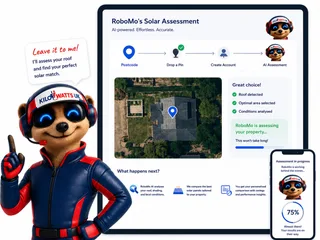

STEP 1
Choose Home, Business or Industrial
Enter your postcode to start your assessment.
STEP 2

Drop a pin on your roof
STEP 3

Create your free account
STEP 4

Sit back and watch RoboMo™ work
RoboMo™ analyses your roof and builds your personalised solar comparison.

Step 1
Enter your postcode
Start designing your wind energy system in seconds.
Are you an installer, distributor or renewable energy business?
Kilowatts UK is expanding the Flower Turbines partner network across the UK.
Become A Flower Turbines PartnerKilowatts UK is an authorised representative
Flower Turbines
Compact vertical-axis turbines built for real UK sites, not just open farmland.
They start in light wind, sit in a small footprint, and are bird-safe by design. Cluster them as a bouquet and the group performs better together than the same turbines standing alone. Enter your postcode for a location-based generation estimate. Figures use area weather data and will differ if buildings, trees or hills sit in the way.
Starts in light UK wind
Built to generate in typical UK wind, not only open farmland.
Small rooftop or ground footprint
Compact towers for roofs, yards and tight sites.
Bird-safe slow rotation
Slow vertical-axis spin, bird-safe by design.
Bouquet clusters raise output
Grouped turbines outperform the same units standing alone.


STEP 2

Choose a location
STEP 3

Place your cluster
Tap the map where you want the turbine cluster to go.
STEP 4

Instant generation forecasts
Compare different turbine layouts and see annual generation forecasts instantly.
STEP 5

No commitment required
Explore different configurations before deciding whether to request a quotation.
FAQ
Need Help? RoboMo's Got Answers
Should I fit as many solar panels as my roof can take?
Not automatically. The sensible maximum is the amount of suitable roof space with good orientation, limited shading, sound structure and a design that works electrically. If that maximum is larger than your first quote, it is worth asking why the smaller system has been proposed and what the fuller option would cost.
Why can a bigger solar system be better value than adding panels later?
Many installation costs happen once, such as survey work, scaffolding, roof access, cabling routes, electrical connection, testing and paperwork. Adding extra panels during the same installation often adds less cost than returning later. A later extension may also be limited by the original inverter, roof layout and connection arrangements.
Will extra panels be wasted if I do not use all the electricity during the day?
Not necessarily, but self-consumption matters. Solar electricity can be used directly in the home, stored in a battery for later, or exported to the grid under an arrangement offered by your electricity supplier. A larger array tends to make more sense if you have daytime usage, a battery, an EV, a heat pump, home working or future electrical loads planned.
Does a bigger solar array always need a bigger battery?
No. The solar array controls how much electricity you generate, while the battery controls how much surplus you can shift into the evening or night. Battery size should be based on your actual usage pattern, budget and aims, not simply matched panel-for-panel with the roof.
Do UK solar panels work well enough in cloudy weather to justify a larger system?
Yes, solar panels still generate useful electricity in overcast conditions, although output is lower than on bright days. UK weather is one reason capacity can matter, because extra panels help improve generation on ordinary grey days. Cold, bright weather can also be favourable because panels generally operate more efficiently when they are cooler.
What limits the size of a domestic solar system in the UK?
The main limits are usable roof area, orientation, shading, roof condition, structural suitability and the electrical design. Larger systems may also require the correct distribution network operator process before connection, which your installer should explain and handle where applicable. Listed buildings, conservation areas and other planning constraints should be checked rather than assumed.
Is it worth putting panels on a shaded or north-facing roof plane?
Persistent shading usually reduces the case for using that roof area, and a good design should work around it rather than ignore it. North-facing planes are often less attractive for domestic solar in the UK, though every roof should be assessed on its own geometry and shading. The key question is not what physically fits, but what is genuinely worth installing.
What should I ask an installer before choosing the size of my solar system?
Ask how many panels would sensibly fit on each suitable roof plane and why the proposed design is smaller, if it is. Ask for the cost difference between the smaller array and the fuller array, including scaffolding, electrical work and any battery option. Also confirm inverter sizing, future expansion limits, roof checks, paperwork and who deals with any network operator requirements.