Founder & Renewable Energy Author, kilowatts.uk


Founder & Renewable Energy Author, kilowatts.uk
Article
Ofgem SIF awarded £7.19m on 8 October 2026 for Electricity North West Net Zero Terrace demo. What the shared ground loop is, who owns it, and what it is not.
Ofgem’s Strategic Innovation Fund has awarded £7,188,365 to Net Zero Terrace, a beta-stage demonstration led by Electricity North West. UKRI published the cycle-six decisions on 8 October 2026. The award sits inside a £16.2 million round covering sixteen discovery, alpha and beta projects.
This is demonstration funding for a network innovation trial. It is not a household grant, not a national heat-pump voucher, and not proof that the system already works in occupied streets. The money is meant to take a shared-ground, indoor heat-pump model from earlier studies into a living demonstration.
Partners named on the UKRI summary are Electricity North West as lead, Northern Powergrid, Buro Happold, UK Power Networks, the Centre for Energy Equality, Looped Energy Communities and Greater Manchester Combined Authority. Earlier project pages also list Rossendale Borough Council, Kensa, the University of Salford and others on related work. Partner lists can change between funding rounds, so treat the UKRI beta list as the one attached to this award.
If you are looking at a heat pump for your own house today, this trial does not replace a normal [{~a.href='https://kilowatts.uk/booking/?kwrf=8SA53&kwpid=6&kwlid=9' title="Book a
If you are looking at a heat pump for your own house today, this trial does not replace a normal survey or the Warm Homes Loan Scheme. It is a street-scale experiment.
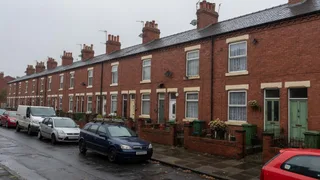
Britain has a large stock of two- and three-bedroom terraces. Many have small or no rear gardens, shared walls, limited loft space, mixed ownership and fabric that was never designed for a modern heat pump. An outdoor air-source unit needs space, air flow, access and a neighbour-tolerant noise path. On a tight terrace that is often the sticking point, not the thermodynamics.
The project’s earlier work argued that a shared ambient loop plus a small indoor heat pump can impose less electricity demand than fitting direct-electric boilers street-wide. That is a modelling claim from the Alpha / NIA stage, not a measured result from this new beta. Direct-electric heating is a harsh counterfactual. It does not tell you how the idea compares with a well-designed individual air-source heat pump on a house that can take one.
The project’s earlier work argued that a shared ambient loop plus a small indoor heat pump can impose less electricity demand than fitting direct-electric boilers street-wide. That is a modelling claim from the Alpha / NIA stage, not a measured result from this new beta. Direct-electric heating is a harsh counterfactual. It does not tell you how the idea compares with a well-designed individual air-source heat pump on a house that can take one.
The project’s earlier work argued that a shared ambient loop plus a small indoor heat pump can impose less electricity demand than fitting direct-electric boilers street-wide. That
The published architecture is a community system, not a box on every back wall.
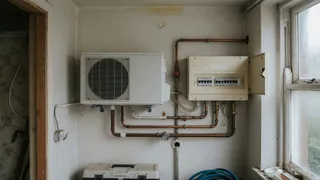
Street or pavement boreholes collect low-grade heat from the ground. A shared ambient loop carries that heat along the street at a modest temperature. Inside each participating home, a compact “shoebox” heat pump lifts that loop temperature to something the radiators or underfloor system can use. Solar generation and smart energy management sit on top of that, with capital recovered over time through a standing charge rather than an upfront kit invoice.
That is closer to a small ambient heat network than to a conventional district-heating main. The loop is not meant to deliver ready-to-use hot water on its own. The household still has a heat pump. The difference is where the heat source sits, and who owns the hole in the street.
Kensa-style shared ground loops already exist in UK housing. The claimed novelty here is packing that idea with indoor units, street-scale solar, a fairness-by-design commercial model and DNO-led network integration so a whole terrace can move together.
This is the part a funding announcement usually skips.
The underground boreholes, the street loop and the network interface are infrastructure. In a DNO-led SIF trial they are unlikely to sit on the household’s title in the way a boiler does. The indoor heat pump, controls and in-home pipework are more likely to be the resident-facing kit, but the contract will decide who owns them, who maintains them, and what happens if you sell the house.
Ask, if a street near you is ever offered this:
- Who owns the boreholes and the loop after the trial? - Who owns the indoor unit, and is it listed on the EPC or the sale pack? - Can you change electricity supplier, or is the heat tied to one commercial wrapper? - What happens if you refuse to join while the neighbours join? - Who pays if a borehole under the pavement fails in year twelve?
Until those answers are in a resident contract, “no upfront cost” is a slogan.
Buro Happold and Electricity North West have described the model as no upfront cost for householders. The planner brief is right to flag the catch. Capital still exists. It is recovered through long-term standing charges or equivalent payments.
That can be a fair way to spread cost across mixed tenure: owner-occupiers, private landlords and social housing on the same street. It can also lock a household into a charge they do not control, with weaker rights than a boiler they bought. The project’s own Alpha work found that making the final customer price affordable remained challenging. That warning is still live. The beta award does not erase it.
Compare that with a household that can use a Boiler Upgrade Scheme grant where eligible, or a Warm Homes loan on an MCS heat pump. Those are individual routes. Net Zero Terrace is a street route. They are not substitutes until a specific street is offered the trial.
UKRI’s summary says the project will showcase a novel solution for six million terraced homes and enable communities to replicate it. Six million is the estimated housing archetype, not the number of homes this £7.19 million will touch. The announcement does not name the final street, the number of participating homes, or the install timetable.
A useful demonstration would publish, in public:
- Seasonal performance of the indoor units on the shared loop, not a lab COP. - Electricity demand per home versus a fair counterfactual, not only versus electric boilers. - Standing-charge levels, tenure mix, and what happens when someone opts out. - Network impact at the substation, including whether active network management is required. - Noise, disruption and pavement works in a lived-in street.
Until those numbers exist, treat the award as permission to try, not as a product you can order.
If your terrace can take an outdoor unit, a conventional MCS air-source heat pump remains the product that exists today. If it cannot, a shared ground loop is one of the serious alternatives, and this trial is worth watching. It is not yet a national scheme.
Do not wait for Net Zero Terrace if the roof, the fabric and the electrics are ready. Get a design, check grant and loan eligibility, and book a survey. Confirm current SIF project pages on UKRI and Electricity North West before you treat any street as enrolled.
This article reflects the 8 October 2026 UKRI / Ofgem SIF announcement.
Solar comparison
Enter your postcode to assess your roof, compare solar options and connect with trusted UK installers.
Choose home, business or industrial, then enter your postcode. RoboMo maps the roof and ranks panel brands by fit.
1. Postcode Start the assessment for your property.
2. Pin the roof Mark the array on the map.
3. Compare RoboMo™ builds your options.

Battery ROI tool
Enter the day rate, off-peak rate and export rate. The calculator ranks batteries in the Kilowatts shop over 10 years. Home batteries also suit offices and small commercial sites.
Reading
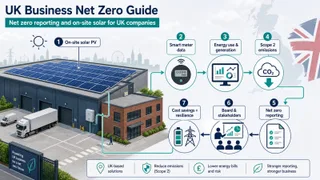
On-site solar supports UK company net zero reporting only where self-use cuts the electricity bought. Export does not reduce the Scope 2 total.
Read article
Energy Prices Rising Under Net Zero, But It Is Not the Whole Story.
Read article

The UK is breaking the link between gas and electricity prices. Discover what this means for heat pumps, solar panels, battery storage, and your energy bills.
Read article
Heat pump installation replaces conventional boilers by extracting heat from air or ground, delivering efficient heating and cooling with lower carbon emissions.
Read article
Write for Kilowatts.uk
Write it here under your own name. Sign in, put a profile up, and start a guide. Pay only if you want more links from your articles out to your own site.
Create a Kilowatts.uk account, or sign in if you already have one.
Put your name, photo and experience on a public author page.
Write a guide or a blog. Free authors can put one followed link to their own site in articles each month.
FAQ
Live help
Talk to RoboMo™ and get instant answers.
Live chat