


Kilowatts UK: Underwater Solar Energy
Published: 2026-09-18 21:24:32
Updated: 2026-09-18 14:26:00
Underwater solar panels can work when enough sunlight reaches them. A recent perovskite solar cell study shows useful prototype output at 10 metres depth.
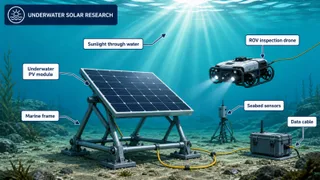
Create an original Kilowatts
uk news and technology article about the development of underwater perovskite solar cells capable of generating electricity at depths of up to 10 metres.
Underwater solar panels work at 10 metres in a perovskite test, but not for homes.
Underwater solar panels can work when enough sunlight reaches them. A recent perovskite solar cell study shows useful prototype output at 10 metres depth. The result matters because the cells were tuned for the blue-green light that remains underwater. It does not mean rooftop-style solar panels are ready to power homes from the seabed.
The likely near-term use is specialist marine power for low-consumption equipment, such as sensors, LEDs, underwater cameras, communications nodes and battery top-ups for autonomous systems. In household terms, the reported output is tiny. In subsea monitoring, a small local charge can still reduce retrievals, vessel trips and battery swaps.
This is a promising research milestone, not a commercial product announcement. The hard work now is not only cell efficiency. It is sealing, fouling control, corrosion resistance, lead containment, maintenance planning and proving the full module in different water conditions over time.
What the Joule underwater solar study actually tested.
The study reported wide-band-gap lead halide perovskite solar cells for submerged photovoltaic harvesting. The supplied research brief identifies the paper title as “Submerged solar harvesting with wide-band-gap perovskites for autonomous underwater energy systems”, published in Joule by researchers from Yunnan University and collaborators. The brief does not provide the DOI, publication date, journal URL or full author list, so those citation details should be checked against the final Joule record before using the work as a formal academic reference. The technical focus was an approximately 1.96 eV bandgap perovskite absorber, selected to match the altered underwater light spectrum at shallow depth. The cells also incorporated polyhexamethylene guanidine hydrochloride, usually shortened to PHMG, to improve crystallisation, charge extraction and stability. In plain terms, the researchers were trying to make the material better matched to underwater light and more stable under the test conditions. The evidence in the study should be separated carefully. Laboratory efficiency, real-sea module output, demonstrated loads and accelerated-ageing estimates all tell us different things. Treating them as one single proof of commercial readiness would overstate the result.
Overview
The laboratory number is impressive within the test set-up, but it is not a household solar comparison. Standard solar module ratings use terrestrial test conditions. A device optimised for filtered underwater light is being judged against a different spectrum and a different application.
How a solar cell can generate electricity underwater.
A solar cell generates electricity when photons are absorbed by the photovoltaic material and create electrical charge that can be collected by the device. Water does not stop this process, but it changes the light available to the solar cell. The deeper the device is placed, the more the spectrum and intensity differ from sunlight above the surface. For a clearer baseline on the normal rooftop process, see this guide to how solar works.
Red and infrared wavelengths are absorbed relatively quickly in water. Blue-green wavelengths generally penetrate further, although the exact result depends on water clarity, suspended sediment, plankton, weather, depth and the angle of the sun. That is why the 10-metre result is technically interesting: the solar material was selected for the light that actually remains underwater.
For a practical system, optical design matters as much as electrical design. The transparent window or encapsulation layer must let the useful wavelengths through, stay clear, resist scratches and avoid becoming covered in marine growth. A highly efficient cell behind a cloudy, fouled or damaged cover will not deliver useful power.
The main point is simple: underwater solar is not ordinary PV with a waterproof case. It is a combined optical, electrical, materials and marine-engineering problem.
Why perovskite solar cells suit this research challenge.
Perovskite solar cells are useful for this type of research because their bandgap can be tuned through material chemistry. The bandgap affects which parts of the light spectrum the cell can use most effectively. In this study, an approximately 1.96 eV wide-band-gap perovskite was chosen to better match the narrower underwater spectrum rather than the full spectrum available to conventional land-based solar panels.
That tunability is the core advantage. A silicon module can be sealed against water, but it is not automatically optimised for the blue-green light that remains below the surface. A perovskite absorber can be designed more deliberately around that light environment, at least at research scale.
There is also an important safety caution. The devices described are lead halide perovskites. Any future marine product would need secure encapsulation, damage tolerance, recovery procedures and end-of-life handling so that lead-containing material cannot leak into seawater.
Perovskites are therefore a useful research platform for submerged photovoltaics, but they are not automatically a low-risk marine product. The material choice creates both the opportunity and some of the hardest environmental questions.
What 324 mWh over two hours could realistically power.
The reported South China Sea prototype output of approximately 324 mWh over two hours is small by household standards. It would not meaningfully contribute to a home, heat pump, EV charger or normal building load. For low-power marine electronics, however, small amounts of harvested energy can still be useful if the device sleeps most of the time and only wakes to measure, log, transmit or illuminate briefly. A useful way to think about this is not “can it power everything?”, but “can it extend the duty cycle of a carefully designed low-power system?”. Many underwater instruments are constrained by battery capacity and maintenance access. Even trickle charging may be valuable if it reduces how often the device has to be recovered.
Overview
The value of submerged solar is highly application-specific. A sensor that sleeps for long periods may benefit from tiny harvested inputs; a propulsion system, continuous camera or high-power communications package may not. For context, household systems are usually assessed by annual yield and site conditions, as explained in this guide to solar electricity generation.
How UK waters change the engineering case.
The South China Sea test is useful because it took the technology outside the laboratory, but UK waters are not the same environment. UK coastal, estuary and harbour conditions often include lower winter sun, cloudier weather, tidal mixing, suspended sediment, biological growth and shorter daylight periods in winter. All of these can reduce the light reaching a submerged module. Clear shallow water is a much more favourable setting than a silty harbour or estuary. A deployment near aquaculture equipment, offshore renewable assets or scientific instruments may also face shading, turbulence, debris and maintenance constraints. In a real UK project, the first site question would be water clarity over the whole year, not just on a bright summer test day.
Overview
This does not mean underwater solar cannot work in the UK. It means performance must be proven locally, with real water, real seasons and realistic maintenance intervals. A short clear-water trial should not be treated as evidence for all marine settings.
The technical obstacles are still substantial.
A working underwater solar cell is only one part of a deployable marine power system. Real installations need encapsulation, cabling, connectors, mounting, protection electronics, battery integration, monitoring and a recovery plan. Saltwater, pressure changes, impact risk and biological growth make the sea a much harsher environment than a roof or field.
Biofouling is one of the most obvious practical problems. Algae, biofilm, barnacles and other organisms can coat transparent surfaces and block light. Even if the underlying cell continues to work, the useful output can fall if the optical surface is not kept clean.
Corrosion and water ingress are equally important. Electrical connections are frequent failure points in marine systems. For a lead-containing perovskite device, encapsulation also has an environmental protection role, because a damaged module must not release hazardous material into the water.
These are not minor add-ons. In marine equipment, the enclosure, connector and maintenance design can be just as decisive as the photovoltaic cell.
What a real deployment checklist would include.
Before underwater solar could move from research prototype to dependable marine equipment, a developer would need to test the whole system under realistic conditions. That means looking beyond peak output and asking whether the device can deliver useful energy after months of exposure, fouling and weather variation.
A practical marine review would normally start with the load profile. If the equipment needs steady high power, underwater PV is unlikely to be the answer. If it needs intermittent sensing, logging or short communication bursts, local harvesting and battery buffering may be more credible.
This is where many early-stage energy concepts struggle. A cell can perform well in a controlled test, but a project succeeds only if the complete system still works when it is dirty, wet, shaded, cold, moved and maintained by real people.
Could underwater solar panels become commercially viable?
Underwater solar panels could become commercially viable for specialist shallow-water marine applications, but the route is still uncertain. The strongest case is likely to be where small amounts of local energy avoid expensive retrievals or extend unattended operating time. The weakest case is any application that needs large, continuous power. The reported estimated T80 lifetime of about 48,094 hours, or around 5.49 years, is encouraging but should be interpreted carefully. It came from accelerated ageing under simulated 10-metre underwater illumination. That is not the same as proving a complete module has survived five and a half years in real seawater with fouling, impact risk, storms and repeated maintenance cycles. For comparison, mature rooftop products are judged over much longer ownership periods, which is why it helps to understand how long panels last. Commercial viability will depend on a bundle of factors rather than one efficiency number. Manufacturing cost, module lifetime, environmental permitting, cleaning frequency, failure consequences and the value of the data or service being powered all matter.
Overview
For now, the sensible conclusion is cautious optimism. The science is promising, but commercial readiness requires full-system proof, not only material performance.
What this means for homes, businesses and marine operators.
For homeowners and most businesses, this research does not change normal solar decisions. Rooftop and ground-mounted solar still belong above water, where the light is stronger, access is easier and the technology is mature. Homeowners comparing practical options should still start with home solar choices, not experimental submerged PV. Underwater perovskite solar is aimed at a different problem: powering low-energy devices in places where battery replacement is awkward.
Marine operators, aquaculture businesses, offshore asset owners and environmental monitoring teams may have a more direct interest. Even then, the question is not whether the technology is exciting, but whether it reduces total operational burden. If cleaning, inspection and recovery cost more than battery replacement, the case weakens. Businesses looking at proven above-water generation should compare commercial solar options separately from early-stage underwater trials.
The best early applications are likely to share several characteristics.
That last point matters. Until longer field trials exist, underwater solar should not be treated as a dependable power source for safety-critical marine systems. It is more credible as a supplementary charger or range extender for carefully selected equipment.
The future of underwater photovoltaic technology.
The wider significance of this research is that photovoltaic technology is becoming more specialised. Conventional silicon PV remains the established option for roofs, solar farms and many above-ground applications. Perovskites and other emerging materials allow researchers to explore niches where the light spectrum, surface shape or operating environment is unusual.
Underwater solar is one of those niches. The breakthrough is not that a normal panel has been submerged and turned into a new energy source for homes. It is that a photovoltaic material was tuned for the filtered light available beneath the water surface, then demonstrated in a real-sea prototype test at 10 metres.
If future versions can survive saltwater, resist fouling, contain lead safely and generate enough energy for real devices, submerged photovoltaic systems could help low-power marine equipment stay deployed for longer. For now, the answer is clear: underwater solar panels can work at shallow depth in the right conditions, but commercial marine use remains an engineering challenge rather than a finished product.
Plan, Compare & Buy Renewable Energy Solutions
AI does the thinking.
You get the perfect solar match.
Use RoboMo™ to assess your property, compare available technologies and connect with trusted UK installers, suppliers and manufacturers.
Simply enter your postcode, drop a pin on your roof, create your free account and let RoboMo™ analyse your property to find the best solar panels for your home.

You don't have to think
RoboMo™'s AI analyses your roof and does all the hard work.

Accurate & tailored
AI-powered assessment based on your roof, location, and conditions.

Best options, maximum savings
Compare top solar panels for the best performance and value.

Simple, fast & effortless
Provide a few details, sit back and watch your results unfold.
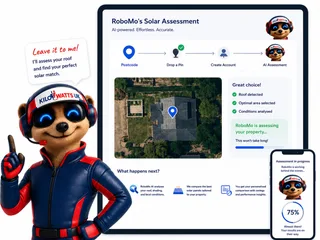
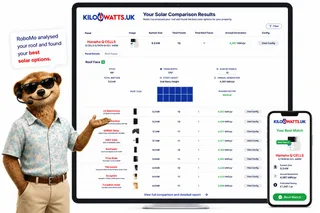
STEP 1
Choose Home, Business or Industrial
Enter your postcode to start your assessment.
STEP 2

Drop a pin on your roof
STEP 3

Create your free account
STEP 4

Sit back and watch RoboMo™ work
RoboMo™ analyses your roof and builds your personalised solar comparison.

Step 1
Enter your postcode
Start designing your wind energy system in seconds.
Are you an installer, distributor or renewable energy business?
Kilowatts UK is expanding the Flower Turbines partner network across the UK.
Become A Flower Turbines PartnerKilowatts UK is an authorised representative
Flower Turbines
Compact vertical-axis turbines built for real UK sites, not just open farmland.
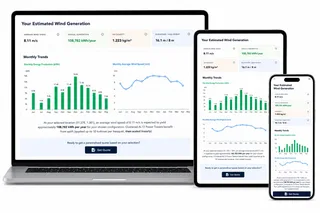
They start in light wind, sit in a small footprint, and are bird-safe by design. Cluster them as a bouquet and the group performs better together than the same turbines standing alone. Enter your postcode for a location-based generation estimate. Figures use area weather data and will differ if buildings, trees or hills sit in the way.
Starts in light UK wind
Built to generate in typical UK wind, not only open farmland.
Small rooftop or ground footprint
Compact towers for roofs, yards and tight sites.
Bird-safe slow rotation
Slow vertical-axis spin, bird-safe by design.
Bouquet clusters raise output
Grouped turbines outperform the same units standing alone.
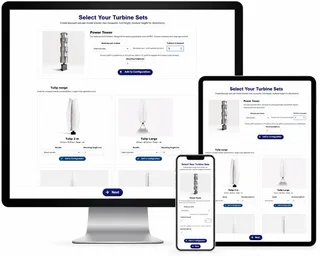
STEP 2

Choose a location
STEP 3

Place your cluster
Tap the map where you want the turbine cluster to go.
STEP 4

Instant generation forecasts
Compare different turbine layouts and see annual generation forecasts instantly.
STEP 5

No commitment required
Explore different configurations before deciding whether to request a quotation.
Related articles
Mo's Mission Nominations
FAQ
Need Help? RoboMo's Got Answers
Can underwater solar panels power a UK home?
No, not on the evidence from this study. The reported underwater prototype output was tiny compared with normal household electricity use. For homes, rooftop or ground-mounted solar panels remain the relevant technology to assess.
What did the underwater perovskite solar study actually prove?
It showed that a specially designed perovskite solar cell could generate useful prototype output under a simulated 10-metre underwater light spectrum and in a short real-sea test. It did not prove that underwater solar panels are commercially ready or suitable for domestic energy supply. Long-term durability, fouling, sealing and environmental safety still need to be demonstrated.
Why is 10 metres underwater a significant test depth?
At 10 metres, much of the red and infrared light has already been filtered out by the water. The remaining light is more blue-green, so the solar cell needs to be matched to that different spectrum. This makes the result technically interesting, but it is not directly comparable with standard rooftop solar panel ratings.
Could underwater solar be useful in UK waters?
Possibly, but it would be very site-specific. UK coastal and harbour waters can be cloudy, silty, fouled by marine growth and affected by lower winter sunlight. Any real UK deployment would need local testing across seasons rather than relying on a short trial in clearer water elsewhere.
What could a small underwater solar system realistically power?
The most plausible uses are low-power marine devices such as sensors, data loggers, LED indicators, communications nodes or battery top-ups. These systems may only need small amounts of energy if they sleep most of the time. It is not evidence that underwater solar can power propulsion, homes or high-demand equipment.
Are perovskite underwater solar cells environmentally safe?
The study used lead halide perovskite materials, so environmental containment is a major issue. Any future marine product would need robust sealing, damage protection, recovery procedures and end-of-life handling. A working cell is not enough on its own for safe deployment in seawater.
What are the main barriers to commercial underwater solar panels?
The main challenges include water ingress, corrosion, marine growth on the transparent surface, mechanical damage and maintenance access. The power electronics, cabling, connectors and mounting also need to survive a harsh marine environment. In many cases, the cost and effort of inspection or cleaning could outweigh the value of the energy produced.
Should UK homeowners wait for underwater solar instead of installing rooftop panels?
No. Underwater solar is a research area aimed mainly at specialist marine equipment, not domestic electricity generation. Homeowners interested in solar should look at proven rooftop or ground-mounted PV systems, site suitability, expected generation and installer credentials.