


Is the solar feed-in tariff still open in Glasgow?
Published: 2026-10-07 01:39:22
Updated: 2026-10-06 18:40:44
No solar feed-in tariff is open in Glasgow for a new system. It closed across Great Britain in 2019; new export pay is the Smart Export Guarantee.

Solar feed in tariff in glasgow?
Understand solar feed in tariff in glasgow in the UK, with clear explanations, examples, and practical next steps.
Is the solar feed-in tariff still open in Glasgow?
No. There is no solar feed-in tariff in Glasgow for a new photovoltaic system. The Feed-in Tariff closed to new applicants across Great Britain on 31 March 2019, and Glasgow has no separate local feed-in tariff. Ofgem’s published information on that closure is the source for the date. It was not a council decision.
Payments that remain are only for systems accredited before closure. They normally continue for the rest of the original term with the existing Feed-in Tariff licensee. A system installed after closure does not receive the old generation tariff. Where new income exists, it is the Smart Export Guarantee for measured export, paid by a licensed supplier. People also mix that up with money saved by using solar at home instead of buying electricity. Only generation payments were the classic feed-in tariff, and they are closed to new Glasgow installations.
A small number of applications that were already in the queue, or that had specific pre-registration, were dealt with under transitional arrangements after the closure date. A household installing now is outside those arrangements. If an old application was never finished, that is a question for the Feed-in Tariff licensee and Ofgem’s records, not a fresh enrolment in Glasgow. This article does not state pence rates, bill savings or payback. The rate source is a supplier tariff sheet dated to the day you compare offers.
What does the Smart Export Guarantee pay for in Glasgow?
For new solar in Glasgow, export income is arranged under the Smart Export Guarantee, which has applied in Great Britain since 1 January 2020. Ofgem publishes the framework, including which licensed suppliers must offer a tariff and which may offer one voluntarily. The rate, contract length and conditions are set by the supplier. They are not a national pence-per-kilowatt-hour figure, and they are not set differently because the roof is in Glasgow.
The guarantee pays for measured export. It does not pay for every kilowatt-hour the panels generate. Electricity used in the property never appears on an export statement, even though avoided import is often the larger financial effect where people are at home in the day. A generation meter, where one is fitted, is not the same thing as an export reading. Confusing the two is how some owners expect a payment for units they have already used.
In practice the installer commissions the system and provides the certification the supplier asks for. The export contract is with a licensee the customer chooses, who may or may not be the company that bills imported electricity. A solar installation company does not enrol a new array onto the closed Feed-in Tariff, and it does not automatically lock in an export rate. Before you treat a quoted income as real, ask to see the supplier’s current tariff sheet and note the date on it. If the next step is a new array rather than a legacy payment, compare home solar options against the roof you actually have.
Does Glasgow City Council pay a solar export rate?
No. Glasgow City Council does not pay a solar export rate, and the Scottish Government does not run a replacement feed-in tariff for the city. These are Great Britain schemes. Northern Ireland sits outside them, so advice written for Belfast does not transfer to a Glasgow postcode, and the reverse is also true. Within Great Britain the export rate does not change because the roof is in Glasgow rather than Manchester or Bristol.
Home Energy Scotland is the public advice service for households in Scotland. It is the right place to ask whether any Scottish support is open for your property and tenure. Ask Glasgow City Council separately if you have heard of a local scheme. Nothing found on either route should be treated as stacking with the Smart Export Guarantee, or with a legacy Feed-in Tariff, unless the written rules for that support say the combination is allowed. This article does not establish that any grant is currently open, or what it would pay. A separate read on UK solar grants is not a substitute for those written rules.
A council top-up is a poor assumption to build into a quote. So is a payment for every unit the panels generate. If a salesperson describes a “Glasgow feed-in tariff” for a system being installed now, ask them to name the payer and the written scheme. If they cannot point to an existing accreditation or to a dated supplier export tariff, the payment they are describing is not the old Feed-in Tariff.
How do Feed-in Tariff and Smart Export Guarantee payments differ?
The closed scheme and the current export duty are easy to conflate because both can involve a supplier payment linked to solar. They are not interchangeable, and they are not both paid on the same exported electricity. A new array does not inherit a neighbour’s generation tariff. Legacy rates depend on technology, capacity band, eligibility date and whether export was metered or deemed. Current export rates change by supplier and product. Neither figure is fixed for Glasgow. Ofgem’s Feed-in Tariff and Smart Export Guarantee pages confirm the scheme rules. They are not a price list for the city. Deemed export, used on some small accredited systems, should not be assumed for a new installation. New export tariffs expect a meter that records export.
What happens to FIT payments when you sell a Glasgow home?
An accredited system generally keeps its remaining payments for the rest of the original term. Those payments are administered by a Feed-in Tariff licensee. They do not automatically move when the household changes its import supplier. Selling the house is not the same event as a new application. The buyer should ask which technology and capacity were accredited, which licensee pays, whether export is metered or deemed, and what must be updated after completion.
The seller should pass on the accreditation documents rather than only the panel warranty. A change of ownership usually has to be registered with the licensee. Until that is done, payments can stall even though the equipment is still generating. A buyer who is told the tariff “comes with the house” should still see the licensee’s confirmation, not only the estate agent’s description.
Extending, replacing or removing panels can affect that accreditation. Adding a battery, an export limit or a different inverter can also change how the system is metered, so check the proposed work with the licensee before it starts. It is not safe to assume the owner can alter the array and keep the same tariff and term. A panel swap is not paperwork-free. Off-grid systems with nothing to export are outside the point of an export tariff. A site that cannot get permission to connect cannot rely on an export payment either.
Which documents are needed before SEG payments start?
Export income does not start when the panels are fixed to the roof. Suppliers pay against eligibility evidence and measured export. The usual order is certification, telling the distribution network operator, proving that export can be measured, and only then choosing a Smart Export Guarantee supplier. Skipping ahead to a tariff comparison, before the meter and the network route are clear, is a common reason a promised start date slips.
For many ordinary houses the installer commissions the system and notifies the operator under the G98 process. Where the plant is larger, uses equipment that needs a different connection, or the network needs a limit agreed first, the job is treated under G99 and should not be connected until that approval is in place. Which route applies is an address and design question. It is not a Glasgow-wide rule. Confirm it with the installer and the operator rather than assuming it from a neighbour’s job.
The distribution network operator for much of the Glasgow area is normally SP Energy Networks. Confirm that for the address. Export limitation, phase balance and local network constraints can cap export even when the panels could produce more. Those limits are site-specific. Meter type is part of the application, not an afterthought. A supplier normally needs an export MPAN so measured export can be attached to the account, together with a meter that can record it.
Does weaker sunshine in Glasgow reduce the export rate?
No. West-of-Scotland irradiance is generally lower than in southern England, so the same array often generates fewer kilowatt-hours, and therefore may export less. The tariff rate itself is not reduced because the site is in Glasgow. What changes is the number of surplus units, not the pence the supplier offers per exported unit.
A single Glasgow annual yield is withheld here on purpose. No city average is a safe stand-in for a particular roof, and quoting one would invent a figure this page does not have. A recognised way to model a specific roof is the European Commission’s PVGIS tool, using orientation, tilt and shading, or the installer’s own model with the same inputs. Monitoring from a comparable nearby array is useful only if the roof geometry really is comparable.
Orientation is not a legal requirement for either scheme. A south-facing slope usually produces more than an east-west pair, but shading from tenement chimneys, neighbouring blocks and dormers can matter more than the compass bearing. In a traditional Glasgow tenement the roof is often shared, so the title, the factor and the other owners can decide whether panels are possible at all. That is a property constraint, separate from the tariff. Installers should also check consumer unit space, whether the supply is single-phase or three-phase, and whether the service is looped or otherwise shared. Those details affect commissioning and any export limit long before a supplier tariff is chosen.
When should Glasgow export income be treated as secondary?
Exported units are only the surplus after on-site use. Daytime occupancy, a hot-water diverter, an electric vehicle charged while the array is producing, and a battery all change how many kilowatt-hours leave the property. A fixed export rate therefore does not produce a fixed income. Two similar roofs on the same Glasgow street can export very different amounts.
A battery does not automatically increase export payments. In many homes it reduces export, because generation is stored and used later instead of being sold as it is produced. That can still be sensible if it avoids a higher import rate in the evening. The export tariff and the import tariff have to be read together. Where export is very small, because the array is modest and daytime use is high, the choice of export product often matters less than self-consumption and the import tariff.
This question matters for homeowners, landlords and small non-domestic sites in Glasgow who already hold an accreditation, and for anyone pricing new solar who wants to know how surplus electricity can be sold. Landlords should confirm who is treated as the generator and who receives any payment. A change of tenant is not a new Feed-in Tariff application, but access to meters still needs a clear arrangement. Businesses, factories and farms sit under the same broad Great Britain framework, but larger connections are more involved. Approval, export limits and half-hourly metering can dominate the process. It is a poor fit if the expectation is a new guaranteed generation rate, a council top-up, or a payment for every unit the panels generate. Before relying on an export payment, ask the installer for the certification route and which of G98 or G99 applies, confirm the distribution network operator for the address, and ask which meter and MPAN will record export. Then compare licensed suppliers on a dated tariff sheet. Keep legacy payment questions with the Feed-in Tariff licensee. Use Home Energy Scotland, and the council if relevant, only as a separate check on support, not as a source of an export rate. To check the roof before you treat any export figure as income, book a free survey.
Plan, Compare & Buy Renewable Energy Solutions
AI does the thinking.
You get the perfect solar match.
Use RoboMo™ to assess your property, compare available technologies and connect with trusted UK installers, suppliers and manufacturers.
Simply enter your postcode, drop a pin on your roof, create your free account and let RoboMo™ analyse your property to find the best solar panels for your home.

You don't have to think
RoboMo™'s AI analyses your roof and does all the hard work.

Accurate & tailored
AI-powered assessment based on your roof, location, and conditions.

Best options, maximum savings
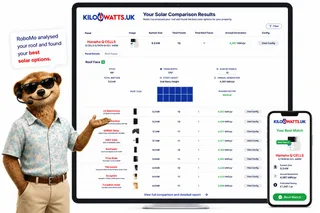
Compare top solar panels for the best performance and value.

Simple, fast & effortless
Provide a few details, sit back and watch your results unfold.
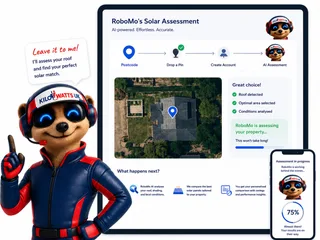
STEP 1
Choose Home, Business or Industrial
Enter your postcode to start your assessment.
STEP 2

Drop a pin on your roof
STEP 3

Create your free account
STEP 4

Sit back and watch RoboMo™ work
RoboMo™ analyses your roof and builds your personalised solar comparison.

Step 1
Enter your postcode
Start designing your wind energy system in seconds.
Are you an installer, distributor or renewable energy business?
Kilowatts UK is expanding the Flower Turbines partner network across the UK.
Become A Flower Turbines PartnerKilowatts UK is an authorised representative
Flower Turbines
Compact vertical-axis turbines built for real UK sites, not just open farmland.
They start in light wind, sit in a small footprint, and are bird-safe by design. Cluster them as a bouquet and the group performs better together than the same turbines standing alone. Enter your postcode for a location-based generation estimate. Figures use area weather data and will differ if buildings, trees or hills sit in the way.
Starts in light UK wind
Built to generate in typical UK wind, not only open farmland.
Small rooftop or ground footprint
Compact towers for roofs, yards and tight sites.
Bird-safe slow rotation
Slow vertical-axis spin, bird-safe by design.
Bouquet clusters raise output
Grouped turbines outperform the same units standing alone.
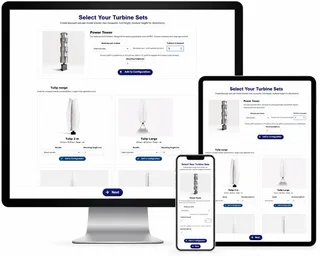
STEP 2

Choose a location
STEP 3

Place your cluster
Tap the map where you want the turbine cluster to go.
STEP 4

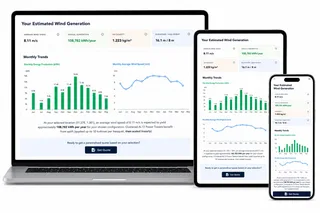
Instant generation forecasts
Compare different turbine layouts and see annual generation forecasts instantly.
STEP 5

No commitment required
Explore different configurations before deciding whether to request a quotation.
Related articles


FAQ
Need Help? RoboMo's Got Answers
Is the solar feed-in tariff still open in Glasgow?
No. The Feed-in Tariff closed to new applicants across Great Britain on 31 March 2019, and Glasgow has no separate local feed-in tariff. Payments that remain are only for systems accredited before closure, normally for the rest of the original term with the existing Feed-in Tariff licensee. A household installing now is outside the transitional arrangements that applied to a small number of applications already in the queue or with specific pre-registration.
What does the Smart Export Guarantee pay for in Glasgow?
For new solar in Glasgow, export income is arranged under the Smart Export Guarantee, which has applied in Great Britain since 1 January 2020. It pays for measured export only, not for every kilowatt-hour the panels generate. Electricity used in the property does not appear on an export statement. The rate, contract length and conditions are set by the licensed supplier, not by Glasgow City Council, and they are not a national pence-per-kilowatt-hour figure.
Does Glasgow City Council pay a solar export rate?
No. Glasgow City Council does not pay a solar export rate, and the Scottish Government does not run a replacement feed-in tariff for the city. These are Great Britain schemes, so advice written for Northern Ireland does not transfer to a Glasgow postcode. Home Energy Scotland is the public advice service for households in Scotland if you want to ask whether any Scottish support is open for your property and tenure. Do not assume a local scheme stacks with the Smart Export Guarantee or a legacy Feed-in Tariff unless the written rules say so.
How do Feed-in Tariff and Smart Export Guarantee payments differ?
A legacy Feed-in Tariff can cover generation, and export where the accreditation includes it. The Smart Export Guarantee pays for measured export only. Legacy rates depend on technology, capacity band, eligibility date and whether export was metered or deemed. Current export rates are set by the licensed supplier and can change by product. Neither scheme has a Glasgow or council rate, and a new array does not inherit a neighbour’s generation tariff.
What happens to FIT payments when you sell a Glasgow home?
An accredited system generally keeps its remaining payments for the rest of the original term, administered by a Feed-in Tariff licensee. Selling the house is not a new application, and the payments do not automatically move when the household changes its import supplier. The buyer should ask which technology and capacity were accredited, which licensee pays, and whether export is metered or deemed. A change of ownership usually has to be registered with the licensee, or payments can stall.
Which documents are needed before SEG payments start?
Export income does not start when the panels are fixed to the roof. Suppliers pay against eligibility evidence and measured export, so the usual order is certification, telling the distribution network operator, proving that export can be measured, and then choosing a Smart Export Guarantee supplier. Many ordinary houses are notified under G98, while G99 applies where approval is required before connection. Suppliers normally need an export-capable meter and an export MPAN. Which route applies is an address and design question, not a Glasgow-wide rule.
Does weaker sunshine in Glasgow reduce the export rate?
No. West-of-Scotland irradiance is generally lower than in southern England, so the same array often generates fewer kilowatt-hours and may export less. The tariff rate itself is not reduced because the site is in Glasgow. What changes is the number of surplus units, not the pence the supplier offers per exported unit. A city-wide annual yield is not a safe stand-in for a particular roof, orientation, tilt or shading.
When should Glasgow export income be treated as secondary?
Exported units are only the surplus after on-site use. Daytime occupancy, a hot-water diverter, an electric vehicle charged while the array is producing, and a battery all change how many kilowatt-hours leave the property. A battery often reduces export because generation is stored and used later. Where export is small, the import tariff and self-consumption can matter more than the choice of export product. It is a poor fit if the expectation is a new guaranteed generation rate, a council top-up, or a payment for every unit the panels generate.