


SEG and 0 percent VAT for Kent solar homes
Published: 2026-10-06 03:10:39
Updated: 2026-10-05 20:11:47
SEG and 0 percent VAT for Kent solar homes are separate rules. VAT can zero-rate a qualifying install; SEG pays only measured export after commissioning.
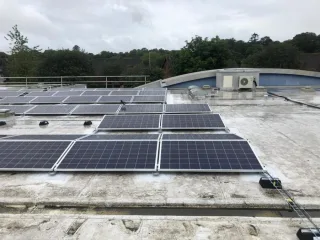
SEG and 0 percent VAT for Kent solar homes
SEG and 0 percent VAT for Kent solar homes from Kilowatts.uk in Broadstairs. Costs, roofs, planning and what to do next then compare a local system.
SEG and 0 percent VAT are separate rules
SEG and 0 percent VAT for a Kent solar home are two different rules, not one grant and not a county scheme. Where a supply-and-install of solar PV on a dwelling in Great Britain qualifies, the installer can invoice that supply at 0 percent VAT instead of the standard rate. Separately, the Smart Export Guarantee can pay for electricity that is measured as exported, at a rate set by a licensed supplier. A house in Kent can fall under both because Kent is in England. Neither applies just because the postcode is in the county.
The VAT treatment changes the invoice on a qualifying job. It does not cut your import unit rate, and it does not create export income. SEG pays only for eligible measured export, not for every kilowatt-hour the panels generate and not for units used in the house. Using solar on site can still reduce imported units. That bill effect is real, but it is not a SEG payment.
In practice the two questions are settled at different times. The invoice is raised when the installer supplies and fits the system. The export contract is applied for after commissioning, once certification, metering and distribution network operator paperwork are in a form a supplier will accept. Treating them as one solar incentive is how quotes and expectations get muddled. This page is a decision guide, not a VAT ruling, a connection offer, or a tariff.
What the Smart Export Guarantee pays for
The Smart Export Guarantee is a Great Britain scheme for eligible small-scale export. It replaced the Feed-in Tariff for new applicants. The Feed-in Tariff is closed to new applications, and SEG does not add a generation payment on top of an export payment. Ofgem’s published supplier test is that licensed electricity suppliers with 150,000 or more domestic customers must offer at least one SEG tariff. Smaller suppliers may offer a tariff voluntarily. That threshold is about the supplier, not about Kent. The live list of mandatory licensees should be read from current Ofgem SEG guidance on the day you apply.
Payment is for measured export. A smart meter that only shows import is not evidence that an export register is recording. Some tariffs also expect an export MPAN, which is a separate meter point for export. Until that metering is in place, the array can be generating while no SEG payment is due. Rates, contract length, and whether a tariff is fixed or variable are commercial terms. They change. They are not set by Kent County Council or by the installer, and this guide does not quote pence-per-kWh figures. Check the licensee’s published tariff on the day you apply, and note the date of that check.
You do not have to take SEG from the company that bills your import. Households can usually choose among SEG licensees, review the contract, and switch later if another tariff suits how the system actually exports. A design that uses almost all generation in the home can be a strong bill strategy and a weak export strategy. A home battery and hybrid inverters change what leaves the site, and suppliers differ on storage and on charging from the grid. Ask the licensee how they treat your meter arrangement before you assume surplus from a battery will be paid.
When 0 percent VAT can apply to a Kent dwelling
The residential energy-saving materials relief is a VAT treatment, not a grant and not a cashback. On a qualifying supply-and-install of certain energy-saving materials in a dwelling, including solar PV, the installer can zero-rate the supply rather than charge the standard rate. Zero-rating is not the same as an exemption. The installer still treats it as a taxable supply and should show the rate on the invoice. The homeowner does not claim the difference back later through a separate form.
The usual homeowner route is a supply-and-install to residential accommodation in Great Britain. HMRC sets this out in VAT Notice 708/6, and in any manual or notice that replaces it. The wider residential zero rate was published as a temporary Great Britain treatment from 1 April 2022, with an end date then stated as 31 March 2027. Do not treat either date as a personal ruling. Finance Acts and later notices can move scope and timing, so the version current on the invoice date is the one that matters. Northern Ireland is outside this Great Britain treatment. A Kent address matters geographically even though the county does not administer the relief.
From 1 February 2024, HMRC brought electrical battery storage into that residential energy-saving materials zero rate, including some installs that are not sold on the same invoice as new panels. That was a change of scope, not a new grant, and later wording can narrow it. Scaffold, bird protection, inverters and batteries still depend on what is supplied, to whom, and whether the line is part of a qualifying installation in a dwelling. A headline of 0 percent VAT on the front of a quote does not settle a mixed schedule. The cash difference is the VAT that is not charged on qualifying lines, not a national figure for 20 percent off solar.
How the two rules compare on a real job
Searchers often want a single yes or no. On a Kent house the useful split is what each rule changes, who applies it, and what still has to be true on site. The table is a decision frame, not a tariff and not a price list. A Kent address does not appear as a qualifying column because the county does not set either rule.
Overview
If a quote bundles non-qualifying goods or non-residential work with the panels, those lines are not automatically zero-rated. If the roof, listing or metering will delay commissioning, the VAT question on a future invoice is not the same as having an export contract today.
How to read a mixed solar invoice
The invoice is the VAT evidence. You should be able to see a VAT registration number, a clear description of supply and installation at a dwelling, and 0 percent on the lines the installer says qualify. Ask for that split before you compare headline quotes. The example below is a reading aid, not a specimen bill and not a statement that any particular line is zero-rated on your job. No prices are shown, because a live quote depends on the survey.
Overview
A consumer-unit change that exists only to make the solar install safe can be part of the installation supply. A general rewire, or an EV charger added because the driveway needs one, should be split out and rated on its own facts. If the schedule does not let you see those lines, the quote is not yet ready to treat as zero-rated.
Landlords, kit-only buys, new-builds and batteries
An owner-occupier of an existing Kent house is the straightforward case: one customer, one dwelling, a supply-and-install, then a later export contract if the system is certified, metered and connected. Other arrangements are not small print on that answer. They are different VAT supplies, and sometimes a different person is allowed to apply for SEG.
A let dwelling can still be residential accommodation, so a landlord installing solar on a rented house is not automatically outside the relief, and is not automatically inside it. HMRC looks at the building and the supply, not at whether the owner sleeps there. A VAT-registered landlord, a portfolio, an HMO that is not clearly a single dwelling, or a mixed commercial and residential building needs the installer’s VAT treatment checked against VAT Notice 708/6 and, where the landlord is registered, against how that business accounts for VAT. The tenant who does not own the system usually cannot control the invoice, the meter, or the SEG application.
A supply-only or DIY purchase is a different supply from an installer who supplies and fits the system. The published relief is an installation treatment. Kit bought online for the owner to fit, or panels supplied without installation, should not be priced as if they were a standard zero-rated supply-and-install. Many materials-only invoices stay at the standard rate. Ask the seller which rate they will charge, and do not assume a later installer can retrospectively zero-rate goods you already bought. New-build construction has its own VAT rules, including reliefs that can apply to the construction of a new dwelling. Solar included in a builder’s new-build contract is not the same question as energy-saving materials fitted to an existing house. The buyer of a finished home often never sees an ESM invoice at all. If you are the developer, the contractor, or a buyer trying to recover VAT from a new-build, use the construction treatment that applies to that contract rather than this homeowner frame. A battery-only retrofit is the case most often misread from an old solar quote. Before February 2024, storage was easy to treat as something that only followed the panels. After the published change, a residential battery install in Great Britain can need its own check against the current notice, including where there is no new array on the same invoice. That still does not make the battery a SEG payment, and it does not make an off-grid battery an export system. If the battery cannot show eligible export through a meter a licensee accepts, there is nothing for SEG to pay.
Commissioning, G98 and G99 before either is secure
Installers in Kent are usually dealing with UK Power Networks, through South Eastern Power Networks, but the postcode should be checked rather than assumed from the county. Connection is not optional paperwork, and it is not the VAT invoice. Certification, the DNO document and the SEG application are three different processes. An MCS certificate, or another scheme the chosen licensee publishes as acceptable, is not the DNO’s connection document, and neither document is a SEG contract.
The usual engineering split is G98 for notification and G99 for a fuller application. G98 is the route for fully type-tested microgeneration up to 16 amps per phase, which is 3.68 kW at 230 volts. A single-phase house with one small type-tested inverter often sits in that notification lane. On three-phase supplies the same 16 amp figure is per phase, so the site total can be higher without leaving G98, but only if the equipment and the site still fit the recommendation. G99 is the application route when the plant is larger, not fully type-tested, aggregated with other generation already on the site, or arranged in a way G98 does not cover. Many hybrid inverters, batteries and export-limitation designs fall into that second lane even when the solar inverter nameplate is under 3.68 kW. A G99 job can add time before the system is allowed to commission. The DNO’s assessment of the equipment and the local network decides the form, not the county boundary.
The licensee will typically want the certificate, meter details, and proof that the network operator has been notified or has given permission. Export is not always visible on the first meter read. Enabling the export register, or waiting for an export MPAN, can delay the first payment even when the array is already generating and the invoice has already been paid. Shading, string layout and inverter limits decide more than the VAT rate. They decide whether the roof can stay within a simpler notification, how much generation is usable on site, and whether a battery is being specified for self-consumption or for a later export strategy. Scaffold, consumer-unit space and cable routes change the quote. They do not, by themselves, create eligibility for SEG.
Planning consent is a separate Kent gate
Many domestic roof arrays in England can be installed as permitted development, but that is not a county-wide clearance and it is not decided by the installer invoice. The main domestic solar provisions sit in Class A of Part 14 of the Town and Country Planning (General Permitted Development) (England) Order 2015. The conditions homeowners actually trip over are practical. Equipment should not project more than 0.2 metres beyond the plane of the roof or wall. It should not sit higher than the highest part of the roof, excluding a chimney. It should be sited to minimise the effect on the appearance of the building and on the amenity of the area, and it should be removed when it is no longer needed.
On land in a conservation area or a World Heritage Site, the same class generally does not allow panels on a wall, or on a roof slope, which fronts a highway. An Article 4 direction can remove permitted development rights even on an ordinary street, so a conservation-area map is not the only check. Listed building consent is a separate consent and is not granted by permitted development. The Kent Downs National Landscape, the former Area of Outstanding Natural Beauty, is not the same test as a conservation area. Designation there does not by itself mean every roof array needs a planning application, and it does not mean every array is acceptable. If listing, an Article 4 direction, or a highway-facing slope in a conservation area is in play, the local planning authority decides, not the quote.
Consent changes the start date more than the tax rate. A qualifying supply-and-install can still be zero-rated if the supply itself qualifies, but the job cannot be commissioned, certified and offered for SEG until it is lawfully installed and connected. If the roof covering is near the end of its life, or the array would sit on a weak or heavily shaded slope, the economic case can fail before either scheme is relevant. South-east England is relatively sunny for the UK. Output still depends on orientation, pitch, shading and system size, and a county label is not a yield. Ask for the planning assumption in writing on the survey: permitted development, or an application. If listing and designation have not been checked, the VAT line on a draft quote is ahead of the real programme.
Grant, generation and postcode are the wrong tests
The first shortcut is to treat 0 percent VAT as a grant. It is not. Nobody at Kent County Council, and no national funder, pays you a cash sum equal to the VAT that was not charged. There is no homeowner claim form under this relief. Current solar support routes are a different question from this VAT treatment. If the supply qualifies, the installer shows 0 percent on those lines and accounts for VAT in the normal way. If it does not qualify, the missing VAT is not something you can recover later by calling it SEG.
The second shortcut is to treat SEG as payment for generation. It is not. SEG pays for electricity measured as exported under a contract with a licensed supplier. Units used in the house are not export, and a monitoring app that shows production is not an export register. There is no Feed-in Tariff-style generation payment for a new Kent array. A month with high generation and no export payment is often a metering or application problem, not proof that the panels have failed, and not proof that the VAT invoice was wrong.
The third shortcut is to treat a Kent postcode as the qualifier. It is not. The postcode does not unlock a county export rate or a county VAT rule. It places the property in England, so Great Britain rules can apply, and it is the clue to which network operator to ask, often UK Power Networks through South Eastern Power Networks. That DNO guess still has to be checked. Eligibility is about the dwelling, the supply, certification, metering and connection. Two neighbouring houses can have different invoices and different connection forms because the roof, the equipment and the consumer unit differ.
What to check on the invoice and the application
SEG is an application after commissioning, not a tick-box on scaffold day. Have the certificate, the meter serial and export details, and the DNO reference ready before you choose a licensee. If the first bill cycle shows generation in the monitoring app but no export payment, the usual causes are an export register that is not yet enabled, a missing export MPAN, or an application the supplier has not accepted.
Before you treat a Kent quote as both zero-rated and SEG-ready, ask for these points in ordinary language.
A system that cannot show export will not be paid for export, however neat the VAT invoice looks. Keep a copy of the invoice, the certificate and the DNO reference together. Those three papers answer different questions, and suppliers and accountants ask for them separately.
Who should not use this as the main decision
This framing suits owners of residential property in Kent who can have a grid-connected, certified system, who will use some generation on site, and who will export a surplus they can measure. It also suits landlords who own that system and will choose and review a supplier tariff, once their own VAT position has been checked. It suits people who accept that export rates are commercial terms, not a fixed national pence-per-kWh figure.
It is a poor fit if you want a grant, a Feed-in Tariff-style generation payment, or a government-set export rate. It is the wrong frame for a commercial rooftop seeking the residential relief, for an off-grid system with nothing to export, and for a tenant who does not own the system and cannot control metering or applications. Supply-only kit, new-build construction and battery-only retrofits need the VAT check described above. They should not be priced as if they were a standard supply-and-install on an existing owner-occupied house.
If consent is likely to be refused or delayed, solve planning before you compare export tariffs. If the roof cannot take the array, or the consumer unit and cable routes make a safe install unrealistic, neither 0 percent VAT nor SEG repairs that. A zero-rated invoice on a system that cannot be connected is not a completed project.
What to settle before you compare a local system
Measure how the house uses electricity across a day, not only the annual bill total, so a design can be judged on self-consumption as well as possible export. Note roof orientation, obvious shading, listing, and whether the street sits in a conservation area or is affected by an Article 4 direction. Ask which DNO area the postcode falls in, whether the proposal is a G98 notification or a G99 application, and which invoice lines will be zero-rated under the HMRC notice current on the quote date. Read that notice, and the current Ofgem SEG guidance, rather than an old forum post or a headline rate.
A site-specific survey is the point at which those answers stop being general. You can book a Kent solar survey when you want the roof, the connection route and the invoice treatment looked at together, rather than assumed from the county. Use that visit to pin down planning assumptions, certification and metering as well. Those checks stay separate from both the VAT line and any later export tariff.
Plan, Compare & Buy Renewable Energy Solutions
AI does the thinking.
You get the perfect solar match.
Use RoboMo™ to assess your property, compare available technologies and connect with trusted UK installers, suppliers and manufacturers.
Simply enter your postcode, drop a pin on your roof, create your free account and let RoboMo™ analyse your property to find the best solar panels for your home.

You don't have to think
RoboMo™'s AI analyses your roof and does all the hard work.

Accurate & tailored
AI-powered assessment based on your roof, location, and conditions.

Best options, maximum savings
Compare top solar panels for the best performance and value.

Simple, fast & effortless
Provide a few details, sit back and watch your results unfold.
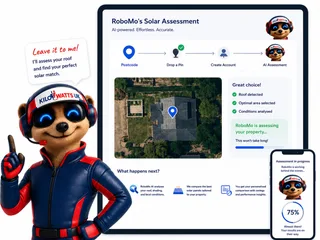
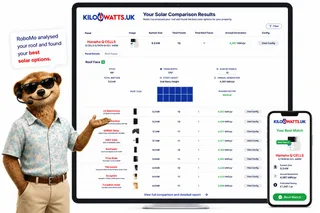
STEP 1
Choose Home, Business or Industrial
Enter your postcode to start your assessment.
STEP 2

Drop a pin on your roof
STEP 3

Create your free account
STEP 4

Sit back and watch RoboMo™ work
RoboMo™ analyses your roof and builds your personalised solar comparison.

Step 1
Enter your postcode
Start designing your wind energy system in seconds.
Are you an installer, distributor or renewable energy business?
Kilowatts UK is expanding the Flower Turbines partner network across the UK.
Become A Flower Turbines PartnerKilowatts UK is an authorised representative
Flower Turbines
Compact vertical-axis turbines built for real UK sites, not just open farmland.
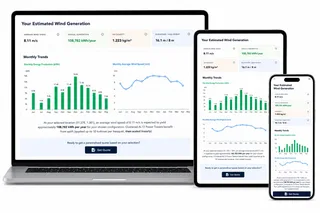
They start in light wind, sit in a small footprint, and are bird-safe by design. Cluster them as a bouquet and the group performs better together than the same turbines standing alone. Enter your postcode for a location-based generation estimate. Figures use area weather data and will differ if buildings, trees or hills sit in the way.
Starts in light UK wind
Built to generate in typical UK wind, not only open farmland.
Small rooftop or ground footprint
Compact towers for roofs, yards and tight sites.
Bird-safe slow rotation
Slow vertical-axis spin, bird-safe by design.
Bouquet clusters raise output
Grouped turbines outperform the same units standing alone.
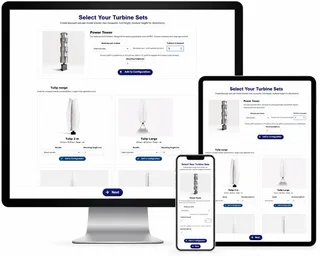
STEP 2

Choose a location
STEP 3

Place your cluster
Tap the map where you want the turbine cluster to go.
STEP 4

Instant generation forecasts
Compare different turbine layouts and see annual generation forecasts instantly.
STEP 5

No commitment required
Explore different configurations before deciding whether to request a quotation.
Related articles


FAQ
Need Help? RoboMo's Got Answers
Are SEG and 0 percent VAT one Kent solar grant?
No. They are two separate rules, not a county scheme and not a single incentive. Where a supply-and-install of solar PV on a dwelling in Great Britain qualifies, the installer can invoice that supply at 0 percent VAT. Separately, the Smart Export Guarantee can pay for electricity measured as exported, at a rate set by a licensed supplier. A Kent address places the home in England, but neither rule applies just because the postcode is in the county.
What does the Smart Export Guarantee actually pay for?
SEG pays only for eligible measured export, not for every kilowatt-hour the panels generate and not for units used in the house. It replaced the Feed-in Tariff for new applicants and does not add a generation payment on top of an export payment. Licensed suppliers with 150,000 or more domestic customers must offer at least one SEG tariff; smaller suppliers may offer one voluntarily. Rates and contract terms change, so check the licensee’s published tariff on the day you apply.
Does 0 percent VAT cut my electricity bill or create export income?
No. The VAT treatment changes the invoice on a qualifying job. It does not cut your import unit rate and it does not create export income. Using solar on site can still reduce imported units, but that bill effect is not a SEG payment. The homeowner does not claim the VAT difference back later through a separate form.
When is each rule settled on a real job?
The invoice is raised when the installer supplies and fits the system, if the job qualifies. The export contract is applied for after commissioning, once certification, metering and distribution network operator paperwork are in a form a supplier will accept. Until export metering is in place, the array can be generating while no SEG payment is due. Treating the two as one solar incentive is how quotes and expectations get muddled.
Can a home battery be zero-rated, and will SEG pay for battery export?
From 1 February 2024, HMRC brought electrical battery storage into the residential energy-saving materials zero rate, including some installs not sold on the same invoice as new panels. That was a change of scope, not a new grant, and later wording can narrow it. A battery is not itself a SEG payment. If it cannot show eligible export through a meter a licensee accepts, there is nothing for SEG to pay, so ask the supplier how they treat storage before you assume surplus will be paid.
Does 0 percent VAT apply to kit-only buys, landlords and new-builds?
The usual homeowner route is a supply-and-install to residential accommodation in Great Britain. A let dwelling can still be residential accommodation, but a VAT-registered landlord, an HMO or a mixed-use building needs the treatment checked against the current notice. Kit bought for the owner to fit, or panels supplied without installation, should not be priced as a standard zero-rated supply-and-install. Solar in a builder’s new-build contract follows construction VAT rules, not this existing-home frame.
Do I need MCS, G98 or G99 before SEG is secure?
Certification, the DNO document and the SEG application are three different processes. An MCS certificate, or another scheme the chosen licensee publishes as acceptable, is not the DNO’s connection document, and neither is a SEG contract. G98 is the notification route for fully type-tested microgeneration up to 16 amps per phase. G99 is the application route when the plant is larger, not fully type-tested, aggregated with other generation, or arranged in a way G98 does not cover. Many hybrid inverters and batteries fall into that second lane even when the solar inverter nameplate is under 3.68 kW.
How should I read a quote that says 0 percent VAT?
The invoice is the VAT evidence. You should see a VAT registration number, a clear description of supply and installation at a dwelling, and 0 percent on the lines the installer says qualify. A headline of 0 percent VAT does not settle a mixed schedule: wider rewires, EV chargers or non-residential work are not pulled into the relief merely by sharing the invoice. Ask for the split before you compare headline quotes, and confirm the rate against the HMRC notice current on the invoice date.