


PAYGO solar for UK commercial sites: UK business guide
Published: 2026-09-27 22:49:37
Updated: 2026-09-27 23:51:14
PAYGO solar for UK commercial sites can avoid day-one capex, but it is not a PPA or outright purchase. Check ownership and term before you sign.
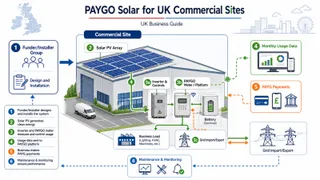
PAYGO solar for UK commercial sites - UK business guide
How pay-as-you-go commercial solar compares with a PPA and outright purchase for UK warehouses, offices and retail. What to check before you sign.
Why this decision sits with finance and estates, not just facilities
UK businesses do not buy solar the way a household does. The roof is an asset class, the bill is a cost centre, and the board will ask who owns the kit, who carries the defect risk, and what the books look like in year seven. Pay-as-you-go (PAYGO) solar is one of three common answers to that conversation. The other two are buying the system outright (CAPEX) and a power purchase agreement (PPA). They are not the same product with different logos. They allocate capital, risk and generation in different ways.
This guide is for commercial sites in the UK — warehouses, offices, retail, light industrial — that want on-site solar without pretending there is a single “best” route. It does not quote tariffs or grant rates. Those move. What does not move is the set of questions you should force any supplier to answer in writing.
If you already have quotes, compare them on commercial solar installation. If you need a site walk before anyone talks finance, book a survey.
What PAYGO solar actually means on a commercial roof
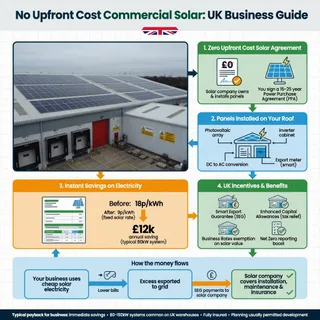
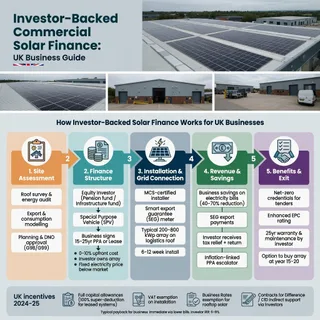
PAYGO, “no upfront cost”, “solar as a service” and “funded install” get used interchangeably in sales decks. In practice they usually mean:
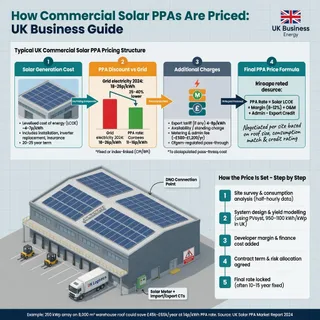
That is close to a PPA, and many “PAYGO” offers *are* PPAs with simpler branding. The useful distinction is commercial, not legal theatre: Ask for the legal form in one sentence: sale, lease, licence, PPA, or hire. If they cannot say, do not sign.
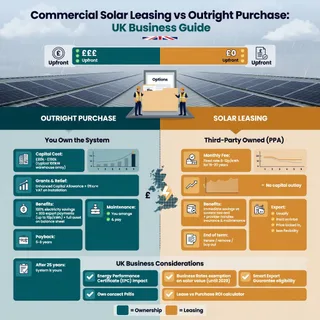
CAPEX, PPA and PAYGO compared
Overview
None of these rows is a score. A cash-rich manufacturer with a 25-year site may prefer CAPEX. A multi-site retailer with landlord constraints may prefer a funded route. An SME with a five-year lease should not pretend it has a 25-year roof.
Match the product to the load, not the brochure
On-site solar earns its keep when generation lands on your meters during your occupied hours.
PAYGO sales stories sometimes assume every kWh is “free electricity”. It is not. You still need: If the proposal cannot show self-consumption versus export, it is a brochure, not a model.
Landlords, leases and who can sign
Commercial solar dies in legal, not on the roof.
Get estates and the landlord’s solicitor in the first meeting, not after a deposit invoice.
Grid, G99 and the DNO
Any commercial array that can export will meet the Distribution Network Operator. G99 (and related connection processes) is not optional paperwork. Export limitation, G100, and wait times can change the economics more than panel brand.
Funded / PAYGO offers sometimes treat DNO as “we handle it”. You still need:
If generation was modelled with unconstrained export and the DNO then clips it, who eats the difference — you or the funder?
Operations, performance and the 10-year hole
Inverters, optimisers, monitoring portals and roof penetrations all have a life. On CAPEX you budget replacement. On PAYGO/PPA the plant owner should budget it — if the contract says so.
Put in the schedule of works:
A PAYGO rate that looks cheap because O&M was left with you is not cheap.
Carbon claims, REGOs and reporting
Boards talking about net zero need to know who can claim the renewable attribute. On-site generation behind the meter is not automatically the same as a bundled REGO from a supplier. If the funder keeps the certificates, your sustainability report may not be able to say what the sales slide said.
State in the contract:
Do not invent SECR or IFRS treatments here. Take the contract to your accountant. Off-balance-sheet is a conclusion, not a feature tick-box.
A practical checklist before you sign a PAYGO term sheet
The following points summarise the key takeaways:
If any item is “we’ll confirm in the full contract”, you do not have a deal yet.
How Kilowatts UK uses this in a commercial quote
We size the roof and the load first. Finance is the second conversation, not the first. A funded route that does not fit the occupancy pattern will still be a bad plant.
Compare a proper commercial design — generation, layout, and battery if peak shaving or backup is in scope — on the commercial solar compare tool. For a site visit, book a survey.
If the site also has urban wind (for example a vertical-axis cluster) or a commercial battery, those are separate yield and connection problems. Do not let a PAYGO solar rate hide a messy hybrid.
Bottom line
PAYGO solar can be a clean way for a UK business to get a roof working without a capex line. It can also be a PPA with the serial numbers filed off. Treat it as a financing and ownership decision sitting on top of a physical solar design. Get the design honest first. Then choose CAPEX, PPA or PAYGO because the contract matches how long you will be on that roof — not because the brochure said “no upfront cost”.
Plan, Compare & Buy Renewable Energy Solutions
AI does the thinking.
You get the perfect solar match.
Use RoboMo™ to assess your property, compare available technologies and connect with trusted UK installers, suppliers and manufacturers.
Simply enter your postcode, drop a pin on your roof, create your free account and let RoboMo™ analyse your property to find the best solar panels for your home.

You don't have to think
RoboMo™'s AI analyses your roof and does all the hard work.

Accurate & tailored
AI-powered assessment based on your roof, location, and conditions.

Best options, maximum savings
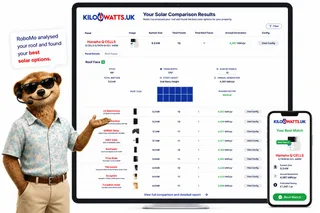
Compare top solar panels for the best performance and value.

Simple, fast & effortless
Provide a few details, sit back and watch your results unfold.
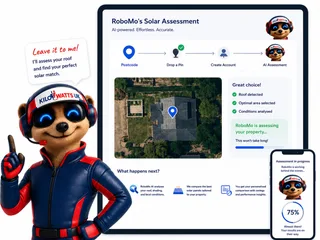
STEP 1
Choose Home, Business or Industrial
Enter your postcode to start your assessment.
STEP 2

Drop a pin on your roof
STEP 3

Create your free account
STEP 4

Sit back and watch RoboMo™ work
RoboMo™ analyses your roof and builds your personalised solar comparison.

Kilowatts UK is an authorised representative
Flower Turbines
Compact vertical-axis turbines built for real UK sites, not just open farmland.
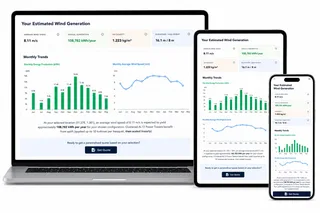
They start in light wind, sit in a small footprint, and are bird-safe by design. Cluster them as a bouquet and the group performs better together than the same turbines standing alone. Enter your postcode for a location-based generation estimate. Figures use area weather data and will differ if buildings, trees or hills sit in the way.
Starts in light UK wind
Built to generate in typical UK wind, not only open farmland.
Small rooftop or ground footprint
Compact towers for roofs, yards and tight sites.
Bird-safe slow rotation
Slow vertical-axis spin, bird-safe by design.
Bouquet clusters raise output
Grouped turbines outperform the same units standing alone.
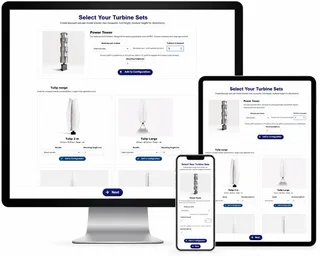
Step 1
Enter your postcode
Start designing your wind energy system in seconds.
STEP 2

Choose a location
STEP 3

Place your cluster
Tap the map where you want the turbine cluster to go.
STEP 4

Instant generation forecasts
Compare different turbine layouts and see annual generation forecasts instantly.
STEP 5

No commitment required
Explore different configurations before deciding whether to request a quotation.
Related articles
Mo's Mission Nominations
FAQ
Need Help? RoboMo's Got Answers
Is PAYGO solar the same as a commercial PPA?
Often it is a PPA or hire agreement sold under a simpler name. Ask for the legal form in one sentence and who owns the kit. The label does not decide ownership or export rights.
Can a tenant sign a 15-year PAYGO solar deal?
Only if the lease, landlord consent and exit terms can survive that long. A PAYGO term longer than the occupational lease is a red flag unless assignment and buy-out are documented.
Does PAYGO solar remove DNO / G99 work?
No. Export connections still go through the DNO. Confirm who applies, who pays, and who bears a worse export limit than the sales model.
Who can claim the carbon benefit of a funded array?
Whoever the contract assigns generation attributes to. If the funder keeps certificates, your net-zero report may not match the sales slide. Put it in writing.