


No upfront cost commercial solar: UK business guide
Published: 2026-09-29 02:49:57
Updated: 2026-10-01 19:51:12
No upfront cost commercial solar is not free UK power. A funder pays capital; you pay by PPA, lease or roof rights if credit, roof and daytime load fit.
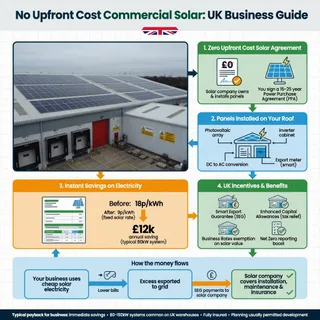
No upfront cost commercial solar - UK business guide
UK business guide B Solar funded install
What no upfront cost commercial solar UK actually means
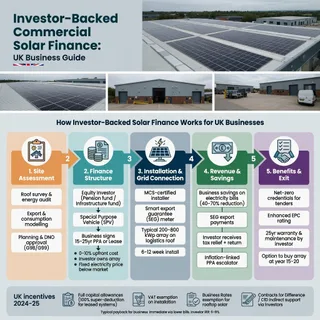
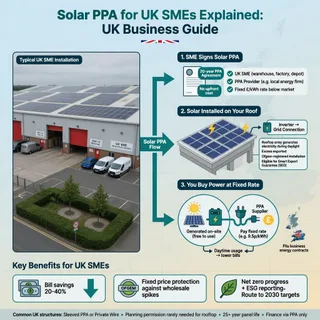
No upfront cost commercial solar UK means a business hosts a photovoltaic array without paying the capital cost on the day of installation. A developer, funder or finance provider pays for the equipment. The business pays over time through a power purchase agreement, a lease or rental, or by granting rights over the roof and the electricity. It is not free power, a grant, or a guaranteed saving against the grid. Fit depends on creditworthiness, roof life, daytime use, landlord consent and the local network connection, including any export limit. In market usage, “funded install” is a commercial description, not a regulated product name. It does not mean a public grant is attached. It does not mean the occupier owns the plant because it is fixed to the building. A domestic free-solar advert does not apply to a limited company. The Feed-in Tariff is closed to new applicants, so it should not appear in the economics of a new arrangement. Any payment for exported electricity depends on a separate current arrangement and should be written into the offer, not assumed. Three contracts are often bundled under the same search. A behind-the-meter power purchase agreement usually leaves the equipment with the funder and sells on-site generation to the business. A roof lease, sometimes called rent-a-roof, can leave both the system and the power with the funder, so cheaper electricity is not automatic unless a supply agreement says so. An equipment lease or hire purchase sits between them: payments replace the capital outlay, and ownership at the end is a clause, not a consequence of whose roof the panels sit on. Funded commercial solar exists. Check whether the party who signs can stay for the term, whether the roof and the daytime load will support a funder’s return, and whether the price, the exit terms and the connection are acceptable beside buying the system or remaining on grid import.
Who owns the equipment and what you pay instead
Under a behind-the-meter power purchase agreement the funder usually owns the panels and inverters, and the business buys electricity generated on site at an agreed price. A roof lease can leave both the system and the power with the funder. An equipment lease or hire purchase replaces a capital sum with payments, and ownership at the end depends on the contract rather than on the building. Instead of the upfront cost, the business may pay a unit rate for metered on-site generation, a lease or rental, or give away the value of the roof and the export. Giving the roof and the export away can mean the occupier pays nothing in cash and may also receive nothing in cheaper power. A unit price can be fixed, indexed, or linked to the grid tariff. A discount to today’s import rate is an outcome of one draft, not a feature of the phrase, and indexation can narrow or remove that gap well before the term ends. Ownership of export revenue is a separate question from ownership of the modules. Hosting the array does not, by itself, give the occupier the export income, the right to alter the roof, or the right to report the electricity as renewable. Those rights sit where the contract puts them. Claims that an offer is off balance sheet, maintenance-free or a guaranteed saving should be checked against the draft and, for the accounting point, against current standards with the business’s own adviser. They are not rules of the technology.
Overview
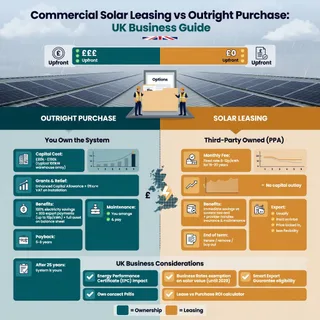
Treat that table as a set of questions for the heads of terms, not as a description of any named product. Two documents both called a power purchase agreement can allocate export income, maintenance and early exit in opposite ways. Compare the draft, not the cover title.
How funded solar compares with grid electricity
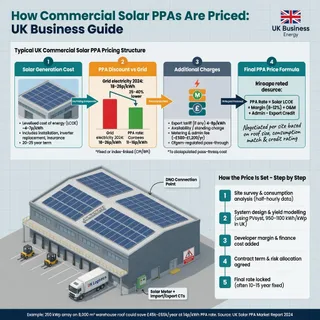
A funded array does not automatically beat grid electricity. The fair comparison is the contract price, including indexation and any extra metering or service charges, set against the business’s own import rate for the kilowatt-hours it will actually use on site. Staying on the grid remains rational where daytime use is thin, the roof will not last the term, or the exit terms are unacceptable.
Commercial solar versus grid electricity for UK businesses should not be tested against a domestic tariff or a headline discount printed on a leaflet. Import prices, standing charges and time-of-use patterns differ by contract. Export is usually worth less, to whoever receives it, than power that avoids an import. Under some roof leases the occupier sees neither benefit. A national bill-saving figure for funded commercial solar is not established. A shaded urban roof should not be given the same yield story as an unshaded south-facing roof in southern England.
Buying the system outright, or borrowing to buy it, moves the capital and the long-term benefit to the business. That can be the better route when the occupier wants control, expects to keep the site, and would rather keep export income and any future change of use. It is not automatically better. The business then carries performance, connection and roof risk, and it still needs the same survey and the same network application. The absence of a funder does not remove those. What changes the quote, on either route, is system size, roof type, region, the cost of money, credit, how much generation is used behind the meter, and whether export is capped. Warehouse-scale arrays are often cheaper per kilowatt to build than small office or shop systems, because access and electrical work are spread over more generation. That is a direction of travel, not a price. No installed cost, agreement rate or payback should be treated as a UK market rate without a current cited source, and none is used here.
Which UK warehouses, offices and shops can be funded
Funders generally need a creditworthy counterparty, a roof that will last the contract, and enough on-site consumption that the power is worth more as avoided import than as export. A warehouse with a large, lightly loaded roof can be a weaker prospect than a smaller office or shop with steady daytime demand. Roof area alone does not make a site fundable.
Commercial solar panel cost for UK warehouses is not a single national figure, and the build cost is not the price the occupier is offered. A funder’s unit rate or rent reflects interest rates, the covenant of the party signing, predicted on-site use, any export cap and the length of the commitment. An empty or night-shift shed can look ideal from the road and still fail the offtake test. An occupied warehouse with process plant running through the day is a different proposition, even on a smaller roof.
Commercial rooftop solar for UK offices often turns on load shape and lease length rather than on spans of felt. Daytime occupancy, IT and ventilation can make a modest array attractive, provided the remaining lease, or the freehold, covers the term and the landlord will sign if the occupier does not own the structure. Plant rooms are often tight. Inverter location, ventilation and a cable route to the intake are design items, not details to leave until after heads of terms. Solar for UK retail parks and shops can work, but only when three roles are identified: roof owner, occupier and electricity account holder. They are often different parties. Consent, access for maintenance, metering and who receives the benefit have to be agreed before a funder will spend money on design. A shop on a single-phase supply may still be connectable. Inverter size and export are more constrained than on a three-phase industrial intake. Check the local network operator’s current process rather than copying a domestic job. Orientation, shading, structural capacity, remaining roof life, fragile coverings and unmanaged asbestos all change whether a funder will proceed. So does a listed building or a sensitive location. Planning and permitted development differ by nation and by building type, in England, Scotland, Wales and Northern Ireland. Consent has to be confirmed. It should not be assumed from a neighbouring scheme.
How a commercial solar G99 DNO connection changes the offer
Paying nothing upfront does not remove the need for a network application. Many commercial systems are too large for the simplest notification route and need a formal application to the distribution network operator, commonly handled under the G99 framework, sometimes with an export limit. Kilowatt thresholds should not be treated as fixed. The current engineering recommendation, and the process used by the operator for that site, need checking.
In Great Britain the application goes to the distribution network operator for the area, such as UK Power Networks, National Grid Electricity Distribution, Northern Powergrid, Electricity North West, SP Energy Networks or SSEN. Each has its own queue, design standards and offer conditions. Northern Ireland is a separate network and consent regime, so a Great Britain assumption should not be copied across. Not funding the capital does not make the connection someone else’s informal courtesy. The funder, the installer and the occupier still need a defined equipment list and defined protection or export settings.
An export cap can shrink the array a funder will build, or cut the value of surplus power, and that feeds into the price offered to the business. If one proposal assumes unconstrained export and another assumes a cap, they are not the same system and should not be compared as if they were. Where generation must be limited, that limit belongs inside the performance assumptions the price was based on. Changing the inverter, adding battery storage, or altering the export limit later can cause both the operator and the funder to treat the job as a new proposal. Metering is part of the connection, not a footnote. Half-hourly or export metering, an export supply number, inverter location and space for switchgear are install items. Larger sites often already have interval data, which is what a funder will want to see before trusting an offtake story. A smaller shop without interval data can still be assessed, but the load assumption should be visible in the contract rather than buried. Ask for the connection assumption in writing before you rank offers on price.
What the contract must settle before you sign
The brochure price is not the deal. Before anyone signs, the contract needs to state who owns the plant, how the price can move, the minimum term, what early exit or a sale of the business costs, and what happens to the equipment and the roof at the end. Those points decide whether the offer is finance, a supply contract, or a disposal of roof rights.
A typical UK contract length is not established here, and this guide will not invent one. Expect a long commitment rather than a short rolling hire, and read the number in the draft. Early termination is rarely a simple notice period with no cost. Ask for the exit mechanism in plain figures or a defined formula, including removal and roof reinstatement if the panels have to come off. If the business may be sold, ask whether the agreement can be assigned and on what conditions. That is a suitability test, not a legal technicality to leave to completion.
On a let building, the solar term and the occupational lease have to be read together. Dilapidations at lease end can require a clear roof, while a solar contract may assume the panels stay for decades. Landlord consent, access, and who may walk the roof for other plant, all need to sit in both documents. The party with the covenant the funder will accept may be the landlord, not the tenant who uses the power. Signing the wrong entity is a common way for a promising survey to die in legal review. Four questions should be answered in the heads of terms, in the same words, for every offer you compare.
Operations, insurance, inverter replacement and the right to report the power as renewable should name a responsible party and a named right, not an assumption. Manufacturer warranties are often discussed in multi-decade terms for modules and in shorter terms for inverters, but warranty length is not economic life, and exact terms differ by product. If a proposal will not answer these points in writing, it is not comparable with one that will.
When a no-upfront-cost offer is a poor fit
Funded commercial solar is a poor fit when the business may leave within a few years, the landlord will not engage, or the roof and the network leave little value for a funder. It is also the wrong tool when the occupier wants control of the asset, the export income and the freedom to alter the building. A capital purchase or a loan can then fit better, even though the business funds the system itself.
Creditworthiness matters because the funder is taking payment risk over a long term. A weak covenant, a short remaining lease, or a landlord who will not join the agreement will usually stop the offer regardless of roof area. Sites that expect to sell, relocate or redevelop should treat assignment and termination costs as a reason to walk away, not as paperwork for later. Adding a shift, losing a shift, sub-letting, or installing other plant can undermine the offtake the price was built on. Ask what happens if operating hours fall, including whether any minimum purchase is implied.
The building can fail the test on its own. A roof that needs replacement, a covering the roofer will not warrant once it is penetrated, heavy shading, or an export limit that strands most of the generation, leave little for a funder to price. Unmanaged asbestos and fragile coverings on older UK industrial roofs are a frequent stop. They need competent identification before design, not a visual check from the yard. Multi-let retail can still proceed where ownership, access and metering are clear. Where they are not, the delay is structural, not administrative. Batteries, backup power and environmental claims need the same honesty. Rooftop solar does not, as standard, keep the site running in a power cut. Islanding is a different design and usually a different network conversation. Storage can improve on-site use, but only if the contract allows it and states who owns the stored energy. The right to treat the electricity as renewable, for reporting or for any certificate, is a contract point. Hosting the panels does not confer it. VAT and business rates can also change the economics. Current treatment should be verified with the business’s adviser, and for rates with the Valuation Office Agency in England and Wales or the relevant body in Scotland or Northern Ireland. Reliefs and tax rules have changed before, and they are not identical across the UK. None should be assumed to apply to a new scheme.
What the roof survey and connection design must prove
The points that decide whether a funded offer survives are usually found at survey, not in the advert. Structure, covering type, drainage, roof warranty, cable route to the intake, metering and space for switchgear all change the design. A visual look by the occupier is not a structural sign-off, and it is not an asbestos survey.
In practice the sequence is closer to a credit and building test than to a panel layout. Identify who can sign and who holds the electricity account. Check the remaining lease and whether the landlord will engage. Review bills or half-hourly data for daytime load. Survey structure, covering, drainage, wind and access, and how cables reach a three-phase intake where there is one. Agree inverter location and switchgear space. Only then should a price be fixed against a defined export position and a defined offtake. Change the equipment list after the network offer, and both the operator and the funder may reopen the job.
Older UK industrial roofs often raise asbestos cement, fragile sheets and load-spread issues. Flat membrane roofs raise ballast versus penetrations, drainage paths and wind uplift. Metal roofs raise clamps, penetrations and whether the roofing contractor will still honour a warranty. Penetrations can void that warranty, so the contract should say who repairs leaks, who may access the roof, and who pays if another trade damages the array. The occupier should not sign a side letter saying they have confirmed the roof is sound. Fire-service isolation, labelling and where inverters sit are design duties, not branding. Do not assume a domestic certification badge is either required or sufficient for a commercial funded scheme. Ask which installation standard and which product warranties the funder is relying on, and keep those documents with the agreement. Insurance of the array, storm damage, and damage during other roof works need a named responsible party. Building insurers may also need to be told that the roof use has changed. None of that appears in a consumer solar advert, and all of it can move the price or stop the install after a first visit.
How to compare a funded offer with buying the system
Judge the offer by putting the same site facts under each route: a funded power purchase, a lease, a capital purchase, and remaining on grid electricity. Do not accept a national saving, a typical payback or a generic discount to the grid. Those figures are site-specific, they move with tariffs and interest rates, and they are not stated here because a current cited UK rate was not available. Ask for the assumptions behind any illustration, then test them against your own bills and your own lease.
Before you invite proposals, gather twelve months of electricity bills if you have them. Note whether the supply is half-hourly. Record the lease expiry and whether you own the roof. List any planned changes to hours, tenancy, heating, cooling or vehicle charging. Those changes alter both offtake and the connection. A photograph of the intake is a starting point for the designer, not a design. Ask each funder the same questions, in writing: who owns the plant, how the price moves, what exit costs, what the network offer assumes, and what happens to the roof at the end.
Set the funded route beside ownership only after those answers match. A lower year-one unit rate that is indexed, capped by the network, and paired with an expensive exit can be worse than a capital purchase the business can actually live with. It can also be better than tying up capital in a roof the business does not control. The decision is commercial, and it is allowed to be “not this site” or “not this contract”. A structured view of installation routes, written so those contractual differences can be compared on the same site facts, is set out in the commercial solar installation comparison. Use it to frame questions for installers and funders. It is not a substitute for the draft contract, the structural survey, or the distribution network operator’s offer.
Plan, Compare & Buy Renewable Energy Solutions
AI does the thinking.
You get the perfect solar match.
Use RoboMo™ to assess your property, compare available technologies and connect with trusted UK installers, suppliers and manufacturers.
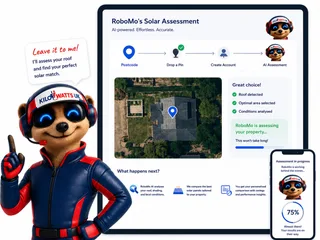
Simply enter your postcode, drop a pin on your roof, create your free account and let RoboMo™ analyse your property to find the best solar panels for your home.

You don't have to think
RoboMo™'s AI analyses your roof and does all the hard work.

Accurate & tailored
AI-powered assessment based on your roof, location, and conditions.

Best options, maximum savings
Compare top solar panels for the best performance and value.

Simple, fast & effortless
Provide a few details, sit back and watch your results unfold.
STEP 1
Choose Home, Business or Industrial
Enter your postcode to start your assessment.
STEP 2

Drop a pin on your roof
STEP 3

Create your free account
STEP 4

Sit back and watch RoboMo™ work
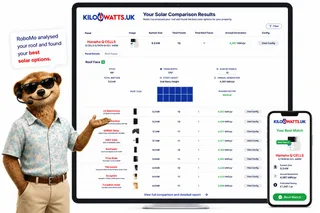
RoboMo™ analyses your roof and builds your personalised solar comparison.

Kilowatts UK is an authorised representative
Flower Turbines
Compact vertical-axis turbines built for real UK sites, not just open farmland.
They start in light wind, sit in a small footprint, and are bird-safe by design. Cluster them as a bouquet and the group performs better together than the same turbines standing alone. Enter your postcode for a location-based generation estimate. Figures use area weather data and will differ if buildings, trees or hills sit in the way.
Starts in light UK wind
Built to generate in typical UK wind, not only open farmland.
Small rooftop or ground footprint
Compact towers for roofs, yards and tight sites.
Bird-safe slow rotation
Slow vertical-axis spin, bird-safe by design.
Bouquet clusters raise output
Grouped turbines outperform the same units standing alone.
Step 1
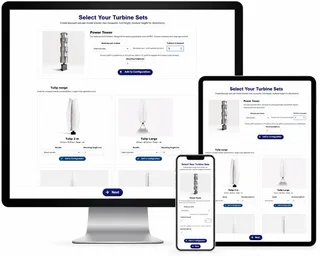
Enter your postcode
Start designing your wind energy system in seconds.
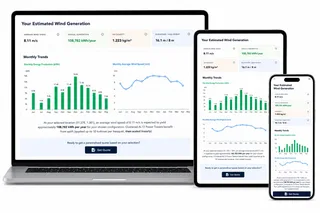
STEP 2

Choose a location
STEP 3

Place your cluster
Tap the map where you want the turbine cluster to go.
STEP 4

Instant generation forecasts
Compare different turbine layouts and see annual generation forecasts instantly.
STEP 5

No commitment required
Explore different configurations before deciding whether to request a quotation.
Related articles
Solar panels
Mo's Mission Nominations
FAQ
Need Help? RoboMo's Got Answers
What does no upfront cost commercial solar mean in the UK?
It means a business hosts a photovoltaic array without paying the capital cost on the day of installation. A developer, funder or finance provider pays for the equipment, and the business pays over time through a power purchase agreement, a lease or rental, or by granting rights over the roof and the electricity. In market usage, a funded install is a commercial description, not a regulated product name. A domestic free-solar advert does not apply to a limited company.
Is no upfront cost commercial solar free electricity or a grant?
No. It is not free power, a grant, or a guaranteed saving against the grid. The business pays through a unit rate, a lease payment, or by transferring the value of the roof and the generation to the funder. The Feed-in Tariff is closed to new applicants, so it should not appear in the economics of a new arrangement. Any payment for exported electricity depends on a separate current arrangement and should be written into the offer, not assumed.
Who owns the equipment, and what do you pay instead?
Under a behind-the-meter power purchase agreement the funder usually owns the panels and inverters, and the business buys electricity generated on site at an agreed price. A roof lease can leave both the system and the power with the funder, so cheaper electricity is not automatic unless a supply agreement says so. An equipment lease or hire purchase replaces a capital sum with payments, and ownership at the end depends on the contract rather than on whose roof the panels sit on. Hosting the array does not, by itself, give the occupier the export income, the right to alter the roof, or the right to report the electricity as renewable.
Does funded commercial solar always cost less than grid electricity?
No. Compare the contract price, including indexation and any extra metering or service charges, with the business's own import rate for the kilowatt-hours it will actually use on site. A discount to today's import rate is an outcome of one draft, not a feature of the phrase, and indexation can narrow or remove that gap before the term ends. Staying on the grid can still make sense where daytime use is thin, the roof will not last the term, or the exit terms are unacceptable. A national bill-saving figure for funded commercial solar is not established.
Which UK warehouses, offices and shops are more likely to be funded?
Funders generally need a creditworthy counterparty, a roof that will last the contract, and enough on-site use that the power is worth more as avoided import than as export. Roof area alone does not make a site fundable: an empty or night-shift warehouse can fail that test, while a smaller office or shop with steady daytime demand can be stronger. On a let building, the remaining lease or the freehold needs to cover the term, and the landlord usually has to consent if the occupier does not own the structure. For shops and retail parks, the roof owner, occupier and electricity account holder are often different parties and should all be identified before design spend.
Does paying nothing upfront remove the need for a network connection?
No. Many commercial systems need a formal application to the distribution network operator, commonly handled under the G99 framework, sometimes with an export limit. Kilowatt thresholds should not be treated as fixed: check the current engineering recommendation and the process used by the operator for that site. In Great Britain the application goes to the local distribution network operator; Northern Ireland is a separate network and consent regime. An export cap can shrink the array or reduce the value of surplus power, so ask for the connection assumption in writing before ranking offers on price.
What must the contract settle before you sign?
It should state who owns the plant, how the price can move, the minimum term, what early exit or a sale of the business costs, and what happens to the equipment and the roof at the end. A typical UK contract length is not established as a fixed market rule, so expect a long commitment rather than a short rolling hire and read the number in the draft. Early termination is rarely a simple notice period with no cost, so ask for the exit mechanism in plain figures or a defined formula, including removal and roof reinstatement. On a let building, read the solar term and the occupational lease together, because dilapidations may require a clear roof while the solar contract assumes the panels stay.
Is buying the system outright automatically better than a funded deal?
Not automatically. Buying outright, or borrowing to buy, moves the capital and the long-term benefit to the business, which can suit an occupier who expects to keep the site and wants control of export income and future changes of use. The business then carries performance, connection and roof risk, and it still needs the same survey and the same network application. Compare the draft rather than the cover title, because two documents both called a power purchase agreement can allocate export income, maintenance and early exit in opposite ways.