


Investor-backed commercial solar finance: UK business guide
Published: 2026-09-29 00:37:51
Updated: 2026-09-30 23:52:17
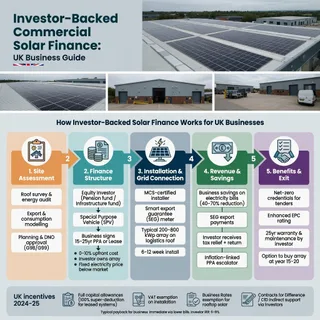
Investor-backed commercial solar finance means a fund owns the UK array. The host buys the power or rents the roof, and does not buy the plant.
Investor-backed commercial solar finance - UK business guide
UK business guide B Solar third-party owned arrays
Investor-backed commercial solar finance UK explained
Investor-backed commercial solar finance in the UK means a third party funds and owns the solar array on a business site. The host supplies the roof or land and either buys the power, usually under an on-site power purchase agreement, or takes a rent for the space. It is not the same as buying the system or borrowing to own it. The decision turns on roof life and structure, daytime electricity use, lease length and landlord consent, offtaker credit, and whether the local network can connect the generation.
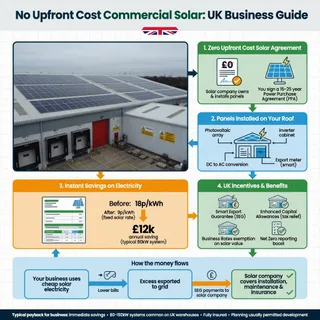
Facilities, finance and sustainability leads usually look at this route when they want generation without committing the firm's own capital. Zero-capex and free solar are labels for that same third-party ownership idea. They describe who pays for the plant. They do not remove the contract, the multi-year commitment, or a price for power. For the contract term, ownership, operation and the right to export or sell surplus usually sit with the investor, subject to the agreement.
Read any proposal by separating three questions: who owns the asset, who must take or pay for the electricity, and who may alter the roof or end the deal early. Those answers change the risk more than a headline rate. Building type does not set a price. This article does not quote a cost per kilowatt, a discount to grid import, a minimum system size or a standard contract length, because those figures are negotiated and are not fixed in any official schedule used here.
How a third-party owned array is contracted
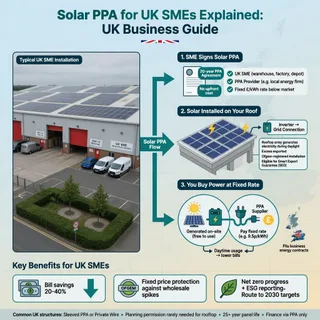
A third-party deal is a property and power contract, not a discount on a system the business will own. In the usual on-site power purchase agreement, often called a PPA, the investor pays for design, equipment and installation, keeps title to the plant, and sells the host electricity the array produces while the site is using power. Any benefit to the host is the gap between that agreed price and the import cost it avoids. Surplus the site does not use may be exported, and that export value usually stays with the investor unless the contract shares it.
A roof lease or roof rental reverses the payment. The host, or more often the landlord, grants a right to occupy part of the roof or land and may receive rent. The investor's revenue then comes from export, a private wire, or a sleeved supply to a meter that is not on the same site. That last route is easy to underestimate. Generation and consumption on different meters means extra metering, a supply interface, and a clear answer on who the energy customer is. It is not a case of landing an inverter on a distribution board and walking away.
Under a loan, hire purchase or asset finance, the business owns the asset and owes a lender. Under investor finance, the business usually does not own the plant, may not control alterations, and owes performance of a host or offtake contract instead. Operation and inverter replacement are often the investor's job, which shifts that risk, but only inside the wording. If the host prevents generation, some agreements deem an output and still require payment. That clause belongs in the first reading, not in a later dispute.
Which finance route fits the site
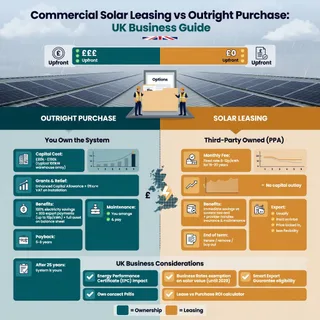
Choosing a route is about control as well as cash. Owning the array, from cash or from finance, leaves the business with the asset, the export position and responsibility for performance. Hosting an investor's array avoids that capital spend and shifts maintenance, but it ties up the roof for long enough for the investor to recover its outlay. No published schedule relied on here says one route is cheaper. Equipment prices, interest rates, site yield and offtaker credit all move the terms, so a figure in a brochure is a proposal, not a market rate. The table sorts the paperwork. It is not a price list, and it does not show discounts, yields or payback, because those are unknown until the site is modelled against a current offer.
Overview
A private-wire or sleeved supply can sit beside either investor route when the array and the consuming meter are not co-located, for example across a campus or between landlord and tenant supplies. It does not remove the need for a connection agreement, and it can make the offtaker harder to name. Firms that want control of roof alterations, or that want to test whether any owner-side tax treatment exists, should price an owned system on the same roof and the same load file. A qualified adviser has to confirm tax, VAT and rates. Nothing in a sales summary should be treated as a relief that currently applies.
What investors check on warehouses, offices and shops
Investors do not fund a roof because it looks large on a satellite image. The first filters are remaining life of the covering, structural capacity, shading, orientation, and whether the site can use a meaningful share of daytime generation. A warehouse with a broad, lightly shaded roof and a steady daytime process load is a different proposition from a shop whose trade is in the evening, or from an office whose lease ends before a fund could recover capital. On retail parks and multi-let buildings, the party who controls the roof is often not the party who pays the electricity bill.
Questions about commercial solar panel cost for UK warehouses, commercial rooftop solar for UK offices, or solar for UK retail parks and shops all meet the same limit. There is no single official price, and this article does not invent one. What changes a quote is physical. A covering whose warranty is voided by penetrations may force a ballasted design, which changes weight and therefore the structural case. A roof that is watertight today can still be refused if its remaining life is shorter than the contract the fund needs. Parapets, soiling and neighbouring structures change yield even when two buildings share a postcode. No national kilowatt-hour figure is stated here for any building type.
Metering is part of the finance, not a late extra. Half-hourly import data, a clear MPAN arrangement, space for generation and export metering, and agreement on who owns those meters are what make a power price meaningful. Without that file, a fund is guessing how much import the array will displace. Ask for the survey scope in writing before exclusivity: a structural assessment, a roof condition report, and a statement on how the design treats the covering warranty.
Commercial solar G99 DNO connection UK
The network application is often what decides whether a funded project is real. Commercial generation normally needs an application to the host distribution network operator, commonly under the G99 process rather than the small-scale G98 route. Where the network cannot take full export, the design may include export limitation, sometimes discussed with G100. Exact capacity thresholds, forms, fees and timescales are not stated here. They must come from current Energy Networks Association recommendations and from the distribution network operator that covers the site, not from a previous job in another region.
The connection sits on the path to financial close, not after it. A roof can be buildable and still stall when the offer arrives with an export limit or a reinforcement cost. Either result can shrink the array, change the investor's return, or stop the project after survey cost has already been spent. An export limit affects the host as well as the fund. It can reduce the capacity that gets built, which reduces how much import the host can offset. Before granting exclusivity, agree who pays for the application and who carries reinforcement if it appears.
Planning is a separate gate from the network. Rules differ between England, Wales, Scotland and Northern Ireland, and a listed building or a conservation area can take a scheme off any permitted-development route that might otherwise exist. Do not assume a warehouse roof is acceptable because a similar building nearby has panels. The investor's advisers will also look at crane and maintenance access, and at whether those rights survive a change of tenant.
Commercial solar versus grid electricity for UK businesses
The useful comparison is energy the site would have imported, not export payments. In an on-site arrangement, the usual value is the imported kilowatt-hours the array displaces while the building is drawing load. Kilowatts describe the size of the plant. Kilowatt-hours describe the energy actually used or generated. A large array does not help the import bill if daytime consumption is small. Export is a different product, often paid at a different rate, and under investor ownership that revenue frequently does not reach the host.
A PPA rate is not guaranteed to stay below the business's grid import price for the whole term. Import prices move. A fixed price, or one that indexes, can finish the term higher or lower than the import rate the host then faces. Standing charges are often barely touched by on-site generation, because they are not a unit rate. Time-of-use periods matter too. Solar output is weighted to the middle of the day, so a business whose expensive periods are early evening may see less displacement than an annual average suggests.
Indexation, a minimum offtake and deemed-generation clauses can matter more than the opening unit rate, which should be read only inside a current proposal. If real daytime use is lower than the file used to price the deal, those clauses can leave the business paying for electricity it did not need. Do not treat the Smart Export Guarantee, or any unnamed grant, as available to an investor-owned commercial array without a current eligibility check. This article does not state that any incentive applies.
Property rights, tax questions and exit terms
If the business does not control the roof for the whole contract, the finance often cannot be completed, however good the irradiance looks. Many commercial roofs are leased. A fund will look for a right that survives the tenant leaving, for landlord consent, for maintenance access, and for a clear position on removal and making good. A tenant with a cooperative landlord and a long unexpired term can still be a fit. A tenant who cannot bind the roof beyond a break clause usually cannot complete the finance, even when the covering is ideal.
The clauses that surprise hosts are rarely in the sales summary. Contracts often restrict alterations, set a buyout or termination sum if the plant must come off for a roof replacement, a refinance or a sale, and allow the investor to assign the agreement to another fund. Deemed output can require payment if the host's own works stop the array generating. Responsibility for inverter replacement, monitoring and safe access should be named. Notify the building insurer before works, and align any licence to alter with the dilapidations position so a later roof dispute is not left between three parties.
Tax and rates are outside an installer's competence to certify. The accounting treatment of a PPA can differ from a loan even when the cash flow looks similar. Business rates, VAT and any capital allowances depend on the contract structure and on current law. Have a qualified adviser review the draft against this building. Do not rely on a relief, a rate or an exemption named in a brochure unless that adviser confirms it applies.
When investor finance is the wrong tool
The model suits UK businesses with credible long-term occupation of a suitable roof or site, daytime electricity use, and a preference to keep capital off the project. Owner-occupiers are the cleanest fit. Tenants can work where the lease is long enough and the landlord will sign the documents the fund requires. Offtaker credit matters because the investor is paid over many years by the host, or by whoever the contract names. A weak covenant can end a conversation that the roof itself would have passed.
It is a poor fit where the lease is short, the covering needs replacement inside the contract horizon, the structure cannot take the load, or shading and orientation leave the yield too weak for the investor's required return. No return figure is stated here. A large retail roof with little daytime load can still fail an on-site PPA, because there is not enough import to displace. The same site might interest a fund only if another revenue route exists, and that route may not suit the landlord. Listed buildings, a severe network constraint, a likely change of use, or a period of vacancy can make the finance unavailable even when a technical install is possible.
Wanting to own the asset is a valid reason to refuse the model. If the business wants control of roof works, wants the export position, or wants to test whether owner-side tax treatment is available, price a purchase or an asset-finance route beside any investor offer. A warehouse, an office and a shop can each go either way once lease, load and connection are known. Building type does not decide it.
What to prepare before you invite proposals
Before you invite funds or installers to price the site, assemble the facts they will ask for anyway. A representative run of half-hourly import data, the occupational lease with break dates, the landlord's identity, and any existing roof warranty or recent condition report will stop a round of speculation. Note which MPAN serves the load you hope to offset, whether landlord and tenant meters are separate, and whether there is physical space for generation metering and switchgear. If a roof replacement or a change of tenant is already planned, say so at the start.
Treat early paperwork as a filter, not as a commitment to proceed. Ask who applies to the distribution network operator, what happens if the offer limits export or prices reinforcement, and whether design fees are payable if the connection fails. Compare an owned option on the same roof report and the same load file, so the investor route is a choice rather than the only paper on the table.
Proposals are comparable only when they rest on the same surveys, the same consumption file and the same connection assumption. If you are still choosing between owning the array and hosting an investor's plant, comparing commercial installation routes is a sensible step before you negotiate a power price or a roof rent. Take the draft contract, not the summary slide, to your property and tax advisers before anyone is given exclusivity over the roof.
Plan, Compare & Buy Renewable Energy Solutions
AI does the thinking.
You get the perfect solar match.
Use RoboMo™ to assess your property, compare available technologies and connect with trusted UK installers, suppliers and manufacturers.
Simply enter your postcode, drop a pin on your roof, create your free account and let RoboMo™ analyse your property to find the best solar panels for your home.

You don't have to think
RoboMo™'s AI analyses your roof and does all the hard work.

Accurate & tailored
AI-powered assessment based on your roof, location, and conditions.

Best options, maximum savings
Compare top solar panels for the best performance and value.

Simple, fast & effortless
Provide a few details, sit back and watch your results unfold.
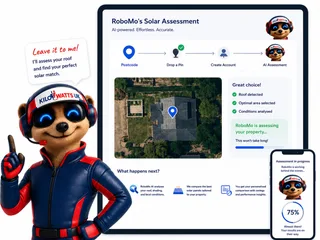
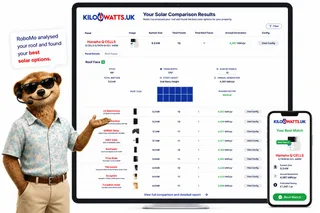
STEP 1
Choose Home, Business or Industrial
Enter your postcode to start your assessment.
STEP 2

Drop a pin on your roof
STEP 3

Create your free account
STEP 4

Sit back and watch RoboMo™ work
RoboMo™ analyses your roof and builds your personalised solar comparison.

Kilowatts UK is an authorised representative
Flower Turbines
Compact vertical-axis turbines built for real UK sites, not just open farmland.
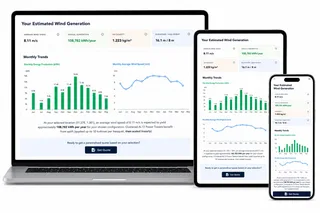
They start in light wind, sit in a small footprint, and are bird-safe by design. Cluster them as a bouquet and the group performs better together than the same turbines standing alone. Enter your postcode for a location-based generation estimate. Figures use area weather data and will differ if buildings, trees or hills sit in the way.
Starts in light UK wind
Built to generate in typical UK wind, not only open farmland.
Small rooftop or ground footprint
Compact towers for roofs, yards and tight sites.
Bird-safe slow rotation
Slow vertical-axis spin, bird-safe by design.
Bouquet clusters raise output
Grouped turbines outperform the same units standing alone.
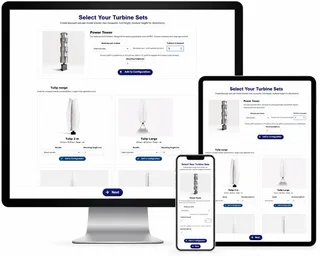
Step 1
Enter your postcode
Start designing your wind energy system in seconds.
STEP 2

Choose a location
STEP 3

Place your cluster
Tap the map where you want the turbine cluster to go.
STEP 4

Instant generation forecasts
Compare different turbine layouts and see annual generation forecasts instantly.
STEP 5

No commitment required
Explore different configurations before deciding whether to request a quotation.
Related articles
Solar panels
Mo's Mission Nominations
FAQ
Need Help? RoboMo's Got Answers
What is investor-backed commercial solar finance in the UK?
It means a third party funds and owns the solar array on a business site. The host supplies the roof or land and either buys the power, usually under an on-site power purchase agreement, or takes a rent for the space. It is not the same as a homeowner buying panels, or as a business buying the system or borrowing in order to own it. For the contract term, ownership, operation and the right to export or sell surplus usually sit with the investor, subject to the agreement. This guide does not set a domestic or commercial price, grant or standard contract length.
How does an on-site solar PPA differ from a roof lease?
Under a typical on-site power purchase agreement, the investor pays for design, equipment and installation, keeps title to the plant, and sells the host electricity the array produces while the site is using power. The host's benefit is the gap between that agreed price and the import cost it avoids, and surplus export value usually stays with the investor unless the contract shares it. A roof lease reverses the payment: the host or landlord grants a right to occupy part of the roof or land and may receive rent, while the investor's revenue comes from export, a private wire or a sleeved supply. Where generation and consumption sit on different meters, extra metering and a clear energy customer are required.
Does zero-capex or free solar mean the business pays nothing?
No. Zero-capex and free solar are labels for the same third-party ownership idea. They describe who pays for the plant, not a removal of the contract, the multi-year commitment or a price for power. If the host prevents generation, some agreements deem an output and still require payment. That clause should be read at the start, not left to a later dispute.
What do investors check on a warehouse, office or shop before funding solar?
The first filters are remaining life of the roof covering, structural capacity, shading, orientation and whether the site can use a meaningful share of daytime generation. A warehouse with a broad, lightly shaded roof and a steady daytime load is a different proposition from an evening-trade shop or an office whose lease ends too soon for the fund. On retail parks and multi-let buildings, the party who controls the roof is often not the party who pays the electricity bill. There is no single official price for any building type, and this guide does not quote one.
Can the grid connection or planning rules stop a funded commercial solar project?
Yes. Commercial generation normally needs an application to the host distribution network operator, commonly under the G99 process rather than the small-scale G98 route. Exact thresholds, forms, fees and timescales are not fixed here and must come from current Energy Networks Association recommendations and the distribution network operator for the site. An export limit or a reinforcement cost can shrink the array, change the investor's case or stop the project after survey cost has been spent. Planning is a separate gate, rules differ across England, Wales, Scotland and Northern Ireland, and a listed building or conservation area can take a scheme off any permitted-development route that might otherwise exist.
Is a commercial solar PPA guaranteed to cost less than grid electricity?
No. The useful comparison is the imported kilowatt-hours the array displaces while the building is drawing load, not export payments. A PPA rate is not guaranteed to stay below the business's grid import price for the whole term, because import prices move and a fixed or indexed price can finish higher or lower than the rate the host then faces. Standing charges are often barely touched, because they are not a unit rate. Indexation, a minimum offtake and deemed-generation clauses can matter more than the opening unit rate in a proposal.
Can a tenant use investor finance if they do not own the building?
Only where the lease is long enough and the landlord will sign the documents the fund requires. A fund will look for a right that survives the tenant leaving, landlord consent, maintenance access, and a clear position on removal and making good. A tenant who cannot bind the roof beyond a break clause usually cannot complete the finance, even if the covering is ideal. Owner-occupiers with credible long-term occupation are generally the cleaner fit, and a short lease, a roof due for replacement, or a structure that cannot take the load is a poor fit.
What should a business check on exit terms, tax and incentives before signing?
Read who owns the asset, who must take or pay for the electricity, and who may alter the roof or end the deal early. Contracts often restrict alterations, set a buyout or termination sum if the plant must come off, and allow the investor to assign the agreement to another fund. Business rates, VAT and any capital allowances depend on the contract structure and on current law, so a qualified adviser should review the draft for this building. Do not treat the Smart Export Guarantee, or any unnamed grant, as available to an investor-owned commercial array without a current eligibility check.