


Solar panel installation in Ashford starts with the roof
Published: 2026-10-06 01:20:13
Updated: 2026-10-07 12:14:12
Solar panel installation in Ashford depends on roof condition, listing and the network route. A survey, not the town name, makes a quote real.
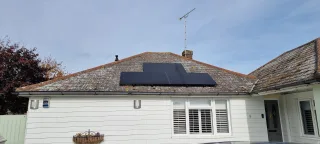
Solar panel installation in Ashford
Solar panel installation in Ashford from Kilowatts.uk in Broadstairs. Costs, roofs, planning and what to do next then compare a local system.
Solar panel installation in Ashford starts with the roof and the supply
Solar panel installation in Ashford means fitting a grid-connected photovoltaic system on a home in the Kent town or surrounding district, then connecting it so the household can use the electricity and export surplus. The job is the survey, design, mounting, electrical work, commissioning and paperwork, not only the modules. Suitability turns on roof condition, shading, ownership, planning constraints, the network connection route and daytime electricity use.
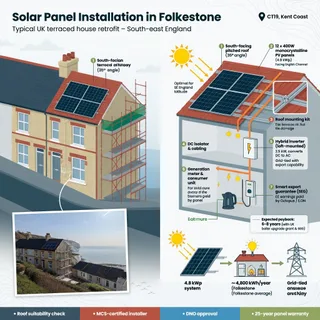
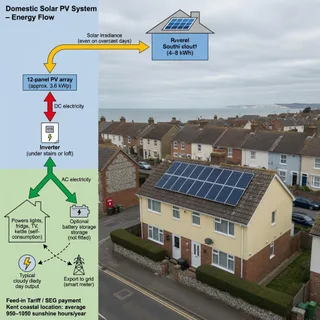
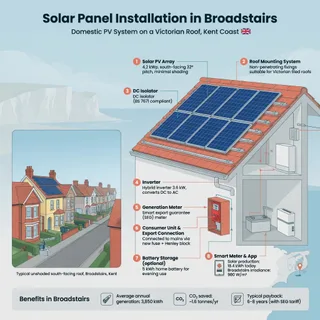
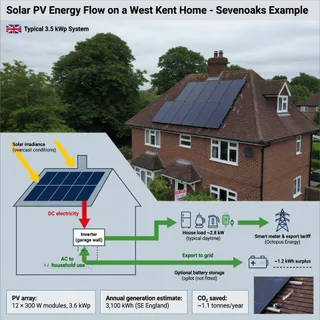
A basic system is modules, roof fixings, cabling, an inverter or microinverters, isolation and protection, and usually a generation meter. Battery storage and an EV charger are separate additions. They are not required for a competent PV install, and they should be decided after the roof and connection are clear. A hybrid battery can also change the connection even when the array itself looks small, so it should not be added after the network paperwork is already filed.
Ashford is not one roof type. Newer estates with simple tiled pitches and good access are often straightforward once surveyed. Older streets can mean slate, awkward access, party walls and limited space for an inverter. A shaded north-facing roof can still be a poor candidate even for solar in Kent, where south-east England is generally favourable for irradiance within the UK. That regional context is not a yield figure for your house.
What a survey has to record before a quote is real
A usable survey records construction, rafter or truss spacing, covering type, pitch, orientation and how fixings will be weathered. Tile, slate and flat-roof systems are not interchangeable. The surveyor should also note shade across the day from trees, chimneys and neighbouring buildings, not only a snapshot at midday.
Cable routes through the loft, fire stopping, and where the inverter and isolators will sit often surprise people in small terraces. Heat and a little fan noise matter if the only spare wall is beside a bedroom. External wall space, meter position and consumer-unit spare ways decide whether the electrical side is a short addition or a larger upgrade.
The installer should identify the distribution network operator from the supply details, not from the town name. In much of Kent that operator is UK Power Networks, but the correct operator has to be confirmed for the postcode, usually from the supply number. Existing supply capacity, earthing and whether the consumer unit can take the new circuits belong in the same visit. A panel-only price that ignores scaffold, access, bird protection or a rotten batten is incomplete. A local quote is only comparable when it itemises the job, not when it quotes a module count.
Planning, building control and the network are different checks
England’s permitted-development route for domestic solar is set out in the Town and Country Planning (General Permitted Development) (England) Order 2015, Part 14, and summarised on the Planning Portal. It often covers roof-mounted equipment on dwellinghouses, but only if the conditions are met. Those conditions cover matters such as how far equipment projects and where it sits. They are not a blanket permission for every Ashford roof, and a blog is not the decision.
The practical constraint check is an address search, not a town-name assumption. Ask Ashford Borough Council, or use its planning constraints records, whether the property is listed, whether an Article 4 direction removes permitted-development rights, and whether it sits in a conservation area. Then compare the proposed mount (pitched roof, flat roof, wall or ground) with the current Part 14 conditions. Listed building consent is a hard stop until it is resolved, and it is separate from planning permission. An Article 4 direction is also a stop until you know whether solar rights have been removed on that street. Leaseholder or freeholder consent is a property-law stop even when no planning application is needed.
Conservation-area status and flat-roof mounts should not be treated as an automatic full application. They are conditional permitted development: some positions stay within Part 14, others do not. Flats are similar. Part 14 can cover solar equipment on a block of flats, but the conditions are not identical to a house, and a lease almost always needs written consent before anyone is on the roof. Ground-mounted arrays and some non-roof locations fall outside the usual house-roof route and need their own check. Electrical work must meet Building Regulations and be notified through a competent-person scheme or building control. Grid connection is a third process, with the network operator. The customer is the person the connection is for, but a competent quote names who submits the forms. At quote stage the usual England split is a connect-and-notify route for smaller microgeneration, often described under ENA Engineering Recommendation G98, versus an application before connection for larger or more complex plant, often under G99. Thresholds, fast-track options and hybrid arrangements change, so the quote should state which route is assumed for this array and this supply. Confirm that against current UK Power Networks connection guidance, or the guidance of whichever operator the postcode actually uses. Export limitation is part of that split, not optional paperwork added at the end. On a constrained network the operator may allow the system only if export is capped. Self-use can still be uncapped while export is limited, but the inverter or a separate limitation scheme has to be designed for that offer. If the survey finds the assumed route was wrong, the equipment list may have to change before scaffold is booked. Certification of the installer or the products does not by itself decide whether planning permission is needed. MCS certification, planning permission and electrical notification are different regimes. A system that can be sold on with confidence usually has an MCS certificate for the commissioned installation, Building Regulations electrical notification, the network confirmation, serial numbers and a clear shutdown procedure. Most suppliers under the Smart Export Guarantee, which Ofgem oversees, ask for an MCS-certified commissioned system before they will accept an export application. A cheap kit that has never been connected properly is a different product. Insurers and a buyer’s surveyor tend to look for that pack later, not only on the day of install.
What usually changes the job once design starts
The practical sequence is survey, design against the roof and the supply, a constraints check, network notification or application as required, scaffold and mounting, electrical connection, commissioning, then handover of records. Who applies to or notifies the network operator, and who notifies Building Regulations, should be named in the quote. If the survey finds undersized supply equipment or failed battens, the job pauses until that is resolved. Solar should not be fixed over a roof that already needs major repair. Scaffold, gutter clearance and access can dominate older streets even when the array itself is modest. Party-wall or neighbour access is a site issue, not a sales detail. Generation and export metering, a clear shutdown procedure, and serial numbers for the equipment are part of a finished job. If an export cap is likely, settle the limitation method before the inverter is ordered, because swapping it after the connection offer wastes time.
Overview
East- and west-facing roofs in Kent can still be viable. The clearer problems are heavy shade for most of the day, a failed roof, or unresolved listing, Article 4 or lease issues. Households empty all day, with almost all use after dark and no plan to shift load or add storage, see less of the generation. Homes occupied in daylight, or with a hot water diverter, heat pump or electric car charging, use more of what the roof produces. That is a usage question, not a town-name question.
Who it suits, and when to pause
Owner-occupiers with a sound roof, reasonable unshaded exposure, a clear connection route and a way to use daytime generation are the usual fit. Renters cannot commission a permanent roof install without the owner’s agreement. Leaseholders should get written consent before treating a survey as a green light. Park homes, commercial roofs and developer PV on new-build plots are different products and should not be treated as a standard house job.
Storage is optional. It is not always the economic choice, and it should not be assumed before PV suitability and the network route are clear. Adding a battery later can mean a fresh look at the connection, not a plug-in extra.
Export payments are set by suppliers under the Smart Export Guarantee. They are not a fixed Ashford rate, and Ofgem does not set a local export price. For many homes the larger effect is electricity not bought from the supplier. That depends on tariff and daytime use. SEG is also generally unavailable unless the system has been MCS certified and commissioned, so a quote that omits certification is not a quote for a saleable, export-paid system. Do not treat a headline array size as a promise of annual kilowatt-hours. Output needs a site model of orientation, pitch, shading and equipment, not a guess at how much panels generate. Module warranties are manufacturer terms, often discussed over many years, and they are not a prediction of roof life or inverter life. Inverter replacement within the life of the panels is common. Exact lifespans vary and should not be quoted as a single Ashford figure. Specific installed costs, payback and grant eligibility for Ashford are not universal and should come from a current quote and official scheme pages, not from a local average. Scaffold, roof repairs, export-limitation equipment and electrical upgrades move the price on a particular house. A national price guide will not capture that.
Records to keep and questions worth asking
Keep commissioning records, equipment serial numbers, the MCS certificate if one was part of the contract, electrical certification, any planning or permitted-development evidence, and the grid-connection confirmation. Missing paperwork is a common problem when the house is sold, not only on the day the scaffold comes down. A permitted-development note that records the Part 14 conditions you relied on is more useful later than a verbal assurance that solar does not need planning.
Before you compare prices, ask the questions that change the job. A lower module count with a named connection route and a written exclusions list is often the clearer offer.
A sensible next step is to book a free survey for a measured check of roof condition, shade, the address constraints with Ashford Borough Council, and the existing supply, then a design that states permissions and connection responsibilities in writing. Compare solar installation options on that scope, not only the number of modules. If listing, an Article 4 direction, a lease or a failing roof is unresolved, sort that before treating solar as a standard install.
Plan, Compare & Buy Renewable Energy Solutions
AI does the thinking.
You get the perfect solar match.
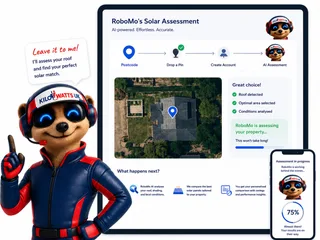
Use RoboMo™ to assess your property, compare available technologies and connect with trusted UK installers, suppliers and manufacturers.
Simply enter your postcode, drop a pin on your roof, create your free account and let RoboMo™ analyse your property to find the best solar panels for your home.

You don't have to think
RoboMo™'s AI analyses your roof and does all the hard work.

Accurate & tailored
AI-powered assessment based on your roof, location, and conditions.

Best options, maximum savings
Compare top solar panels for the best performance and value.

Simple, fast & effortless
Provide a few details, sit back and watch your results unfold.
STEP 1
Choose Home, Business or Industrial
Enter your postcode to start your assessment.
STEP 2
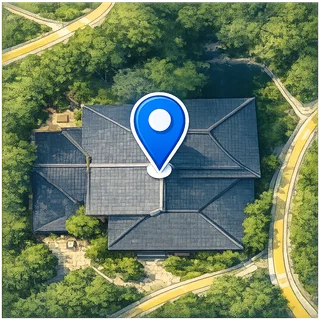
Drop a pin on your roof
STEP 3

Create your free account
STEP 4

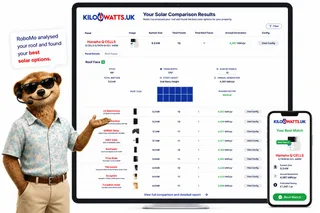
Sit back and watch RoboMo™ work
RoboMo™ analyses your roof and builds your personalised solar comparison.

Step 1
Enter your postcode
Start designing your wind energy system in seconds.
Are you an installer, distributor or renewable energy business?
Kilowatts UK is expanding the Flower Turbines partner network across the UK.
Become A Flower Turbines PartnerKilowatts UK is an authorised representative
Flower Turbines
Compact vertical-axis turbines built for real UK sites, not just open farmland.
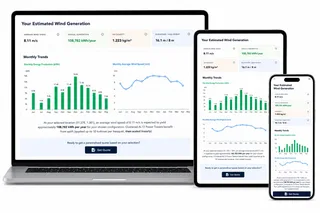
They start in light wind, sit in a small footprint, and are bird-safe by design. Cluster them as a bouquet and the group performs better together than the same turbines standing alone. Enter your postcode for a location-based generation estimate. Figures use area weather data and will differ if buildings, trees or hills sit in the way.
Starts in light UK wind
Built to generate in typical UK wind, not only open farmland.
Small rooftop or ground footprint
Compact towers for roofs, yards and tight sites.
Bird-safe slow rotation
Slow vertical-axis spin, bird-safe by design.
Bouquet clusters raise output
Grouped turbines outperform the same units standing alone.
STEP 2

Choose a location
STEP 3

Place your cluster
Tap the map where you want the turbine cluster to go.
STEP 4

Instant generation forecasts
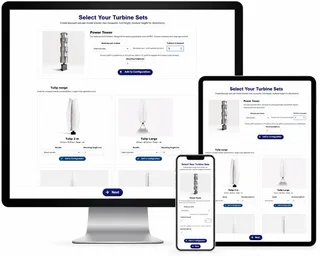
Compare different turbine layouts and see annual generation forecasts instantly.
STEP 5

No commitment required
Explore different configurations before deciding whether to request a quotation.
Related articles
FAQ
Need Help? RoboMo's Got Answers
What does a solar panel installation in Ashford actually include?
A grid-connected home system is more than the modules. A competent job covers survey, design, mounting, cabling, an inverter or microinverters, isolation and protection, commissioning and the paperwork that lets the household use the electricity and export surplus. Battery storage and an EV charger are separate additions and are not required for a basic photovoltaic install.
How do I know if my Ashford roof is suitable?
Suitability depends on roof condition, covering, pitch, orientation, shading, ownership and how the system will connect to the supply, not on the town name. Newer estates with simple tiled pitches are often straightforward once surveyed, while older streets may involve slate, awkward access or limited space for an inverter. A shaded north-facing roof can still be a poor candidate even though south-east England is generally favourable for irradiance within the UK.
What should a survey record before a quote is comparable?
A usable survey records construction, rafter or truss spacing, covering type, pitch, orientation, weathering of fixings, and shade across the day from trees, chimneys and neighbouring buildings. It should also cover cable routes, inverter and isolator locations, meter position, consumer-unit spare ways, earthing and existing supply capacity. A panel-only price that ignores scaffold, access, bird protection or rotten battens is incomplete.
Do I need planning permission for solar in Ashford?
Domestic roof-mounted solar in England is often covered by permitted development under the Town and Country Planning (General Permitted Development) (England) Order 2015, Part 14, but only if the conditions are met. That is not a blanket permission for every roof. Check the address with Ashford Borough Council for listing, Article 4 directions and conservation-area status, and get leaseholder or freeholder consent where the property is not a freehold house. Listed building consent, an Article 4 direction that removes solar rights, and a lease are stops until they are resolved.
Who handles the grid connection, and can export be limited?
The distribution network operator has to be identified from the supply details for the postcode, not assumed from the town name. In much of Kent that operator is UK Power Networks, but this must be confirmed. Smaller systems are often connect-and-notify, commonly described under G98, while larger or more complex plant often needs an application before connection under G99. Thresholds change, so the quote should state the assumed route. On a constrained network the operator may allow the system only if export is capped.
Is MCS certification the same as planning permission or Building Regulations sign-off?
No. MCS certification, planning or permitted development, Building Regulations notification and network confirmation are different regimes. Electrical work must meet Building Regulations and be notified through a competent-person scheme or building control. Most suppliers under the Smart Export Guarantee, which Ofgem oversees, ask for an MCS-certified commissioned system before they will accept an export application. Keep the certificate, electrical notification, serial numbers, shutdown procedure and grid confirmation for a later sale.
Should I add a battery or EV charger at the same time?
Storage and an EV charger are optional and should be decided after the roof and connection route are clear. A hybrid battery can change the network application even when the array looks small, so it should not be added after the paperwork is already filed. Homes that use electricity in daylight, or that can shift load with a hot-water diverter, heat pump or car charging, generally use more of what the roof produces than homes empty all day with no storage plan.
Can a local article tell me the cost, payback or grant for solar in Ashford?
No. Installed cost, payback and grant eligibility are not universal and should come from a current quote and official scheme pages, not a local average. Scaffold, roof repairs, export-limitation equipment and electrical upgrades move the price on a particular house. Export payments under the Smart Export Guarantee are set by suppliers, not as a fixed Ashford rate, and for many homes the larger effect is electricity not bought from the supplier.