


Solar panel installation in Folkestone
Published: 2026-10-06 01:10:44
Updated: 2026-10-05 18:11:40
Solar panel installation in Folkestone hinges on the roof, salt air, Folkestone and Hythe planning and a UK Power Networks limit, not the postcode.

Solar panel installation in Folkestone
Solar panel installation in Folkestone from Kilowatts.uk in Broadstairs. Costs, roofs, planning and what to do next then compare a local system.
Solar panel installation in Folkestone
Solar panel installation in Folkestone means fitting a grid-connected photovoltaic system on a house in the town or its nearby streets, so daylight can supply the home and any surplus can be exported. Whether that is a sound job depends on usable roof area, shade, covering condition, planning status and the local network, not on the postcode alone. A south-east coastal setting can help, but a broken, shaded or constrained roof can still be a poor installation. A typical system is modules, mounting and DC cabling, an inverter or microinverters, generation metering, and a connection agreed with the distribution network operator. Batteries, hot-water diverters and EV charge points are optional. They are not the array, and they do not take a house off the grid. In practice, this kind of search covers the town, nearby coastal and hillside streets, and sometimes wider Folkestone and Hythe addresses. It does not automatically include every Kent postcode. East-west roofs can still be viable. What usually fails a survey is heavy shade, a roof that needs major renewal first, or a consent or connection constraint that was never checked.
What the installer is actually fitting
The hardware is straightforward once the roof and the cable route are understood. Modules sit on rails fixed through or to the covering. DC cables run to an inverter, which converts that power for the household alternating-current system. A generation meter records what the array produces. The supply stays connected, so the house still imports when the array is not covering demand.
What changes the job in older Folkestone houses is rarely the module count on a satellite photo. It is the route from roof to consumer unit, spare ways in that board, and whether the covering and structure can take the fixings. Party-wall proximity, pavement access and scaffolding on a terrace can add more complexity than on a detached house set back from the road. A tight loft, a distant meter cupboard, or a consumer unit with no spare ways often forces electrical work that is not visible on the roof.
Inverter location needs ventilation, a sensible cable run and room to replace the unit later. Module performance warranties are often quoted near 25 years. Confirm that on the product sheet rather than treating it as a town rule. Inverters commonly need replacement sooner than the modules. Exact life depends on the product, heat and how it is installed, so it should not be promised as a fixed number of years. Electrical work on a dwelling in England is also a Building Regulations matter, commonly discussed under Part P. That is separate from product warranties and from MCS certification. A competent installer should say who notifies or self-certifies the electrical work. Handover should include that compliance evidence, rather than leaving notification to the homeowner after the scaffold has gone.
Coast, shade and older roofs
No Folkestone-only yield figure is established in this guide, and a verbal Kent average is not a design. Output has to be estimated from orientation, pitch, shade and the module layout, not from the town name. Panels still generate under cloud, at lower output. They do not need uninterrupted summer sun. A claim that the town sits towards the better end of the UK range is not used here, because this article is not citing a solar-resource dataset.
Coastal weather brings wind exposure and salt-laden air. Fixings, cable entries and exposed metalwork should be specified for that, not copied from an inland default. Salt air does not mean panels cannot be fitted. It means corrosion resistance, sealed penetrations and safe access in wind are design inputs. It also does not mean every coastal roof is structurally sound. Slate, concrete tile and ageing lead valleys take fixings differently, and a covering that is already leaking should be repaired before it is penetrated for an array.
Much of the local stock is older: terraces, villas, bays and chimneys, plus later estates. Usable area is often broken by dormers, valleys and party walls. Chimney and neighbouring-roof shade should be modelled across the year, not judged from one sunny afternoon. A small unshaded array can be more suitable than a larger shaded one. System size should follow roof area, household use and any export limit, not a supposed town average.
Planning status is not the same as a connection
Many ordinary unlisted houses proceed under permitted development, but that is not a blanket right for every Folkestone address. The current national conditions are published through the Planning Portal, and the local view of a particular property sits with the local planning authority, usually Folkestone and Hythe District Council. Confirm both for that address before equipment is ordered. This is not legal advice, and it is not a prediction of how a given application or enquiry will be decided. Conservation areas, listed buildings, flats, and some street-facing designs are common reasons a layout cannot be treated as settled. Heritage streets in the town are not the same case as a later estate house with a plain rear slope. A lease, a freeholder, or a covenant can also block work even where planning itself would allow it. Ordering modules before that route is clear is a common and expensive mistake. Planning permission, where it is required, does not connect the system to the network. The distribution network for this part of the South East is typically UK Power Networks. Confirm that for the specific postcode at design stage, using the operator’s own connection information rather than a town-wide assumption. A homeowner cannot read the connection route off the postcode alone. Export payments, if any, come from a supplier under the Smart Export Guarantee. Ofgem sets the framework for that scheme. The rate is the supplier’s current published figure, and it changes. On the usual domestic route, suppliers require an MCS-certified installation, or another certification their terms accept, before they pay. Fitting panels does not by itself create a right to a tariff. There is no reliable public Folkestone-only grant figure behind this guide, so a local grant should not be assumed. Installed price and payback also move with products, labour, tariffs and the site, and should come from a survey rather than a generic table.
When G98, G99 or an export limit applies
For a typical single-phase house, the usual Great Britain split is 16 amps per phase, which is 3.68 kW of inverter capacity at 230 volts. At or below that, and where the equipment meets the product conditions in the current Engineering Recommendation, the job is commonly a G98 notification to the distribution network operator rather than a full application before work starts. Notification is commonly made after commissioning, within the period set in the current G98 document, often discussed as 28 days. The installer should follow the current document and UK Power Networks’ process for that postcode, not a remembered timetable.
Above that threshold, or where the equipment or the connection does not fit G98, the job is commonly a G99 application. That application should be settled before the system is connected. Some larger type-tested systems still use a shortened G99 route, but that is still an application. It is not permission to connect and tell the operator later. Most houses in the town are single-phase, so the 3.68 kW figure is the relevant usual cut-off. A three-phase supply is assessed per phase, which can allow a higher total before G99 applies. Do not copy a three-phase allowance onto a single-phase cut-out.
An export limit is different from the inverter’s rated capacity. The roof and the inverter might be able to produce more than the network will accept as export. Approved limitation equipment, often referenced to ENA Engineering Recommendation G100, measures what is leaving the property and constrains the inverter so export stays within the cap. Power above that cap has to be used on site, stored, or curtailed. That can be an acceptable design, but it reduces what surplus can earn even when the roof could hold more modules. The cap, and whether limitation equipment is required, should be explained before the kit list is fixed. These figures and labels are the usual national engineering split. They are not a Folkestone bylaw, and the operator’s response controls the job.
Who it suits, and who should wait
It suits owner-occupiers, or landlords with the right to alter the roof, who have a sound covering, enough unshaded area, and daytime or shiftable electricity use. East-west pairs and some flat roofs can work if loading, layout and the planning route are acceptable. Savings depend on how much power is used while the array is producing, the import tariff, and any export payment. Export income is not the main saving for many households, and a Smart Export Guarantee rate should only be taken from the supplier’s current terms.
It is a weak fit where the roof needs major renewal first, where shade covers the only usable slope for much of the day, or where consent cannot be obtained. That includes a listed building, a lease, a freeholder, or a conservation constraint that the design cannot meet. An export cap does not automatically make a project unsuitable, but it can make a large array a poor match if little of the surplus will be used on site. Very low consumption with little export value can still be technically possible and still a poor match. That judgement needs usage data, not a rule of thumb.
Renters cannot commission a permanent roof array themselves. Houses with no realistic roof or ground space, or with access that prevents safe installation and later inverter replacement, should be screened out at survey. A battery is optional storage for timed use or for power that would otherwise be curtailed. It does not make a Folkestone house independent of the grid. Domestic systems normally stay connected, and a battery does not remove the need for a DNO path, planning checks or MCS paperwork if a normal export tariff is part of the plan.
What a Folkestone quote should itemise
A useful quote is a specification, not a panel count and a single figure. Two prices cannot be compared if one includes scaffold, a consumer-unit change and coastal-grade fixings, and the other assumes an inland kit on a clear rear roof. Ask for those items to be written out even when the supplier will not give a firm price until survey. This guide does not state a Folkestone installed price, because that figure would be invented.
The same quote should say which connection path it assumes. A design drawn as a simple G98 notification is a different job from one that needs a G99 application or export-limitation equipment. If the covering is tired, roof repair should be priced as its own line so solar is not being asked to fund a failing roof. Warranties should name the product, the workmanship cover and who provides the MCS certificate if you want the usual Smart Export Guarantee route.
What a proper Folkestone survey should cover
A proper survey measures each roof plane, pitch, orientation, covering type and condition. It does not stop at how many panels fit in a photograph. Structural and covering condition can stop a job that looks fine online. Generation estimates should state the orientation, pitch and shade assumptions they used. If those assumptions are missing, the figure is not something to compare with another quote. No town-average yield should be substituted for that layout.
Cable route, consumer-unit condition and spare ways often force electrical work beyond the PV equipment itself. On coastal jobs, fixing choice and corrosion resistance belong in the specification, not in a later variation. Scaffolding and any pavement arrangement should be visible in the method, especially on tight terraces. The surveyor should also say whether the design is likely to be G98 or G99, and whether an export limit would change the value of surplus before you agree a module count.
Handover should include schematics, product warranties, the MCS certificate if that route was sold, the UK Power Networks notification or application reference, and the Building Regulations compliance evidence for the electrical work. Those records are evidence of what was fitted and notified. They are not a general promise of output, bill savings or a particular export rate. An app login is not a substitute for them. Before you request quotes, gather a year of electricity use if you have it, note when the house uses power, and photograph each roof slope, the consumer unit and the likely inverter wall. Ask the surveyor to confirm the planning route against current Planning Portal conditions and the local authority, the UK Power Networks path for your postcode, and whether an export limit is likely. If the covering is tired, understand the roof work before you treat solar as the next step.
Plan, Compare & Buy Renewable Energy Solutions
AI does the thinking.
You get the perfect solar match.
Use RoboMo™ to assess your property, compare available technologies and connect with trusted UK installers, suppliers and manufacturers.
Simply enter your postcode, drop a pin on your roof, create your free account and let RoboMo™ analyse your property to find the best solar panels for your home.

You don't have to think
RoboMo™'s AI analyses your roof and does all the hard work.

Accurate & tailored
AI-powered assessment based on your roof, location, and conditions.

Best options, maximum savings
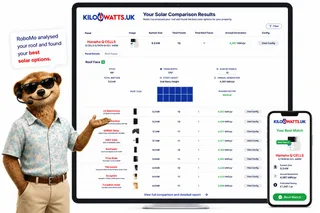
Compare top solar panels for the best performance and value.

Simple, fast & effortless
Provide a few details, sit back and watch your results unfold.
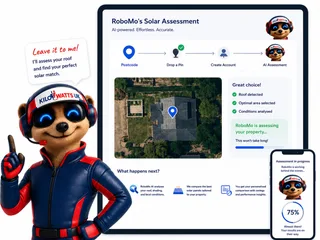
STEP 1
Choose Home, Business or Industrial
Enter your postcode to start your assessment.
STEP 2
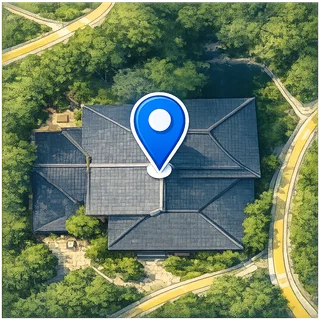
Drop a pin on your roof
STEP 3

Create your free account
STEP 4

Sit back and watch RoboMo™ work
RoboMo™ analyses your roof and builds your personalised solar comparison.

Step 1
Enter your postcode
Start designing your wind energy system in seconds.
Are you an installer, distributor or renewable energy business?
Kilowatts UK is expanding the Flower Turbines partner network across the UK.
Become A Flower Turbines PartnerKilowatts UK is an authorised representative
Flower Turbines
Compact vertical-axis turbines built for real UK sites, not just open farmland.
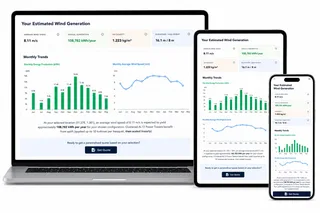
They start in light wind, sit in a small footprint, and are bird-safe by design. Cluster them as a bouquet and the group performs better together than the same turbines standing alone. Enter your postcode for a location-based generation estimate. Figures use area weather data and will differ if buildings, trees or hills sit in the way.
Starts in light UK wind
Built to generate in typical UK wind, not only open farmland.
Small rooftop or ground footprint
Compact towers for roofs, yards and tight sites.
Bird-safe slow rotation
Slow vertical-axis spin, bird-safe by design.
Bouquet clusters raise output
Grouped turbines outperform the same units standing alone.
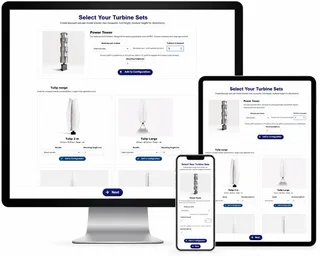
STEP 2

Choose a location
STEP 3

Place your cluster
Tap the map where you want the turbine cluster to go.
STEP 4

Instant generation forecasts
Compare different turbine layouts and see annual generation forecasts instantly.
STEP 5

No commitment required
Explore different configurations before deciding whether to request a quotation.
Related articles

FAQ
Need Help? RoboMo's Got Answers
Does living in Folkestone guarantee strong solar output?
No. A south-east coastal setting can help, but output depends on usable roof area, orientation, pitch, shade and the module layout, not on the postcode. Panels can still generate under cloud, at lower output. This guide does not cite a Folkestone-only yield figure, so a design should be estimated for the actual roof rather than taken from a town average.
What is actually fitted in a typical home solar installation?
A typical grid-connected system includes modules, mounting and DC cabling, an inverter or microinverters, generation metering, and a connection agreed with the distribution network operator. The house stays on the supply and still imports when the array does not cover demand. Batteries, hot-water diverters and EV charge points are optional extras. They are not the array, and they do not take a house off the grid.
Are older Folkestone roofs and coastal weather a problem?
They can change the job, but they do not automatically rule it out. Wind exposure and salt-laden air mean fixings, cable entries and exposed metalwork should be specified for the coast, not copied from an inland kit. Older terraces, villas and chimney-broken roofs often have limited usable area, and a leaking covering should be repaired before it is penetrated. Heavy shade or a roof that needs major renewal first is a common reason to wait.
Do I need planning permission in Folkestone?
Many ordinary unlisted houses proceed under permitted development, but that is not a blanket right for every address. Conservation areas, listed buildings, flats and some street-facing designs often need a different route, and a lease, freeholder or covenant can block work even where planning would allow it. Confirm the current national conditions and the local planning authority’s view of that property before ordering equipment. This is not legal advice.
Who handles the grid connection, and when do G98 or G99 apply?
The distribution network for this part of the South East is typically UK Power Networks, but that should be confirmed for the specific postcode. For a typical single-phase house, inverter capacity at or below 3.68 kW is commonly a G98 notification rather than a full application before work starts, where the equipment meets the current conditions. Above that, or where the connection does not fit G98, a G99 application is commonly needed before the system is connected. An export limit is separate from inverter rating and can cap what surplus may be exported.
Will I automatically get export payments or a local grant?
No. Export payments, if any, come from a supplier under the Smart Export Guarantee, and the rate is that supplier’s current published figure. On the usual domestic route, suppliers require an MCS-certified installation, or another certification their terms accept. Fitting panels does not by itself create a right to a tariff. There is no reliable public Folkestone-only grant figure behind this guide, so a local grant should not be assumed.
Who is a solar installation in Folkestone most likely to suit?
It tends to suit owner-occupiers, or landlords with the right to alter the roof, who have a sound covering, enough unshaded area, and daytime or shiftable electricity use. East-west roofs can still be viable if layout, loading and consent are acceptable. It is a weak fit if the roof needs major renewal, shade covers the only usable slope for much of the day, or consent cannot be obtained. Renters cannot commission a permanent roof array themselves.
What should a Folkestone quote and survey include?
A useful quote is a specification, not only a panel count and a single figure. It should itemise scaffold and access, coastal-grade fixings, any roof repairs, consumer-unit work, the assumed G98 or G99 path, any export limit, warranties and the MCS and Building Regulations paperwork where the usual domestic route needs them. A proper survey should measure each roof plane, pitch, orientation, covering condition and shade, and check the cable route and spare ways. This guide does not state an installed price, because that depends on the site and should come from a survey.