


Should the UK build solar or nuclear power? A nuanced debate
Published: 2026-08-27 19:44:14
Updated: 2026-08-26 13:25:12
Solar PV can be installed comparatively quickly and generate low-carbon electricity whenever sufficient daylight is available.
Should the UK build solar or nuclear power? A nuanced debate
Solar PV can be installed comparatively quickly and generate low-carbon electricity whenever sufficient daylight is available.
Should the UK build solar or nuclear power?
The UK should not treat solar and nuclear power as an either-or decision. Solar PV can be installed comparatively quickly and generate low-carbon electricity whenever sufficient daylight is available, while nuclear can provide large amounts of controllable low-carbon generation regardless of the weather. The more interesting question is therefore what type of nuclear technology should accompany rapid deployment of solar, wind, storage and other flexible resources.
For future nuclear development, one technology that deserves serious attention is the fast-spectrum reactor operating as part of a closed nuclear fuel cycle. Such systems have the potential to extract substantially more energy from nuclear material and reuse actinides recovered from spent fuel rather than treating all spent nuclear fuel as material destined only for long-term disposal.
That does not make fast reactors waste-free, nor does it remove the engineering, economic and policy challenges associated with nuclear construction. It does, however, change an important part of the argument about nuclear fuel and waste.
Why solar being faster to build does not settle the argument
Solar has an obvious deployment advantage. Individual systems can be relatively small, projects can be built incrementally and generation can begin without waiting for an entire national-scale power station to be completed. A large conventional nuclear project is a fundamentally different construction undertaking.
That is a good reason to build suitable solar capacity now. It is not, by itself, a good reason to abandon technologies that will be required for decades.
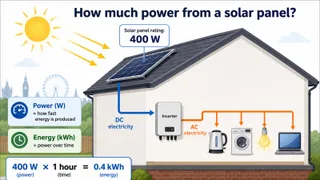
Electricity infrastructure has to be planned across different timescales. A solar installation commissioned this year can contribute while longer-term generation, storage, transmission and grid projects are being developed. Waiting until a future electricity-system problem becomes urgent before starting long-lead infrastructure simply moves the problem into the future. The practical comparison also needs to account for what each asset produces. A solar panel has a variable output determined principally by available sunlight, which is why understanding how solar panels generate electricity matters when comparing technologies. A nuclear reactor is designed to produce large quantities of electricity independently of whether it is sunny, cloudy, day or night. The system therefore has to be considered as a whole rather than comparing only construction dates.
What is a fast-spectrum nuclear reactor?
A fast-spectrum reactor uses high-energy neutrons without deliberately slowing them to the same extent as the thermal neutrons used in conventional light-water reactors. This difference allows fast reactors to use nuclear materials in ways that conventional reactors cannot exploit as effectively.
The important point for the wider energy debate is fuel utilisation. Conventional reactors leave significant quantities of potentially useful heavy elements in their spent fuel. Fast-spectrum systems can potentially fission a broader range of those heavy isotopes.
Some fast reactors can also be configured as breeder reactors. These can convert fertile nuclear material, such as uranium-238, into fissile material that can subsequently be used to produce energy. The terms are related but should not be confused. A fast reactor describes the neutron spectrum, while a breeder describes a reactor configured to produce fissile material from fertile material. Not every fast reactor necessarily has to operate as a breeder.
How can a fast reactor recycle nuclear waste?
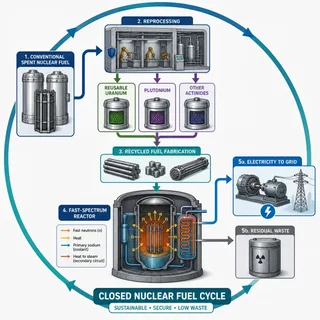
The phrase "a reactor that recycles its own waste" is convenient, but it needs qualification. The reactor does not simply consume every radioactive waste product until nothing remains. The more accurate concept is a closed nuclear fuel cycle in which reusable nuclear material is recovered from spent fuel, fabricated into new fuel and returned to a reactor.
Spent nuclear fuel can contain uranium, plutonium, minor actinides and fission products. With an appropriate reprocessing system, useful heavy elements can be separated and recycled.
A simplified cycle is therefore spent fuel, processing, recovered actinides, new fuel, fast reactor and then further processing of the resulting spent fuel. Material that remains useful can pass around the cycle again. Fast neutrons are particularly important because they can fission several of the actinides that are difficult to use efficiently in conventional thermal reactors. Instead of regarding all of these heavy elements purely as a disposal problem, a closed fast-reactor fuel cycle attempts to extract additional energy from them.
Does recycling mean there is no nuclear waste?
No. Any credible discussion of closed-cycle nuclear power needs to make this clear.
Nuclear fission splits heavy atoms into lighter elements known as fission products. Recycling fuel does not magically turn all of these products back into useful nuclear fuel. Residual radioactive material still requires appropriate management and disposal.
The potential advantage is that repeatedly recycling and fissioning actinides can change the composition and long-term characteristics of the material requiring disposal. That is materially different from claiming that a fast reactor produces no nuclear waste. There are also losses during fuel processing, engineering constraints and practical limits to any real recycling system. The objective is better utilisation of nuclear material and a reduction in the long-lived actinide burden, not the impossible promise of a perfectly waste-free reactor.
How is this different from the nuclear stations being built today?
Most operating nuclear power stations use thermal-neutron reactors, with light-water reactors forming the dominant family internationally. These are mature technologies with extensive operating experience, but they are not designed around maximising consumption of the full range of heavy elements present in spent fuel. Fast reactors address a different part of the fuel-cycle problem. Combining them with reprocessing can make materials that would otherwise remain in spent fuel available for further energy production. The distinction matters when deciding what future nuclear investment is intended to achieve.
Overview
This is why arguing simply about "solar versus nuclear" misses the more useful engineering question. They have different strengths, constraints and development requirements.
Why not just build solar panels and batteries instead?
Solar and battery storage are an important combination, but batteries do not create electricity. They move electricity from one period to another, with losses along the way. For homes, that makes it important to understand how batteries work before treating them as a direct substitute for generation.
That distinction becomes important when considering prolonged periods of low renewable generation, seasonal changes in solar output and increasing electricity demand from transport, heating, industry and other sectors.
A well-designed electricity system can combine technologies rather than forcing one technology to perform every job.
Nuclear is one potential source of that dependable generation. The case for it should be assessed against its cost, construction risk, fuel cycle, safety case and alternatives rather than dismissed simply because solar panels can be installed sooner.
What are the drawbacks of fast reactors and closed fuel cycles?
Fast reactors are not an easy solution to the nuclear problem. If they were, closed fuel cycles would already dominate global nuclear generation.
Fuel reprocessing adds industrial facilities and processes beyond the reactor itself. Recycled fuel has to be handled, manufactured and transported appropriately. Reactor designs using liquid-metal or other non-water coolants introduce different engineering requirements from familiar light-water technology.
There are also important economic questions. A technically elegant fuel cycle is not automatically a commercially attractive electricity system. Capital cost, construction time, financing, operating performance, regulatory approval, decommissioning and fuel-cycle costs all matter. Nuclear-material separation and recycling also have security and proliferation implications that have to be considered in the design and governance of any fuel cycle. These are substantial issues. They are reasons to evaluate the technology rigorously, not reasons to misrepresent what the technology can potentially achieve.
Are small modular reactors the same as fast reactors?
No. Small modular reactor, or SMR, describes an approach to reactor size and manufacture rather than a particular neutron spectrum or fuel cycle.
An SMR could use relatively conventional reactor physics, while another advanced modular reactor could use a fast neutron spectrum. Likewise, a fast reactor does not automatically have to be small or modular.
This distinction is important because several different nuclear concepts are often grouped together as "next-generation nuclear".
A future system could combine several of these characteristics. For example, an advanced modular fast reactor could theoretically form part of a closed fuel cycle. The terms should not be treated as interchangeable.
What should the UK actually be building?
The immediate priority should not be choosing a single winning technology. The UK needs an electricity system capable of delivering low-carbon energy reliably, affordably and at the scale required by future electrification.
Solar should continue to be deployed rapidly on appropriate homes, commercial buildings, brownfield sites and suitable land. Its comparatively modular construction means useful generation does not have to wait for the completion of a huge national infrastructure project, and larger sites should still compare commercial solar options against demand, roof space and grid constraints.
At the same time, long-term nuclear policy should look beyond simply repeating conventional mega-projects. Fast-spectrum reactors, advanced modular designs and closed fuel cycles deserve serious consideration where they can demonstrate a credible safety, engineering and economic case. The attraction of the fast-reactor route is particularly significant because it addresses two questions simultaneously: how to produce dependable low-carbon electricity and how to extract more useful energy from nuclear material that would otherwise remain within spent fuel. That is a much stronger argument than claiming nuclear can replace solar, or that solar can replace every function currently performed by controllable generation.
Why waiting for nuclear because it takes too long is a false choice
A nuclear station taking many years to develop does not prevent solar installations being completed during those years. The two programmes can happen simultaneously.
Energy policy also has to look beyond the next construction cycle. Power stations and electricity networks are long-lived infrastructure. Decisions made now affect the electricity system that will exist decades from now.
If a technology is judged necessary but rejected solely because it may take many years to deploy, the same argument can be repeated when those years have passed. The relevant question is whether the asset will be useful and economically justified when it enters service. That does not excuse nuclear projects that suffer unnecessary delays or uncontrolled costs. Construction performance is part of the technology's real-world viability and should be assessed accordingly.
The sensible debate is about the whole electricity system
Solar versus nuclear makes an effective headline, but it is a poor way to design an electricity system.
Solar has characteristics nuclear cannot replicate. Nuclear has characteristics solar cannot replicate. Batteries, wind, interconnectors, demand flexibility and grid infrastructure add further capabilities. Each also introduces its own constraints.
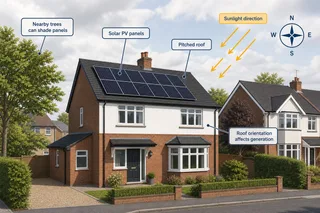
Fast-spectrum reactors with closed fuel cycles are particularly interesting because they could alter one of nuclear power's longstanding weaknesses by extracting additional energy from recovered nuclear material and reducing the quantity of long-lived actinides ultimately requiring disposal. They do not eliminate radioactive waste and they do not eliminate the considerable challenges of constructing nuclear infrastructure. The practical strategy is therefore to deploy technologies according to the problems they solve. Build solar where it makes technical and economic sense now, develop storage and flexibility alongside variable renewables, strengthen the grid, and investigate advanced nuclear technologies capable of providing dependable generation while making substantially better use of nuclear fuel. For solar, that also means matching system design to site conditions, including panel direction and placement. The fact that one technology can start generating sooner is a reason to start building it. It is not a reason to stop planning for the electricity system we will need decades from now.
Plan, Compare & Buy Renewable Energy Solutions
AI does the thinking.
You get the perfect solar match.
Use RoboMo™ to assess your property, compare available technologies and connect with trusted UK installers, suppliers and manufacturers.
Simply enter your postcode, drop a pin on your roof, create your free account and let RoboMo™ analyse your property to find the best solar panels for your home.

You don't have to think
RoboMo™'s AI analyses your roof and does all the hard work.

Accurate & tailored
AI-powered assessment based on your roof, location, and conditions.

Best options, maximum savings
Compare top solar panels for the best performance and value.

Simple, fast & effortless
Provide a few details, sit back and watch your results unfold.
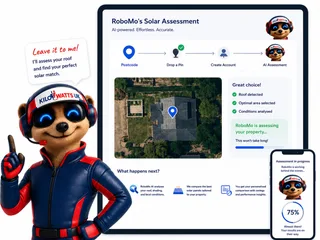

STEP 1
Choose Home, Business or Industrial
Enter your postcode to start your assessment.
STEP 2

Drop a pin on your roof
STEP 3

Create your free account
STEP 4

Sit back and watch RoboMo™ work
RoboMo™ analyses your roof and builds your personalised solar comparison.
Kilowatts UK is an authorised representative
Flower Turbines
Compact vertical-axis turbines built for real UK sites, not just open farmland.
They start in light wind, sit in a small footprint, and are bird-safe by design. Cluster them as a bouquet and the group performs better together than the same turbines standing alone. Enter your postcode for a location-based generation estimate. Figures use area weather data and will differ if buildings, trees or hills sit in the way.
Starts in light UK wind
Built to generate in typical UK wind, not only open farmland.
Small rooftop or ground footprint
Compact towers for roofs, yards and tight sites.
Bird-safe slow rotation
Slow vertical-axis spin, bird-safe by design.
Bouquet clusters raise output
Grouped turbines outperform the same units standing alone.

Step 1
Enter your postcode
Start designing your wind energy system in seconds.
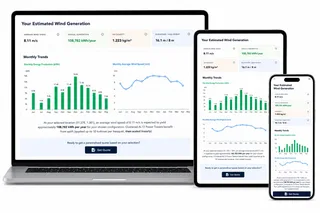
STEP 2

Choose a location
STEP 3

Place your cluster
Tap the map where you want the turbine cluster to go.
STEP 4
Instant generation forecasts
Compare different turbine layouts and see annual generation forecasts instantly.
STEP 5
No commitment required
Explore different configurations before deciding whether to request a quotation.
Related articles
Mo's Mission Nominations
FAQ
Need Help? RoboMo's Got Answers
Should the UK choose solar power instead of nuclear power?
It is more practical to treat solar and nuclear as complementary rather than as an either-or choice. Solar PV can be deployed quickly on suitable roofs and sites, while nuclear can provide large amounts of low-carbon electricity when solar output is low. The right mix depends on cost, buildability, grid needs, storage, planning and long-term energy security.
Why is solar power faster to build than nuclear power?
Solar projects are modular, so panels can be installed in small or large batches and start generating once connected. Nuclear power stations are major engineering projects with long design, licensing, construction and commissioning stages. That speed advantage makes solar valuable now, but it does not remove the need to plan dependable generation for future decades.
What is a fast-spectrum nuclear reactor?
A fast-spectrum reactor uses high-energy neutrons rather than slowing them down in the way many conventional reactors do. This can allow the reactor to use a wider range of nuclear isotopes, including some materials left in spent nuclear fuel. Fast reactors are not the same as all advanced reactors, and they are not automatically small modular reactors.
Can fast reactors recycle nuclear waste?
Fast reactors can potentially form part of a closed nuclear fuel cycle, where useful material is recovered from spent fuel and made into new fuel. This does not mean the reactor simply eats all waste until nothing remains. It can improve fuel utilisation and may reduce the long-lived actinide burden, but residual radioactive waste still needs careful management and disposal.
Do closed fuel cycles mean there is no nuclear waste?
No. Fission produces fission products and other radioactive materials that cannot all be turned back into useful fuel. A closed fuel cycle aims to recover and reuse suitable nuclear material, especially actinides, rather than treating all spent fuel as final waste. It changes the waste challenge; it does not eliminate it.
Are small modular reactors the same as fast reactors?
No. Small modular reactor, or SMR, refers mainly to the size and manufacturing approach of a reactor. A fast reactor refers to the neutron spectrum used in the reactor. Some future designs could combine modular construction with fast-reactor physics, but the terms should not be used interchangeably.
Why not rely only on solar panels and batteries?
Solar panels generate electricity when there is enough daylight, while batteries store electricity that has already been generated. Batteries can help move energy from one time of day to another, but they do not solve every challenge caused by long periods of low renewable output or seasonal variation. A reliable electricity system is likely to need a combination of generation, storage, flexible demand and grid reinforcement.
What are the main drawbacks of fast reactors and closed fuel cycles?
Fast reactors and closed fuel cycles add engineering, regulatory, economic and security complexity. Reprocessing, recycled fuel manufacture and specialist reactor designs require facilities and governance beyond the reactor itself. Their case depends on proving safety, cost, construction performance and fuel-cycle benefits in practice, not just on the theoretical advantages.