


Why A 7 kW Home Charger Won't Always Give You 7 kW
Published: 2026-09-22 17:30:01
Updated: 2026-10-06 12:18:07
A 7 kW wallbox doesn't guarantee 7 kW. On AC, your car's onboard charger sets the ceiling. Here's how to work out your real UK home charging speed.

The Limit Inside The Car: Why A 7 kW Wallbox Doesn't Always Deliver 7 kW
If you have fitted a 7 kW home charger and the app stubbornly reports something closer to 3.7 kW, nothing is broken and nobody has mis-sold you anything. When you charge on alternating current — which is what every domestic wallbox in the UK supplies — the speed is decided by the smaller of two numbers: what the wallbox can deliver, and what the car's own onboard charger can accept. That second number lives inside the vehicle, it varies enormously between models, and it is almost never printed on the side of the charger. This article explains where the bottleneck sits, why rapid public chargers ignore it entirely, how to find your car's real AC limit before you commit to hardware, and why a lower charging rate matters far less on a British driveway than most people expect.
"Seven kilowatt wallbox. So seven kilowatts? Not always."
What a 7 kW wallbox is actually promising
A typical UK single-phase home charge point is rated at 32 A. At a nominal 230 V, that arithmetic lands at roughly 7.4 kW — the familiar "7 kW" figure. That rating describes the charger's capability: the current it can safely pass through the cable to the car's inlet, assuming the house supply and any load-management settings allow it.
It is a ceiling, not a guarantee. The wallbox offers current; the car decides how much of it to take. Higher AC ratings exist — 11 kW and 22 hW-class units — but they rely on a three-phase supply, which is uncommon in UK homes. For most British driveways, 7.4 kW single-phase is the practical maximum, and for many cars the real figure on the meter is lower still.
The onboard charger: the narrow point inside the vehicle
Batteries store direct current. The grid delivers alternating current. Something has to convert one into the other, and on a home wallbox that job is done inside the car by a component called the onboard charger — a module with its own power rating, its own cooling limits and its own cost and weight penalty for the manufacturer.
That rating is the true ceiling for home charging. If a car's onboard charger is a 7.4 kW unit, a 32 A wallbox will be used more or less fully. If it is a 3.7 kW single-phase unit — still common on smaller or older models, and on some base trims — the car will politely draw around 16 A and no more, however generous the wallbox is. Plug two different cars into the identical charger on the identical driveway and you will see two different live power figures. The wallbox has not changed. The narrow point sat inside the vehicle all along.
The same logic explains the opposite surprise: a car with a larger onboard charger plugged into a 3.6 kW socket-style charger will still be capped by the hardware on the wall. Whichever number is smaller wins.

Why rapid public chargers behave completely differently
This is the part that confuses people most: the same car that crawls at 3.7 kW on the driveway can accept ten or twenty times that at a motorway rapid charger. The reason is that rapid chargers are direct current devices. They do the AC-to-DC conversion inside the big cabinet at the roadside and feed direct current straight to the battery, bypassing the car's onboard charger entirely.
So a modest AC limit does not mean a slow car in general — it means a slow car on AC. DC rapid speeds are governed by a different set of limits: the battery's own acceptance rate, its temperature, its state of charge and the charger's output. A car with a small onboard charger can still be a perfectly capable long-distance vehicle. Conversely, a car with a fast onboard charger is not automatically a fast rapid-charging car.
What a lower AC ceiling really costs you overnight
Put illustrative numbers on it. Adding 40 kWh of energy at around 7 kW takes roughly six hours. At around 3.7 kW it takes roughly eleven. Both fit inside a single night; one of them uses almost all of it. Real-world times run slightly longer again, because some energy is always lost as heat in conversion and cabling.
That is the honest trade-off, and it matters in two specific cases. First, if you rely on a narrow off-peak tariff window, a slower car may not be able to take all the cheap hours' worth of energy it needs before the window closes. Second, if you do unusually high mileage and turn the car around quickly between long trips, the slower onboard charger is a genuine constraint.
For everyone else, it is close to irrelevant — and here is the useful fact to hold on to: a typical EV's range vastly exceeds the average daily journey, which is why range anxiety is usually unfounded. Most UK drivers are not refilling a battery each night. They are topping up a modest daily deficit, and even a 3.7 kW trickle across eight quiet hours covers far more driving than an average day demands.
How solar and a home battery change the arithmetic
A slower onboard charger is not always a disadvantage when you generate your own electricity. Solar output on a British roof rises and falls through the day, and UK homes still produce useful power on overcast days — not peak output, but not nothing either. A car that draws a steady, modest 3.7 kW can often be matched more closely to real generation than one demanding 7.4 kW, which will usually pull the shortfall from the grid.
The smarter approach is to stop thinking about the charger in isolation. Solar-aware charging, a home battery buffering midday generation for an evening charge, and scheduling around a cheap overnight window are all ways to make the car's ceiling matter less. It is also worth remembering that solar panels convert more efficiently in cold weather than in hot weather — a crisp, bright winter afternoon is often kinder to panel efficiency than a sweltering July one, even though the day is shorter.
If you are planning solar, storage and charging together rather than in sequence, the design questions change. Our guide to residential solar panel installation covers how those elements are sized as one system.
Checklist: working out your real home charging speed
Before you choose hardware, work through these in order.
- Find your car's AC onboard charger rating. Look in the vehicle handbook or manufacturer specification for "onboard charger" or "maximum AC charging power", quoted in kW. Ignore the DC rapid-charging figure — it tells you nothing about home speed. - Check the trim, not just the model. Onboard charger size sometimes varies between versions of the same car, and occasionally an upgrade is a factory option. - Confirm what your house supply allows. A 32 A charger needs the spare capacity to run alongside showers, ovens and heat pumps. Your installer will assess this and notify the network operator as required. - Ask about load management. Dynamic load balancing lets a 7 kW unit throttle itself when the house is busy, rather than forcing a smaller charger permanently. - Decide whether the extra capability is worth having anyway. Cars change more often than wallboxes. Fitting 7.4 kW today costs little more and leaves headroom for the next vehicle. - Match the plan to your tariff and your generation. If you have or want solar, ask how the charger will respond to available surplus. - Measure once installed. Compare the charger app's live power figure against your expectation. A consistent, stable lower figure is almost always the car's ceiling, not a fault.
Follow-up questions people ask next
Is a 7 kW charger a waste of money if my car only takes 3.7 kW? Rarely. The wallbox will simply be underused by that car. It is the more future-proof choice, since the limitation is in the vehicle you may well replace first.
Could a long or thin cable be slowing things down? A correctly specified, properly installed cable should not meaningfully reduce your rate. If speed varies wildly or drops off mid-session, that is worth investigating with your installer rather than assuming it is the car.
Why does my charging rate drop as the battery fills? On AC this is usually the car's battery management system easing off near the top of the pack. On DC rapids it is much more pronounced, which is why rapid sessions are most efficient in the lower and middle part of the state of charge. Does cold weather reduce home charging speed? It can extend the session slightly, as some energy goes into conditioning the battery rather than storing charge. The effect is far smaller overnight at 7 kW than it is during a short rapid stop. Will three-phase fix it? Only if the car has a three-phase onboard charger, and only if your property can be supplied that way. For most UK homes it is neither available nor necessary. Does any of this affect my solar payback? Not directly, though a car that charges more slowly and steadily can often absorb more of your own generation. Comparing installation options and system designs is the better place to answer that.
Video transcript
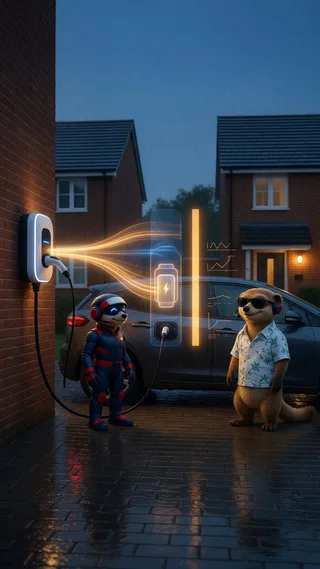
Mo: Seven kilowatt wallbox. So seven kilowatts? RoboMo: Not always. The car's onboard charger sets the ceiling.
Mo: So the wallbox isn't the bottleneck? RoboMo: Correct. The narrow point sits inside the vehicle.
Mo: And rapid public chargers? RoboMo: Those feed direct current straight past the module. Mo: Seven kilowatt wallbox. So seven kilowatts? RoboMo: Not always. The car's onboard charger sets the ceiling. / Mo: So the wallbox isn't the bottleneck? RoboMo: Correct. The narrow point sits inside the vehicle. / Mo: And rapid public chargers? RoboMo: Those feed direct current straight past the module.
Wrapping up
The headline number on a wallbox describes what the wall can offer, not what the car will take. On alternating current, the onboard charger inside the vehicle sets the ceiling, which is why two cars on the same driveway, on the same charger, can finish hours apart. Rapid public chargers sidestep the whole issue by delivering direct current straight to the battery — which is exactly why a car can feel slow at home and perfectly quick on a motorway. None of this is a flaw to be fixed; it is engineering, and once you know which number is the smaller one, you can plan around it. For the overwhelming majority of UK drivers, an ordinary night on an ordinary driveway restores far more range than an ordinary day uses.
Next step
If you are weighing up solar, a home battery and EV charging as one system rather than three separate purchases, we are happy to talk it through and look at what your roof, supply and driving pattern actually need. A no-pressure survey is the simplest way to get honest numbers for your own home.
Plan, Compare & Buy Renewable Energy Solutions
AI does the thinking.
You get the perfect solar match.
Use RoboMo™ to assess your property, compare available technologies and connect with trusted UK installers, suppliers and manufacturers.
Simply enter your postcode, drop a pin on your roof, create your free account and let RoboMo™ analyse your property to find the best solar panels for your home.

You don't have to think
RoboMo™'s AI analyses your roof and does all the hard work.

Accurate & tailored
AI-powered assessment based on your roof, location, and conditions.

Best options, maximum savings
Compare top solar panels for the best performance and value.

Simple, fast & effortless
Provide a few details, sit back and watch your results unfold.


STEP 1
Choose Home, Business or Industrial
Enter your postcode to start your assessment.
STEP 2

Drop a pin on your roof
STEP 3

Create your free account
STEP 4

Sit back and watch RoboMo™ work
RoboMo™ analyses your roof and builds your personalised solar comparison.

Kilowatts UK is an authorised representative
Flower Turbines
Compact vertical-axis turbines built for real UK sites, not just open farmland.
They start in light wind, sit in a small footprint, and are bird-safe by design. Cluster them as a bouquet and the group performs better together than the same turbines standing alone. Enter your postcode for a location-based generation estimate. Figures use area weather data and will differ if buildings, trees or hills sit in the way.
Starts in light UK wind
Built to generate in typical UK wind, not only open farmland.
Small rooftop or ground footprint
Compact towers for roofs, yards and tight sites.
Bird-safe slow rotation
Slow vertical-axis spin, bird-safe by design.
Bouquet clusters raise output
Grouped turbines outperform the same units standing alone.

Step 1
Enter your postcode
Start designing your wind energy system in seconds.

STEP 2

Choose a location
STEP 3

Place your cluster
Tap the map where you want the turbine cluster to go.
STEP 4

Instant generation forecasts
Compare different turbine layouts and see annual generation forecasts instantly.
STEP 5

No commitment required
Explore different configurations before deciding whether to request a quotation.
FAQ
Need Help? RoboMo's Got Answers
Why is my 7 kW home charger only showing about 3.7 kW?
A 7 kW wallbox is the maximum the charger can offer, not a guarantee that every car will take it. On home AC charging, the car’s onboard charger sets the limit. If that onboard charger is rated at around 3.7 kW, the car will not draw more than that from a 7 kW wallbox.
How do I find my car’s real home charging speed?
Look for the maximum AC charging power or onboard charger rating in the vehicle handbook or manufacturer specification. Check the exact trim and model year, as different versions of the same car can have different AC limits. Do not use the DC rapid charging figure, because that applies to public rapid chargers, not home wallboxes.
Is a 7 kW charger a waste if my current car only accepts 3.7 kW?
Usually not. The charger will simply be underused by that particular car. A 7 kW unit can still be useful for a future vehicle, and cars are often replaced sooner than wallboxes.
Why can my car charge much faster at a public rapid charger than at home?
Most home chargers supply AC, so the car must convert that power to DC using its onboard charger. Rapid public chargers supply DC directly to the battery and bypass the onboard charger. That is why a car with a modest AC limit can still charge quickly on a suitable rapid charger.
Will a slower 3.7 kW home charge be enough overnight?
For many UK drivers, yes, because most people are topping up daily use rather than refilling the whole battery. A 3.7 kW charge over several overnight hours can add a useful amount of range. It becomes more limiting if you do high mileage, need quick turnarounds, or rely on a short off-peak tariff window.
Can solar panels or a home battery help with slower EV charging?
They can, depending on the system design and your driving pattern. A car drawing a steadier, lower rate may sometimes match solar generation more easily than one demanding the full 7 kW. Smart scheduling, solar-aware charging and home battery storage can all affect how much grid electricity you use.
Would three-phase charging fix a low home charging speed?
Only in specific cases. The car must have a three-phase onboard charger, and the property must have a suitable three-phase supply. Most UK homes are single phase, so a standard 7 kW single-phase charger is usually the practical domestic option.