


The Math Breakdown: The Orbit Doesn't Pay the Bill
Published: 2026-07-19 14:01:21
Updated: 2026-08-04 12:27:24
Break down the real maths behind UK solar savings, electricity bills, self-consumption and ROI. See what really determines whether solar pays for itself.
Space Sunlight Sounds Fun, But Your Roof Has Better Manners.
Author note: Written by the Kilowatts UK renewable-energy editorial team for UK homeowners comparing real solar, battery storage, EV charging, and headline-grabbing energy ideas. Our focus is practical domestic performance: system design, usable kilowatt-hours, installer competence, safety standards, DNO paperwork, warranties, and long-term value.
No, reflected sunlight from orbit is not a practical replacement for home solar batteries.
It is clever. It is shiny. It is extremely good at making the internet shout “the future!” before breakfast. But UK households do not need a cosmic torch. They need controllable electricity at the right time, with known costs, proper installation, safe equipment, and paperwork that will not terrify a future house buyer. Quick summary: space sunlight is a fascinating concept. Rooftop solar is a working product. Batteries solve the awkward bit of solar ownership: evening energy use. The viral idea is simple enough. Satellites reflect sunlight after sunset. Your panels receive bonus light. The internet claps. Someone declares “batteries are dead”. Then physics quietly clears its throat. Reflect Orbital and similar concepts are interesting. They may have future applications. Solar farms may care. Grid operators may care. Astronomers definitely care. But for a normal UK home, the buying question is blunt: Can you buy it, install it, insure it, meter it, control it, and calculate payback? Right now, for reflected sunlight from orbit as a domestic solar-battery alternative, the answer is no.
The Hook: Moonlight With A Marketing Budget.
The dream sounds deliciously simple. Why store sunshine when space can post it back later?
It feels like solar with a night shift. Lovely idea. Tiny issue: your home does not just need light. It needs usable electrical energy, delivered when your appliances ask for it.
A kettle does not run on vibes. An EV charger does not accept moon-adjacent enthusiasm. A heat pump wants real kilowatt-hours, not orbital jazz hands. Reflected light from orbit would still face the boring realities of Earth:
That makes the return on investment hard to calculate. Not because innovation is bad, but because homeowners need numbers, not fireworks. For a buyer, the practical question is not “does this look exciting?” It is “will this reduce my grid imports, safely and predictably, for a known cost?” At household level, a battery answers that question far better than a space mirror.
The Math Breakdown: The Orbit Does Not Pay The Bill.
Let us use a normal UK solar benchmark.
A 14-panel system is often around 5.6kWp to 6.3kWp, depending on panel rating. For example, 14 panels at 430W gives about 6.02kWp.
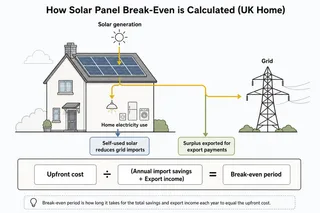
A system like that might generate around 5,000kWh per year, depending on roof angle, orientation, shading, location, and system losses. If you want the basics behind output estimates, start with how much electricity a solar panel produces. A solar-only installed cost might be around £8,000 in a typical illustrative example, though real quotes vary by equipment, roof complexity, scaffolding, inverter choice, warranties, and installer scope. Now compare the known maths with the shiny space myth.
[{~b}]Unknown control
[{/b~}] Satellite passes, cloud cover, and availability are not the same as stored electricity in your property.[{~b}]Unknown metering
[{/b~}] A UK homeowner cannot yet see a standard way to meter, bill, or verify the value of reflected orbital sunlight.[{~b}]Known system size
[{/b~}] A 14-panel rooftop system can be specified, quoted, installed, commissioned, and monitored.[{~b}]Known annual output
[{/b~}] Around 5,000kWh can be modelled for a suitable roof, then checked against real generation data.[{~b}]Unknown space price
[{/b~}] Reflected sunlight has no normal domestic installation price for UK homes.[{~b}]Known simple payback
[{/b~}] On an £8,000 example cost, that gives a rough payback of about 11.5 years.[{~b}]Unknown warranty route
[{/b~}] Homeowners cannot compare standard guarantees, installer obligations, service terms, or fault support.[{~b}]Known solar-only benefit
[{/b~}] With 35% self-consumption, 25p import value, and 8p export value, the example annual benefit is about £697.50.[{~b}]Unknown household tariff
[{/b~}] There is no proven retail tariff letting one home buy orbital after-sunset sunlight.
This is not anti-innovation. It is pro-calculator. A homeowner cannot make a sound energy decision from a viral clip. They need installed cost, usable kWh, tariff value, export assumptions, maintenance risk, warranty terms, and evidence that the system can actually be installed at their property. Without those details, ROI becomes “Return on Imagination”.
The Real Solution: Store The Sunshine You Already Own.
Here is the boring miracle: your roof already receives daylight for free.
Solar panels turn that daylight into electricity. Your home uses some instantly. The rest often exports to the grid. Export can be useful, especially with a fair export tariff, but import savings are often more valuable than export income.
That is the central battery argument. If buying electricity from the grid costs more than selling spare solar back to the grid, then using more of your own solar can improve the economics. A battery changes the timing. It captures spare daytime solar and releases it later. That suits real households because many people use more electricity after work than at midday. For a deeper look at whether the numbers stack up, see how to compare home battery costs. Evening demand is not theoretical:
A battery can also charge from cheap off-peak tariffs, if the tariff, inverter, meter, and battery system support it. It can then discharge when grid electricity is more expensive. That does not make batteries magic. Sizing matters. A battery that is too small may fill early and miss useful storage opportunities. A battery that is too large may not cycle enough to justify the extra cost. Both can weaken payback. Good design starts with your usage pattern, not the biggest number on a datasheet, so it is worth checking what size battery your home actually needs.
What A Battery Does That A Space Mirror Does Not.
A home battery gives you local control. That is the whole point.
It stores electricity at your property. It responds to your household load. It can work with solar, smart tariffs, EV charging, and, in some designs, backup circuits.
The space mirror idea gives reflected light. That is not the same thing as dependable stored energy. A home battery can support:
[{~b}]Monitoring
[{/b~}] A good system lets you check generation, charging, discharge, state of charge, and grid imports.[{~b}]Evening use
[{/b~}] Batteries directly support cooking, lighting, appliances, heat pumps, and EV charging, subject to inverter output and system design.[{~b}]Expandability
[{/b~}] Some modular batteries allow capacity changes if the system design supports it.[{~b}]Tariff shifting
[{/b~}] Batteries may charge when electricity is cheaper and discharge when it costs more.[{~b}]Real commissioning
[{/b~}] You receive test results, certificates, app setup details, and system handover documents.[{~b}]Practical ownership
[{/b~}] You can inspect, insure, document, maintain, and service a battery installation.[{~b}]Known compliance route
[{/b~}] Installers can work to UK electrical standards, manufacturer instructions, and grid connection requirements.[{~b}]Solar self-consumption
[{/b~}] Batteries can reduce the amount of daytime solar exported at lower rates.
There are limits. Backup power is not automatic. Some batteries shut down during grid cuts for safety. Whole-home backup can need extra equipment, careful circuit design, and clear expectations about what will and will not run. Ask before buying. Do not discover the answer during a power cut, while holding a torch and judging your past self.
Product Pitch: Fogstar Energy Battery Storage, Firmly On Planet Earth.
If the goal is practical storage, Fogstar Energy battery storage is the more grounded idea. Literally. It sits in your home, not in low Earth orbit.
Fogstar Energy sells home battery storage products, including the Fogstar 16.1kWh Modular Battery Stack. Before buying, check the current datasheet, approved inverter list, warranty terms, installation requirements, and commissioning instructions. Specifications can change, and compatibility matters.
The pitch is simple: store real solar energy and use it when your home needs it. Avoid betting your evening electricity on a satellite fly-by. Potential advantages include:
[{~b}]Cell heating
[{/b~}] Built-in heating can help protect lithium batteries during cold charging conditions, where fitted.[{~b}]Solar pairing
[{/b~}] A battery can increase self-consumption from a suitable rooftop solar system.[{~b}]Scalable capacity
[{/b~}] Modular battery storage can suit homes needing more evening energy, subject to correct design.[{~b}]Tariff flexibility
[{/b~}] Smart charging may support off-peak charging and peak-time discharge.[{~b}]Installable hardware
[{/b~}] Unlike space mirrors, home batteries have real datasheets, manuals, clearances, commissioning steps, and warranty documents.[{~b}]Practical value case
[{/b~}] Known battery hardware and installation requirements make ROI planning more realistic than an unpriced orbital concept.[{~b}]Safety-focused design
[{/b~}] Look for battery management, temperature monitoring, and low-temperature charging protection.[{~b}]Inverter compatibility
[{/b~}] Check CAN, RS485, and named approved inverter models before purchase.
This is still not a blind purchase. Match the battery to your load profile. Check where it will be installed. Confirm clearances, access, ventilation, temperature range, IP rating, inverter compatibility, and warranty conditions. Garages and utility areas are often more practical than lofts. Lofts can be hot, awkward, and difficult to access. Batteries should not block escape routes. They should not be squeezed into unsuitable cupboards because “it looked fine on the internet”. If you want a practical next step, you can book a free home energy survey rather than guessing from a viral video.
The Safety Bit: Less Glamorous, More Important.
Home energy equipment is not a gadget shelf.
Solar panels, batteries, and EV chargers connect to your electrical system. That means standards, competence, and documentation matter.
For solar and battery work, competent installers should design around BS 7671, manufacturer instructions, grid connection rules, and battery installation guidance such as PAS 63100:2024 where relevant. Battery products should have suitable compliance documents for the exact model being installed, not a cousin with a similar name. For more on competence and solar installation, see how to choose a qualified electrician. MCS certification is important for many solar installations, especially where Smart Export Guarantee payments are part of the plan. DNO notification or approval is also part of proper grid-connected work. EV chargers need the same seriousness. A home EV charger installer should be a qualified electrician working to BS 7671, often described as the 18th Edition wiring regulations. Domestic work may also fall under Building Regulations Part P. If you are planning charging at home, read what to know before you install an EV charger. For EV chargers, look for installer registration with a recognised competent person scheme such as NICEIC or NAPIT. If a grant is involved, OZEV authorisation may matter. The charger should also meet relevant product standards and UK smart charge point rules where applicable. The technical details are not decoration. They affect safety and performance. Important design points can include:
A neat app is nice. Correct electrical design is nicer.
Paperwork You Should Receive Before Anyone Leaves.
Good paperwork is not admin confetti. It protects your warranty, insurance position, resale value, and future upgrade options.
For solar and battery installations, expect a clear handover pack. For EV charger installations, expect certificates and test results showing the circuit was installed and checked correctly.
For solar and battery storage, your handover pack should typically include:
For an EV charger, also expect: If someone says paperwork is unnecessary, raise one eyebrow. Then ask again. Missing paperwork can cause problems later. It may affect warranty claims. It can slow a property sale. It can make future installers cautious because they cannot see what was installed, how it was tested, or whether grid notification was completed. A good installer does not treat documentation as an optional souvenir. It is part of the job.
When Solar Batteries May Not Suit You.
Batteries are useful. They are not automatically right for every home.
If your electricity use is very low, the battery may not save enough. If your roof is heavily shaded, there may be little spare solar to store. If you already export on a very strong tariff, storing energy may be less attractive.
The decision depends on the whole design. Solar batteries may be less suitable where there is:
[{~b}]Heavy shading
[{/b~}] Poor solar generation reduces the energy available to store.[{~b}]Limited space
[{/b~}] Safe battery locations need access, clearance, and suitable environmental conditions.[{~b}]Inverter limits
[{/b~}] Existing inverters may not support the battery you want.[{~b}]Tariff mismatch
[{/b~}] Some smart savings need compatible meters, chargers, and suppliers.[{~b}]Backup assumptions
[{/b~}] Emergency power may need extra equipment and separate design.[{~b}]Low evening demand
[{/b~}] A small household may not cycle a battery enough.[{~b}]Very high export value
[{/b~}] If your export arrangement is unusually strong, storing every spare kWh may not always be the best financial choice.[{~b}]Short payback expectations
[{/b~}] Batteries often need a longer view than simple bill cutting.
A good installer will ask awkward questions. That is a positive sign. They should ask when you use electricity. They should ask about EV charging. They should ask about heat pumps, future appliances, export tariffs, roof shading, inverter compatibility, and where equipment can safely go. If they only ask for your card details, keep shopping.
The Verdict: Choose Kilowatt-Hours Over Cosmic Jazz Hands.
Reflected sunlight from space is exciting, but it is not a household ROI plan today.
A well-designed rooftop solar system with the right battery can be specified, priced, installed, monitored, certified, and supported. It can help you use more of the electricity your roof already produces. It can work with smart tariffs where suitable. It can come with real warranties, real paperwork, and a real installer who answers the phone.
That is less glamorous than orbital mirrors. It is also far more useful when you are cooking dinner at 7pm and trying not to import expensive peak electricity. If you want lower grid imports after sunset, store the solar you already generate. Compare proper quotes, check the paperwork, and look at practical residential solar battery storage rather than orbital wishful thinking. Keep the satellites for science fiction. Keep your savings grounded.
Plan, Compare & Buy Renewable Energy Solutions
AI does the thinking.
You get the perfect solar match.
Use RoboMo™ to assess your property, compare available technologies and connect with trusted UK installers, suppliers and manufacturers.
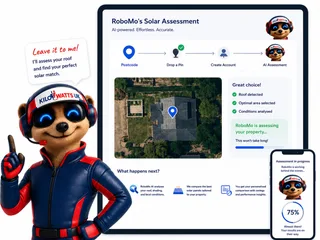
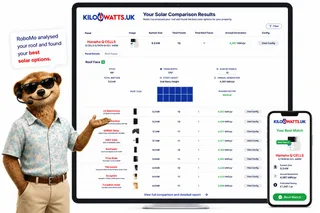
Simply enter your postcode, drop a pin on your roof, create your free account and let RoboMo™ analyse your property to find the best solar panels for your home.

You don't have to think
RoboMo™'s AI analyses your roof and does all the hard work.

Accurate & tailored
AI-powered assessment based on your roof, location, and conditions.

Best options, maximum savings
Compare top solar panels for the best performance and value.

Simple, fast & effortless
Provide a few details, sit back and watch your results unfold.
STEP 1
Choose Home, Business or Industrial
Enter your postcode to start your assessment.
STEP 2

Drop a pin on your roof
STEP 3

Create your free account
STEP 4

Sit back and watch RoboMo™ work
RoboMo™ analyses your roof and builds your personalised solar comparison.

Kilowatts UK is an authorised representative
Flower Turbines
Compact vertical-axis turbines built for real UK sites, not just open farmland.
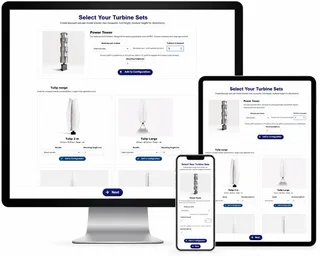
They start in light wind, sit in a small footprint, and are bird-safe by design. Cluster them as a bouquet and the group performs better together than the same turbines standing alone. Enter your postcode for a location-based generation estimate. Figures use area weather data and will differ if buildings, trees or hills sit in the way.
Starts in light UK wind
Built to generate in typical UK wind, not only open farmland.
Small rooftop or ground footprint
Compact towers for roofs, yards and tight sites.
Bird-safe slow rotation
Slow vertical-axis spin, bird-safe by design.
Bouquet clusters raise output
Grouped turbines outperform the same units standing alone.
Step 1
Enter your postcode
Start designing your wind energy system in seconds.
STEP 2

Choose a location
STEP 3

Place your cluster
Tap the map where you want the turbine cluster to go.
STEP 4

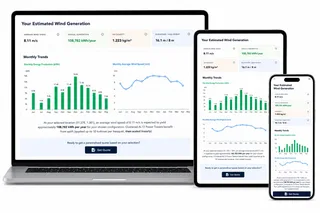
Instant generation forecasts
Compare different turbine layouts and see annual generation forecasts instantly.
STEP 5

No commitment required
Explore different configurations before deciding whether to request a quotation.
Related articles

Mo's Mission Nominations
FAQ
Need Help? RoboMo's Got Answers
Can reflected sunlight from orbit replace a home solar battery?
No. Reflected sunlight from orbit is an interesting concept, but it is not a practical domestic alternative to battery storage for UK homes today. A household needs controllable electricity at specific times, with known costs, metering, warranties, installation standards, and a clear payback calculation. Reflected orbital light does not currently offer a standard UK domestic product, tariff, installer route, warranty package, or reliable way for one home to control when energy is available.
Why is reflected light not the same as stored electricity?
Reflected light would still need to reach your solar panels, and it could be affected by cloud cover, satellite position, timing, coverage, and intensity. A battery stores usable electrical energy at your property and releases it when your home needs it. That makes it much more predictable for evening cooking, lighting, appliances, heat pumps, EV charging, and other real household loads.
What does a home solar battery actually do?
A home solar battery stores spare electricity from your solar panels during the day so you can use more of it later, often in the evening when household demand is higher. Some batteries can also charge from cheaper off-peak electricity tariffs and discharge when grid electricity is more expensive, if the inverter, meter, tariff, and battery system support that setup. The main benefit is better control over when you use solar or low-cost energy.
Do solar batteries save money in the UK?
They can, but the savings depend on your electricity use, solar generation, import tariff, export tariff, battery size, inverter setup, and installation cost. Batteries often make more sense when your import rate is higher than your export rate and you have enough spare solar or cheap off-peak electricity to charge the battery regularly. A properly sized battery is important because an oversized system may not cycle enough to justify the extra cost, while an undersized system may miss useful storage opportunities.
How much electricity can a typical 14-panel solar system produce?
A 14-panel system is often around 5.6kWp to 6.3kWp, depending on the panel rating. For example, 14 panels rated at 430W would give about 6.02kWp. In suitable UK conditions, a system of this size might generate around 5,000kWh per year, although output depends on roof angle, orientation, shading, location, panel performance, inverter losses, and installation quality.
How should I compare solar, battery storage, and new energy ideas?
Compare them using installed cost, usable kilowatt-hours, expected savings, export income, warranty terms, maintenance risk, safety standards, installer competence, and whether the system can actually be installed and supported at your property. A working rooftop solar and battery system can be quoted, designed, installed, monitored, certified, and maintained. A headline-grabbing concept without a domestic price, tariff, warranty, metering method, or installer route is not yet a reliable household investment.
What should I check before buying a home battery?
Check the battery capacity, usable capacity, inverter compatibility, approved inverter list, warranty terms, installation location, temperature limits, clearances, ventilation requirements, IP rating, monitoring features, and whether it supports your intended use, such as solar self-consumption, off-peak charging, or backup circuits. You should also confirm that the installer understands the manufacturer’s requirements and can provide proper commissioning documents.
Can a solar battery power my home during a power cut?
Not always. Many battery systems shut down during a grid outage for safety unless they have specific backup capability and the correct additional equipment. Whole-home backup or essential-load backup must be designed properly, including circuits, isolation, inverter capacity, battery capacity, and safety controls. If backup power matters to you, ask this before buying and get the answer confirmed in writing.
Where should a home battery be installed?
A home battery should be installed in a suitable, accessible, and safe location that meets the manufacturer’s instructions and relevant electrical guidance. Garages and utility areas are often more practical than lofts because lofts can be hot, cramped, difficult to access, and unsuitable for heavy equipment. Batteries should not block escape routes, be squeezed into unsuitable cupboards, or be installed without proper clearance, access, and environmental checks.
Are Fogstar Energy batteries a practical alternative to space-based energy ideas?
Fogstar Energy battery storage is a practical, ground-based product category rather than a speculative orbital concept. Products such as modular home battery stacks can store real electricity for later use, subject to correct system design, inverter compatibility, installation conditions, and warranty requirements. Before buying, always check the latest datasheet, approved inverter list, installation manual, commissioning instructions, and warranty terms for the exact model being installed.
What safety standards matter for solar panels, batteries, and EV chargers?
Solar, battery, and EV charger installations should be designed and installed by competent professionals following BS 7671, manufacturer instructions, grid connection requirements, and relevant battery guidance such as PAS 63100:2024 where applicable. EV charger installations should also consider earthing, PEN fault protection, RCD selection, load monitoring, surge protection, cable routing, isolation, labelling, and Building Regulations requirements. Safety is not just about the product; it is about the full design and installation.
Do I need DNO approval or notification for solar and battery storage?
Grid-connected solar, battery storage, and EV charger installations may require DNO notification or approval, depending on the system size, inverter rating, export capacity, and connection arrangement. A competent installer should handle the correct process and give you evidence that the DNO requirements have been met. This paperwork matters for safety, compliance, future upgrades, and property sales.
What paperwork should I receive after a solar or battery installation?
You should receive a clear handover pack that may include the quotation, system design, datasheets, warranty documents, Electrical Installation Certificate, MCS certificate where applicable, DNO notification or approval evidence, Building Regulations compliance certificate where required, commissioning record, user manuals, app setup details, emergency shutdown instructions, and maintenance guidance. Good paperwork protects your warranty, insurance position, resale value, and future upgrade options.
What paperwork should I receive after an EV charger installation?
For an EV charger, you should receive installation and commissioning details, electrical test results, RCD test results where relevant, load management settings if used, smart app setup information, installer registration details, and DNO notification evidence where required. The installer should be able to explain how the charger has been configured and what safety features are in place.
When might a solar battery not be worth it?
A solar battery may be less suitable if your electricity use is very low, your evening demand is small, your roof is heavily shaded, you have limited safe installation space, your existing inverter is incompatible, or your export tariff is unusually valuable. It may also be less attractive if you expect a very short payback or assume backup power is included when it is not. A good installer should assess your real usage pattern before recommending a battery size.
What questions should I ask a solar battery installer?
Ask how the battery size was chosen, how much of your solar generation is likely to be stored, whether your inverter is compatible, whether the system supports off-peak charging, what happens during a power cut, where the battery will be installed, what standards the installation follows, what warranties apply, and what paperwork you will receive. A good installer should answer these clearly before you commit.