


Get MCS Certification in the UK: Requirements and Process
Published: 2026-08-09 13:43:50
Updated: 2026-08-12 08:00:12
Gain MCS certification in the UK by understanding the installer requirements, technology scope, competent people, live job evidence, document control.
How to Get MCS Certification in the UK: Installer Requirements and Process
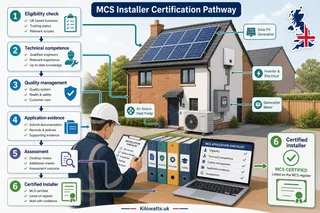
To get MCS certification in the UK, an installer business must apply to an approved certification body, prove competence for the technology scope it wants, show suitable quality and customer-care processes, and pass assessment. It is business certification, not simply a training course. The main factors are technology scope, competent people, live job evidence, document control, customer protection and ongoing surveillance.
A strong application normally starts before the form is submitted. The business should check the current MCS scheme requirements, identify any competence gaps, prepare real job records, choose a certification body that covers the required scope, complete document and site assessment, then close any findings with evidence.
MCS is important because customers, lenders, energy suppliers and some public schemes may require installations to be carried out by an MCS certified contractor. Eligibility rules can change, so neither installers nor customers should assume MCS alone guarantees access to a grant, tariff or finance product without checking the current rules. For solar customers, it is also useful to understand what MCS means before comparing contractors.
What MCS Certification Actually Covers
MCS certification is a contractor certification scheme for low-carbon and renewable installations. It is different from a product certificate, an individual training qualification or a manufacturer approval. The certified contractor is assessed against MCS scheme rules, relevant technology requirements, quality management processes and evidence from completed work.
For installers, the key point is scope. A business is certified for particular technologies and activities. A company certified for solar PV should not assume that the same approval covers heat pumps, battery storage or other low-carbon technologies unless those scopes have been assessed and added by the certification body.
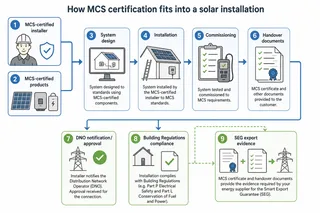
For customers, the individual installation certificate is usually the document showing that an eligible installation was completed by an MCS certified contractor under the relevant scope. For installers, the business-level certification is what allows eligible installations to be registered and documented through the MCS process.
Key Requirements to Check Before Applying
Before applying, installers should read the current MCS documents rather than relying on old templates, training notes or advice from other contractors. Requirements change, and the certification body will assess against the current scheme documents that apply to the chosen technology and business model.
The core sources to check are the current MCS contractor scheme requirements, the relevant technology-specific MCS installation standards, certification body guidance and the rules for approved consumer code membership where domestic work is involved. Installers should also check whether any additional requirements apply to the type of work they undertake, such as solar PV with battery storage, heat pumps in retrofit homes, or systems involving export limitation.
Useful primary sources and requirement areas include:
Current scheme or funding rules
Any grant, tariff or finance requirements should be checked separately because they may include conditions beyond MCS certification.Technology-specific MCS standards
The installation and design requirements for the chosen scope, such as solar PV, heat pumps, battery storage or other eligible technologies.MCS contractor scheme requirements
The business-level rules covering management processes, responsibilities, records, corrective action and certification obligations.Approved consumer code requirements
The customer-care obligations that commonly apply to domestic renewable installations, including quotations, contracts, complaints and cancellation information.Certification body application guidance
The documents, assessment route, fees, site evidence and timescales set by the chosen approved certification body.
This is where many businesses discover that the technical installation is only part of the assessment. The assessor will also look for evidence that the business can sell, survey, design, install, commission, hand over and deal with complaints in a controlled and repeatable way.
Decide Your Certification Scope Before You Apply
The first practical decision is which technology scope to apply for. This should reflect the work the business genuinely intends to deliver, the competence it can evidence, and the installations it can make available for assessment. Applying too widely can slow the process down if the business cannot prove readiness across every scope. A solar PV contractor will need clear evidence around electrical design, roof suitability, mounting, inverter selection, DNO connection requirements, commissioning and handover. A heat pump contractor will need solid evidence around heat loss, emitter suitability, system sizing, controls, commissioning and customer explanation. Battery storage introduces additional questions around system integration, charge and discharge behaviour, inverter compatibility, backup arrangements where applicable, and export control. The best initial scope is usually the one the business can evidence cleanly from real work. Certification bodies are unlikely to be persuaded by polished generic procedures if the job files do not show how those procedures are used in practice.
| Scope decision | Why it matters | What to check early |
|---|---|---|
| Solar PV | Requires evidence of roof assessment, electrical design, grid connection handling and commissioning. | Survey process, mounting evidence, electrical competence, DNO records and handover pack. |
| Heat pumps | Performance depends heavily on survey quality, heat loss, emitter checks and controls. | Heat loss method, design responsibility, commissioning records and customer instructions. |
| Battery storage | Often interacts with solar PV, inverters, consumer units and export limits. | System compatibility, design boundaries, safety documentation and integration records. |
| Multiple technologies | Wider scope increases assessment evidence and management burden. | Competence matrix, subcontractor control, job examples and document consistency. |
| Retrofit work | Existing buildings often create design constraints and customer expectation risks. | Survey assumptions, exclusions, remedial works, access issues and change control. |
Evidence of Competence and the Nominated Technical Person
MCS assessment checks more than whether someone in the business has attended a course. The business must show that competent people are responsible for the relevant tasks and that those responsibilities are understood. This often includes identifying a nominated technical person or equivalent technical lead for the scope being assessed, depending on the certification body’s process and current MCS requirements.
Competence evidence can include relevant qualifications, training records, experience records, manufacturer training where appropriate, supervision arrangements and examples of completed work. The exact evidence depends on the technology, the role and the certification body’s interpretation of current requirements, so installers should confirm this before applying. Where the scope involves electrical work, customers and businesses should also understand the basics of choosing a qualified electrician.
A practical competence map should cover the full job, not only the installation day. It should show who gathers site information, records assumptions, sizes the system, checks compliance, approves design changes, supervises work on site, completes testing and commissioning, explains operation and maintenance to the customer, and confirms that the final installation matches the approved design and certification scope. If one person carries most of the technical responsibility, the business should consider resilience. Assessors may want to understand how competence is maintained during absence, growth, subcontractor use or staff changes.
Build the Quality Management System First
Before applying, the business should build a quality management system that staff can actually use. It does not need to be overcomplicated, but it does need to control the work from enquiry to aftercare. Assessors are looking for a real system, not a folder of templates that nobody follows.
The quality system should make each job traceable. A survey should feed the design. The design should feed the quotation and installation pack. The commissioning record should confirm what was actually installed. The handover information should match the final system, not an early proposal.
Preparation should cover survey and design procedures, controlled customer templates, contract documents, competence records, installation checklists, commissioning records, change control, complaints, corrective action and subcontractor supervision. These documents should be part of normal work, not created only for assessment. The common mistake is treating MCS as a paperwork exercise. The paperwork matters because it proves the process, but it must describe how the business really operates. If an assessor asks how roof suitability is checked, how a heat pump design change is approved, or how a DNO application is handled, the answer should match the records.
What Assessors Are Likely to Check
MCS assessment normally looks at both the business process and technical installation evidence. The exact route is set by the certification body, but installers should expect document review, assessment of procedures, competence checks and inspection of work within the applied scope. The key question is whether the business can repeatedly deliver compliant installations, not whether one job happened to go well. Records should show the thread from initial enquiry to survey, design, quotation, contract, installation, commissioning, handover and aftercare.
| Assessment area | Why it matters | What to prepare early |
|---|---|---|
| Technical competence | The business must show that the right people can design, install, supervise and sign off the work. | Training records, role responsibilities, experience evidence, supervision arrangements and completed job examples. |
| Quality management | Certification depends on repeatable control of documents, work stages and corrective actions. | Procedures, controlled templates, audit records, version control and nonconformity processes. |
| Customer process | Domestic renewable work requires clear information, fair contracts and reliable aftercare. | Quotation templates, contract terms, handover packs, complaints procedure and customer communication records. |
| Site evidence | The assessor needs to see that the process works on real installations. | Survey records, design calculations, photographs, commissioning sheets and signed handover documents. |
| Scope control | Certification applies only to assessed technologies and activities. | Clear scope list, responsibility boundaries, subcontractor controls and technology-specific evidence. |
| Change control | Installed systems often differ from early proposals, and changes must be justified. | Design revisions, product substitutions, customer approvals and updated commissioning records. |
Overview
For electrical systems such as solar PV and battery storage, assessors may also look closely at how grid connection requirements are handled. In UK projects this often means understanding when G98 or G99 processes are relevant, how export limits are documented, and how changes to inverters or system design are controlled before commissioning.
Consumer Code Membership and Customer Protection
For domestic work, MCS certification is closely linked with customer protection requirements. Installers should check the current MCS rules on membership of an approved consumer code, such as the schemes recognised by MCS at the time of application. The approved options and detailed obligations should always be checked directly before committing to a route.
The customer-care side is not a minor administrative detail. It affects how quotations are written, how performance estimates are explained, how deposits and cancellations are handled, how complaints are recorded, and how remedial work is managed. Poor customer documentation can create assessment problems even if the technical installation is neat.
A good customer process makes the journey traceable. The homeowner should be able to understand what has been proposed, why the system has been sized that way, what assumptions have been made, what exclusions apply, and what operational or maintenance limits they need to understand after handover.
Costs, Timescales and Whether You Need a First Installation
The cost and timescale for MCS certification depend on the certification body, technology scope, business size, assessment route, assessor availability, number of sites to inspect and how ready the business is. It is risky to rely on informal price estimates because fees and assessment arrangements can change, and different scopes may require different evidence.
Many applicants need suitable completed installation evidence for assessment, but the exact requirements and acceptable routes should be confirmed with the chosen certification body. Some businesses struggle because they apply before they have a suitable job file, a site available for inspection, or customer permission for assessment access.
Cost and time variables commonly include:
Competence gaps
Additional training or evidence may be needed before assessment can be completed.Nonconformities
Findings raised during assessment can extend the process until corrective evidence is accepted.Preparation work
Templates, procedures, training, technical support and internal staff time can be more significant than the application form itself.Scope complexity
Multiple technologies, subcontractor-heavy delivery or complex retrofit work can increase preparation effort.Site availability
Assessment can be delayed if a suitable installation cannot be inspected or the job file is incomplete.Certification body fees
Application, assessment and surveillance fees vary by provider and scope.
Installers should avoid promising customers that certification will be achieved by a fixed date unless the certification body has confirmed the assessment position and any findings have been closed. A realistic plan builds in time for document review, site evidence, assessor availability and corrective action.
How to Choose a Certification Body
A certification body must be approved for the MCS scope the installer wants. The decision should not be based only on the application fee. The quality of guidance, clarity of evidence requirements, availability of assessors and experience with the relevant technology can all affect how smoothly the process runs.
Installers should speak to more than one suitable certification body where practical. The aim is not to find the easiest assessment, but to understand the route, evidence expectations, fees, surveillance requirements and how findings are managed. A good early conversation can prevent wasted time preparing the wrong documents.
Useful questions to ask include:
Scope coverage
Does the certification body assess the exact technology and activity you want certified for.Assessment route
How much is document review, remote assessment, office assessment and site inspection.Timescale factors
What usually causes delays and how site availability affects scheduling.Evidence expectations
What completed installations, job files and competence records will be needed.Nonconformity process
How findings are issued, evidenced, reviewed and closed.Surveillance requirements
What ongoing checks and fees apply after certification is granted.
The certification body should also explain how it deals with subcontractors, new businesses, multiple branches, changes in nominated technical personnel and applications for additional technology scopes.
Practical Documents to Prepare Before Assessment
The strongest applications usually have documents that connect directly to real jobs. A survey form should not sit separately from the design. The quotation should reflect the design assumptions. The commissioning record should reflect the installed system. The handover pack should reflect the final commissioned installation.
Version control matters. If staff use old templates, informal spreadsheets, uncontrolled design notes or unapproved substitutions, the quality system becomes difficult to defend. Assessors need confidence that the business can control work consistently when more than one person is involved.
Practical document areas usually include survey records, design notes, calculations, risk assessments, method statements, installation checklists, test and commissioning records, product information, customer quotations, contracts, handover packs, user instructions, complaints logs, corrective action records, competence evidence and subcontractor approval records. The exact set depends on the technology scope and business model. The safest approach is to compare live job documents against the current MCS requirements and the certification body’s checklist before applying.
Common Reasons Applications Are Delayed
Applications are often delayed because the business has underestimated the gap between doing competent installation work and proving that work through consistent records. A tidy finished installation is not enough if the survey, design assumptions, customer information and commissioning evidence are incomplete.
For solar PV and battery work, common issues include unclear design responsibility, weak roof suitability evidence, missing DNO records, product substitutions not reflected in the documents, incomplete commissioning records or handover packs that do not match the final installed system. Export limitation and hybrid inverter arrangements can also cause problems if the design intent and installed settings are not clearly recorded.
For heat pumps, delays often come from incomplete heat loss evidence, unclear emitter checks, poor explanation of controls, weak commissioning records, or a mismatch between the design and the system actually handed over to the customer. Heat pump assessment is often less forgiving where design assumptions are vague, because system performance depends heavily on the building and distribution system. Another frequent issue is subcontractor control. If subcontractors are used for roofing, electrical work, scaffolding, plumbing or commissioning, the certified business still needs to show how competence, supervision, records and responsibilities are managed. Simply saying that a subcontractor is experienced is unlikely to be enough.
How MCS Links to Solar PV, Heat Pumps and Battery Storage
MCS certification sits within a wider design and compliance picture. It does not remove the need for competent electrical work, safe roofing practice, suitable plumbing design, correct commissioning, product documentation, customer explanation or grid connection handling where relevant.
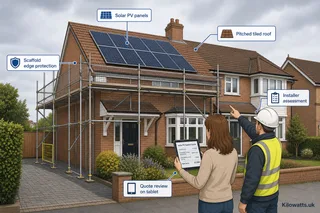
For solar PV, the practical focus is often roof suitability, mounting design, electrical design, inverter selection, isolation, labelling, commissioning, monitoring and DNO process. Installers preparing for this scope should understand the full solar installation process from survey through to handover. For heat pumps, the focus shifts towards heat loss, emitter sizing, flow temperatures, cylinder arrangements, controls, noise considerations, commissioning and user education, so the evidence trail should reflect the heat pump installation route. For battery storage, the installer must think carefully about integration with solar PV, inverter compatibility, consumer unit arrangements, backup function where included, safety documentation and export control, especially where customers are new to home battery systems.
This is why businesses should avoid copying procedures from another technology and assuming they are enough. Each scope has different technical risks, different customer expectation risks and different evidence requirements.
MCS Certification After Approval Is an Ongoing Duty
Once certified, the business must continue operating to the assessed standard. MCS certification is maintained through continued compliance, surveillance and proper handling of changes. If the business adds a new technology, changes key technical staff, alters subcontractor arrangements or expands into more complex system types, it should check whether the certification body needs to be informed.
The ongoing workload is often underestimated. Each installation should leave a clear audit trail because future surveillance may look back at completed projects. Good installers build evidence capture into daily workflow so that records are created at survey, design, installation and commissioning rather than reconstructed later.
A practical internal review helps. Periodically choose a completed job and ask whether another competent person could understand the survey, design, quotation, installation, commissioning and customer handover from the file alone. If the answer is no, the process needs tightening before surveillance exposes the same weakness.
Next Steps if You Want to Become MCS Certified
If you want to gain MCS certification, start by treating it as a business readiness project rather than a form to submit. Choose one realistic technology scope, read the current MCS scheme and technology requirements, speak to suitable approved certification bodies, and compare your live job records with what will be assessed.
For a small installer, the most useful first exercise is a gap review. Take one completed job and check whether the file proves the survey, design, quotation, contract, installation, commissioning, handover and aftercare process from start to finish. Where evidence is missing, fix the process before applying.
MCS certification can strengthen trust and help installers serve customers who require certified installations, but it also brings ongoing responsibilities. The right approach is to build a system your team can genuinely use, keep technical competence current, and make every installation file strong enough to stand up to independent assessment. If you are a homeowner looking for certified support rather than applying as an installer, you can compare home solar options.
Plan, Compare & Buy Renewable Energy Solutions
AI does the thinking.
You get the perfect solar match.
Use RoboMo™ to assess your property, compare available technologies and connect with trusted UK installers, suppliers and manufacturers.
Simply enter your postcode, drop a pin on your roof, create your free account and let RoboMo™ analyse your property to find the best solar panels for your home.

You don't have to think
RoboMo™'s AI analyses your roof and does all the hard work.

Accurate & tailored
AI-powered assessment based on your roof, location, and conditions.

Best options, maximum savings
Compare top solar panels for the best performance and value.

Simple, fast & effortless
Provide a few details, sit back and watch your results unfold.
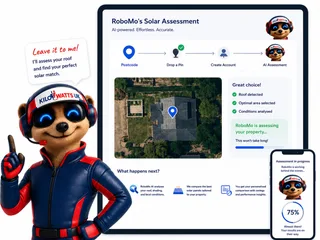

STEP 1
Choose Home, Business or Industrial
Enter your postcode to start your assessment.
STEP 2

Drop a pin on your roof
STEP 3

Create your free account
STEP 4

Sit back and watch RoboMo™ work
RoboMo™ analyses your roof and builds your personalised solar comparison.

Kilowatts UK is an authorised representative
Flower Turbines
Compact vertical-axis turbines built for real UK sites, not just open farmland.
They start in light wind, sit in a small footprint, and are bird-safe by design. Cluster them as a bouquet and the group performs better together than the same turbines standing alone. Enter your postcode for a location-based generation estimate. Figures use area weather data and will differ if buildings, trees or hills sit in the way.
Starts in light UK wind
Built to generate in typical UK wind, not only open farmland.
Small rooftop or ground footprint
Compact towers for roofs, yards and tight sites.
Bird-safe slow rotation
Slow vertical-axis spin, bird-safe by design.
Bouquet clusters raise output
Grouped turbines outperform the same units standing alone.

Step 1
Enter your postcode
Start designing your wind energy system in seconds.

STEP 2

Choose a location
STEP 3

Place your cluster
Tap the map where you want the turbine cluster to go.
STEP 4

Instant generation forecasts
Compare different turbine layouts and see annual generation forecasts instantly.
STEP 5

No commitment required
Explore different configurations before deciding whether to request a quotation.
Related articles

Mo's Mission Nominations
FAQ
Need Help? RoboMo's Got Answers
Is MCS certification something a homeowner gets or the installer gets?
MCS certification is held by the installer business for specific renewable technologies, not by the homeowner. After an eligible installation, the homeowner may receive an MCS certificate for that installation. This certificate is evidence that the work was registered through the MCS process by a certified contractor.
Why does MCS certification matter when choosing a renewable energy installer?
MCS certification shows that the installer has been assessed against scheme requirements for the technology they are installing. It can also be required by some lenders, energy suppliers, export tariffs or public schemes. You should still check the current rules for any grant, tariff or finance product, as MCS alone does not automatically guarantee eligibility.
How can I check whether an installer is MCS certified?
You can check an installer’s status on the official MCS installer register. Make sure the company name matches the business quoting for the work and that the certification covers the technology you want, such as solar PV, heat pumps or battery storage. If in doubt, ask the installer to confirm their certification scope in writing.
Does MCS certification cover every type of renewable installation?
No. An installer is certified for particular technologies and activities, so approval for one area does not automatically cover another. For example, a business certified for solar PV may not be certified for heat pumps or battery storage. Always check the specific scope before accepting a quote.
What documents should I receive after an MCS installation?
You should normally receive an MCS certificate for the completed installation, along with handover documents, commissioning records and operating information. For systems such as solar PV or battery storage, you may also need relevant electrical and grid-connection paperwork. Keep these documents safe, as they may be needed for tariffs, warranties, maintenance or future property sale enquiries.
Can I use a non-MCS installer for solar panels, a heat pump or battery storage?
You can choose who carries out work on your property, but using a non-MCS installer may affect access to some schemes, export arrangements, finance products or customer protections. It may also make it harder to prove that the installation followed recognised scheme requirements. Before proceeding, check the consequences with your energy supplier, lender or scheme provider where relevant.
Does MCS certification mean the installer is guaranteed to do a good job?
MCS certification is a useful quality and compliance indicator, but it is not a personal recommendation or a guarantee that every job will be problem-free. You should still compare quotes, check reviews, ask about design assumptions and make sure the installer explains the system clearly. Good documentation, realistic performance estimates and a clear complaints process are important signs of a professional installer.