


Get MCS Certification in the UK: A Step-by-Step Guide
Published: 2026-08-09 13:33:50
Updated: 2026-08-12 02:20:31
Homeowners do not usually get MCS certified themselves. They choose an MCS certified installer and keep the installation certificate and handover evidence.
How to get MCS certification in the UK
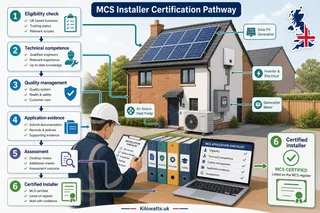
To get MCS certification in the UK, an installer business chooses the technology scope it wants certified for, prepares its management and technical evidence, applies to an MCS-approved certification body, passes office and site assessments, closes any corrective actions, and then maintains certification through surveillance. Homeowners do not usually get MCS certified themselves. They choose an MCS certified installer and keep the installation certificate and handover evidence.
The details depend on the technology, the business structure, the certification body and the current MCS scheme documents. Solar PV, heat pumps, battery storage and other small-scale low-carbon technologies each need evidence that matches the work being carried out. For solar-specific context, our guide to what MCS means explains why the certificate matters for UK installations.
MCS matters because it gives customers, suppliers and scheme administrators a recognised way to check that an installation has been delivered by a certified business using controlled processes. It does not guarantee that every design is perfect. Good survey work, clear specification, competent installation and proper handover still matter.
What MCS certification actually covers
MCS certification is not a short training course. It is not normally a personal badge for an individual engineer either. It is certification of an installer business against MCS scheme requirements, including technical competence, documented processes, customer care, installation quality, commissioning and handover. The business must show that it can deliver compliant work consistently. The assessor will look at how enquiries are handled, how surveys are recorded, how designs are produced, how equipment is selected, how subcontractors are controlled, how complaints are managed and how customers receive final documents. The scope is important. A company certified for solar PV is not automatically certified for heat pumps or battery storage. Each technology scope has its own competence, design, installation, commissioning and documentation requirements, so a business moving into heat pump installation needs evidence that matches that technology rather than relying on another scope.
| Decision area | Why it matters | What to check early |
|---|---|---|
| Technology scope | Certification applies to defined types of work | Confirm the exact scope before preparing evidence |
| Business system | MCS looks for repeatable control, not one good job | Check procedures for survey, design, installation, checks and handover |
| Technical competence | People must be competent for the actual work | Record training, experience, supervision and responsibilities |
| Example installation | Site assessment needs suitable real evidence | Choose a completed job that matches the scope and has full records |
| Customer documents | Weak paperwork can delay approval | Review contracts, commissioning sheets, certificates and handover packs |
| Ongoing compliance | Certification must be maintained after approval | Track scheme updates, complaints, corrective actions and surveillance dates |
Overview
For customers, MCS should be treated as an important filter rather than the only sign of a good installer. The proposal still needs to make sense for the property, the design assumptions should be explained, and any limits should be made clear before a contract is signed.
The official sources to check before applying
Before applying, installer businesses should check the current MCS website rather than relying on old templates, course notes or advice from a supplier. Requirements can change, and the certification body will assess against the current scheme rules and the relevant technology scope.
Key official sources include the MCS installer certification guidance, the current list of MCS-approved certification bodies, the MCS standards and scheme documents, the MCS certified installer search, and the relevant consumer protection requirements linked to the scheme. Where accreditation status matters, check the current UKAS context for the certification body rather than assuming every organisation offering help can certify you.
MCS 001
This is the core installer certification scheme document that sets out the general requirements an installer business needs to understand.Consumer protection documents
Check the current customer contract, complaints, cancellation and handover expectations that apply through the scheme.Certification body requirements
Each approved certification body will have its own application process, assessment scheduling and evidence submission route within the MCS framework.Technology-specific MIS documents
These are the installer standards for the chosen scope, such as the current solar PV, heat pump or battery storage requirements.Installer database and scope search
Use the official MCS search tools to verify certification status and the exact technologies covered.
Be careful with advisers or package sellers at this stage. A consultant can help a business organise evidence, but certification itself must come through an approved certification body following the scheme process.
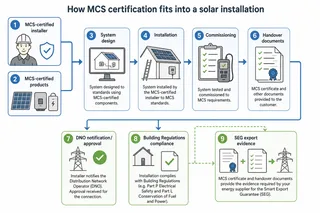
The typical route for an installer business
The process starts with deciding which technology the business is ready to be assessed for. This should be a practical decision based on competence, available work, documentation, tools, test equipment, design capability and the ability to provide a suitable installation for assessment.
A business then prepares its management system and technical records before applying to a certification body. In real assessments, weak records are a common cause of delay. The assessor needs to see more than workmanship. They need evidence that the business can control the full customer journey from enquiry to handover.
Choose the scope
Decide whether the application is for solar PV, heat pumps, battery storage or another technology, then check the current MCS requirements for that exact scope.Complete assessments
Expect review of office systems and at least one technical installation assessment relevant to the chosen scope.Maintain certification
Keep records current, follow scheme updates and prepare for ongoing surveillance or reassessment.Close corrective actions
If gaps are found, fix the root cause and provide evidence that the issue has been corrected.Apply to a certification body
Select an MCS-approved certification body and follow its application, assessment and evidence process.Prepare the business evidence
Put procedures, responsibilities, training records, calibration records, contracts, complaints handling and customer handover processes in order.
The order matters because a rushed application can expose avoidable gaps. A competent tradesperson or engineer may still be delayed if the business cannot show controlled design decisions, subcontractor supervision, commissioning records or customer documentation. If the chosen scope is battery storage, the evidence should show how the system is specified, installed, commissioned and handed over for that use case.
What to have ready before applying
Before applying, the business should test whether it is genuinely assessment-ready. The strongest applications usually come from businesses that already work in a controlled way and use certification to formalise good practice, rather than trying to create every document after an assessor has asked for it.
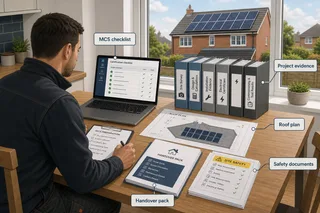
A useful self-check is to take a recent job and follow it from first enquiry through to final handover. If the business cannot quickly show who made the design decisions, why equipment was selected, what was tested, what was handed over and how customer protection was handled, more preparation is needed.
Scope evidence
Current scheme documents, technology-specific requirements and proof that the business understands the standard it is applying against.Technical records
Design information, drawings where relevant, product details, test results, commissioning sheets and photographs of key installation stages.Competence records
Training, experience, supervision arrangements and clear responsibilities for design, installation, commissioning and sign-off.Customer paperwork
Quotations, contracts, cancellation information, complaints process, warranties, manuals and handover pack templates.Quality procedures
Written processes that reflect how surveys, quotations, designs, variations, installation checks, commissioning and handover actually happen.Control of subcontractors
Evidence that subcontracted work is supervised, checked and covered by the business management system.
The paperwork should not be treated as a parallel world that only exists for assessment day. If the written process says one thing and the site team routinely does another, the certification body may question whether the business has proper control.
Training, qualifications and competence
MCS certification does not remove the need for competent people. The installer business has to show that employees or subcontractors doing the work are suitably skilled for the chosen technology and that technical responsibility is clear.
Competence must match the work. A business moving from general electrical work into solar PV will need technology-specific knowledge around DC design, inverter installation, isolation, testing, labelling, commissioning and grid connection processes. A heating business moving into heat pumps will need to understand heat loss, emitter sizing, low-temperature system design, controls, hot water performance and commissioning.
Training certificates can support an application, but they are not the whole answer. Assessors are likely to look for evidence that competence is being applied on real jobs, including design calculations, installation choices, inspection results, commissioning records and supervision of anyone working under the business name. For domestic electrical work, it is still sensible to understand how to choose a qualified electrician rather than treating renewable certification as a substitute for electrical competence. An individual installer can build competence and hold relevant training records, but MCS certification is normally held by the installer business. If a sole trader applies, the business still needs the required systems, documents, competence evidence and assessed installation.
Common mistakes that delay certification
Many delays come from treating MCS as an admin exercise. The documents matter, but they must reflect real working practice and be supported by complete job evidence.
Another common problem is applying before there is a suitable installation to assess. The sample job needs to represent the technology scope being certified, and the records must be complete enough for an assessor to follow the design, installation, commissioning and handover without relying on verbal explanations.
Frequent issues include choosing the wrong technology scope, assuming one certified technology covers another, using generic procedures that do not match the company’s workflow, and missing commissioning records, customer agreements or handover documents. Problems also arise when subcontracted work is not clearly controlled, equipment choices are not recorded, corrective actions are left too late, or current MCS scheme documents are not tracked.
Wrong scope
The application does not match the work the business wants to carry out.Weak records
Design, commissioning, customer agreement or handover evidence is missing.Generic procedures
The written process does not match what the company actually does.Out-of-date documents
The business is working from old scheme documents or templates.Late corrective actions
Gaps found during assessment are not closed promptly.Poor subcontractor control
Subcontracted work is not supervised, checked or recorded clearly.
The best way to reduce these risks is to run a mock audit before applying. Take one completed job, gather every document, walk through the installation process and ask whether an independent assessor could understand the technical and customer-care decisions from the evidence alone.
How MCS certification differs for homeowners
If you are a homeowner asking how to get MCS certification because you want solar panels, a heat pump or another low-carbon system, you normally need an MCS certified installer rather than certification for yourself. The installer business should be certified for the specific technology you are buying.
Before signing, check the installer’s current MCS status on the official MCS installer database and confirm the exact certified scope. Do not assume that a company advertising renewable-energy services is certified for every technology it sells. If you are still at the quote stage for PV, you can compare home solar quotes before choosing who to instruct.
Keep grid paperwork
For relevant electrical systems, retain DNO notification or application evidence, export correspondence and any settings agreed for export limitation.Check current status
Verify the business on the official MCS database before you agree to the work.Keep the handover pack
Store the quotation, design information, commissioning sheets, manuals, warranties and certificates.Check changes after survey
If the design changes, ask for the reason and keep the revised documents.Confirm the technology scope
Make sure the installer is certified for the system you are buying, not only for a different technology.Ask about the installation certificate
Confirm that you will receive the correct MCS installation certificate or installation record after completion where applicable.
For solar PV, grid connection details can affect the job. Smaller systems may be handled differently from larger or higher-export systems, and export limits or DNO requirements can influence inverter settings, battery design and commissioning paperwork. MCS does not replace those grid connection steps.
Grants, export tariffs and why the evidence matters
MCS is often relevant because some grants, finance routes, export tariffs, warranty processes or customer requirements may ask for evidence that the installation was completed by an MCS certified installer. The exact rule depends on the scheme, supplier or organisation involved, so it should be checked at the time rather than assumed.
This is why homeowners should keep the MCS installation certificate or record and all associated handover documents. If a supplier, lender, warranty provider or future buyer asks for evidence later, missing paperwork can be frustrating even where the installation itself is sound.
Installers should also be careful with promises. It is better to tell customers which documents will be issued, which steps depend on third parties, and which scheme or tariff rules the customer must check separately. MCS certification helps create recognised evidence, but it does not automatically guarantee eligibility for every incentive, payment or export arrangement.
How long MCS certification takes and what affects it
There is no single guaranteed timescale for MCS certification. The duration depends on the certification body, the chosen scope, assessor availability, how prepared the business is, whether a suitable installation is ready for assessment and whether corrective actions are raised.
Cost should also be checked through live quotes rather than guessed. Fees can depend on the certification body, number of scopes, audit requirements and reassessments, while the business also needs to budget for internal time spent preparing, maintaining and improving its management system.
The biggest controllable factor is preparation. Complete documents, clear responsibilities, evidenced competence and a suitable sample installation make the process more predictable. Gaps in design control, customer contracts, commissioning or handover records usually make the process slower and harder to manage.
What to ask before choosing an MCS certified installer
A customer should not judge an installer only by whether a certificate exists. Certification is a useful starting point, but the quality of the survey, design and explanation still matters.
For solar PV, a good proposal should consider roof condition, shading, orientation, inverter sizing, consumer unit suitability, scaffolding access, DNO process and whether battery storage is worthwhile. For heat pumps, it should consider heat loss, radiator or emitter sizing, hot water demand, pipework, controls and likely performance in cold weather. For a broader first step, our solar installation guide explains what a typical PV project involves.
Aftercare
Ask who handles faults, monitoring, warranty claims and future maintenance.Survey evidence
Ask what was checked on site and what assumptions were made.Design reasoning
Ask why the proposed system suits your property and usage.Product selection
Ask why the chosen equipment is suitable rather than just available.Handover documents
Ask what certificates, commissioning records, manuals and warranties you will receive.Installation limits
Ask about access, disruption, noise, roof condition, electrical constraints or heating system changes.
If an installer cannot explain the design in plain English, or avoids questions about scope, certification status and handover documents, it is sensible to pause before committing.
Practical next steps
If you are an installer, start with the current MCS documents for your chosen technology and speak directly to MCS-approved certification bodies about their process. Build the business system, competence records and sample job evidence before booking assessment, rather than using the audit to discover basic gaps.
If you are a homeowner, check the installer’s current MCS status, confirm the exact technology scope and ask what documents you will receive after completion. Keep copies of quotations, design documents, commissioning sheets, warranties, certificates and any DNO or export paperwork where relevant. Businesses planning larger PV projects can also review commercial solar quotes as part of their installer and specification checks.
MCS certification is most useful when it supports good design, accountable workmanship and clear records. Whether you are applying as a business or choosing an installer as a customer, the practical goal is the same: a system that is correctly specified, properly installed, properly documented and maintainable after handover.
Plan, Compare & Buy Renewable Energy Solutions
AI does the thinking.
You get the perfect solar match.
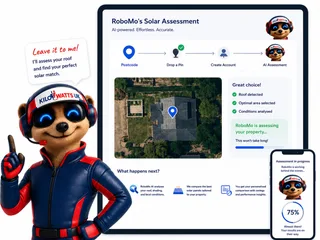
Use RoboMo™ to assess your property, compare available technologies and connect with trusted UK installers, suppliers and manufacturers.
Simply enter your postcode, drop a pin on your roof, create your free account and let RoboMo™ analyse your property to find the best solar panels for your home.

You don't have to think
RoboMo™'s AI analyses your roof and does all the hard work.

Accurate & tailored
AI-powered assessment based on your roof, location, and conditions.

Best options, maximum savings
Compare top solar panels for the best performance and value.

Simple, fast & effortless
Provide a few details, sit back and watch your results unfold.

STEP 1
Choose Home, Business or Industrial
Enter your postcode to start your assessment.
STEP 2
Drop a pin on your roof
STEP 3

Create your free account
STEP 4

Sit back and watch RoboMo™ work
RoboMo™ analyses your roof and builds your personalised solar comparison.

Kilowatts UK is an authorised representative
Flower Turbines
Compact vertical-axis turbines built for real UK sites, not just open farmland.
They start in light wind, sit in a small footprint, and are bird-safe by design. Cluster them as a bouquet and the group performs better together than the same turbines standing alone. Enter your postcode for a location-based generation estimate. Figures use area weather data and will differ if buildings, trees or hills sit in the way.
Starts in light UK wind
Built to generate in typical UK wind, not only open farmland.
Small rooftop or ground footprint
Compact towers for roofs, yards and tight sites.
Bird-safe slow rotation
Slow vertical-axis spin, bird-safe by design.
Bouquet clusters raise output
Grouped turbines outperform the same units standing alone.

Step 1
Enter your postcode
Start designing your wind energy system in seconds.

STEP 2

Choose a location
STEP 3
Place your cluster
Tap the map where you want the turbine cluster to go.
STEP 4

Instant generation forecasts
Compare different turbine layouts and see annual generation forecasts instantly.
STEP 5

No commitment required
Explore different configurations before deciding whether to request a quotation.
Related articles
Mo's Mission Nominations
FAQ
Need Help? RoboMo's Got Answers
Can a homeowner get MCS certification for their own solar panels or heat pump?
Homeowners do not usually get MCS certified themselves. MCS certification normally applies to the installer business, not the property owner. If you are buying solar PV, a heat pump or battery storage, you should choose an installer that is currently MCS certified for that specific technology and keep the certificate and handover documents after installation.
How does an installer business get MCS certified in the UK?
An installer business chooses the technology scope it wants, such as solar PV or heat pumps, then applies to an MCS-approved certification body. It must provide management, technical, competence and customer-care evidence, pass office and site assessments, and close any corrective actions. Certification must then be maintained through ongoing checks and surveillance.
Is MCS certification the same as doing a training course?
No. Training can help show competence, but MCS certification is not simply a course or an individual badge. It is certification of an installer business against MCS scheme requirements, including design, installation, commissioning, customer documents, complaints handling and handover processes.
How can I check whether an installer is MCS certified?
Use the official MCS installer search before signing a contract. Check that the business name matches the company quoting for the work and that the certified scope covers the technology you are buying. A company certified for solar PV is not automatically certified for heat pumps or battery storage.
Why does MCS certification matter when buying renewable energy equipment?
MCS gives buyers a recognised way to check that an installer business has been assessed against scheme requirements. It can also be relevant to eligibility for certain schemes or payments, where those schemes require an MCS installation. It does not remove the need to review the quote, design assumptions, warranties and handover information carefully.
What documents should I receive after an MCS installation?
You should receive the MCS certificate where the installation is eligible, along with commissioning records, manuals, warranty information and a proper handover pack. The exact documents depend on the technology and the job. Keep them safely, as they may be needed for future maintenance, property sale questions or scheme administration.
What can delay an installer’s MCS certification application?
Common delays include applying for the wrong technology scope, incomplete design or commissioning records, weak customer paperwork and procedures that do not match real working practice. Problems can also arise where subcontracted work is not properly controlled or current MCS scheme documents have not been followed. A business should be assessment-ready before applying, rather than trying to fix everything after the assessor finds gaps.