


Compare Solar Panel Quotes UK (2026): Costs & Savings guide
Published: 2026-08-23 23:36:43
Updated: 2026-10-06 10:42:32
Compare UK solar panel quotes for 2026: see 2kW to 6kW costs, yearly savings of £350 to £1,000, and a typical payback of 9 to 15 years before choosing.
Compare Solar Panel Quotes UK (2026) - Costs & Savings
Compare solar quotes in the UK and save up to 800. See 2026 panel costs, payback periods, and vetted installers. Get matched quotes in under 60 seconds.
Overview
If you are tired of watching your electricity bills climb and wondering whether solar is finally the answer, the single smartest move you can make right now is to compare solar quotes before you commit to anything. This guide walks you through exactly what a solar panel system costs in 2026, how much you can genuinely save, and the step-by-step process of lining up installers so you do not overpay. The difference between accepting the first quote and shopping around is often hundreds of pounds, and in many cases closer to a thousand. We will cover system sizes from 2kW to 6kW, realistic payback periods, and how to spot a fair deal from a pushy sales pitch.
Why You Should Compare Solar Panel Quotes Before Buying
The UK solar installation market is competitive, but it is not regulated on price. Two MCS-certified installers can quote wildly different amounts for the same 4kW system, sometimes with a gap of over £1,000. Homeowners who take the time to compare solar quotes save an average of £800, with some reporting savings closer to £950 simply by gathering multiple figures for the same specification.
Rushing into a single quote puts you at risk of overpaying or locking yourself into weaker finance terms, shorter warranties, or lower-efficiency panels without realising it. Comparing also helps you spot the difference between transparent, no-pressure providers and old-school sales tactics that rely on a home visit and a hard close. With three million UK households planning to install solar in the next five years, demand is surging, but so is the spread in pricing. A little legwork upfront pays off for decades.
How Much Do Solar Panels Cost in the UK? (2026 Pricing)
System Size and Price Ranges
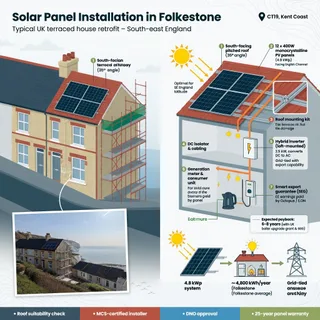
Solar panel costs in 2026 remain closely tied to system size, and the figures below reflect a typical domestic installation without battery storage. A small 2kW system, suited to a flat or a home with very low daytime usage, runs between £4,600 and £5,800. The most common setup, a 3.5kW to 4kW array, sits in the £5,000 to £7,000 bracket and covers the needs of an average three-bedroom household. For larger families or homes with high consumption, a 6kW system costs between £6,000 and £8,000.
These ranges come from aggregated installer pricing and include the panels, inverter, mounting hardware, and standard installation labour. They do not automatically include scaffolding, which can add £500 to £1,000 depending on roof height and access. Always check whether scaffolding is itemised in the quote. If you want a sense of typical UK figures before you request quotes, start with a guide to the best solar price.
Northern Ireland Pricing (Regional Note)
If you live in Northern Ireland, expect slightly higher headline figures due to a smaller installer network and different supply chains. A 4kW system typically costs between £6,000 and £8,000, while a 6kW system can reach £8,000 to £12,000. The good news is that all domestic solar installations in Northern Ireland benefit from 0% VAT, which trims a meaningful chunk off the final invoice. Local grants such as the Warm Homes Plan and NISEP can also reduce upfront costs for eligible households. A wider look at UK solar grants helps you separate national routes from regional ones.
What Affects the Final Price?
Panel brand and efficiency play a significant role. Mainstream manufacturers like JA Solar and Longi offer solid performance at competitive prices, while premium panels push the cost higher. The inverter type matters too: a standard string inverter is cheaper, but microinverters or power optimisers add cost while improving output on shaded or complex roofs. Roof pitch, tile type, and the need for specialist mounting frames on flat roofs all influence the labour charge. Finally, adding battery storage, which we cover in detail below, adds £2,000 to £4,000 to the upfront total but can dramatically change your long-term savings.
Solar Panel Savings: What Can You Really Expect?
Annual Electricity Bill Savings
A well-sized solar panel system cuts your electricity bill by 50% to 70%, depending on when you use power during the day. In pounds, a 3kW system typically saves between £350 and £500 per year. A 4kW array pushes that to £500 to £700, and a 6kW system can deliver £700 to £1,000 in annual savings. These figures assume you shift some of your heavy consumption, like running the washing machine or charging devices, into daylight hours. It helps to know how much electricity a typical UK array actually produces before you treat a savings claim as fixed.
The Smart Export Guarantee (SEG)
You also get paid for the electricity you generate but do not use. Under the Smart Export Guarantee, energy suppliers pay a set rate per kilowatt-hour for your exports. Rates vary between suppliers, so comparing SEG tariffs is a worthwhile second step once you have your installation quotes lined up. The income is not enormous, but it shortens your payback period and turns surplus generation into a small revenue stream.
Payback Period – When Do You Break Even?
The Energy Saving Trust puts the average payback window at 9 to 15 years. Larger systems tend to pay back faster because the fixed costs of scaffolding and installation are spread over more generating capacity. A 6kW system can break even in 8 to 11 years. With panels lasting 25 years or more, that leaves well over a decade of effectively free electricity after you recoup your initial outlay. For a clearer view of the variables, read how long it takes to break even on solar.
How to Compare Solar Panel Installers (Beyond Price)
Essential Accreditation Checks
Price is only one part of the equation. Always confirm that an installer is MCS-certified. Without MCS certification, you cannot claim SEG payments, and you have no independent assurance that the installation meets UK standards. It is worth reading what MCS certification means before you treat a logo on a quote as enough. It is also worth asking whether the company uses in-house installation teams or subcontractors. In-house teams, like those at Hometree, tend to deliver more consistent quality and clearer accountability.
Trust Signals and Reviews
Look for verified review scores on platforms like Trustpilot. Comparison services such as MoneySuperMarket hold a 4.8 out of 5 rating from over 57,000 reviews, while Uswitch carries a 4.7 TrustScore from nearly 40,000 reviews. These benchmarks give you a sense of what a trusted intermediary looks like. Be cautious around installers with only a handful of reviews or those who insist on a home visit before providing any pricing, as that can be a sign of high-pressure selling.
Warranty and Aftercare
Panel performance warranties typically run for 25 years, guaranteeing a minimum output level over that period. The inverter warranty is shorter, usually 5 to 10 years, and you should budget for a replacement somewhere between year 10 and year 15. Ask prospective installers about cleaning, maintenance support, and what aftercare looks like. Most comparison pages skip this detail entirely, but it directly affects your long-term costs.
Should You Add Battery Storage? (Cost vs. Benefit)
A battery lets you store excess solar generation during the day and use it in the evening when your panels are not producing. Uswitch notes that adding a battery can double your annual savings because you buy far less electricity from the grid at peak rates. The trade-off is the upfront cost, which ranges from £2,000 to £4,000 depending on capacity, with 5kWh to 10kWh being the typical domestic range. Compare solar battery costs against your evening use before you add storage to every quote.
Without a battery, you export your surplus at SEG rates, which are lower than the retail price you pay for electricity. That means you sell low and buy high. Our recommendation is straightforward: when you compare solar quotes, ask for two versions, one with a battery and one without. Seeing the ROI difference side by side for your actual roof and consumption pattern makes the decision far clearer.
The Installation Process: What to Expect in 2026
Timeline from Quote to Switch-On
Installation timelines have shortened as the industry has matured. Some providers, such as Glow Green, can complete an install in as little as two weeks from quote acceptance. Others, including Heatable and iHeat, quote a more typical window of four to six weeks. Remote quoting is now standard practice, meaning you can receive an accurate price and system design without anyone visiting your home.
Roof Suitability (What Installers Check)
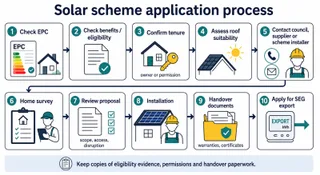
South-facing roofs capture the most sunlight, but east and west orientations also work well in the UK, especially with the long summer evenings. A pitch between 30 and 40 degrees is ideal, while flat roofs need angled mounting frames that add a small cost. Shading from trees, chimney stacks, or neighbouring buildings reduces output, and a competent installer will model this using satellite imagery or a site survey before finalising the design. Check which way panels should face if your roof is not due south.
Payment and Finance Options
Paying outright delivers the best long-term return because you avoid interest charges. That said, green mortgages, interest-free finance, and zero-deposit plans are widely available through partners of comparison platforms like MoneySuperMarket. Some installers also offer price-beat guarantees: Glow Green, for instance, pledges to beat any like-for-like solar quote by £100, which is worth factoring into your comparison.
Common Mistakes to Avoid When You Compare Solar
Focusing only on the bottom-line price is the most frequent error. The cheapest quote may use lower-efficiency panels or an inverter with a short lifespan, costing you more in replacement and lost generation over time. Ignoring the inverter brand is another pitfall: a budget unit can fail within five years, while a premium option from Sungrow or Solax typically lasts a decade or more.
Not checking SEG compatibility can lock you out of export payments if the system or installer lacks MCS certification. Assuming scaffolding is included is risky; always confirm in writing. And the biggest mistake of all is skipping the comparison step entirely. When the average saving from gathering multiple quotes sits at £800, leaving that money on the table makes no sense.
Frequently Asked Questions About Comparing Solar Panels
How many solar panel quotes should I get?
Aim for at least three. Two quotes can still leave you guessing about the true market range, while three or more give you a clear picture of fair pricing and installer quality.
Do solar panels work in cloudy weather?
Yes, they generate electricity from daylight, not direct sunlight. The UK's diffuse light conditions are perfectly adequate, and panels continue producing even on overcast days, just at a reduced rate. The same logic applies if you are asking whether panels work in winter.
Can I get solar panels if I rent?
It is difficult under current rules. Most schemes assume homeownership, and while community solar projects are emerging, they remain limited in availability. Speak with your landlord, but expect limited options for now.
What is the best time of year to install solar?
Spring and autumn tend to offer shorter installer waiting times, and you still capture plenty of summer generation. Winter installs are possible but can be slowed by weather and shorter working days.
Will solar panels increase my home's value?
Yes. Solar panels improve your Energy Performance Certificate rating, which is increasingly important to buyers and lenders. A higher EPC rating can make your property more attractive when you sell.
Start Comparing Solar Panel Quotes Today
The UK solar market is full of good installers and fair prices, but you only access them by shopping around. Using a comparison tool lets you see multiple vetted, MCS-certified installers side by side, matched to your actual roof and energy use. Enter your postcode and estimated monthly electricity bill to start comparing solar quotes tailored to your home, or book a free survey if you want a site-specific design first. The process takes under sixty seconds, and the average homeowner saves £800 by lining up quotes rather than settling for the first one that lands. Do not leave that money on the table.
Plan, Compare & Buy Renewable Energy Solutions
AI does the thinking.
You get the perfect solar match.
Use RoboMo™ to assess your property, compare available technologies and connect with trusted UK installers, suppliers and manufacturers.
Simply enter your postcode, drop a pin on your roof, create your free account and let RoboMo™ analyse your property to find the best solar panels for your home.

You don't have to think
RoboMo™'s AI analyses your roof and does all the hard work.

Accurate & tailored
AI-powered assessment based on your roof, location, and conditions.

Best options, maximum savings
Compare top solar panels for the best performance and value.

Simple, fast & effortless
Provide a few details, sit back and watch your results unfold.
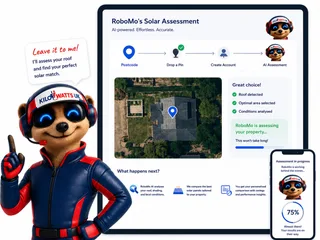
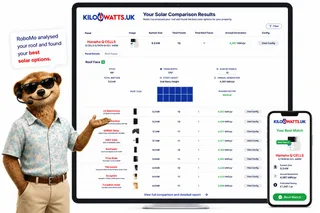
STEP 1
Choose Home, Business or Industrial
Enter your postcode to start your assessment.
STEP 2

Drop a pin on your roof
STEP 3

Create your free account
STEP 4

Sit back and watch RoboMo™ work
RoboMo™ analyses your roof and builds your personalised solar comparison.

Kilowatts UK is an authorised representative
Flower Turbines
Compact vertical-axis turbines built for real UK sites, not just open farmland.
They start in light wind, sit in a small footprint, and are bird-safe by design. Cluster them as a bouquet and the group performs better together than the same turbines standing alone. Enter your postcode for a location-based generation estimate. Figures use area weather data and will differ if buildings, trees or hills sit in the way.
Starts in light UK wind
Built to generate in typical UK wind, not only open farmland.
Small rooftop or ground footprint
Compact towers for roofs, yards and tight sites.
Bird-safe slow rotation
Slow vertical-axis spin, bird-safe by design.
Bouquet clusters raise output
Grouped turbines outperform the same units standing alone.
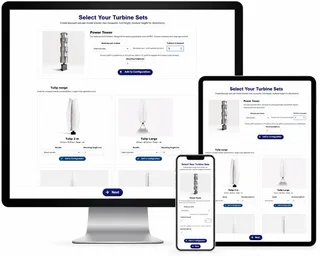
Step 1
Enter your postcode
Start designing your wind energy system in seconds.
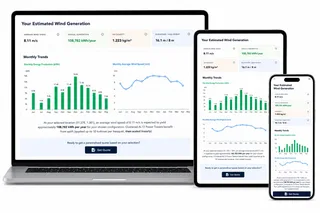
STEP 2

Choose a location
STEP 3

Place your cluster
Tap the map where you want the turbine cluster to go.
STEP 4

Instant generation forecasts
Compare different turbine layouts and see annual generation forecasts instantly.
STEP 5

No commitment required
Explore different configurations before deciding whether to request a quotation.
Related articles

Mo's Mission Nominations
FAQ
Need Help? RoboMo's Got Answers
How many solar panel quotes should I get?
Aim for at least three quotes for the same system size and specification. Two figures can still leave the market range unclear, while three or more make it easier to see a fair price and to compare warranties, equipment and aftercare. Ask each installer to itemise panels, inverter, mounting, labour and scaffolding so you are not comparing unlike offers.
What should a solar panel quote include?
A useful quote should state system size in kW, panel and inverter brands, estimated annual generation, warranty lengths, and whether scaffolding, electrical works and any battery are included. It should also say whether the installer is MCS certified and how the design accounts for roof orientation and shading. If a price is only given after a hard-sell home visit, treat that as a warning sign and ask for a written breakdown first.
Why does MCS certification matter when comparing quotes?
MCS certification is the usual route for showing that a domestic solar installation meets the standards energy suppliers expect. Without an MCS-certified installation, you may not be able to register for Smart Export Guarantee payments. Check the installer’s current MCS status yourself rather than relying only on a logo on a quote, and confirm who will actually carry out the work if subcontractors are used.
How much do solar panels cost in the UK in 2026?
Costs vary with system size, equipment, roof access, scaffolding and whether you add a battery, so there is no single national price. Published ranges are only a starting point and can differ between regions, including Northern Ireland. Use them to sense-check quotes, then compare itemised offers for your own roof rather than treating any headline figure as a fixed quote.
How much can solar panels save on a UK electricity bill?
Savings depend on system size, how much electricity you use in daylight, local generation, and future energy prices, so no installer can guarantee a fixed annual saving. Shifting flexible use, such as laundry or EV charging, into sunny hours usually improves the benefit. Treat savings and payback estimates as scenarios, and ask how they change if you export more of your generation or add a battery.
Should I add a battery when I compare solar quotes?
A battery can store daytime surplus for evening use, which may reduce what you buy from the grid, but it also raises the upfront cost and has its own warranty and replacement life. Export payments under the Smart Export Guarantee are often lower than the retail price of electricity, which is why storage can look attractive, but it is not automatically worthwhile for every home. Ask for like-for-like quotes with and without a battery, based on your evening usage, before you decide.
Do solar panels work on cloudy days or on east- and west-facing roofs?
Yes. Panels still generate in cloud, though output is lower than in full sun, and UK systems are designed around typical weather rather than constant sunshine. South-facing roofs usually produce the most, but east- and west-facing roofs can still be suitable, especially if you use power in the morning or evening. Shading from trees, chimneys or nearby buildings matters more than a perfect orientation, so ask for a design that models it.
Are there grants or VAT relief I should factor into a quote?
Support can change by nation, date and household circumstances, so do not assume a grant or a tax rate applies until you have checked a current official source. Some quotes mention VAT treatment or local schemes, but eligibility is not automatic and names of schemes can be easy to confuse. Ask the installer to show any discount as a separate line, and confirm the rules yourself before you rely on it to make the project affordable.