


First 33MW Enhanced Geothermal Block Enters Commercial Operation
Published: 2026-10-05 16:25:59
Updated: 2026-10-05 10:27:10
Utah’s first 33MW enhanced geothermal block is earning PPA revenue. It does not prove reservoir life or give Britain a cost, timetable or capacity factor.
First 33MW Enhanced Geothermal Block Enters Commercial Operation
How and commissioned in 23 months work, typical output, costs and limits, and whether they have a future for UK homes, balconies and businesses.
What the first 33 MW enhanced geothermal block means for Britain
The first 33 MW net enhanced-geothermal block to reach contractual commercial operation does not give Britain a cost, a capacity factor or a consenting timetable. It shows that one engineered reservoir in Utah has started earning revenue. Fervo Energy’s commercial-operation notice states that the first GeoBlock at Cape Station was in contractual commercial operation on 30 September 2026, and the company announced that start on 1 October 2026. The unit is generating under a power-purchase agreement. The notice does not disclose the offtaker, the price, the contract term, the capacity factor or the rate of reservoir decline.
For a UK reader the useful question is narrower than the headline. Can horizontal drilling and a stimulated hot-rock reservoir reach a metered, contracted start, and which parts of that evidence travel to British geology, planning and grid connection? Cape Station answers the first part for a single block. It does not answer the second. Contractual commercial operation means a buyer is paying for output. It is not a geological certificate that flow and temperature will hold for the life of the contract.
What contractual commercial operation confirms
A successful well test and a plant a buyer is paying for are different events. Enhanced geothermal systems create or enlarge permeability in hot rock, then circulate fluid to a power cycle. Reaching a contracted start is more meaningful than another circulation trial, because revenue depends on the plant actually delivering electricity under an agreement. That is the substance of Fervo’s description of a first greenfield enhanced-geothermal development to reach contractual commercial operation. The concrete claims that can be taken from the notice are contracted operation, revenue and 33 MW of net output.
A declaration and a next-day announcement cannot establish annual energy, outage rates or decline. Six figures that would turn a milestone into a benchmark (price, term, offtaker, capacity factor, forced outages and temperature trend) are unpublished. Anyone using Cape Station as a British cost or availability benchmark would be inventing numbers the notice does not contain.
What 33 MW net output does and does not prove
Net output is the power left after the plant’s own pumps, fans and auxiliaries. Fervo states that this first block reached 33 MW net, so the figure already allows for parasitic load. It is not a gross nameplate, and it is not a promise of 33 MW in every hour of the year. Parasitic load matters more in enhanced geothermal than in many other renewables, because circulation pumps are part of making the reservoir work, not a minor station service.
Geothermal electricity is often designed for a high duty cycle, which is why it is described as round-the-clock renewable power. Intended duty is not measured availability. Cape Station has not published a capacity factor, a forced-outage record or a winter and summer comparison. Until those exist, 33 MW net should be read as delivered capability at the contractual start, not as annual energy. A power-purchase agreement shows that a buyer has agreed to take output. It does not disclose what that buyer is paying, for how long, or on what availability terms.
How enhanced geothermal differs from conventional fields
Conventional hydrothermal geothermal electricity needs heat, water and permeability to coincide in the rock. If the rock is hot but tight, a conventional well may not flow enough to justify a power plant. Enhanced geothermal systems drill into that hot rock and stimulate a reservoir so fluid can be circulated between injection and production wells. The heat is geological. The flow path is designed. Stimulation, circulation, scaling, corrosion and seismic monitoring stay with the operating plant. They are not a one-off construction task that ends at handover.
That is why Cape Station is discussed as next-generation geothermal rather than as another volcanic-field development. It is also why the milestone should not be folded into shallow ground-source heat pumps or into Britain’s existing geothermal heat schemes. A ground-source heat pump moves low-grade heat for a building through shallow loops or boreholes. A GeoBlock is a deep, engineered reservoir feeding a power station. They share the word geothermal and very little else in depth, consenting, supply chain or operating risk.
Horizontal drilling and the GeoBlock model
Fervo’s GeoBlock approach borrows horizontal drilling from oil and gas so a pad can contact more hot rock than a set of simple vertical wells. Fluid is injected, travels through a stimulated fracture network and returns hot enough to drive the power cycle. Standardising wells and surface plant is meant to make later blocks a repeat of the first, rather than a fresh science project on every pad. That is an engineering claim about repeatability. It is not yet a multi-block operating record. Standardisation only works if the next volume of rock behaves enough like the first. Injectivity, produced temperature and scaling can change from block to block even on the same site. A repeatable surface design does not guarantee a repeatable reservoir. Horizontal wells also do not remove water management. Circulation needs a source, a reinjection or disposal route, and chemistry control. Those choices sit alongside drilling technique when a regulator or lender asks whether the plant can keep running.
Why a 23-month Utah build is not a British timetable
Fervo says this block was built and commissioned in 23 months. For a greenfield power project that is a short surface-and-wells schedule, and it is a company claim about Utah, not a measured UK programme duration. It should not be copied into a British consenting, water or grid timetable. The number shows that, in that basin’s supply chain, rigs, crews, pads and a power island were sequenced to a contracted start. It does not show that Britain’s thinner deep-drilling market would produce the same calendar.
What would change a UK equivalent is less the turbine and more the front end. Baseline seismic monitoring, water permissions, drilling-pad access, minerals planning and the time taken to permit a stimulated reservoir can dominate even if the wells themselves are drilled quickly. Connection offers and any reinforcement sit on that same critical path. A 23-month Utah build is evidence of delivery in one setting. Treating it as a template for a British critical path would confuse construction speed with permission and network time.
Where the rest of Cape Station stands
Only the first block is in contractual commercial operation. Fervo describes Cape Station Phase I as three blocks of about 33 MW each. At the announcement the other two were still in commissioning, with commercial operation expected by the company by 1 January 2027. That date is a company expectation, not a delivered fact. A further phase, described by the company as 400 MW under construction for 2028, is also a company schedule. Commentary sometimes rounds the wider development toward 500 MW. That wider figure is not an operating plant.
In project terms, commissioning is where design assumptions meet the reservoir. Flow, temperature and power-cycle stability on blocks two and three will say more about the GeoBlock model than the first declaration alone. Slippage against the company’s 1 January 2027 expectation would not erase the first block. It would weaken any claim that the method is already routine. Until each later block is metered and contracted, scaling remains a plan.
Reservoir life, water and induced seismicity
Commercial operation has not proved that the reservoir will last. Sustained flow rate, produced temperature versus time, injectivity, tracer results, outage causes and workovers are not in the announcement. Temperature decline and maintenance load need several years of production data before Cape Station can be used as a performance benchmark. A high intended duty cycle makes those missing series more important, not less. A plant that is meant to run most hours has more to prove about chemistry, pump wear and injectivity than a plant that runs only in peaks.
Enhanced geothermal projects can also face induced seismicity and water-management concerns. Stimulation changes stress in the rock. A traffic-light seismic protocol, a real baseline and a clear stop criterion are part of whether a plant is allowed to keep operating, not a public-relations appendix. The Cape Station notice, as used here, is not a published seismic catalogue. Water balance matters in the same way. A closed-circulation description still needs real volumes, losses and disposal routes before a water-stressed or tightly regulated basin can treat the design as proven.
These are not reasons to dismiss the milestone. They are the tests that separate a revenue start from a durable resource. Lenders, planners and network operators should ask for metered decline and seismic records, not only for the date commercial operation was declared.
What this changes for deep geothermal in the UK
Britain has deep-geothermal heat prospects and very limited geothermal electricity. Cape Station is evidence that horizontal drilling and an engineered reservoir can reach contracted output in one United States setting. It is not a site that can be copied into British granite or sedimentary basins, and it does not create a UK capacity factor.
The nearest electricity-oriented comparator is Geothermal Engineering Ltd’s United Downs Deep Geothermal Power project in Cornwall, which targets hot granite and a natural structure rather than a Fervo-style multi-lateral stimulated block. It should not be credited with Cape Station’s contracted 33 MW record. Eden Geothermal, at the Eden Project, is a separate Cornwall deep-heat project, not the same scheme and not a utility power block. Southampton’s long-running geothermal contribution to a city energy scheme is sedimentary hydrothermal heat, not enhanced-geothermal electricity. Mixing those projects with Cape Station produces a false UK pipeline.
Public geological context starts with British Geological Survey heat-flow and subsurface-temperature mapping, which shows why Cornwall’s granites are often discussed and why many other UK basins are heat prospects rather than power prospects. Mapping is not a well test. A UK project would still turn on drilled temperature, permeability before and after any stimulation, water sourcing and disposal, induced-seismicity controls, and planning conditions. In England that commonly means minerals planning alongside environmental permits. Scotland, Wales and Northern Ireland have their own planning and environmental regulators. This is not a single national checklist, and the Utah notice does not supply one. Grid value of firm power only matters after a project can connect. A generator on this scale is a connection and reinforcement problem for National Energy System Operator or the relevant network operator, not a domestic notification. Queue position and export limits are site-specific. The same caution applies to land and energy comparisons with wind or solar. A high-duty geothermal block can use a compact surface site, but this announcement gives no UK availability or land figure. Quoting one would be invention. A heat network that might take deep geothermal heat remains a different asset from a power block. A power station does not automatically heat homes, and a heat scheme does not become a 33 MW generator. For homeowners and small businesses there is no install decision in this story. A ground-source heat pump is specified for a building. A Utah power-purchase agreement does not create a domestic product, a tariff or a small-scale certification route. If the real question is a home electricity system, you can compare home solar options or book a free survey. The practical UK use of the milestone is narrower. Next-generation geothermal electricity has cleared a revenue hurdle abroad. British geology, consenting, water management and drilling capacity still have to be proved on their own wells.
Operating data that would change a UK judgement
The next evidence that would change a British reading is ordinary operating data, published often enough to audit. Flow, temperature, net export, availability and workovers over multiple seasons would show whether 33 MW net was a start-up snapshot or a sustained resource. Seismic event records and water use would show whether the operating envelope is acceptable, not only whether the turbine turned. Without those series, Cape Station remains a contractual start, not a decline curve.
Blocks two and three either entering commercial operation by the company’s 1 January 2027 expectation, or missing it for explained reservoir reasons, will test the repeatable-block claim. The phase the company has described as 400 MW for 2028 should be treated as construction progress until it too has a contractual start. Until then, Cape Station is one commercial enhanced-geothermal power block, plus a larger development that has not yet earned the same description.
Plan, Compare & Buy Renewable Energy Solutions
AI does the thinking.
You get the perfect solar match.
Use RoboMo™ to assess your property, compare available technologies and connect with trusted UK installers, suppliers and manufacturers.
Simply enter your postcode, drop a pin on your roof, create your free account and let RoboMo™ analyse your property to find the best solar panels for your home.

You don't have to think
RoboMo™'s AI analyses your roof and does all the hard work.

Accurate & tailored
AI-powered assessment based on your roof, location, and conditions.

Best options, maximum savings
Compare top solar panels for the best performance and value.

Simple, fast & effortless
Provide a few details, sit back and watch your results unfold.
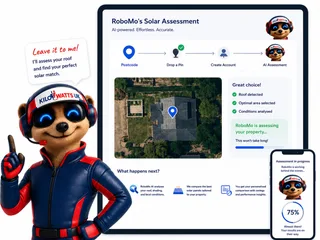

STEP 1
Choose Home, Business or Industrial
Enter your postcode to start your assessment.
STEP 2

Drop a pin on your roof
STEP 3

Create your free account
STEP 4

Sit back and watch RoboMo™ work
RoboMo™ analyses your roof and builds your personalised solar comparison.

Step 1
Enter your postcode
Start designing your wind energy system in seconds.
Are you an installer, distributor or renewable energy business?
Kilowatts UK is expanding the Flower Turbines partner network across the UK.
Become A Flower Turbines PartnerKilowatts UK is an authorised representative
Flower Turbines
Compact vertical-axis turbines built for real UK sites, not just open farmland.
They start in light wind, sit in a small footprint, and are bird-safe by design. Cluster them as a bouquet and the group performs better together than the same turbines standing alone. Enter your postcode for a location-based generation estimate. Figures use area weather data and will differ if buildings, trees or hills sit in the way.
Starts in light UK wind
Built to generate in typical UK wind, not only open farmland.
Small rooftop or ground footprint
Compact towers for roofs, yards and tight sites.
Bird-safe slow rotation
Slow vertical-axis spin, bird-safe by design.
Bouquet clusters raise output
Grouped turbines outperform the same units standing alone.


STEP 2

Choose a location
STEP 3

Place your cluster
Tap the map where you want the turbine cluster to go.
STEP 4

Instant generation forecasts
Compare different turbine layouts and see annual generation forecasts instantly.
STEP 5

No commitment required
Explore different configurations before deciding whether to request a quotation.
Related articles
FAQ
Need Help? RoboMo's Got Answers
Does the first 33 MW enhanced geothermal block change anything I can install at home?
No. This milestone is a utility-scale power plant in Utah, not a domestic product, tariff or small-scale certification route. A ground-source heat pump for a house uses shallow loops or boreholes to move low-grade heat. It is not the same technology as a deep, stimulated reservoir feeding a power station. If you are choosing a home electricity system, look at options specified for buildings, such as solar, rather than this power-purchase agreement.
What does contractual commercial operation actually confirm?
It means a buyer is paying for electricity from the first GeoBlock under a power-purchase agreement, and Fervo states the block was in contractual commercial operation on 30 September 2026, announced the next day. That is stronger evidence than a circulation trial alone, because revenue depends on delivered output. It is not a certificate that flow and temperature will hold for the life of the contract. The notice does not disclose the offtaker, price, contract term, capacity factor or reservoir decline.
Does 33 MW net mean the plant produces 33 MW all year?
No. Net output is power left after the plant’s own pumps, fans and other auxiliaries, so the 33 MW figure already allows for parasitic load. It is delivered capability at the contractual start, not a gross nameplate and not annual energy. Geothermal is often designed for a high duty cycle, but intended duty is not measured availability. Cape Station has not published a capacity factor, forced-outage record or seasonal comparison.
Is enhanced geothermal the same as a ground-source heat pump or Britain’s existing geothermal heat schemes?
No. Enhanced geothermal systems drill into hot rock and stimulate permeability so fluid can be circulated to a power cycle. A ground-source heat pump serves a building and does not create a deep engineered reservoir. Southampton’s geothermal contribution is sedimentary hydrothermal heat for a city energy scheme, not enhanced-geothermal electricity. They share the word geothermal and very little else in depth, consenting, supply chain or operating risk.
Can the 23-month Utah build be used as a British planning or grid timetable?
No. Fervo’s 23-month figure is a company claim about sequencing wells, pads and a power island in one Utah setting. It is not a measured UK programme duration. In Britain, baseline seismic monitoring, water permissions, minerals planning, drilling-pad access and grid connection or reinforcement can dominate the critical path even if wells are drilled quickly. England, Scotland, Wales and Northern Ireland also have different planning and environmental regulators, so there is no single national checklist in this notice.
Does this mean the UK now has a 33 MW geothermal power plant, or that Cornwall projects match Cape Station?
No. Cape Station is in Utah. Britain has deep-geothermal heat prospects and very limited geothermal electricity, and this announcement does not create a UK capacity factor or a copyable site. United Downs in Cornwall targets hot granite and a natural structure, not a Fervo-style multi-lateral stimulated block, and should not be credited with this contracted 33 MW record. Eden Geothermal is a separate Cornwall deep-heat project, not a utility power block.
Is the whole Cape Station development now operating?
Only the first block is in contractual commercial operation. Fervo describes Phase I as three blocks of about 33 MW each, with the other two still in commissioning and commercial operation expected by the company by 1 January 2027. That date, and a later phase described as 400 MW under construction for 2028, are company schedules, not delivered facts. Wider figures sometimes rounded toward 500 MW are not an operating plant. Later blocks still have to be metered and contracted before the method can be treated as routine.
What operating evidence would be needed before this could inform a UK project judgement?
Multi-season records of flow, produced temperature, net export, availability and workovers would show whether 33 MW net was a start-up snapshot or a sustained resource. Seismic event records, a real baseline and a clear stop criterion matter because stimulation can change stress in the rock, and the notice used here is not a published seismic catalogue. Water volumes, losses and disposal routes also need to be shown, not only a closed-circulation description. Without those series, lenders, planners and network operators should not treat the commercial-operation date as a performance benchmark.