


Three-Pin EV Lead vs 7 kW Wallbox: Why Rate Beats Time
Published: 2026-10-02 06:45:41
Updated: 2026-10-02 03:52:07
The granny lead supplied with most EVs draws about 2.3 kW. A 7 kW wallbox adds roughly triple the range in the same overnight window. Here's why.

The Lead That Came In The Boot: Why 2.3 kW And 7 kW Are Not The Same Night
Almost every electric car in Britain arrives with a three-pin cable rolled up under the boot floor, and almost every new owner asks the same reasonable question: if it charges overnight anyway, why bother with a wallbox? The short answer is that it doesn't charge overnight anyway — not in the way people assume. A standard domestic socket is derated for continuous load, which in practice caps that lead at around ten amps, or roughly 2.3 kW. A dedicated 7 kW home charger moves about three times as much energy in exactly the same hours. Same car, same driveway, same night, same sunrise deadline — just a different rate. This article explains where the ten-amp limit comes from, how to work out whether it actually matters for your driving pattern, what to check before committing to a wallbox, and how home charging changes again once you have solar on the roof. If you came here wondering whether the lead in the boot is good enough, you'll leave with an arithmetic answer rather than an opinion.
"The lead in the boot is a convenience item, not a charging strategy."
What the three-pin lead in your boot actually delivers
The cable that ships with most EVs is a convenience item, not a charging solution. It plugs into an ordinary 13 A socket, but the control box in the middle of the lead deliberately tells the car to draw less than the socket's headline rating — typically around ten amps. At the UK nominal supply voltage of roughly 230 volts, ten amps works out at about 2.3 kW. That is the number you are living with all night, not thirteen amps, and certainly not the 7 kW figure quoted on wallboxes.
Put that into an overnight window. Eight hours at 2.3 kW moves somewhere in the region of 18 kWh into the battery, minus a little to charging losses and, in cold weather, battery conditioning. Depending on the car and the season, many EVs return somewhere around three to four miles per kWh, so you are realistically looking at a double-figure range top-up rather than a full tank. For a lot of drivers that is genuinely fine. For anyone doing a long commute, towing, or running two cars off one driveway, it quietly becomes the limiting factor in the whole household.
Why a domestic socket is derated for continuous load
This is the part that surprises people, because a 13 A socket is clearly marked 13 A. The distinction is between intermittent load and continuous load. A kettle pulls hard for three minutes. A toaster for two. A hoover for ten. Domestic sockets, their back-boxes, the terminations behind them and the ring final circuit feeding them were all designed around that duty cycle, with diversity assumed across the house.
An EV is a different animal. It asks for the same current, without pause, for eight, ten or twelve hours at a stretch, often on a cold wet driveway through an outdoor socket that may be older than the car. Sustained current means sustained heat at every connection in the chain, and the weakest point is rarely the cable — it is a slightly loose terminal screw or a tired socket face. Derating to around ten amps is the manufacturer's way of building in margin so the installation never gets near that limit. It is a sensible engineering decision, and it is also exactly why the lead cannot simply be told to go faster.
The window is fixed, so the rate decides the range
This is the sentence worth keeping. You do not get to choose how long the night is. Whether you plug in at six in the evening or eleven, sunrise and the school run arrive when they arrive — and if you are on a time-of-use tariff, the cheap window is even shorter and even more fixed. Within a fixed window, the only variable you control is the rate.
That is why the comparison is so clean. Take the same car, the same driveway and the same overnight hours. At roughly 2.3 kW the state-of-charge arc creeps. At roughly 7 kW it climbs about three times as far before the sunrise marker. Nothing clever has happened; no efficiency trick has been applied. The feed is simply wider. The practical consequence is that a wallbox doesn't just make charging faster in the abstract — it makes it possible to put a full day's driving back into the car inside a short off-peak window, which is where the real running-cost benefit of home charging lives.
When the three-pin lead is genuinely good enough
We are not here to tell anyone they must buy hardware. There is a true and comforting fact buried in this topic: a typical EV's usable range vastly exceeds the average daily journey in the UK, so range anxiety is usually unfounded. If your driving is short, local and predictable, a slow trickle every night may genuinely keep you permanently topped up, and the lead does its job.
The three-pin lead tends to be sufficient if you drive modest daily distances, plug in every single night rather than occasionally, have a plug-in hybrid with a small battery, park somewhere the cable run is short and properly weather-rated, and have had the circuit and socket checked by a qualified electrician. It starts to fall short if you need large top-ups on a limited off-peak window, you share one driveway between two EVs, you do irregular long journeys and need a quick turnaround, you want to charge from surplus solar during the day, or you find yourself routinely arriving home below a comfortable buffer. Honest self-assessment here saves money in both directions.
A practical checklist before you commit to a 7 kW wallbox
If the arithmetic points towards a wallbox, the decision becomes an electrical and siting question rather than a shopping one. Work through this before anyone quotes you anything.
First, your incoming supply: a single-phase domestic supply will normally support a 7 kW charger, but the available headroom depends on your main fuse rating and what else the house draws. A competent installer will assess this rather than assume it. Second, consumer unit capacity — is there a usable way to add a dedicated circuit with appropriate protection? Third, cable route and distance from the board to the parking space, because long runs cost more and may need a larger cable. Fourth, where the car actually parks, including which side the charge port is on and whether a tethered or untethered unit suits you. Fifth, whether you want load management, so the charger can back off when the oven and the shower are both running. Sixth, smart control and scheduling, so you can target an off-peak window reliably. Seventh, future proofing: if solar, a battery or a second EV are on the horizon, say so now, because it is far cheaper to plan one installation than to revisit three.
How solar changes the charging conversation
Overnight charging is only half the picture once there are panels on the roof. A 7 kW wallbox with solar-matching capability can modulate its output to follow surplus generation during the day, pushing energy you have already produced into the car rather than exporting it. The three-pin lead is far less flexible in this role: it is effectively a fixed low draw, so on a bright but variable British afternoon it either overshoots your surplus and starts importing, or it sits idle while generation goes elsewhere.
It is also worth correcting a common assumption here. UK homes still generate useful solar power on overcast days — output drops, but it does not vanish — and panels actually convert more efficiently in cold conditions than in heat. That makes daytime solar charging more viable across more of the British year than people expect, particularly for anyone working from home or running a second car that sits on the drive. If you are weighing up a charger and panels in the same year, it is worth looking at them as one system rather than two purchases, which is exactly what a proper site survey is for.

Common follow-up questions
Can I just use a higher-rated extension lead to go faster? No. The limit is set by the control box in the lead and by the derating logic described above, not by the cable you reach for. Coiled extension leads also introduce their own heat problem under sustained load, which is precisely the scenario to avoid.
Is 7 kW the fastest I can have at home? For most UK homes on a single-phase supply, roughly 7 kW is the practical ceiling for AC charging. Higher rates generally require a three-phase supply, which is uncommon in domestic properties.
Does charging at 7 kW harm the battery? Home AC charging is gentle compared with high-power rapid charging on the public network. The thermal stress at 7 kW is modest, and most manufacturers treat regular overnight AC charging as the normal case. Will a wallbox actually save me money? That depends entirely on your tariff and driving pattern, and we won't pretend otherwise. The mechanism is simple though: a wider feed lets you complete your charging inside a cheaper window instead of spilling into a more expensive one. Does it still work in the rain? Properly specified outdoor charging equipment is designed for the British climate. The weak link in the three-pin approach is usually an ageing outdoor socket and a trailing lead, not the car.
Video transcript
Mo: The three-pin lead charges overnight anyway... right? RoboMo: Yes. But a 7 kW wallbox adds roughly triple the range.
Mo: So why is it stuck that low all night? RoboMo: A domestic socket is derated for continuous load — about ten amps.
Mo: Same car, same night — just a faster feed? RoboMo: Correct. The window is fixed, so the rate decides the range. Mo: The three-pin lead charges overnight anyway... right? RoboMo: Yes. But a 7 kW wallbox adds roughly triple the range. / Mo: So why is it stuck that low all night? RoboMo: A domestic socket is derated for continuous load — about ten amps. / Mo: Same car, same night — just a faster feed? RoboMo: Correct. The window is fixed, so the rate decides the range.
Wrapping up
The lead that came in the boot is not a con, and it is not useless. It is a sensible piece of engineering that has been quietly derated to protect a domestic circuit it was never designed to run flat out for ten hours. The problem is that most people read it as a charging solution rather than a get-you-home option. Once you accept that the overnight window is fixed, the whole question collapses into arithmetic: roughly 2.3 kW versus roughly 7 kW, in the same hours, on the same driveway. Three times the feed, three times the range, same sunrise. For some households that difference is academic, because the daily mileage is small and the trickle keeps up. For others it is the single change that makes an EV feel effortless instead of mildly stressful. Work out which one you are before you spend anything — the numbers, not the sales pitch, should make that decision.
Next step
If you're weighing up home charging alongside solar, it's worth looking at the whole system in one go rather than piecemeal. You can read how we approach residential solar, compare options at your own pace, or book a no-pressure site survey when you're ready for actual numbers for your roof and your supply.
Plan, Compare & Buy Renewable Energy Solutions
AI does the thinking.
You get the perfect solar match.
Use RoboMo™ to assess your property, compare available technologies and connect with trusted UK installers, suppliers and manufacturers.
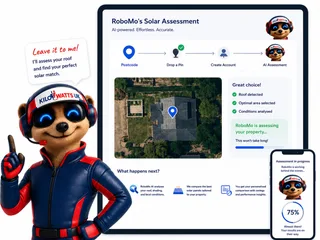
Simply enter your postcode, drop a pin on your roof, create your free account and let RoboMo™ analyse your property to find the best solar panels for your home.

You don't have to think
RoboMo™'s AI analyses your roof and does all the hard work.

Accurate & tailored
AI-powered assessment based on your roof, location, and conditions.

Best options, maximum savings
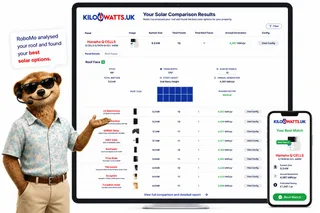
Compare top solar panels for the best performance and value.

Simple, fast & effortless
Provide a few details, sit back and watch your results unfold.
STEP 1
Choose Home, Business or Industrial
Enter your postcode to start your assessment.
STEP 2

Drop a pin on your roof
STEP 3

Create your free account
STEP 4

Sit back and watch RoboMo™ work
RoboMo™ analyses your roof and builds your personalised solar comparison.

BATTERY ROI TOOL
See what a battery saves on your bill
Enter the day rate, off-peak rate and export rate. The calculator ranks batteries in the Kilowatts shop over 10 years.
Home batteries also suit offices and small commercial sites. Industrial batteries are listed on their own calculator.

Step 1
Enter your postcode
Start designing your wind energy system in seconds.
Are you an installer, distributor or renewable energy business?
Kilowatts UK is expanding the Flower Turbines partner network across the UK.
Become A Flower Turbines PartnerKilowatts UK is an authorised representative
Flower Turbines
Compact vertical-axis turbines built for real UK sites, not just open farmland.
They start in light wind, sit in a small footprint, and are bird-safe by design. Cluster them as a bouquet and the group performs better together than the same turbines standing alone. Enter your postcode for a location-based generation estimate. Figures use area weather data and will differ if buildings, trees or hills sit in the way.
Starts in light UK wind
Built to generate in typical UK wind, not only open farmland.
Small rooftop or ground footprint
Compact towers for roofs, yards and tight sites.
Bird-safe slow rotation
Slow vertical-axis spin, bird-safe by design.
Bouquet clusters raise output
Grouped turbines outperform the same units standing alone.


STEP 2

Choose a location
STEP 3

Place your cluster
Tap the map where you want the turbine cluster to go.
STEP 4

Instant generation forecasts
Compare different turbine layouts and see annual generation forecasts instantly.
STEP 5

No commitment required
Explore different configurations before deciding whether to request a quotation.
FAQ
Need Help? RoboMo's Got Answers
Why does the three-pin lead only charge at about 2.3 kW when the socket says 13 A?
A 13 A socket is meant for short, intermittent loads such as a kettle, not the same current for eight to twelve hours. The control box in the lead tells the car to draw less, typically around ten amps, so terminals and an outdoor socket stay within a safer continuous-load margin. At a nominal supply of roughly 230 volts, that is about 2.3 kW for the whole session. You cannot simply instruct the lead to use the full 13 A rating.
How much more can a 7 kW wallbox add in the same overnight window?
The night is fixed, and a cheap off-peak window is often shorter still, so the rate decides how much energy goes in. Eight hours at about 2.3 kW is in the region of 18 kWh before losses and any cold-weather battery conditioning. Many cars return somewhere around three to four miles per kWh, so that is often a double-figure range top-up rather than a full charge. A 7 kW charger moves about three times as much energy in those same hours.
When is the lead in the boot genuinely good enough?
It can be enough if your daily mileage is short, local and predictable, you plug in every night, or you have a plug-in hybrid with a small battery. The circuit and socket should still be checked by a qualified electrician, and the cable run should be short and properly weather-rated. It starts to fall short with long commutes, two EVs on one driveway, irregular long trips that need a quick turnaround, a tight off-peak window, or if you want to charge from surplus solar.
Can a heavier extension lead make three-pin charging faster?
No. The limit is set by the control box in the EV lead and by continuous-load derating, not by the extension you reach for. A coiled extension under a sustained load can also heat up, which is the situation to avoid. Treat the boot lead as a get-you-home option rather than something to push harder.
Is 7 kW the fastest AC charging I can have at home?
For most UK homes on a single-phase supply, roughly 7 kW is the practical ceiling for AC charging. Higher rates generally need a three-phase supply, which is uncommon in ordinary houses. A single-phase supply will often support 7 kW, but available headroom depends on the main fuse rating and what else the house draws. A competent installer should assess that rather than assume it.
Does regular charging at 7 kW harm the battery?
Home AC charging at about 7 kW is gentle compared with high-power rapid charging on the public network. Thermal stress at that rate is modest, and most manufacturers treat regular overnight AC charging as normal use. Check the vehicle handbook if the maker sets a preferred home-charging limit for your model.
Will a wallbox actually save me money?
That depends on your tariff and driving pattern, not on the charger alone. A wider feed can finish the charge inside a cheaper window instead of spilling into a dearer period. If the three-pin lead already covers your mileage inside that window, the bill may barely change. Work it out from your own tariff and mileage before you spend anything.
What should I check before fitting a wallbox, and does solar change the choice?
Check supply headroom, whether the consumer unit can take a dedicated protected circuit, the cable route to where the car parks, charge-port side, tethered or untethered, load management, and smart scheduling for an off-peak window. If solar, a home battery or a second EV are likely, say so before the install, because planning once is simpler than revisiting later. A charger that can follow surplus solar is far more flexible than a fixed low three-pin draw, which may start importing when generation dips or sit idle while surplus is exported. UK arrays still produce on overcast days, and panels often convert more efficiently in the cold than in heat, so daytime solar charging can matter for more of the year than people expect.