


Does Exporting Solar Run Your Meter Backwards? The Truth
Published: 2026-09-25 15:52:46
Updated: 2026-10-06 11:26:55
A smart meter keeps import and export in two separate registers, so exported units never cancel imported ones. Here is what that means for UK solar homes.

The Two Numbers On Your Meter: Why Export Never Cancels Import
If you have solar panels, or you are thinking about them, you have probably heard someone say that on a sunny afternoon the meter "runs backwards". It is a lovely image, and it is wrong. A modern UK smart meter does not have a single total that goes up when you buy and down when you sell. It has two independent registers: one counting every unit imported from the grid, and one counting every unit exported to it. They sit side by side, they never touch, and they are settled separately — export is paid, import is charged. That distinction is not a technicality. It is the single idea that decides whether a solar array quietly saves you money every day or merely produces impressive-looking generation figures. This article unpacks what those two numbers are, why they cannot cancel each other, and where the real cancellation actually happens.
"No. Two registers. Export never cancels import; they're settled separately."
What the two registers on a smart meter actually count
Open a hallway meter cupboard in almost any recently metered UK home and the display will cycle through several readings rather than showing one figure. Among them are the two that matter to a solar household. The import register counts kilowatt hours that flowed from the network into your home. The export register counts kilowatt hours that flowed from your home out onto the network. Each one only ever increases. Neither has any mechanism for going down, and neither is aware of what the other is doing.
Picture the meter as a doorway with two counters mounted beside it, one for each direction of travel. A unit passing outwards at midday clicks the export counter and leaves the import counter untouched. A unit passing inwards at nine in the evening clicks the import counter and leaves the export total exactly where it stopped. At the end of the day you have two honest totals describing two different events. What you do not have is a net figure, because the meter was never designed to produce one.
Why the 'meter runs backwards' myth is so persistent
The myth has a sensible ancestor. Household energy metering in Britain spent decades represented by a single spinning dial and a single climbing total, and most people's mental model of a meter still comes from that era: one number, one direction, one bill. When solar arrived, the intuitive extension was that the same single number would simply reverse.
Smart metering replaced that mental model with something more precise. Because the two directions are recorded independently, the network can see exactly how much energy you drew and exactly how much you supplied, rather than a blended figure that hides both. That precision is genuinely in your favour: it means your export is measured as its own quantity and can be paid for as its own quantity. It also means nobody can quietly assume that a unit you supplied at lunchtime somehow pre-paid for a unit you drew at dusk. It did not. The two events were separate, and your meter recorded them that way on purpose.
One unit out does not buy one unit back
The second assumption follows naturally from the first: if the numbers do not cancel at the meter, perhaps they cancel on the bill. They do not, and this is the part worth understanding properly before you plan a system around it.
Each register is settled at its own rate. The units on your import register are charged at whatever you pay your supplier for electricity. The units on your export register are paid at whatever rate applies under your export arrangement. Those are two separate commercial terms, set independently, and there is no rule of nature that makes them equal. In practice, across the UK market, they very rarely are. That is why sending a unit out and buying a unit back is not a neutral exchange — it is one transaction where you are paid and a completely different transaction where you are charged. The practical conclusion is simple and it shapes good system design: energy that leaves your house and comes back later is worth less to you than energy that never left in the first place.
The only unit that truly cancels is the one that never reaches the meter
quietly powerful bit. If your panels generate a kilowatt hour at 1pm and your fridge, dishwasher, immersion heater or EV charger consumes it at 1pm, that unit never passes the doorway at all. It does not move the export register, because it never left. It does not move the import register, because you never had to buy it. Both counters sit still, and you have avoided a purchase outright.
That is self-consumption, and it is the mechanism most people assume they are getting when they picture a meter running backwards. A unit consumed on site is worth the full price you would otherwise have paid to import it. A unit exported is worth whatever your export arrangement pays. Both are worthwhile — exporting is far better than curtailing — but they are not the same thing, and a system designed around self-consumption behaves very differently from one designed purely around generation totals.
It also helps to remember that self-consumption is not only a summer phenomenon. UK homes still generate useful solar power on overcast days, and on a grey afternoon that modest output often lands entirely inside the household's baseline demand, quietly never reaching the meter at all.
How to read your own two numbers this week
You do not need a spreadsheet or an app subscription to understand your own household. You need ten minutes and a torch.
- Find the meter and let the display cycle. Note which readings are labelled as import and which as export; the labelling varies by meter, so read carefully rather than assuming the first number is the important one. - Write both figures down with the date and time. Do it again a week later, same time of day if you can. - Subtract to get one week of imported units and one week of exported units. You now have two real numbers describing your actual behaviour, not a projection. - Compare them against your generation figure from the inverter or monitoring app. Generation minus export is roughly what you consumed on site — the units that never reached the meter. - Repeat in a different season. A February week and a June week tell very different stories, and both are true. - If your export register is not moving at all, that is worth investigating with your supplier or installer rather than assuming it is normal.
That simple exercise tells you whether your household is naturally using its own solar or sending most of it past the doorway.
Designing a system around self-consumption rather than headline generation
Once you accept that the two registers never cancel, some design decisions become obvious. The goal is not simply to make the biggest number on the generation graph. It is to keep as many generated units as possible inside the house.
Timing is the cheapest lever and costs nothing. Running the dishwasher, washing machine or tumble dryer during daylight rather than late evening moves demand into the hours when your own supply exists. Heating domestic hot water with surplus solar rather than exporting it is a well-established way to convert would-be export into avoided import. Charging an EV during the day, where your routine allows it, does the same on a much larger scale. Battery storage extends the idea across time: it holds midday surplus that would otherwise have crossed the doorway and releases it in the evening, when the import register would otherwise be ticking. Whether that stacks up for your household depends on your daily consumption shape, your tariff and your roof — which is precisely the sort of thing a proper site assessment answers rather than a rule of thumb. And a note against a common worry: solar panels generate more efficiently in cold weather than in hot weather. A crisp bright Scottish March day is kinder to panel efficiency than a humid August afternoon, so self-consumption opportunities are not confined to high summer.
Follow-up questions people ask next
Does a smart meter measure export automatically? It has the capability, but export needs to be set up correctly with your supplier so the register is read and settled. If you have solar and no export arrangement in place, the units are still leaving the house — they are simply not being paid for. It is worth checking.
Can I stop exporting entirely? Not realistically, and you would not want to. Any instant where generation exceeds demand produces surplus, and exporting it is better than throwing it away. The sensible aim is to reduce unnecessary export, not eliminate it.
Does a battery make my export register stop moving? It usually reduces it rather than stopping it. On a bright day with a full battery and low demand, surplus still flows outward — which is exactly what should happen. If import and export are separate, why does my bill sometimes look 'netted'? Some suppliers present both lines on one statement, which can look like subtraction. Read the detail: you will normally see units charged and units credited as two distinct entries, at two distinct rates. What single habit helps most? Shifting one heavy appliance cycle into daylight hours. It moves real units off the import register without any hardware at all — and while you are at it, standby mode on idle appliances wastes a meaningful amount of household energy, so switching things fully off trims the baseline you are trying to cover.
Video transcript
Mo: Exporting runs the meter backwards... right? RoboMo: No. Two registers. Export never cancels import; they're settled separately.
Mo: So one unit out buys one unit back? RoboMo: No. Each register settles at its own rate — export is paid, import is charged.
Mo: Then when does a unit actually cancel out? RoboMo: When it never reaches the meter. Solar used as it is generated moves neither register. Mo: Exporting runs the meter backwards... right? RoboMo: No. Two registers. Export never cancels import; they're settled separately. / Mo: So one unit out buys one unit back? RoboMo: No. Each register settles at its own rate — export is paid, import is charged. / Mo: Then when does a unit actually cancel out? RoboMo: When it never reaches the meter. Solar used as it is generated moves neither register.
Wrapping up
Two counters, two directions, two separate settlements. That is the whole architecture, and once you can see it, a lot of solar advice sorts itself into useful and useless very quickly. Exported units are genuinely worth having and should always be paid for. But the unit that never reaches the meter is the one that does the most work for you, because it avoids a purchase entirely rather than trading one transaction for another at a different rate. Knowing your own two numbers — and how far apart they are in a typical week — tells you more about your household than any generic payback estimate ever will.
Next step
If you would like to know how much of your own generation would realistically stay inside the house, that is exactly what a proper survey works out — roof, routine, demand shape and all. You can read how we approach residential solar, compare options at your own pace, or book a no-pressure assessment when you are ready.
Plan, Compare & Buy Renewable Energy Solutions
AI does the thinking.
You get the perfect solar match.
Use RoboMo™ to assess your property, compare available technologies and connect with trusted UK installers, suppliers and manufacturers.
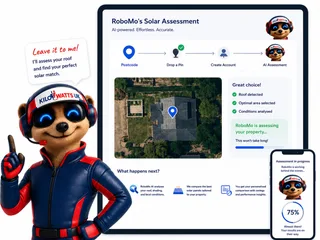
Simply enter your postcode, drop a pin on your roof, create your free account and let RoboMo™ analyse your property to find the best solar panels for your home.

You don't have to think
RoboMo™'s AI analyses your roof and does all the hard work.

Accurate & tailored
AI-powered assessment based on your roof, location, and conditions.

Best options, maximum savings
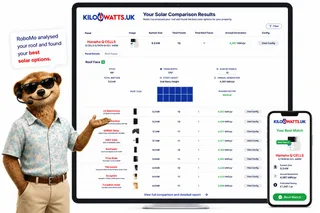
Compare top solar panels for the best performance and value.

Simple, fast & effortless
Provide a few details, sit back and watch your results unfold.
STEP 1
Choose Home, Business or Industrial
Enter your postcode to start your assessment.
STEP 2
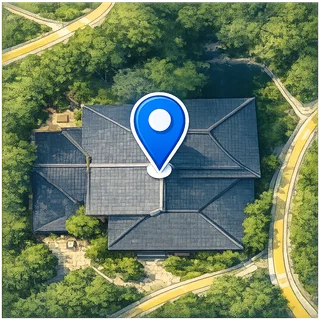
Drop a pin on your roof
STEP 3

Create your free account
STEP 4

Sit back and watch RoboMo™ work
RoboMo™ analyses your roof and builds your personalised solar comparison.

Step 1
Enter your postcode
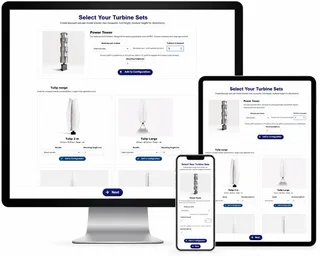
Start designing your wind energy system in seconds.
Are you an installer, distributor or renewable energy business?
Kilowatts UK is expanding the Flower Turbines partner network across the UK.
Become A Flower Turbines PartnerKilowatts UK is an authorised representative
Flower Turbines
Compact vertical-axis turbines built for real UK sites, not just open farmland.
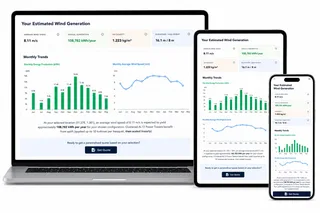
They start in light wind, sit in a small footprint, and are bird-safe by design. Cluster them as a bouquet and the group performs better together than the same turbines standing alone. Enter your postcode for a location-based generation estimate. Figures use area weather data and will differ if buildings, trees or hills sit in the way.
Starts in light UK wind
Built to generate in typical UK wind, not only open farmland.
Small rooftop or ground footprint
Compact towers for roofs, yards and tight sites.
Bird-safe slow rotation
Slow vertical-axis spin, bird-safe by design.
Bouquet clusters raise output
Grouped turbines outperform the same units standing alone.
STEP 2

Choose a location
STEP 3
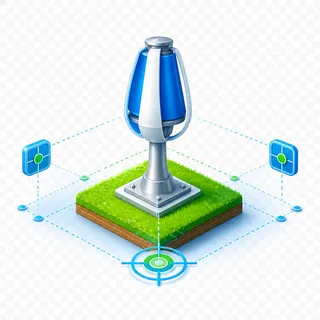
Place your cluster
Tap the map where you want the turbine cluster to go.
STEP 4

Instant generation forecasts
Compare different turbine layouts and see annual generation forecasts instantly.
STEP 5
No commitment required
Explore different configurations before deciding whether to request a quotation.
FAQ
Need Help? RoboMo's Got Answers
What is Does Exporting Solar Run Your Meter Backwards? The Truth about?
If you have solar panels, or you are thinking about them, you have probably heard someone say that on a sunny afternoon the meter "runs backwards". It is a lovely image, and it is wrong. A modern UK smart meter does not have a single total that goes up when you buy and down when you sell. It has two independent registe
Who is this video for?
UK homeowners comparing the options discussed in Does Exporting Solar Run Your Meter Backwards? The Truth.