


Can Potatoes Grow Better Under Solar Panels - New Agrivoltaics Research Explained
Published: 2026-06-12 15:07:02
Updated: 2026-06-12 15:39:00
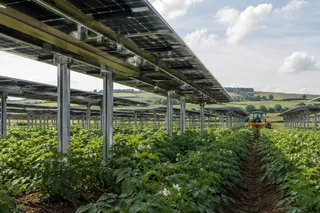
Can Potatoes Really Grow Better Under Solar Panels?
Possibly, yes, but not quite in the way many headlines suggest. A 2025 agrivoltaics study found that potatoes grown beneath simulated solar panel shading achieved stronger yields, improved water productivity and changes in nutrient content compared with conventional growing areas. However, the study did not use operational solar panels, and it was conducted in Iraq rather than the UK. The finding is still important because it challenges the assumption that solar energy and food production must always compete for the same land.
The research is interesting because it sits directly in the middle of one of the biggest arguments about solar farms
Critics often say solar panels take productive farmland out of use. Supporters argue that renewable energy is essential for lowering emissions, improving energy security and reducing exposure to volatile electricity markets. Agrivoltaics adds a third possibility: what if some land could produce food and electricity at the same time?
That does not mean every solar farm improves farming. It does not mean potatoes will always grow better beneath panels. It does mean the conversation is more complicated than a simple choice between crops and kilowatt-hours.
The Potato Study Everyone Is Sharing
The study was published in Frontiers in Horticulture under the title The effect of agrivoltaic system on nutrient content, yield, and water productivity of potatoes. It examined how potato plants responded to different light, irrigation and fertiliser conditions.
The researchers compared potatoes grown in shaded areas, partially shaded areas and open light areas. They also tested different irrigation levels and potassium fertiliser treatments. The aim was to understand how agrivoltaic-style growing conditions affected yield, water productivity and nutrient content.
The headline result was the one that caught everyone’s attention. The best results were found in the partially shaded areas between the simulated solar panel structures. In the study, light conditions were reported as one of the most important factors influencing results, more significant than irrigation or fertiliser for many observations. That is the part that makes people stop scrolling. Potatoes growing better near solar panels sounds like the kind of fact that feels almost too perfect for renewable energy supporters. It is surprising, simple and shareable. It also fits neatly into a wider argument that solar farms may not be as harmful to agriculture as some critics claim. But the careful version of the claim is more important than the viral version.
The Important Twist Most Headlines Miss
The study is widely discussed as research into potatoes growing under solar panels.
Strictly speaking, that is not what happened.
The researchers used structures designed to simulate the shading effect of solar panels. They were not measuring potato production underneath a live commercial solar farm connected to an inverter, generating electricity and operating as a full renewable energy installation. That distinction matters. It does not make the research worthless. In fact, isolating the shading effect is scientifically useful because it helps researchers understand one specific part of the agrivoltaic system. But it does mean the findings should be described accurately. A more accurate statement is that the study found potatoes performed well under simulated agrivoltaic shading conditions. That is different from saying solar panels have been proven to increase potato yields in all real-world settings. Real solar farms introduce many extra variables that a shading experiment cannot fully capture. These include panel height, row spacing, mounting angle, seasonal sun path, wind movement, rainfall distribution, maintenance access and the way machinery moves through the site. In practical solar design, small layout decisions can change the outcome. The height of the panels affects whether farm machinery can pass underneath. The row spacing affects how much direct light reaches the crop. The orientation affects when shade falls during the day. The ground conditions affect whether the site remains workable through wet months. That is why the twist in the study is not a reason to dismiss it. It is a reason to read it properly.
Why Partial Shade Can Sometimes Help Crops
Many people assume that more sunlight always means better crop growth.
That is not always true.
Plants need light for photosynthesis, but they also need suitable temperatures, available water and manageable stress levels. When heat and light intensity become too high, the plant can experience stress. In those conditions, more sunlight is not automatically better. Partial shading can sometimes improve the growing environment by reducing heat pressure and slowing moisture loss from the soil.
- The potential benefits include:
- Lower soil temperature.
- Reduced evaporation.
- Better moisture retention.
- Reduced heat stress.
- Improved water-use efficiency.
This is especially relevant in hot and water-stressed regions. If a crop is losing too much water or operating under excessive heat stress, a carefully shaded environment may improve performance even though total sunlight exposure is reduced. That appears to be part of what makes the potato study interesting. The strongest results were not simply found in the darkest areas. They were found in the partially shaded areas, where the balance between light availability and stress reduction may have been more favourable. This is an important practical point. Agrivoltaics is not about blocking sunlight. It is about managing sunlight. Too much shade can reduce crop performance. Too little shade may fail to reduce heat and water stress. The design challenge is finding the right balance for the crop, the climate and the site.
What Agrivoltaics Actually Means
Agrivoltaics is the combination of agricultural production and solar energy generation on the same land. A general overview of the concept can be found in this agrivoltaics introduction, but the practical meaning is simple: the land is not treated as either a farm or a solar site. It is designed to be both.
Different agrivoltaic systems can look very different depending on the crop, the land and the purpose of the project.
Some systems use elevated solar panels so crops can grow underneath. Some use wider row spacing so machinery can move between panel rows. Some combine solar arrays with grazing livestock. Others focus on high-value crops that may benefit from partial shade during hotter periods.
- Common examples include:
- Sheep grazing beneath solar arrays.
- Vegetable crops grown between panel rows.
- Fruit crops protected from excessive heat.
- Vineyards using solar structures for partial shade.
- Mixed farming systems with renewable energy income.
The key point is that agrivoltaics is a design approach, not just a label. A poorly designed solar farm with a few animals grazing around it is not necessarily a strong agrivoltaic project. A well-designed system considers farming activity from the beginning, including access, drainage, soil health, machinery movement, crop requirements and long-term maintenance. This is where renewable energy design and agricultural knowledge need to meet. Solar engineers understand generation, cabling, mounting and grid connection. Farmers understand soil, crops, machinery, water and seasonal work patterns. Agrivoltaics needs both.
Why The Study Location Matters
The potato research was conducted in Iraq. That matters because Iraq has very different growing conditions from most of the UK.
A result that makes sense in a hot, dry environment may not translate directly to a cooler, wetter climate. In a region where heat stress and water availability are major limiting factors, partial shading may create a meaningful benefit. In a damp British season with limited sunlight, the same level of shade could produce a different outcome.
This is not a weakness in the study. It is a boundary around what the study can reasonably tell us.
- Important local factors include:
- Average temperature.
- Rainfall pattern.
- Sunlight intensity.
- Soil type.
- Irrigation availability.
- Crop variety.
- Growing season length.
This is why agrivoltaic claims need to be handled carefully in the UK. A field in Kent, a farm in East Anglia and agricultural land in Scotland may all respond differently. Even within the UK, local climate, drainage and soil conditions vary significantly. It would be wrong to take the Iraqi potato study and claim that every UK potato farmer should immediately install solar panels above their crop. It would also be wrong to ignore the study because it was not conducted here. The correct response is to treat it as useful evidence that partial shading can influence crop performance, while recognising that UK-specific trials and site assessments are needed before firm conclusions can be drawn for British agriculture.
Could This Apply To UK Farming?
Agrivoltaics could work in the UK, but it will not be suitable for every crop, every field or every farm.
The UK has a different agricultural profile from the environment in the study. Some crops need as much light as possible. Some may tolerate partial shade. Some may benefit during hot, dry periods but suffer during dull seasons. The answer depends on the crop and the design.
For a UK landowner, the first question should not be whether agrivoltaics is good or bad. The first question should be what the land is currently used for and what the solar design would change.
- A good agrivoltaic assessment would consider:
- The crop currently grown on the land.
- The machinery needed to farm it.
- The seasonal access requirements.
- The shading pattern throughout the year.
- The effect on drainage and soil condition.
- The likely electricity generation profile.
- The planning and grid connection constraints.
The electrical design also matters. Solar generation is affected by orientation, spacing and shading, so an agrivoltaic layout may not produce the maximum possible electricity per acre. That trade-off may be acceptable if the site also preserves agricultural value, but it needs to be understood from the beginning. This is similar to rooftop solar, where the best system is not always the one with the most panels. Roof shape, shading, inverter choice, cable routes and long-term performance all matter. Our guide to solar panel lifespan and long-term performance explains why system design and realistic expectations are so important. The same principle applies on farmland. A successful agrivoltaic system is not just a solar farm with crops underneath. It is a land-use design that has to work agriculturally and electrically.
Why This Matters For The Solar Farm Debate
The potato study matters because it challenges a popular assumption.
The assumption is that solar farms automatically remove agricultural productivity.
Sometimes that criticism may be fair. A badly chosen or badly designed site could reduce productive farming use. But agrivoltaics shows that the issue is not always so simple. The public debate often turns into a binary argument. Either we use land for food. Or we use land for electricity. Agrivoltaics asks whether that binary choice is always necessary. This matters because the UK is trying to solve several problems at once. Electricity demand is expected to rise as more heating, transport and industry become electrified. Energy prices remain a major concern for households and businesses. Farmers are under pressure from input costs, changing weather and uncertain income. Land use is becoming more politically sensitive. Those pressures are connected. Our article on why UK electricity prices are so high explains how energy markets affect bills. The same wider issue affects farmers because electricity, fuel, fertiliser and infrastructure costs all influence agricultural economics. If a farm can generate clean electricity while keeping land in productive use, that could be valuable. If the solar income helps stabilise a farming business, that may also have social and economic value. But those benefits depend on careful design and honest assessment. Agrivoltaics should not be used as a marketing phrase to make every solar farm sound agricultural. It should be treated as a specific design approach with measurable farming and energy outcomes.
The Practical Design Issues People Often Forget
The idea of growing crops beneath solar panels sounds simple until the practical details are considered.
A real farm is not a diagram. It has machinery, access routes, wet ground, uneven levels, drainage issues, seasonal deadlines and commercial pressures. A solar layout that looks sensible on paper may create problems if it blocks machinery or makes routine work inefficient.
Panel height is one of the first design questions. Low-mounted panels may be cheaper and easier to install, but they may restrict farming activity. Higher-mounted systems can improve access and light distribution, but they may increase structural cost and wind loading. Row spacing is another major issue. Wider spacing can allow more light and better access, but it reduces the density of solar panels and may lower energy output per acre. Narrower spacing may increase generation but reduce agricultural usability. Maintenance also matters. Solar sites need access for inspection, cleaning, vegetation management, electrical testing and repairs. Farms need access for planting, spraying, irrigation, harvesting and soil management. These activities must be compatible. Real agrivoltaic planning needs to answer practical questions.
- Can machinery move safely through the site.
- Can the crop be planted and harvested efficiently.
- Can cables and mounting structures be protected.
- Can maintenance teams access equipment without damaging crops.
- Can drainage be managed properly.
- Can the system survive local wind and weather conditions.
These are the details that determine whether a project works in reality. For landowners considering renewable energy, it is sensible to involve experienced designers and installers early. The Kilowatts UK business directory can help users explore renewable energy and electrical specialists.
What Farmers And Landowners Should Take From The Study
The study should not be treated as proof that solar panels always improve farming.
That would be too strong.
It should be treated as evidence that shading, water productivity and crop performance deserve serious attention when solar is proposed on agricultural land. For farmers and landowners, the useful lesson is not simply that potatoes may grow well with partial shade. The useful lesson is that land-use decisions should be evidence-led. Before supporting or rejecting an agrivoltaic project, it is worth asking what the design is actually trying to achieve.
- Key questions include:
- Which crop or farming activity will continue on the land.
- How much shade will the solar structure create.
- Whether the land can still be worked efficiently.
- Whether water use or soil moisture could improve.
- Whether the solar income supports the farm business.
- Whether the project has been designed around agriculture or only around electricity generation.
A project that cannot answer those questions probably should not be described as agrivoltaic in any meaningful sense. This is especially important because renewable energy projects can last for decades. Decisions made at design stage affect the land, the farm and the energy output for a long time. The same long-term thinking applies to other clean energy investments. The UK energy system is changing, and our article on the UK energy shake-up affecting batteries, heat pumps and solar explains why homes and businesses are increasingly looking at energy systems as long-term infrastructure rather than short-term purchases.
Why The Study Is Still Good News For Solar
Even with its limitations, the potato study is good news for the solar industry.
Not because it proves every solar farm is good for farming.
It does not. It is good news because it shows that the interaction between solar infrastructure and agriculture can be studied, measured and improved. That moves the conversation away from slogans and towards evidence. For renewable energy supporters, that matters. Overclaiming the study would be a mistake. Saying "solar panels make potatoes grow better" is too broad and too easy to challenge. A more credible statement is that research found potatoes performed well under simulated agrivoltaic shading in specific conditions, and that the result supports further investigation into dual-use solar farming. That is a stronger position because it is accurate. Good renewable energy communication should not pretend trade-offs do not exist. Solar farms can raise legitimate questions about land use, landscape impact, biodiversity, grid connection, access and agricultural value. Those questions deserve serious answers. Agrivoltaics may be one of those answers in the right circumstances. It offers a way to think about solar farms not only as energy assets, but as part of a wider land management strategy.
What The Study Does Not Prove
It is worth being clear about what the study does not prove.
It does not prove that UK potato yields will increase beneath commercial solar panels.
It does not prove that all crops benefit from shade. It does not prove that every solar farm is compatible with agriculture. It does not prove that agrivoltaics is always financially better than conventional solar or conventional farming. It does not remove the need for planning, environmental assessment, engineering design or agricultural consultation. That may sound cautious, but it is exactly the kind of caution that makes the research more useful. The strongest case for agrivoltaics is not built on hype. It is built on understanding when it works, when it does not and what conditions affect the outcome. A shaded system in a hot region may improve water productivity. A similar system in a low-light climate may need a different design. A crop that tolerates shade may respond well. A crop that depends heavily on full sun may not. A grazing system may be straightforward. A high-machinery arable system may be more complicated. This is why site-specific design matters.
The Real Lesson From The Potato Study
The most important lesson from the potato study is not that potatoes definitely grow better under solar panels.
The most important lesson is that assumptions need testing.
For years, the debate around solar farms and farmland has often been too simplistic. One side says solar damages food production. The other side says renewable energy is necessary. Agrivoltaics introduces a more practical question: can we design land use more intelligently? The answer, in some cases, may be yes. The potato research shows that partial shading can influence crop performance in meaningful ways. It also shows that the details matter. The study used simulated panels, took place in Iraq and examined specific growing conditions. Those limitations do not weaken the article. They make the conclusion more honest. The future of renewable energy will not be built by pretending every technology is perfect. It will be built by designing better systems, measuring outcomes and learning from real evidence. Agrivoltaics is still developing, but it could become an important part of that future. If farming and solar can be designed to work together, the question changes completely. It is no longer only about whether land should produce food or electricity. It becomes about how much value one piece of land can responsibly produce.
Ready to compare your options?
Get tailored comparisons and connect with trusted installers in under a minute.
Plan, Compare & Buy Renewable Energy Solutions
AI does the thinking.
You get the perfect solar match.
Use RoboMo™ to assess your property, compare available technologies and connect with trusted UK installers, suppliers and manufacturers.
Simply enter your postcode, drop a pin on your roof, create your free account and let RoboMo™ analyse your property to find the best solar panels for your home.
You don't have to think
RoboMo™'s AI analyses your roof and does all the hard work.

Accurate & tailored
AI-powered assessment based on your roof, location, and conditions.

Best options, maximum savings
Compare top solar panels for the best performance and value.

Simple, fast & effortless
Provide a few details, sit back and watch your results unfold.
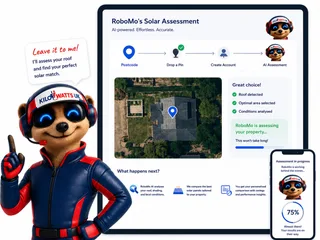
STEP 1
Choose Home, Business or Industrial
Enter your postcode to start your assessment.
STEP 2
Drop a pin on your roof
STEP 3

Create your free account
STEP 4

Sit back and watch RoboMo™ work
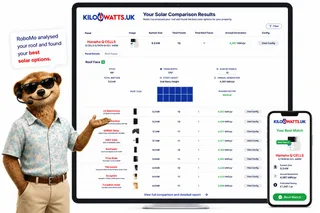
RoboMo™ analyses your roof and builds your personalised solar comparison.
Kilowatts UK is an authorised representative
Flower Turbines
Compact vertical-axis turbines built for real UK sites, not just open farmland.
They start in light wind, sit in a small footprint, and are bird-safe by design. Cluster them as a bouquet and the group performs better together than the same turbines standing alone. Enter your postcode for a location-based generation estimate. Figures use area weather data and will differ if buildings, trees or hills sit in the way.
Starts in light UK wind
Built to generate in typical UK wind, not only open farmland.
Small rooftop or ground footprint
Compact towers for roofs, yards and tight sites.
Bird-safe slow rotation
Slow vertical-axis spin, bird-safe by design.
Bouquet clusters raise output
Grouped turbines outperform the same units standing alone.
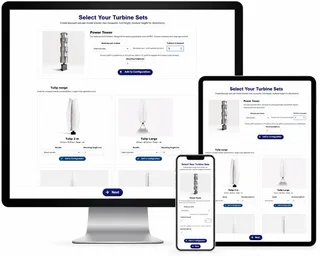
Step 1
Enter your postcode
Start designing your wind energy system in seconds.
STEP 2

Choose a location
STEP 3
Place your cluster
Tap the map where you want the turbine cluster to go.
STEP 4
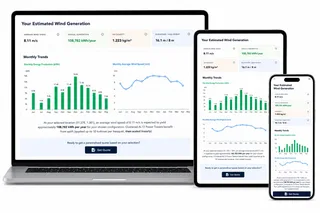
Instant generation forecasts
Compare different turbine layouts and see annual generation forecasts instantly.
STEP 5
No commitment required
Explore different configurations before deciding whether to request a quotation.
Related articles
Solar panels
Mo's Mission Nominations
FAQ
Need Help? RoboMo's Got Answers
Can potatoes really grow better under solar panels?
Possibly. A 2025 agrivoltaics study found that potatoes grown beneath simulated solar panel shading achieved stronger yields, improved water productivity and changes in nutrient content compared with conventional growing areas. However, the study used structures that simulated solar panel shading rather than operational solar panels, and the research was conducted in Iraq rather than the UK.
What did the potato agrivoltaics study actually investigate?
The researchers examined how potato crops responded to different light conditions, irrigation levels and potassium fertiliser treatments. They compared potatoes grown in shaded areas, partially shaded areas and open light areas to understand how agrivoltaic-style growing conditions affected yield, nutrient content and water productivity.
Did the study use real solar panels?
No. One of the most important details is that the researchers used structures designed to simulate the shading effect of solar panels. They were investigating how shading influenced crop performance rather than measuring potatoes grown beneath a fully operational solar farm.
Why is the distinction between simulated shading and real solar panels important?
Real solar farms involve many additional factors that were not part of the study, including panel height, row spacing, orientation, seasonal sunlight patterns, wind movement, rainfall distribution and farm machinery access. The study provides useful evidence about shading, but it does not automatically predict how every real-world agrivoltaic project will perform.
Why can partial shade sometimes help crops?
Plants need sunlight for photosynthesis, but excessive heat and intense sunlight can create stress. Partial shading may reduce soil temperatures, slow evaporation, improve moisture retention and reduce heat stress. In some environments, these benefits can outweigh the reduction in direct sunlight.
What is agrivoltaics?
Agrivoltaics is the practice of combining agricultural production and solar electricity generation on the same piece of land. Rather than treating farmland and renewable energy as competing land uses, agrivoltaic systems are designed to support both activities simultaneously.
What are some examples of agrivoltaic systems?
Agrivoltaic projects can include sheep grazing beneath solar arrays, vegetable crops growing between panel rows, vineyards operating alongside solar infrastructure, berry production under elevated panels and mixed-use agricultural sites that generate renewable electricity while remaining productive farmland.
Why does the location of the study matter?
The research was conducted in Iraq, which has very different environmental conditions from most parts of the UK. Temperature, rainfall, sunlight intensity, soil characteristics and water availability all affect crop performance. Results observed in a hot and dry climate may not translate directly to cooler and wetter regions.
Could agrivoltaics work in the UK?
Potentially, yes. However, suitability depends on factors such as crop type, local climate, solar panel design, row spacing, machinery access requirements and site conditions. What works well in one location or for one crop may not work as effectively elsewhere.
Does agrivoltaics reduce solar electricity generation?
It can. Agrivoltaic layouts are often designed to balance agricultural productivity and electricity generation. Wider panel spacing, higher mounting structures and agricultural access requirements may reduce the maximum amount of solar capacity that could otherwise be installed on the same area of land.
Why is agrivoltaics becoming more popular?
Agrivoltaics offers the possibility of producing both food and renewable electricity from the same site. As concerns grow around energy security, food production, land use and climate resilience, dual-use land strategies are attracting increasing interest from researchers, farmers and policymakers.
Does this study prove that all crops benefit from shade?
No. The study focused on potatoes under specific growing conditions. Different crops respond differently to shade, temperature and moisture levels. Some crops may benefit from partial shading while others may perform best in full sunlight.
Does the study prove that solar farms improve farming?
No. The research suggests that partial shading can influence crop performance positively under certain conditions, but it does not prove that all solar farms improve agricultural productivity. Site design, crop selection and local environmental conditions remain critical factors.
Why does this study matter for the solar farm debate?
The study challenges the assumption that farmland and solar energy must always compete for the same land. While it does not prove that every solar farm is beneficial to agriculture, it supports further investigation into whether carefully designed agrivoltaic systems can combine food production and renewable energy generation.
What is the main lesson from the potato study?
The key lesson is that assumptions should be tested rather than accepted at face value. The research suggests that the relationship between agriculture and solar energy may be more complex than many people realise, and that carefully designed agrivoltaic systems could create opportunities for both food production and renewable electricity generation.