


UK Energy Shake-Up 2026: Heat Pumps & Solar
Published: 2026-04-30 07:59:13
Updated: 2026-05-03 07:17:44
The UK is breaking the link between gas and electricity prices. Discover what this means for heat pumps, solar panels, battery storage, and your energy bills.

Heat Pump Grant 2026 UK: What Solar, Battery Storage and the BUS Changes Mean for Your Home
On 21 April 2026 the UK government announced a set of energy reforms that are worth paying attention to if you have been thinking about a heat pump, solar panels, or battery storage. Grant amounts have changed, planning rules are being overhauled, and the direction of UK energy policy is now clear enough that sitting on the fence has a real cost. This article covers what actually changed, what things cost in 2026, and how to decide whether now is the right time to act. The figures here draw on the latest Ofgem BUS guidance, the government's Warm Homes Plan, and installation data tracked across the UK.
Ready to compare your options?
Get tailored comparisons and connect with trusted installers in under a minute.
What the Government Announced
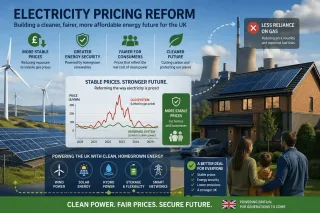
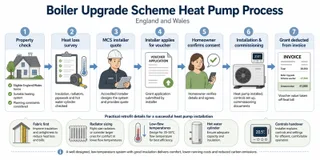
The core problem these reforms are trying to fix is that UK electricity prices have been tied to gas prices even when most of the electricity on the grid is coming from wind and solar. Gas-fired power stations set the market clearing price, so when gas is expensive everyone pays more regardless of where their electricity actually came from. The April 2026 package is partly about breaking that link over time, and partly about making it easier and cheaper to install low-carbon technology at home. The Boiler Upgrade Scheme has been extended to 2030 and the eligibility rules changed significantly from 28 April. The main grant for an air source or ground source heat pump is still £7,500, claimed by your installer through Ofgem and applied as a discount off your installation price. You do not handle the application yourself. If your home runs on oil or LPG you can now get £9,000 instead. Air-to-air heat pumps have been added to the scheme for the first time at £2,500, which matters for flats and smaller properties where a traditional wet heating system is not practical. Around 4.8 million households in flats previously had no realistic low-carbon heating option, and that has now changed. The scheme has £295 million allocated for 2025/26 according to Ofgem's updated guidance. On planning, permitted development rights are being extended to make it easier to install solar panels, heat pumps and EV chargers in flats, rented properties, and homes without driveways. The Electricity Generator Levy goes up from 45% to 55%, capturing profits from generators who have benefited from inflated market prices, with revenue redirected toward the energy transition. The government's Warm Homes Plan sits behind all of this, a £15 billion programme targeting 5 million home upgrades by 2030, with a 0% consumer loan scheme for solar planned for April 2027.
What a Heat Pump Actually Costs Right Now
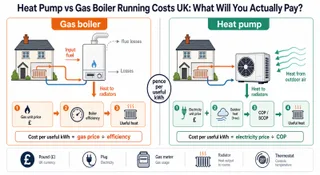
Before any grant, an 8kW air source heat pump installed typically runs between £8,000 and £14,000 depending on where you are, who does the work, and how complex the system is. After the £7,500 BUS grant you are looking at a net cost of £500 to £6,500, which puts it in the same ballpark as a replacement gas boiler. With 0% VAT on energy-saving materials on top of that, the upfront comparison looks very different to what it did two years ago. Running costs are where the detail matters and where most articles skip the important bits. At typical UK winter temperatures around 8 degrees, a modern air source heat pump achieves a Coefficient of Performance of around 5.0, meaning five units of heat for every unit of electricity consumed. In a cold snap around 0 degrees that falls to about 3.0, which is still three times more efficient than direct electric heating. Performance data tracked across UK installations through winter 2025/26 confirms these figures hold in real conditions, not just manufacturer testing. The catch is that electricity costs around 24.67p per kWh against gas at around 5.74p, so at COP 3.0 on a standard tariff you are not quite at cost parity with gas. Get onto a smart tariff with overnight rates around 14p or below and annual heating bills of £400 to £700 become realistic for a typical semi-detached, a saving of over £500 a year compared to running on a standard electricity tariff. Most installers do not lead with the tariff conversation and they probably should, because your energy contract makes more difference to your running costs than almost anything else about the installation. Heat pumps work best in well-insulated homes with large radiators or underfloor heating set up for lower flow temperatures. Most problems with installations come down to poor system design rather than any fault in the technology itself, specifically inadequate hydronic design for low-temperature operation. Across installations connected through Kilowatts.uk, the cases where homeowners report dissatisfaction almost always trace back to an installer who did not properly assess flow temperatures and radiator sizing before starting the job. When getting quotes, ask directly whether your installer is MCS-certified and whether they have specific experience with low-temperature hydronic systems. If they cannot answer that confidently, that tells you something. Rural homes on oil or LPG are currently in the strongest position of anyone: high existing fuel costs, a £9,000 grant, and the option to pair a heat pump with self-generated solar electricity to bring running costs down further. Properties with solid walls or poor insulation may still benefit but are better off addressing insulation first, since that improves system performance and shortens the payback period on the heat pump itself.
Solar Panels and Battery Storage in 2026
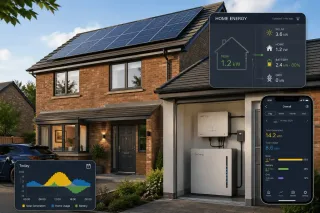
Hardware costs for solar have kept falling and the government has made expanding rooftop solar a stated priority. A typical 4kWp system generates between 3,400 and 3,800 kWh a year across most of England. March 2026 was the sunniest month on UK record since 1910, with 185.8 hours of sunshine logged, a useful reminder that the UK generates more solar than its reputation suggests and that generation figures from installers are not unrealistic. Battery storage is increasingly what makes a solar install work financially rather than just environmentally. Without it, surplus generation during the day gets exported via the Smart Export Guarantee at rates up to 20p per kWh with some providers. With a home battery storage system, that electricity gets shifted into the evening when you actually need it, cutting grid imports during peak rate periods. Pair that with a time-of-use tariff and you are charging the battery cheaply overnight and drawing on stored solar through the day. Homeowners who have gone through this setup report that the battery pays for itself faster than the solar panels in many cases, because it changes how much of your own generation you actually use rather than export at a lower rate. The process is simpler than most people expect. DNO approval through the G98 grid connection process takes around 2 to 4 weeks, and the physical install is usually done in a day or two once that clears. If capturing summer generation matters to you, getting started in spring makes a real difference to how much you generate in year one, and comparing solar installers now with a system in place by May or June is realistic if you move fairly soon.
The Planning Changes Worth Knowing About
The permitted development changes are not getting much coverage but they matter for a lot of people. If you live in a flat, rent your home, or do not have a driveway, there is a good chance you have been told at some point that a heat pump or solar installation is not straightforward or simply not possible. The government is specifically targeting these three situations with the new rules, so getting a fresh assessment if you were put off before is worth doing. The answer may now be different. For renters there is also a longer-term angle that is easy to miss. New minimum energy efficiency standards are expected to require private landlords to bring properties up to EPC C or above by 2030, with projected savings for tenants in upgraded properties of around £210 a year according to government figures. Even if you cannot act on your home directly today, your landlord may end up being required to do it over the next few years.
Should You Do It Now or Wait
There is a reasonable case for acting sooner rather than later and it is not just marketing talk. BUS grant funding is allocated on a first-come, first-served basis within each financial year and the budget is not unlimited. £295 million sounds substantial but it moves quickly when installer demand is rising and lead times are already extending in many regions. For solar specifically, every month you delay during spring and summer is generation you do not get back. Waiting does make sense in some situations. Heat pump hardware costs are still falling year on year, and the 0% consumer loan scheme for solar planned for April 2027 could make financing easier if upfront cost is currently the main barrier. If your home needs insulation work before a heat pump will perform properly, doing that first is not wasted time, it is the right order of operations and will get you better results from the heat pump when you do install it. The honest answer is that it depends on your property: its insulation, its current heating setup, your roof orientation, and how you actually use energy. Getting an independent survey from someone who is not selling you the installation is worth doing before you commit to anything, and finding a vetted MCS-certified installer through a platform that has already checked their credentials removes a lot of the risk from that process.
Ready to compare your options?
Get tailored comparisons and connect with trusted installers in under a minute.
Plan, Compare & Buy Renewable Energy Solutions
AI does the thinking.
You get the perfect solar match.
Use RoboMo™ to assess your property, compare available technologies and connect with trusted UK installers, suppliers and manufacturers.
Simply enter your postcode, drop a pin on your roof, create your free account and let RoboMo™ analyse your property to find the best solar panels for your home.

You don't have to think
RoboMo™'s AI analyses your roof and does all the hard work.

Accurate & tailored
AI-powered assessment based on your roof, location, and conditions.

Best options, maximum savings
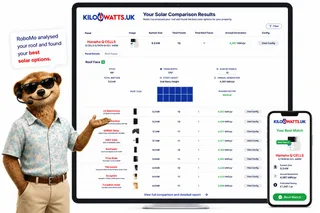
Compare top solar panels for the best performance and value.

Simple, fast & effortless
Provide a few details, sit back and watch your results unfold.
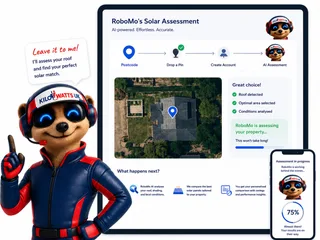
STEP 1
Choose Home, Business or Industrial
Enter your postcode to start your assessment.
STEP 2

Drop a pin on your roof
STEP 3

Create your free account
STEP 4

Sit back and watch RoboMo™ work
RoboMo™ analyses your roof and builds your personalised solar comparison.

Step 1
Enter your postcode
Start designing your wind energy system in seconds.
Are you an installer, distributor or renewable energy business?
Kilowatts UK is expanding the Flower Turbines partner network across the UK.
Become A Flower Turbines PartnerKilowatts UK is an authorised representative
Flower Turbines
Compact vertical-axis turbines built for real UK sites, not just open farmland.
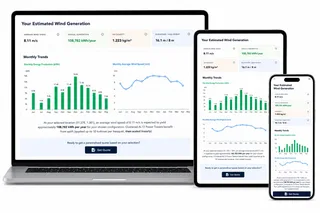
They start in light wind, sit in a small footprint, and are bird-safe by design. Cluster them as a bouquet and the group performs better together than the same turbines standing alone. Enter your postcode for a location-based generation estimate. Figures use area weather data and will differ if buildings, trees or hills sit in the way.
Starts in light UK wind
Built to generate in typical UK wind, not only open farmland.
Small rooftop or ground footprint
Compact towers for roofs, yards and tight sites.
Bird-safe slow rotation
Slow vertical-axis spin, bird-safe by design.
Bouquet clusters raise output
Grouped turbines outperform the same units standing alone.

STEP 2

Choose a location
STEP 3

Place your cluster
Tap the map where you want the turbine cluster to go.
STEP 4

Instant generation forecasts
Compare different turbine layouts and see annual generation forecasts instantly.
STEP 5

No commitment required
Explore different configurations before deciding whether to request a quotation.
Related articles

Mo's Mission Nominations
FAQ
Need Help? RoboMo's Got Answers
What is the BUS grant amount in 2026?
The standard grant is £7,500 for air source and ground source heat pumps.
Homes on oil or LPG heating qualify for £9,000.
Air-to-air heat pumps, newly eligible from 28 April 2026, attract a £2,500 grant.
The scheme runs to 2030 with updated Ofgem guidance in effect from the same date.
Homes on oil or LPG heating qualify for £9,000.
Air-to-air heat pumps, newly eligible from 28 April 2026, attract a £2,500 grant.
The scheme runs to 2030 with updated Ofgem guidance in effect from the same date.
Do I need a current EPC to apply for the Boiler Upgrade Scheme?
Since the April 2026 rule changes, a valid EPC is no longer a strict requirement for BUS applications.
Where no EPC is available, your installer can provide alternative evidence such as recent utility bills and photographs of the existing heating system.
Where no EPC is available, your installer can provide alternative evidence such as recent utility bills and photographs of the existing heating system.
Can I use the BUS grant alongside other schemes?
Yes, BUS can be combined with ECO4 for different measures on the same property.
For example, ECO4 can cover insulation while BUS covers the heat pump.
You cannot use two grants toward the same individual measure, and ECO4 is scheduled to end in December 2026.
For example, ECO4 can cover insulation while BUS covers the heat pump.
You cannot use two grants toward the same individual measure, and ECO4 is scheduled to end in December 2026.
Does the Boiler Upgrade Scheme cover Scotland?
No, BUS covers England and Wales only.
Scotland operates the Home Energy Scotland Grant, offering up to £7,500 plus a £7,500 interest-free loan through a separate scheme.
Northern Ireland does not have a direct equivalent but has smaller grants available through the NI Sustainable Energy Programme.
Scotland operates the Home Energy Scotland Grant, offering up to £7,500 plus a £7,500 interest-free loan through a separate scheme.
Northern Ireland does not have a direct equivalent but has smaller grants available through the NI Sustainable Energy Programme.
How long does a solar panel installation take from start to finish?
The G98 grid connection approval from your DNO typically takes 2 to 4 weeks.
Physical installation is usually completed in one to two days once that approval comes through.
If you want generation in place for the summer months, starting the process in spring gives you the best chance of hitting that window.
Physical installation is usually completed in one to two days once that approval comes through.
If you want generation in place for the summer months, starting the process in spring gives you the best chance of hitting that window.
What goes wrong with heat pump installations?
The most common issue is poor hydronic design, where the system is sized or configured for flow temperatures that do not suit the home's existing radiators, leaving some rooms that do not heat properly.
Choosing an MCS-certified installer with specific experience in low-temperature system design significantly reduces this risk.
Getting a full property survey done before any installation is agreed is the single most important step you can take before committing.
Choosing an MCS-certified installer with specific experience in low-temperature system design significantly reduces this risk.
Getting a full property survey done before any installation is agreed is the single most important step you can take before committing.
How much can I save on heating bills with a heat pump?
It depends heavily on your current heating system and which energy tariff you move to.
On a standard electricity tariff, savings over gas are modest at current rates.
On a smart tariff with overnight rates around 14p per kWh or below, annual heating costs of £400 to £700 become realistic for a typical semi-detached, which represents a saving of over £500 a year compared to running on a standard tariff.
On a standard electricity tariff, savings over gas are modest at current rates.
On a smart tariff with overnight rates around 14p per kWh or below, annual heating costs of £400 to £700 become realistic for a typical semi-detached, which represents a saving of over £500 a year compared to running on a standard tariff.
Is a heat pump suitable for my home?
Heat pumps work best in well-insulated homes with large radiators or underfloor heating designed for lower flow temperatures.
Properties with solid walls or significant heat loss can still benefit but are usually better served by addressing insulation first.
Rural homes currently on oil or LPG tend to see the strongest financial case, combining high existing fuel costs with the increased £9,000 grant.
Properties with solid walls or significant heat loss can still benefit but are usually better served by addressing insulation first.
Rural homes currently on oil or LPG tend to see the strongest financial case, combining high existing fuel costs with the increased £9,000 grant.