Founder & Renewable Energy Author, kilowatts.uk


Founder & Renewable Energy Author, kilowatts.uk
Article
UK Warm Homes Loan Scheme from 27 October 2026: loan caps for solar, batteries and heat pumps, named lenders, MCS rules, and how it sits with the Boiler Upgrade Scheme.
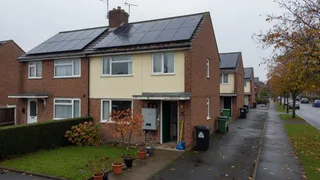
The Warm Homes Loan Scheme is a government-backed way to spread the cost of home energy kit instead of paying the installer in one lump. From 27 October 2026, participating lenders can offer no-interest and low-interest loans for solar panels, a home battery, heat pumps, biomass, a heat-network connection and some micro-renewables. The Department for Energy Security and Net Zero published the consumer factsheet that day. Households in England, Scotland, Wales and Northern Ireland can apply.
It is not a grant. You still borrow money, and you still have to repay it. The Treasury support is there so lenders can cut the interest rate compared with ordinary home-improvement lending. Some products are interest-free. Terms, monthly cost and who you can use as an installer vary by lender, so the scheme name on its own does not tell you the deal.
If you already know you want home solar or a battery, treat this as a finance option sitting on top of a proper design, not a reason to skip the design.
It is still a loan. The scheme name does not replace a design, an MCS installer or a written quote.
The factsheet says the loans are available to households across the UK. Owner-occupiers are the obvious audience. Reporting on the scheme rules also covers private landlords, including an owner of more than one property taking a loan on each qualifying home. That is a lender decision as well as a scheme rule: expect affordability, credit and eligibility checks on every application.
You apply to a participating lender, or through an installer who works with one. The lender, not a government portal, runs the credit process. If a lender only works with its own installer network, you cannot take that product to a different MCS firm.
Keep the paperwork if you are accepted: the quote, the finance agreement, the invoice, proof of purchase and the MCS certificate. Those records are what you will need if anything later needs checking.
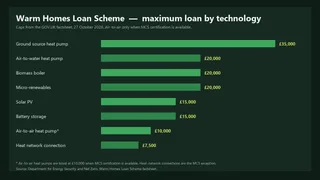
The scheme sets a maximum supported loan for each listed technology. That cap is the most a participating lender can advance under the scheme for that measure, including the ancillary work that belongs with the installation. It is not a promise that every quote will come in at the cap, and it is not a price list.
Air-to-air heat pumps sit on the list with a clear caveat: they can only be financed once the relevant MCS certification exists. Until that standard is in place, treat air-to-air as not yet in the scheme even though a cap has been published.
You can combine measures. A household putting solar and a battery on the same job can borrow against both caps in one application where the lender allows it. An EV charge point can sit inside a solar or battery job on some readings of the rules; a standalone charge-point loan is not what this scheme is for. Confirm that point with the lender before you sign, because product rules differ.
A scheme cap is a ceiling, not a typical installed price.
Maximum supported loan for each listed measure, including ancillary work that belongs with that installation. Confirm on the live GOV.UK factsheet before you treat a figure as current.
| Technology | Maximum loan under the scheme |
|---|---|
| Solar PV | £15,000 |
| Electrical storage battery | £15,000 |
| Air-to-water heat pump | £20,000 |
| Air-to-air heat pump | £10,000, when MCS certification is available |
| Ground source heat pump | £35,000 |
| Biomass boiler | £20,000 |
| Heat network connection | £7,500 |
| Micro-renewable system | £20,000 |
These figures come from the GOV.UK factsheet of 27 October 2026. Caps can be updated. Check the live factsheet before you treat a number as current.
The government says it has worked with lenders to deliver up to a five percentage point reduction against the rate those lenders would otherwise charge for this kind of borrowing. That is a comparison against that lender's own regular rate, not a promise that every Warm Homes loan will undercut every high-street personal loan.
Loans run for a minimum of three years. Some products allow up to thirty years. A long term cuts the monthly figure and raises the total you repay, even at a low rate. Compare the total amount repayable, not only the monthly number.
The factsheet gives one worked example. A homeowner borrowing £10,000 at 8% over seven years might repay around £155 a month on a loan available outside the scheme. Through the Warm Homes Loan Scheme, that borrower could save up to £285 a year on repayments. That is a government illustration, not a quote from Kilowatts and not a rate you should assume you will be offered. On the bill side, the same factsheet says installing a heat pump, a battery and solar panels could save a household up to £550 a year, rising by a further £300 a year with a time-of-use tariff. Those figures are also government illustrations. Real savings depend on the house, the tariff, how you use the kit, and whether the design matches the occupancy. Do not use them as a payback model.
You can use a Warm Homes loan alongside a grant of up to £9,000 through the Boiler Upgrade Scheme in Great Britain, and alongside Home Energy Scotland support in Scotland. The heat-pump loan caps are described as applying before that grant is deducted, which is why a loan and a grant can sit on the same job.
Grant rules change. The £9,000 figure is what the October 2026 factsheet stated. Check the live Boiler Upgrade Scheme pages and Home Energy Scotland before you treat a grant amount as current. Off-gas homes, property type and installer accreditation all affect eligibility. A loan does not create a grant you were not already entitled to.
An earlier Kilowatts note on the wider Warm Homes Plan covered the grant landscape as it stood earlier in 2026. This article is specifically about the loan products that opened with the October factsheet.
Every funded installation except a heat-network connection must use MCS-certified products, fitted by an MCS-certified installer to the relevant MCS standard. Lenders have to check the installer and the completed installation, using an MCS data link where one exists, before scheme support is released.
That is the consumer-protection spine of the scheme. It is also why a cheap non-MCS quote cannot be dropped into a Warm Homes loan. Some lenders will only work with partner installers. Others will accept any MCS-certified firm. Ask that question first, because it decides whether you can book a survey with the installer you actually want.
Fabric work is the other boundary. Insulation, windows, doors and roofing that a solar job might need first sit outside these technology caps. A lender may still offer separate finance for that work, but it does not attract the scheme support. If the roof needs replacing before panels go on, budget that as its own line.
Ten lenders were named on launch. Further lenders and products are expected later. The factsheet list on 27 October 2026 was:
How each one lends is a commercial product, not a government tariff. Some will be installer-tied. Some will be closer to a personal loan. South Manchester Credit Union is a local membership organisation, so geography and membership rules apply. British Gas and E.ON were quoted in the launch material as working with lenders rather than lending in their own name.
Shop the total cost. Ask who the installer can be, whether the rate is fixed, whether there are arrangement fees, what happens if you sell the house, and whether early repayment is charged. Do not assume an interest-free headline is the cheapest path over a long term if fees sit elsewhere.

Start with the house, not the lender. Get a design and a written quote for the kit you actually need. For solar that means roof condition, usable area, shading and a generation estimate for this property. For a battery it means daily use, inverter type and whether you are adding storage to an existing array. Battery cost still depends on capacity and install complexity; the loan cap is not a typical price.
Then check MCS status, DNO / G98 or G99 implications, and whether a heat-pump grant is in play. Only then compare lenders who will fund that specific quote.
The government's own sequence is sensible: consider which upgrades fit the home, check grant eligibility, compare quotes and loan terms, apply, keep records, then look at a smart tariff once the kit is working. Free energy-efficiency advice sits on GOV.UK. The loan is the finance step, not the design step. If a salesperson leads with the scheme and cannot show a design, walk away. Cheap finance on the wrong system is still the wrong system.
If a salesperson leads with the scheme and cannot show a design, walk away.
Solar and batteries are the two measures most Kilowatts readers will meet first. Each has a £15,000 cap. That will cover many domestic jobs and will not cover every hybrid, every scaffolding-heavy roof, or every large storage system. If the quote is above the cap, you either reduce the scope, fund the difference yourself, or use non-scheme finance for the remainder.
Micro-renewables, including domestic wind, sit at £20,000. A small turbine is still a planning, noise and yield problem before it is a finance problem. See the wind power notes before you treat a loan cap as a reason to add a turbine to a solar quote.
A battery on a time-of-use tariff is where the government's extra £300 illustration comes from. That only works if the tariff, the inverter and the way you live actually shift units. A battery bought because the loan is cheap, then left on a flat-rate tariff, will not match the brochure.
Get a quote that would still make sense if you paid cash. Check MCS, roof, electrics and, for heat pumps, grant eligibility. Then ask participating lenders for the rate, the term, the total repayable and the installer rules on that exact quote.
Solar comparison
Enter your postcode to assess your roof, compare solar options and connect with trusted UK installers.
Choose home, business or industrial, then enter your postcode. RoboMo maps the roof and ranks panel brands by fit.
1. Postcode Start the assessment for your property.
2. Pin the roof Mark the array on the map.
3. Compare RoboMo™ builds your options.

Battery ROI tool
Enter the day rate, off-peak rate and export rate. The calculator ranks batteries in the Kilowatts shop over 10 years. Home batteries also suit offices and small commercial sites.
Reading

Discover the UK Warm Homes Plan 2026. Learn about £15 billion in grants and low-interest loans for solar panels, heat pumps, insulation and batteries.
Read article

The UK is breaking the link between gas and electricity prices. Discover what this means for heat pumps, solar panels, battery storage, and your energy bills.
Read article
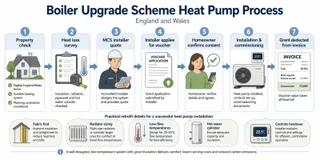
The grant is not based on heat pump size, so an eligible 4 kW air source heat pump and an eligible 6 kW air source heat pump receive the same subsidy.
Read article
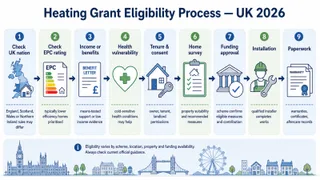
Being over 55 may help where a scheme considers vulnerability, health, low income or local council rules.
Read article
Write for Kilowatts.uk
Write it here under your own name. Sign in, put a profile up, and start a guide. Pay only if you want more links from your articles out to your own site.
Create a Kilowatts.uk account, or sign in if you already have one.
Put your name, photo and experience on a public author page.
Write a guide or a blog. Free authors can put one followed link to their own site in articles each month.
FAQ
Live help
Talk to RoboMo™ and get instant answers.
Live chat