


micro generation certification scheme: eligibility and how
Published: 2026-08-09 13:24:04
Updated: 2026-08-11 10:30:15
The Microgeneration Certification Scheme, usually shortened to MCS, is the UK certification route for eligible small-scale renewable installations.
What the Microgeneration Certification Scheme means in the UK
The Microgeneration Certification Scheme, usually shortened to MCS, is the UK certification route for eligible small-scale renewable installations and products. Most homeowners do not apply for MCS certification themselves. They choose an MCS-certified installer using suitable certified products, and the installer registers the finished installation so an MCS certificate can be issued.
That certificate is often important for Smart Export Guarantee applications, some funding routes, finance checks and future property paperwork. It is not a guarantee of bill savings, payback, grant approval, planning permission or grid export capacity.
MCS links installer competence, product suitability, customer contracts, technical design, commissioning records and handover evidence. If one part is missing, such as the installer not being certified for that technology, the finished system may not be eligible for an MCS certificate even if the equipment works.
Who MCS certification is for
MCS means different things depending on who is involved. A customer receives an installation certificate for a qualifying job. An installer business applies to become certified for specific technologies. A manufacturer follows the product certification route if its equipment is to be listed as suitable for MCS-certified installations.
For a homeowner, landlord or small business, the practical question is not usually “How do I become MCS certified?” but “Can this project be installed and registered under MCS?” The answer depends on the installer, the product selection, the technology scope, the property and whether the work is a new installation or an alteration to an existing system.
Homeowners usually need an MCS-certified installer and suitable certified equipment if they want an MCS certificate for a new eligible installation. Landlords need the same installation route, with clear handling of tenant access, permissions, metering, warranties and handover records. Small businesses may need MCS evidence for export arrangements, funding, finance or internal checks, depending on the system and scheme rules, especially when comparing commercial solar options. Installer businesses apply through an approved certification body and must show competence, procedures, records and compliant installations. Manufacturers need product certification where their equipment is to be used as an MCS-listed product in certified installations. Eligibility can change where the work is an extension, a replacement, a repair or a retrofit. Replacing an inverter, adding a battery or expanding a solar array is not always treated in the same way as a new system. The certification position should be confirmed before parts are ordered or contracts are signed.
Eligibility scope and technology boundaries
MCS is designed for small-scale renewable and low-carbon technologies, not every energy project of any size. The scheme is commonly associated with installations up to 50 kW electrical output and up to 45 kW thermal output, depending on the technology and current standard. Those thresholds and technical scopes should always be checked on the official MCS website before committing, because scheme documents and technology standards can change. Technologies commonly associated with MCS include solar PV, heat pumps, biomass, solar thermal, small wind and small hydro where they fall within the current scheme scope. Battery storage can also be relevant, especially when designed alongside solar PV or as part of a certified installation route, but the exact certification position depends on the technology standard, system design and timing of the work.
| Applicant or project type | What MCS looks at | Practical point to check early |
|---|---|---|
| Homeowner installation | Certified installer, suitable products and completed registration | Confirm MCS is included before accepting the quote |
| Installer business | Competence, procedures, contracts, records and assessed work | Prepare documents and define the technology scope before applying |
| Product manufacturer | Product certification against the relevant requirements | Check the product is listed as suitable before specifying it |
| Existing system alteration | Whether the change can be certified under the current route | Ask before replacing major components or adding equipment |
| Larger project | Whether the size and technology still fall inside MCS scope | Check current MCS limits and scheme requirements before procurement |
Overview
The boundary matters because a system can be technically sound but outside the route a customer expects. For example, an oversized commercial system, a non-listed product or an uncertified subcontracted installation may create paperwork problems later even if the system operates correctly.
Check the official MCS registers before you commit
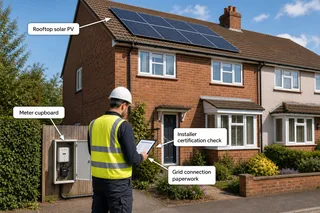
The safest way to confirm MCS status is to check the official sources before signing a contract. Use the MCS installer search to confirm the company is certified for the specific technology, not just active in the renewables market. Use the MCS product directory to check whether key equipment is listed where product certification is required.
You should also check the current MCS standards guidance, the list of approved certification bodies for installers, and the scheme rules that apply at the time of your project. For export payments, check Ofgem Smart Export Guarantee guidance and the chosen energy supplier’s current evidence requirements. For consumer protection and complaints routes, look at the consumer code arrangements associated with the installer, such as RECC or HIES where applicable.
Current standards
Use current MCS documents rather than old forum posts, historic tariff rules or outdated installer claims.Product directory
Confirm that the main product is suitable for the proposed certified installation route.Installer register
Check the company name, certification status and technology scope before paying a deposit.Consumer protection
Ask which consumer code or protection route applies to the contract and how complaints are handled.Certification bodies
Installers apply through an approved certification body rather than directly through a simple customer form.
This step is especially important where a salesperson, finance provider or subcontractor is involved. The business selling the job, the business installing the job and the business responsible for certification should be clear in writing.
How homeowners get an MCS certificate
A homeowner normally gets an MCS certificate through the installer. The customer does not usually submit a separate application after the event. The installer designs, installs, commissions and registers the eligible installation under its MCS certification, provided the job meets the relevant requirements.
This means the MCS route starts before installation day. The quote and contract should state whether an MCS certificate is included, which technology is being certified and what assumptions the design relies on. If MCS evidence is needed for an export tariff, funding route, lender or future sale, it should not be treated as paperwork to sort out later.
Keep the handover pack
Store the certificate, commissioning records, warranties, manuals and DNO paperwork together.Confirm installer status
Check that the company is MCS certified for the technology being installed.Check the contract wording
Make sure MCS registration and handover documents are clearly included where expected.Confirm product suitability
Ask whether the proposed panels, inverter, heat pump, thermal product or battery-related equipment fits the relevant route.Apply separately where needed
Use the MCS certificate as supporting evidence for export tariffs or schemes that require it.
If you are buying a property with existing solar panels or a heat pump, ask for the original MCS certificate and handover pack before exchange where possible. Missing records can be difficult to recreate, particularly if the original installer has stopped trading, changed certification scope or the system has been altered.
How installers apply to become MCS certified
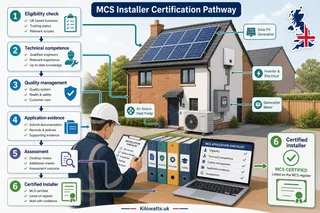
Installer businesses apply for MCS certification through an approved certification body. This is a business assessment route, not a simple online listing. The applicant must show that its procedures, technical competence, customer documents, complaints process, quality management and installation records meet the relevant MCS requirements.
The process varies by certification body and technology, but the underlying route is consistent. A solar PV installer will need different technical evidence from a heat pump installer. A company adding battery storage, solar thermal or biomass must be clear about which scope it is applying for.
The business should choose an approved certification body that can assess the technology scope it wants to offer. It should then define whether the application covers solar PV, heat pumps, biomass, solar thermal, battery storage or another eligible technology. Before assessment, quality procedures, customer contracts, quotations, complaints handling and record control should be in order.
Submit evidence
Supply the documents, project records and technical information requested by the certification body.Undergo assessment
Expect a document review and an assessment of real or representative installation work.Demonstrate competence
Provide evidence that responsible staff have the relevant technical knowledge, experience and supervision arrangements.Maintain certification
Keep records, update procedures and prepare for surveillance or reassessment under the certification body’s timetable.Correct non-conformities
Resolve issues found during assessment before certification is granted or maintained.
The common mistake is underestimating the administrative evidence. Good workmanship matters, but MCS assessment also looks at design records, customer information, commissioning sheets, handover packs, complaints processes and version-controlled documents. A business that installs well but cannot prove its process may struggle at assessment.
MCS, SEG, DNO and other approvals are separate
MCS is not the same as a Distribution Network Operator process, Building Regulations compliance, planning permission, export tariff approval or a financial incentive. These routes can interact, but they are not interchangeable. A project may need more than one approval or evidence pack.
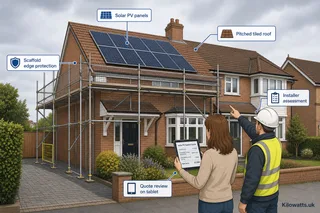
For solar PV, the installer may need to consider roof condition, structural suitability, electrical design, inverter location, consumer unit capacity, scaffolding, metering and DNO requirements. Smaller grid-connected systems are commonly associated with G98 notification, while larger or more complex systems may require G99 application or approval. The installer should confirm the correct route for the actual design rather than assume.
For the Smart Export Guarantee, an MCS certificate or equivalent evidence is often requested for eligible small-scale generation, but the energy supplier still applies its own onboarding and metering checks. The certificate is important evidence, not a promise that an export tariff will be accepted automatically.
Where MCS fits with solar, batteries and heat pumps
For solar PV, MCS is commonly linked to the post-installation paperwork that customers need for export tariff applications and future evidence. The certificate sits alongside commissioning documents, product information, DNO notification or approval evidence, warranties and user instructions.
Battery storage can add complexity because it may be installed with solar, retrofitted later, AC-coupled, DC-coupled through a hybrid inverter, or designed with backup capability. Backup power is not standard on every battery system. Where it is included, the design must avoid unsafe islanding and unrealistic expectations about running the whole property during a power cut. If storage is part of the plan, it helps to understand home battery systems before agreeing the specification.
For heat pumps, MCS is often important because it supports a more structured design process. A credible design should be based on heat loss, emitter sizing, hot water requirements and expected operating temperatures, not simply the output of the old boiler. MCS paperwork cannot rescue a weak design if the system has been underspecified or the property fabric has been ignored. The main lesson is that MCS is part of the specification decision, not a substitute for it. A certified installation still needs sensible sizing, clear assumptions, suitable products, practical installation details and honest discussion of limitations.
Common mistakes that delay or prevent certification
Most MCS problems are avoidable if the certification route is checked early. Delays usually happen when a customer assumes the certificate is automatic, when a salesperson overpromises, or when equipment changes without checking whether the revised design still meets the required route.
Another frequent issue is confusion between a company that markets renewable systems and a company certified to install a specific technology. Subcontracting is not automatically a problem, but the contract should identify who is responsible for installation quality, certification registration, aftercare and complaints.
Common problems include assuming every renewable installer can issue MCS paperwork, relying on a logo without checking the official installer register, and choosing products before checking certification suitability. Changes to inverter, battery or heat pump models after the quote can also create problems if the design is not updated. DNO paperwork, planning issues and MCS should not be treated as the same approval. Handover documents also need to be kept safely after installation, especially if you later apply for tariffs or schemes with current evidence rules. If the installation is already complete and no MCS certificate was issued, contact the installer and ask whether the job was registered and why not. Retrospective certification should not be assumed. It may be impossible if the installer was not certified for that technology at the time, suitable products were not used, or the required design and commissioning records were not created.
Quick answers before you apply
Three questions come up repeatedly because MCS is often discovered only when a customer applies for an export tariff, funding route or house sale paperwork. The answers are usually straightforward, but they depend on the project history and current scheme requirements.
Can I get an MCS certificate retrospectively? Sometimes a missing certificate is a registration or administration issue, but retrospective certification is not guaranteed. If the installation was not carried out by an appropriately MCS-certified installer using suitable products and proper records, it may not be possible to issue one later.
Do I need MCS for the Smart Export Guarantee? For many small-scale export applications, suppliers ask for an MCS certificate or equivalent evidence, alongside metering and DNO information. Always check current Ofgem guidance and the chosen supplier’s requirements before assuming eligibility. Who issues the MCS certificate? The MCS-certified installer is responsible for registering the eligible installation after completion. The certificate is then made available through the MCS process, and the customer should receive it as part of the handover record.
What to ask before you sign a quote
Before accepting a renewable energy quote, ask direct questions about MCS rather than relying on a brochure, badge or verbal reassurance. The answers should be specific to your technology, property and proposed design.
For solar, ask how DNO notification or application will be handled, whether export limitation is expected, what equipment is being specified and what documents you will receive at handover. For heat pumps, ask how heat loss will be calculated, what flow temperatures are assumed and whether existing radiators or pipework need upgrading. For batteries, ask whether the design is solar-linked, retrofit, hybrid or AC-coupled, and whether backup operation is included.
Product status
Ask whether the main products are listed or suitable for the MCS route being proposed.Subcontracting
Ask who will carry out the work and who remains accountable for certification and aftercare.Technology scope
Check that the installer is certified for the specific technology, not just another renewable technology.Certificate timing
Ask when the certificate will be registered and what happens if a component changes before installation.Consumer protection
Ask which consumer code or complaints route applies to the contract.Installer responsibility
Ask which company will register the installation and issue the handover pack.
If the answers are vague, pause before paying a deposit. Certification questions are easier to resolve before installation than after scaffolding is down, equipment is fitted and the final invoice has been paid.
Practical next steps
Start by deciding why you need MCS. Your reason may be an export tariff, a funding route, mortgage or conveyancing evidence, a commercial assurance requirement, or simply wanting a recognised quality framework. Once you know the purpose, check the current requirements with the official scheme, supplier or funding provider before choosing an installer.
Next, gather the information needed for a proper survey. For solar, that includes roof age, roof covering, orientation, shading, loft access, meter position and consumer unit details. For a heat pump, it includes insulation history, radiator sizes, hot water use, existing heating controls and how the building is occupied. For batteries, it includes electricity use, existing solar details, tariff plans and whether backup power is genuinely required.
Finally, compare quotes on design quality, certification clarity and documentation, not only headline price. A cheaper quote that leaves MCS unclear can become expensive if you later need evidence for SEG, a scheme application, a property sale or a system upgrade. If you are planning a domestic solar installation, start by checking how to compare home solar options before you sign.
Plan, Compare & Buy Renewable Energy Solutions
AI does the thinking.
You get the perfect solar match.
Use RoboMo™ to assess your property, compare available technologies and connect with trusted UK installers, suppliers and manufacturers.
Simply enter your postcode, drop a pin on your roof, create your free account and let RoboMo™ analyse your property to find the best solar panels for your home.

You don't have to think
RoboMo™'s AI analyses your roof and does all the hard work.

Accurate & tailored
AI-powered assessment based on your roof, location, and conditions.

Best options, maximum savings
Compare top solar panels for the best performance and value.

Simple, fast & effortless
Provide a few details, sit back and watch your results unfold.
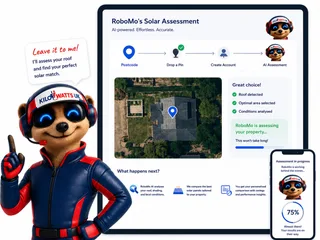
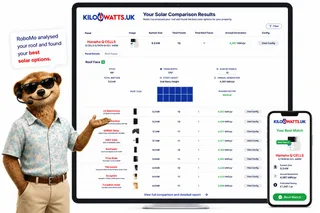
STEP 1
Choose Home, Business or Industrial
Enter your postcode to start your assessment.
STEP 2

Drop a pin on your roof
STEP 3

Create your free account
STEP 4

Sit back and watch RoboMo™ work
RoboMo™ analyses your roof and builds your personalised solar comparison.

Kilowatts UK is an authorised representative
Flower Turbines
Compact vertical-axis turbines built for real UK sites, not just open farmland.
They start in light wind, sit in a small footprint, and are bird-safe by design. Cluster them as a bouquet and the group performs better together than the same turbines standing alone. Enter your postcode for a location-based generation estimate. Figures use area weather data and will differ if buildings, trees or hills sit in the way.
Starts in light UK wind
Built to generate in typical UK wind, not only open farmland.
Small rooftop or ground footprint
Compact towers for roofs, yards and tight sites.
Bird-safe slow rotation
Slow vertical-axis spin, bird-safe by design.
Bouquet clusters raise output
Grouped turbines outperform the same units standing alone.
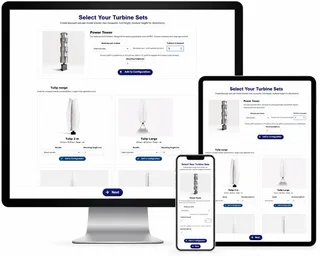
Step 1
Enter your postcode
Start designing your wind energy system in seconds.
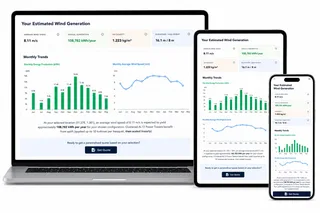
STEP 2

Choose a location
STEP 3
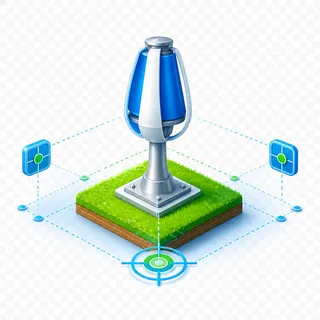
Place your cluster
Tap the map where you want the turbine cluster to go.
STEP 4

Instant generation forecasts
Compare different turbine layouts and see annual generation forecasts instantly.
STEP 5
No commitment required
Explore different configurations before deciding whether to request a quotation.
Related articles
Mo's Mission Nominations
FAQ
Need Help? RoboMo's Got Answers
Do homeowners apply for MCS certification themselves?
Usually, no. For a home installation, the MCS-certified installer normally designs, installs, commissions and registers the eligible system so an MCS certificate can be issued. Your job is to check before signing that MCS registration is included in the quote and contract.
How do I check whether an installer is MCS certified?
Use the official MCS installer register before paying a deposit. Check the exact company name and make sure it is certified for the technology you are buying, such as solar PV or a heat pump. If another company or subcontractor will do the work, ask who is responsible for the MCS registration in writing.
Does an MCS certificate guarantee Smart Export Guarantee payments?
No. An MCS certificate is often important evidence for Smart Export Guarantee applications, but the energy supplier still applies its own checks, including metering and eligibility requirements. You should confirm the supplier’s current requirements before assuming export payments will be accepted.
Can an existing solar panel system or heat pump get an MCS certificate later?
It may be difficult or impossible to certify a system retrospectively if it was not installed through the correct MCS route at the time. Missing design records, uncertified products, changes to the system or an installer that is no longer certified can all create problems. If you are buying a property, ask for the original MCS certificate and handover pack before exchange where possible.
Is MCS the same as DNO approval, planning permission or Building Regulations?
No. MCS is separate from Distribution Network Operator processes, planning rules, Building Regulations and export tariff applications. A project may need several different approvals or notifications, depending on the technology, size and property. Your installer should explain which routes apply to your specific design.
Do batteries need MCS certification?
Battery storage can be relevant to an MCS installation, especially where it is designed with solar PV, but the position depends on the system design, equipment and current MCS standards. Retrofitting a battery to an existing system may not be treated the same as a new combined installation. Check the certification route before ordering equipment.
What documents should I keep after an MCS installation?
Keep the MCS certificate, commissioning records, warranties, manuals, product information and any DNO notification or approval documents. These may be needed for export tariff applications, future maintenance, finance checks or a house sale. Store them together and ask the installer to explain anything missing before final payment.
Does MCS certification prove the system will save a certain amount of money?
No. MCS certification supports the installation process and paperwork, but it does not guarantee bill savings, payback time, grant approval or export income. Savings depend on the design, property, energy use, tariff, weather and how the system is operated. Treat any savings estimate as a forecast, not a promise.