


Solar Panel Efficiency: What It Actually Buys You (UK)
Published: 2026-09-25 00:14:25
Updated: 2026-10-06 12:20:02
Two panels with the same wattage produce the same power. Here's what solar panel efficiency really changes on a UK roof — and when it's worth paying for.
What Solar Panel Efficiency Actually Buys You
If you have been comparing solar quotes, you have almost certainly seen efficiency quoted as though it were a performance score: one panel is 21-point-something per cent, another is a fraction lower, and the higher number feels like the better buy. Here is the short answer that the episode above delivers in ten seconds. A 440-watt panel is a 440-watt panel. Two modules with the same wattage, on the same roof, in the same light, produce the same power. Efficiency does not decide how much electricity a panel makes — it decides how much roof that wattage needs to occupy. That distinction sounds academic until your roof runs out of space, at which point it becomes the single most important spec on the datasheet. This article unpacks the three beats of the film in full: why identical wattages behave identically, why two very different-looking layouts can share the same total system rating, and why fixing the roof area is the moment efficiency stops being a marketing line and starts buying you real kilowatts.
"Efficiency does not make a panel more powerful. It makes the same power take up less roof."
Efficiency is a density measurement, not a power measurement
Panel efficiency describes what proportion of the sunlight landing on a module's surface is converted into electricity. Because it is measured per unit of area, it is fundamentally a density figure: watts per square metre. A higher-efficiency panel squeezes the same electrical output into a smaller rectangle.
Wattage, by contrast, is the output itself. It is the number that tells you what the module is rated to produce under standard test conditions, and it is the number that gets multiplied up to give you your system size in kilowatts peak. When an installer says you are being quoted a 4.4 kWp system, that figure comes from the panel wattage and the panel count — not from the efficiency percentage.
This is why the opening beat of the episode shows the two footprint rectangles changing size while the power figure pulsing above them stays identical. The panels are not equals in area. They are equals in output. Once you internalise that, most of the confusion around efficiency quietly disappears, and you can start asking a much better question: is roof space actually the constraint on this house?
Same wattage, same output — what that means in real British weather
Two modules of the same wattage sitting on the same pitch, at the same orientation, under the same flat Yorkshire overcast, will deliver essentially the same generation across a year. Both see the same irradiance. Both face the same shading. Both feed the same inverter and the same house.
It is worth saying plainly, because the marketing rarely does: the weather does far more to your daily output than a percentage point of efficiency ever will. And British weather is kinder to solar than most people assume. UK homes still generate useful power on overcast days — diffuse light through cloud is still light, and a well-sized array keeps working through it rather than switching off. Panels also perform more efficiently in cold conditions than in heat, which is why a bright, crisp February afternoon can produce a surprisingly strong output curve while a sweltering July rooftop loses a little to temperature.
None of that changes between two same-wattage panels. Which is the point. If you are choosing between two quotes and the array size, orientation and shading are the same, the efficiency figure on the datasheet is not the thing separating your energy bills.
Beat two: two layouts, one system size, different amounts of roof
In the second beat, ghosted panel outlines tile outwards from each type across the same slope until both blocks reach an identical total system rating. The higher-efficiency block finishes early, leaving bare slate. The other reaches the ridge exactly.
This is the real-world scenario for the majority of British homes. A typical rear slope on a semi has more usable area than the household actually needs for the system they want. If you are aiming for a system sized around your consumption and your battery strategy, and the roof comfortably swallows either layout, then the efficient panels have bought you… some spare tiles. That spare area has no financial value unless you intend to use it later. There is one honest caveat: spare roof is optional headroom. If you expect an EV, a heat pump, or a larger household in a few years, leaving space rather than filling it can be a deliberate choice. But it should be a choice you make knowingly, not a benefit you are charged for by accident. Ask any installer to show you the layout drawing, not just the panel brand — the drawing tells you whether the roof is full or half empty.
Beat three: lock the roof area and the picture flips
The third beat is where efficiency earns its keep. The roof boundary locks as a hard white outline, and both layouts refill to the edges of that fixed area. Now the constraint is not the system size — it is the space. And with space fixed, the denser panel fits more kilowatts inside the same outline. The total-kW counter climbs past the other and settles, and the generation curve beneath it rises in proportion.
This is the correct mental model. Efficiency is not a bonus applied to your output. It is a way of converting scarce area into additional capacity. If the area is not scarce, the conversion has nothing to work on.
So the question to put to any quote is simply: is this roof full? If the proposed layout runs edge to edge and you still want more generation than it delivers, a higher-efficiency module is a legitimate, engineering-led upgrade. If the layout leaves clear slate and the system already matches your needs, you are paying a premium for a property you are not using.
Which UK roofs genuinely reward higher-efficiency panels
Space-constrained is more common than people think, because usable roof area is never the same as total roof area. Work through this list honestly before deciding whether to pay for density.
Efficiency is likely to be worth it if: - The only decent slope is small — a narrow terrace rear, a single dormer face, or a short flat-roof extension. - Obstructions eat the area: chimneys, soil vents, roof windows, satellite fixings, valleys and hips all carve out chunks you cannot tile over. - Shading forces you to abandon part of the slope entirely, concentrating the array into a smaller clear zone. - Only one orientation is viable, so you cannot spill panels onto a second slope to make up the shortfall. - Planning or conservation considerations limit which elevations can be used. - Your demand is genuinely high — an EV, a heat pump, or both — and the constrained area cannot otherwise reach the capacity you need.
Efficiency is probably not worth a premium if: - The proposed layout leaves clear unused slate and the system already matches your consumption and battery plan. - You have a second usable slope in reserve. - The quotes differ by a fraction of a percentage point, which will be invisible next to shading, orientation and pitch. - You are being asked to pay for the number rather than for a layout that demonstrably fits more kilowatts on your roof. The deciding artefact is always the roof layout drawing with the panel count and total kWp on it. Two quotes are only comparable when you can see both layouts on the same outline. Our solar comparison guidance walks through reading those drawings side by side.
What else changes when you use fewer, denser panels
Density has a few genuine second-order effects worth knowing, none of which are usually decisive on their own.
Fewer panels means fewer roof fixings, fewer clamps and a slightly simpler mechanical install. It can also mean a shorter string, which the designer must still keep within the inverter's operating window — a design detail, not a benefit or a drawback. Fewer, larger panels can also be harder to fit neatly around awkward obstructions. Sometimes a slightly smaller module tessellates better around a chimney or a roof window, and that tessellation recovers more capacity than the efficiency premium would have. This is exactly why the layout matters more than the datasheet. Finally, efficiency is not a proxy for quality, longevity or warranty. Degradation rate, temperature coefficient, mechanical load rating and the warranty terms behind them are separate specifications, and a panel can score well on one and unremarkably on another. Judge those on their own merits rather than assuming a high efficiency figure carries them along.
Common follow-up questions
Will higher-efficiency panels perform better in poor UK light? Not inherently. Low-light behaviour is governed by cell technology and module design rather than by the headline efficiency percentage. Two same-wattage panels on the same roof see the same diffuse light and produce comparable output through cloud.
Do efficient panels get hotter, or lose more in summer? Heat losses are described by a module's temperature coefficient, which is a separate figure on the datasheet. If you are comparing panels for a hot, unventilated roof, read that number rather than inferring it from efficiency. Remember that cooler conditions favour solar output generally — British springs are often the strongest part of the year.
Does efficiency affect how much battery or EV charging I can support? Only through total system size. Your battery and charger see kilowatt-hours arriving, and those come from the array's total rating and the weather, not from how tightly the cells are packed. If two quotes have the same kWp, is the cheaper one automatically better? Not automatically — but you have removed the biggest variable. Compare the layout drawings, the inverter specification, the warranty terms, the workmanship guarantee and the quality of the survey. Those differences are usually far more material than the efficiency line. Should I fill the roof now in case I need more later? That depends on your future load. A future EV or heat pump meaningfully raises household demand, and adding panels later is rarely as cheap per kilowatt as fitting them in the first visit. Discuss it at survey stage so the design accounts for it deliberately.
Video transcript
Mo: Higher efficiency means more power... right? RoboMo: Same wattage, same output. Efficiency only pays when roof space runs out.
Mo: So both blocks are the same system size? RoboMo: Identical rating. One simply needs less roof to reach it.
Mo: And when the roof runs out of room? RoboMo: Then efficiency buys kilowatts. Limited space is the only place it pays. Mo: Higher efficiency means more power... right? RoboMo: Same wattage, same output. Efficiency only pays when roof space runs out. / Mo: So both blocks are the same system size? RoboMo: Identical rating. One simply needs less roof to reach it. / Mo: And when the roof runs out of room? RoboMo: Then efficiency buys kilowatts. Limited space is the only place it pays.
Wrapping up
Panel efficiency is one of the most misunderstood numbers in domestic solar, largely because it looks like a performance grade and behaves like a packing instruction. Same wattage, same output — that is the whole of it. What efficiency really controls is how much of your roof a given system size consumes, which makes it genuinely valuable on small, obstructed or shaded roofs and largely irrelevant on generous ones. So before you weigh one datasheet against another, establish whether your roof is the limiting factor at all. If it is, higher efficiency is engineering, not marketing, and it will show up as extra kilowatts inside a fixed outline. If it is not, spend the money on the parts of the system that will actually change your year: a well-sized array, a properly specified inverter, sensible battery strategy, and a survey that has actually measured your roof rather than estimated it.
Next step
If you would like to know whether your roof is the constraint — or whether you have space to spare — a proper survey will answer it with a layout drawing rather than a guess. You can read more about how we approach residential solar installation, or arrange a no-pressure survey whenever you are ready.
Plan, Compare & Buy Renewable Energy Solutions
AI does the thinking.
You get the perfect solar match.
Use RoboMo™ to assess your property, compare available technologies and connect with trusted UK installers, suppliers and manufacturers.
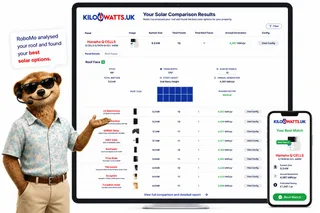
Simply enter your postcode, drop a pin on your roof, create your free account and let RoboMo™ analyse your property to find the best solar panels for your home.

You don't have to think
RoboMo™'s AI analyses your roof and does all the hard work.

Accurate & tailored
AI-powered assessment based on your roof, location, and conditions.

Best options, maximum savings
Compare top solar panels for the best performance and value.

Simple, fast & effortless
Provide a few details, sit back and watch your results unfold.
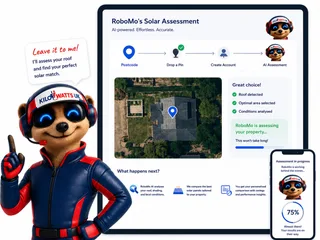
STEP 1
Choose Home, Business or Industrial
Enter your postcode to start your assessment.
STEP 2

Drop a pin on your roof
STEP 3

Create your free account
STEP 4

Sit back and watch RoboMo™ work
RoboMo™ analyses your roof and builds your personalised solar comparison.

Kilowatts UK is an authorised representative
Flower Turbines
Compact vertical-axis turbines built for real UK sites, not just open farmland.
They start in light wind, sit in a small footprint, and are bird-safe by design. Cluster them as a bouquet and the group performs better together than the same turbines standing alone. Enter your postcode for a location-based generation estimate. Figures use area weather data and will differ if buildings, trees or hills sit in the way.
Starts in light UK wind
Built to generate in typical UK wind, not only open farmland.
Small rooftop or ground footprint
Compact towers for roofs, yards and tight sites.
Bird-safe slow rotation
Slow vertical-axis spin, bird-safe by design.
Bouquet clusters raise output
Grouped turbines outperform the same units standing alone.

Step 1
Enter your postcode
Start designing your wind energy system in seconds.

STEP 2

Choose a location
STEP 3

Place your cluster
Tap the map where you want the turbine cluster to go.
STEP 4

Instant generation forecasts
Compare different turbine layouts and see annual generation forecasts instantly.
STEP 5

No commitment required
Explore different configurations before deciding whether to request a quotation.
FAQ
Need Help? RoboMo's Got Answers
What is Solar Panel Efficiency: What It Actually Buys You (UK) about?
If you have been comparing solar quotes, you have almost certainly seen efficiency quoted as though it were a performance score: one panel is 21-point-something per cent, another is a fraction lower, and the higher number feels like the better buy. Here is the short answer that the episode above delivers in ten seconds
Who is this video for?
UK homeowners comparing the options discussed in Solar Panel Efficiency: What It Actually Buys You (UK).