LinkedIn profile for David Coleman David Coleman
Founder & Renewable Energy Author, kilowatts.uk


LinkedIn profile for David Coleman David Coleman
Founder & Renewable Energy Author, kilowatts.uk
Article
Main works are underway on the 400 kV grid connection for Agratas’s Somerset battery gigafactory. See how it will meet 350 MW of campus demand.
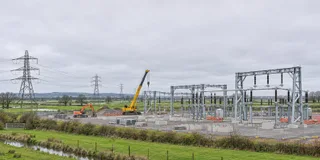
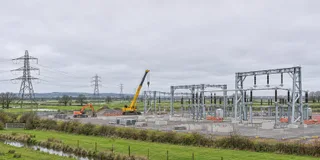
How agratas battery factory grid connection work, typical output, costs and limits, and whether they have a future for UK homes, balconies and businesses.
National Grid Electricity Transmission is building a 400/132 kV substation near Woolavington, Somerset, to connect the Gravity Smart Campus to Britain’s transmission network. The permanent connection is designed to meet around 350 MW of demand across the campus, including the Agratas electric vehicle battery factory. National Grid confirmed on 18 November 2026 that main construction was underway. Two interim 33 kV connections are supplying the Agratas site during construction. National Grid construction announcement · National Grid connection case study
Agratas plans to manufacture around 40 GWh of battery cells a year once all phases are complete. The Competition and Markets Authority’s Subsidy Advice Unit says this would make Agratas the UK’s largest battery manufacturer by planned capacity. CMA Subsidy Advice Unit report on Agratas
Existing substations in the area lacked the capacity to serve the development. National Grid chose a site beneath an existing 400 kV overhead line so it could connect the new substation without adding pylons or overhead wires. Supergrid transformers at Woolavington will step the voltage down from 400 kV on the transmission side to 132 kV for the onward connection. Woolavington substation project page · National Grid connection case study
National Grid Electricity Distribution installed the two interim 33 kV connections so Agratas could start building the factory while National Grid developed the permanent connection for the campus’s longer-term demand. National Grid connection case study
The incoming transmission line operates at 400 kV. The permanent connection is designed to accommodate around 350 MW of electrical demand across the campus. Electricity consumption over a given period depends on how much power the campus draws and for how long. National Grid connection case study · Woolavington substation project page The Environment Agency gives the factory’s planned manufacturing capacity as around 40 GWh per year. That figure adds up the energy storage capacity of the cells the factory is designed to make in a year. The CMA report ties that capacity to completion of all project phases. Environment Agency project overview · CMA Subsidy Advice Unit report on Agratas
The distinction between power and stored energy also matters when sizing batteries for business premises.
National Grid is aiming to finish construction in summer 2029. Early work included laying foundations and preparing the existing overhead line for the connection. The main build includes above-ground steelwork and major electrical equipment. Three supergrid transformers are expected to arrive in early 2027. Woolavington substation project timetable · National Grid construction announcement
Woolavington Parish Council reported on 13 October 2026 that main works were underway. The summer 2029 construction target may change. The permanent connection’s first energisation and the factory reaching full production each have their own timetable. Woolavington Parish Council’s October 2026 update · Woolavington substation project timetable
National Grid’s normal working hours are 8 am to 6 pm on weekdays and 8 am to 1 pm on Saturdays. Some deliveries or construction work may take place outside those hours. National Grid says it will give advance notice of work that could affect residents, businesses or local roads. Check the project updates when planning deliveries or journeys around the site. National Grid construction announcement · Woolavington substation project updates
National Grid’s November announcement estimates that the factory will support around 4,600 direct jobs once fully operational. National Grid also announced a £530,000 fund for projects that benefit communities near the substation. It expects applications to open in 2027. National Grid construction announcement
If you’re expanding a business site, estimate how much power each phase will need and when. Half-hourly electricity data can show when demand is highest. If your readings are in kWh per half hour, double each reading to get the average power in kW for that interval. Allow separately for brief peaks, such as motors starting, that a half-hour average can hide. That demand profile can also help you compare solar for factories against the hours when your site uses the most electricity.
Estimate the extra demand from new machinery, heat pumps or EV charging points, taking into account which could run at the same time. Give your distribution network operator the breakdown and proposed installation dates. It can assess whether your existing supply can handle the extra demand and whether an upgrade could affect your opening date.
If you’re considering solar and battery storage for a home or small business, use your smart-meter data to see when you use electricity and compare that with when you expect surplus solar generation. When sizing a home battery or specifying storage for a business, ask installers to show the battery’s usable capacity in kWh and its continuous discharge power in kW. Usable capacity tells you how much energy the battery can deliver. Continuous discharge power tells you how much of your demand it can meet at any one time.
Solar comparison
Enter your postcode to assess your roof, compare solar options and get quotes from UK installers.
Choose home, business or industrial, then enter your postcode. RoboMo maps the roof and ranks panel brands by fit.
1. Postcode Start the assessment for your property.
2. Pin the roof Mark the array on the map.
3. Compare RoboMo™ builds your options.

Battery ROI tool
Enter the day rate, off-peak rate and export rate. The calculator ranks batteries in the Kilowatts shop over 10 years. Home batteries also suit offices and small commercial sites.
Reading
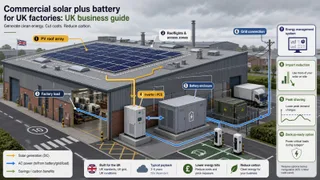
See when commercial solar plus a battery fits a UK factory: shift timing, export caps and connection headroom. A standard battery is not backup power.
Read article
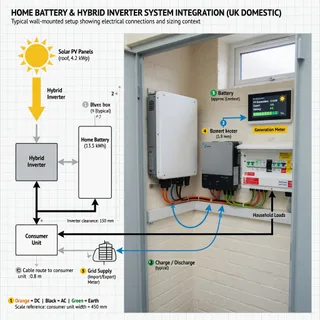
What battery do I need depends on usable kilowatt-hours you can shift, inverter power, and whether the charge window and connection can fill it.
Read article

Discover what Flower Turbines' UK Power Networks approval means for small wind buyers in the UK, and how it affects their projects.
Read article

Yes - a home battery can fill from cheap off-peak grid electricity, then run your house through the expensive peak. Here's how it works in UK homes.
Read article
Write for Kilowatts.uk
Write it here under your own name. Sign in, put a profile up, and start a guide. Pay only if you want more links from your articles out to your own site.
Create a Kilowatts.uk account, or sign in if you already have one.
Put your name, photo and experience on a public author page.
Write a guide or a blog. Free authors can put one followed link to their own site in articles each month.
FAQ
Live help
Talk to RoboMo™ and get instant answers.
Live chat