


New UK Smart Heat-Pump Control Claims 17% Efficiency Improvement
Published: 2026-10-05 16:36:15
Updated: 2026-10-05 09:37:14
Navien and Passiv’s PEM750 package claims a 17% COP gain from smart control. It is not a guaranteed bill cut, and software cannot fix poor commissioning.

New UK Smart Heat-Pump Control Claims 17% Efficiency Improvement
How renewable energy work, typical output, costs and limits, and whether they have a future for UK homes, balconies and businesses Updated 2026.
What the 17% efficiency claim actually means
Passiv states that Energy Saving Trust testing of its ecoHeat control found a 17% improvement in heat-pump coefficient of performance. That figure, as repeated in the public Navien-Passiv announcement, is a manufacturer-reported ecoHeat result. It is not shown to be a Navien PEM750 test, a seasonal performance factor, or a 17% bill cut. What it means on a real house still depends on the unpublished test method, heat loss, emitter sizing, the tariff, hot water and backup heat.
A smart heat pump control can still be a sensible specification. It is a control and aftercare option, not a new kind of heat pump, and not proof that automatic optimisation replaces commissioning. The announcement does not reproduce an Energy Saving Trust test note, protocol, dataset, or link that a buyer can check. Until Navien, Passiv or Energy Saving Trust publish that note, ask for it in writing rather than treating installer coverage of the partnership as independent consumer evidence.
A point COP is heat delivered divided by electricity at one condition. A seasonal coefficient of performance, or SCOP, is a standardised laboratory seasonal rating, not a reading from your house. A seasonal performance factor, or SPF, is in-use performance over a season, and the boundary may or may not include pumps, controls, defrost and backup heat. The announcement does not present the 17% figure as an SPF, or as a SCOP for the PEM750. Under UK advertising rules, including the CAP Code overseen by the Advertising Standards Authority, a performance claim needs evidence a reader can examine. A repeated percentage is not that evidence.
What the Navien and Passiv package includes
From 1 October 2026, Navien's PEM750 air-source heat pump can be supplied with the Passiv Smart Thermostat as an integrated package, available through selected merchants. That is not a confirmed national roll-out to every installer, and the public announcement does not list which PEM750 variants are included. Merchant availability and the variant list are questions for Navien and the merchant, not facts that can be inferred from the headline.
Passiv says the control adjusts flow temperatures and schedules running around time-of-use tariffs and surplus rooftop solar, without extra interface hardware, and that installers do not have to set a fixed weather-compensation curve by hand. Installers also get remote monitoring and diagnostics through the Passiv Portal. Households can separately enrol in Passiv's Greener Grid Payment, which pays to shift heat-pump use during network constraint. Payment rates, eligibility and opt-out rules are not stated in the announcement.
The 17% figure is not a guarantee for a PEM750, for your house, or for your bill. Price, installed cost and measured seasonal performance for this package are not stated either, so they should not be assumed. The useful buying question is whether you want tariff-aware scheduling, solar surplus use and a manufacturer-supported diagnostic path on a compatible unit.
How smart heat pump control is meant to change flow temperature
Weather compensation raises flow temperature in colder weather and lowers it when it is milder, because COP falls as the temperature lift increases. A fixed curve is that relationship locked in at commissioning. Dynamic optimisation, as Passiv describes it, keeps adjusting the relationship instead of leaving one curve untouched. The absence of extra interface hardware matters to installers who usually add a third-party gateway. It does not remove site checks.
In practice the control still has to live inside the heat the building can accept. If radiators or underfloor loops were sized for a low flow temperature, the software can spend more time there and COP should benefit. If emitters only meet the heat loss when the water is hot, the control will be forced upwards on a cold day whatever the algorithm prefers. Hot-water priority, defrost and any backup heater still interrupt space heating.
If the weather curve is no longer a simple installer setting, the handover should still record target flow temperatures, the design-day condition, and what the control is allowed to change. Factory defaults are not a substitute for that record. A dashboard that never shows the design flow temperature leaves the next engineer guessing whether the unit is optimising or merely coping.
Why a COP gain is not a 17% bill cut
A higher COP means more heat per unit of electricity at the stated condition. It is not, by itself, a seasonal result, and it is not a bill. If the home still needs the same heat, electricity for that heat equals heat divided by COP. Raise COP by 17% and that electricity falls to 1 divided by 1.17 of the previous figure, a cut of about 14.5% in that electricity, not 17%. The percentage gain in COP is not the percentage fall in kWh, and neither figure is a percentage fall in the household bill. That slice is not the whole bill. A standing charge does not move when COP improves, and other household electricity is untouched. Hot water can be a large share of heat-pump electricity in a small, well-insulated house, and it may sit outside a space-heating test. Backup heat is typically direct electric, near a COP of 1, and can wipe out a compressor gain. The announcement does not give a typical split between space heating, hot water and backup, so no national bill cut should be inferred. A short illustration shows the method, not a surveyed home. Suppose, only as arithmetic, that half of heat-pump electricity is the space-heating load the control can improve, and half is hot water and backup that the test did not change. A 14.5% cut in the first half is about a 7% cut in heat-pump electricity, before the standing charge and the rest of the household bill. Those halves are not a UK average. They show why a COP claim shrinks once unchanged loads are included. Shifting heat into a cheaper period can lower the electricity charge while using more kWh, if the unit runs longer or less efficiently. It can also raise the charge if the evening recovery calls backup heat. Passiv separately advertises bill reductions of up to 30%. That is an upper figure, qualified by property, tariff, previous controls and operating pattern. It is not an average, not a guarantee, and not evidence that this package will beat a carefully commissioned weather-compensated system by that margin.
Overview
The public announcement does not include the test method, the baseline controller, the property, the climate file or the dataset. It is also unclear whether that test used a Navien PEM750 or another heat pump running ecoHeat. A fair comparison would name the previous control, the sample, and whether comfort, cycling and backup heat were held constant. None of that is in the material released with the launch.
Where solar surplus and time-of-use tariffs help
Scheduling around cheap electricity or rooftop surplus only helps if the home actually has that tariff or generation, and if it can store heat in the building, cylinder or buffer without comfort complaints. Pre-heating a well-insulated house on a time-of-use tariff can be sensible. The same shift in a leaky house with small radiators often shows up as a cold evening and a recovery spike. A time-of-use strategy is a tariff and fabric question first, and a thermostat feature second.
Surplus solar is intermittent and seasonal. A control that raises cylinder temperature or advances space heating when the array is exporting can use electricity that would otherwise go to the grid, but only within cylinder limits, legionella schedules and the heat pump's own minimum run times. Homes without solar, without a time-of-use tariff, or without reliable internet will not get this part of the package. Distribution network notifications and metering sit with the electrical installation, not with the thermostat.
What MCS commissioning still has to prove
For a UK installation under the MCS heat pump standard, currently the MIS 3005 family, the design is expected to rest on a room-by-room heat-loss calculation and on emitter outputs at the intended flow temperature. Commissioning then has to show that the system can deliver that design. A portal does not calculate heat loss, and dynamic flow temperature does not resize a radiator.
On site, the installer still has to confirm flow rate, air removal, zone behaviour, cylinder set-point, defrost, backup-heat lockout, the legionella schedule and minimum run times. Those checks decide whether the unit can hold the design temperature on a design day. If any of them fail, software will spend the season compensating for a hydraulic or sizing fault.
Grant schemes such as the Boiler Upgrade Scheme have their own eligibility rules, often including an MCS-certified installation. This pairing does not, on the published material, set the grant value, change eligibility, or remove that requirement where the scheme imposes it. Check current scheme terms rather than reading a control launch as a grant update. The announcement is also a domestic control story, not a guide to commercial renewable systems.
What remote monitoring does not replace
The Passiv Portal is the aftercare half of the launch. Remote diagnostics can shorten fault-finding when someone is contracted to look, the unit is online, and the fault is visible in the data. A dashboard does not replace an emitter schedule, system balancing, or a room-by-room heat-loss calculation. Homeowners often hear "no manual weather curve" and assume the factory settings are the design. They are not.
If connectivity drops, the installer should have said what the heat pump does next: hold the last schedule, fall back to a local setting, or stop shifting for tariffs and grid events. That fallback is not described in the announcement. A control strategy that depends on continued internet access needs a written offline behaviour before it is treated as part of the heating design. Until that note exists, assume the tariff and grid features may simply stop, and do not assume the heat pump itself has a defined safe mode beyond what the manufacturer confirms.
How the Greener Grid Payment fits
Passiv's Greener Grid Payment lets enrolled customers shift heat-pump consumption during periods of network constraint. It is optional and separate from the thermostat pairing. Rates, minimum shift, eligibility and what happens if a household opts out are not in the public material, so any income should be treated as unknown until the scheme terms are in writing. Do not put a payment into a payback sum when the rate has not been published.
Constraint shifting can conflict with a comfort-led schedule. Someone needs to explain who authorises the shift, whether backup heat is allowed during an event, and whether lost connectivity pauses payments. A payment that depends on continued connectivity is not a reason to accept a heat pump that cannot meet the design heat loss on a cold day without that shift. Comfort and design load come first. A flexibility payment is an extra, and only after the written terms match the way the household actually wants to be heated.
What to ask before you treat the claim as a reason to buy
Automatic optimisation can refine a correctly designed system. It cannot make an undersized heat pump deliver the design load, and it cannot make small emitters deliver enough heat at a low flow temperature. High heat loss, poor pipe sizing and low flow rates still set the seasonal result. Installers who expect the portal to fix those problems are asking software to do a hardware job.
The package is relevant if you are specifying a PEM750, or already have a compatible unit, and you want tariff-aware scheduling, solar surplus use and a manufacturer-supported diagnostic path. It is a poor fit if the complaint is the building fabric, the radiator schedule, or a unit chosen without a heat-loss calculation. It is also a poor fit if the only reason to buy is a 17% bill cut, a guaranteed PEM750 result, or an income from Greener Grid Payment. None of those outcomes is established in the launch material.
Before you treat the marketing figures as a reason to buy, ask for the test protocol and the scheme terms in writing.
If those answers are not in writing, keep the specification decision on heat loss, emitters and a commissioned weather strategy. The 17% figure can stay in the file as an unverified ecoHeat claim until the protocol is published.
Plan, Compare & Buy Renewable Energy Solutions
AI does the thinking.
You get the perfect solar match.
Use RoboMo™ to assess your property, compare available technologies and connect with trusted UK installers, suppliers and manufacturers.
Simply enter your postcode, drop a pin on your roof, create your free account and let RoboMo™ analyse your property to find the best solar panels for your home.

You don't have to think
RoboMo™'s AI analyses your roof and does all the hard work.

Accurate & tailored
AI-powered assessment based on your roof, location, and conditions.

Best options, maximum savings
Compare top solar panels for the best performance and value.

Simple, fast & effortless
Provide a few details, sit back and watch your results unfold.
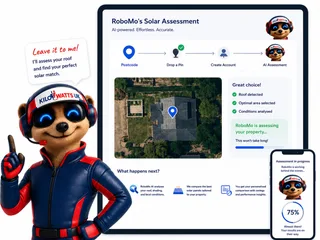
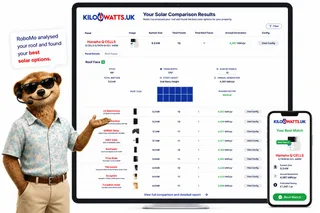
STEP 1
Choose Home, Business or Industrial
Enter your postcode to start your assessment.
STEP 2

Drop a pin on your roof
STEP 3

Create your free account
STEP 4

Sit back and watch RoboMo™ work
RoboMo™ analyses your roof and builds your personalised solar comparison.

Step 1
Enter your postcode
Start designing your wind energy system in seconds.
Are you an installer, distributor or renewable energy business?
Kilowatts UK is expanding the Flower Turbines partner network across the UK.
Become A Flower Turbines PartnerKilowatts UK is an authorised representative
Flower Turbines
Compact vertical-axis turbines built for real UK sites, not just open farmland.
They start in light wind, sit in a small footprint, and are bird-safe by design. Cluster them as a bouquet and the group performs better together than the same turbines standing alone. Enter your postcode for a location-based generation estimate. Figures use area weather data and will differ if buildings, trees or hills sit in the way.
Starts in light UK wind
Built to generate in typical UK wind, not only open farmland.
Small rooftop or ground footprint
Compact towers for roofs, yards and tight sites.
Bird-safe slow rotation
Slow vertical-axis spin, bird-safe by design.
Bouquet clusters raise output
Grouped turbines outperform the same units standing alone.
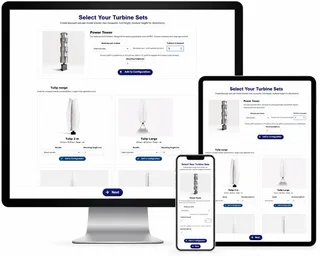
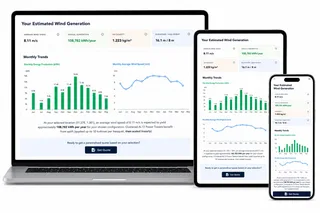
STEP 2

Choose a location
STEP 3

Place your cluster
Tap the map where you want the turbine cluster to go.
STEP 4

Instant generation forecasts
Compare different turbine layouts and see annual generation forecasts instantly.
STEP 5

No commitment required
Explore different configurations before deciding whether to request a quotation.
Related articles


FAQ
Need Help? RoboMo's Got Answers
Does the 17% figure mean my heat pump bill will fall by 17%?
No. Passiv states that Energy Saving Trust testing of its ecoHeat control found a 17% improvement in heat-pump coefficient of performance. That is a manufacturer-reported result for a stated test, not a seasonal performance factor, not shown as a Navien PEM750 test, and not a bill cut. If the same heat is delivered, a 17% rise in COP cuts that electricity to about 1 divided by 1.17 of the previous figure, roughly 14.5%, and only for the load the test actually changed. Standing charges, other household electricity, hot water and backup heat can shrink that further, so no national bill saving should be inferred.
What is the difference between COP, SCOP and SPF?
A point COP is heat delivered divided by electricity at one condition. A seasonal coefficient of performance, or SCOP, is a standardised laboratory seasonal rating, not a reading from your house. A seasonal performance factor, or SPF, is in-use performance over a season, and the boundary may or may not include pumps, controls, defrost and backup heat. The announcement does not present the 17% figure as an SPF, or as a SCOP for the PEM750.
Has the Energy Saving Trust test been published so I can check it?
The public announcement, as described, does not reproduce an Energy Saving Trust test note, protocol, dataset or a link a buyer can check. It is also unclear whether the test used a Navien PEM750 or another heat pump running ecoHeat. Under UK advertising rules, including the CAP Code overseen by the Advertising Standards Authority, a performance claim needs evidence a reader can examine. Until Navien, Passiv or Energy Saving Trust publish that note, ask for it in writing rather than treating installer coverage of the partnership as independent consumer evidence.
What does the Navien and Passiv package actually include, and from when?
From 1 October 2026, Navien’s PEM750 air-source heat pump can be supplied with the Passiv Smart Thermostat as an integrated package, available through selected merchants. That is not a confirmed national roll-out to every installer, and the public announcement does not list which PEM750 variants are included. Passiv says the control adjusts flow temperatures and schedules running around time-of-use tariffs and surplus rooftop solar, without extra interface hardware, and that installers get remote monitoring and diagnostics through the Passiv Portal. Price, installed cost and measured seasonal performance for this package are not stated, so they should not be assumed.
Will smart control replace weather compensation and MCS commissioning?
No. Weather compensation raises flow temperature in colder weather and lowers it when it is milder, because COP falls as the temperature lift increases. Dynamic optimisation, as Passiv describes it, keeps adjusting that relationship instead of leaving one curve untouched, but it does not remove site checks. For a UK installation under the MCS heat pump standard, currently the MIS 3005 family, the design is expected to rest on a room-by-room heat-loss calculation and emitter outputs at the intended flow temperature. A portal does not calculate heat loss, and software cannot resize a radiator or make an undersized heat pump deliver the design load.
When do solar surplus and time-of-use scheduling actually help?
They help only if the home has that tariff or generation, and if it can store heat in the building, cylinder or buffer without comfort complaints. Pre-heating a well-insulated house on a time-of-use tariff can be sensible; the same shift in a leaky house with small radiators often shows up as a cold evening and a recovery spike. Surplus solar is intermittent and seasonal, and use is limited by cylinder limits, legionella schedules and the heat pump’s minimum run times. Homes without solar, without a time-of-use tariff, or without reliable internet will not get this part of the package.
Does this launch change Boiler Upgrade Scheme eligibility or grant value?
No. Grant schemes such as the Boiler Upgrade Scheme have their own eligibility rules, often including an MCS-certified installation. This pairing does not, on the published material, set the grant value, change eligibility, or remove that requirement where the scheme imposes it. Check current scheme terms rather than reading a control launch as a grant update. The announcement is also a domestic control story, not a guide to commercial renewable systems.
What is the Greener Grid Payment, and should I include it in a payback calculation?
Passiv’s Greener Grid Payment lets enrolled customers shift heat-pump consumption during periods of network constraint. It is optional and separate from the thermostat pairing. Rates, minimum shift, eligibility and opt-out rules are not in the public material, so any income should be treated as unknown until the scheme terms are in writing. Do not put a payment into a payback sum when the rate has not been published, and do not accept a heat pump that cannot meet the design heat loss on a cold day just because a flexibility payment exists.