


3.0V Aluminium-Graphite Battery Runs for 35,000 Cycles - What the Lab Result Really Shows
Published: 2026-11-23 18:10:08
Updated: 2026-11-23 10:10:51
See why 3.0 V is the charge cut-off, how aluminium-graphite battery capacity fell over 35,000 lab cycles and what UK storage buyers still need to know.
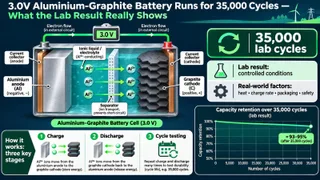
Aluminium–graphite lab cell exceeds 35,000 cycles at a 3.0 V charge cut-off
Researchers reported more than 35,000 charge–discharge cycles in a rechargeable aluminium–graphite lab cell with a quasi-solid-state electrolyte. The 3.0 V figure was the upper charging cut-off. Voltage fell during discharge, and the charge recovered per gram of graphite declined over the test. The result shows that the cell can keep cycling at that cut-off under controlled conditions. Usable energy, service life and installed cost for a UK storage system using the design remain unverified. Nature Communications study
How the electrolyte raised the charging cut-off
The cell pairs an aluminium negative electrode with a graphite positive electrode. During charging, negatively charged ions from the electrolyte move between the graphite layers. They leave during discharge. In the electrolyte chemistry studied, breakdown reactions around 2.5 V can limit how much charge the graphite can store and release.
The researchers held a liquid electrolyte in a solid framework to create a quasi-solid-state electrolyte. The formulation changed how ions interact in the electrolyte and helped form a fluorine-rich layer on the graphite surface. These changes suppressed breakdown reactions at higher voltages. In Figure 5c–d, raising the cut-off from 2.5 V to 3.0 V increased discharge capacity from about 64 to 110 mAh per gram of graphite at the same specific current of 5.0 A per gram. The paper separately reports about 137 mAh per gram at the 3.0 V cut-off and the same specific current. Nature Communications study, Figure 5
How much capacity remained after prolonged cycling?
The researchers cycled a Swagelok-type lab cell at 25 °C between 0.1 V and 3.0 V, using a specific current of 5.0 A per gram of graphite. Figure 5e shows discharge capacities of about 101 mAh per gram near 10,000 cycles, 86 near 20,000 and 71 near 30,000. The 30,000-cycle reading is the closest labelled value to 35,000 cycles. The exact endpoint capacity remains unverified. The baseline for the paper’s retention claim at 10,000 cycles is unclear, so the plotted capacities give a clearer picture of the decline. Nature Communications study, Figure 5 and Methods
The study used pouch cells for separate demonstrations and safety tests. An installed pack would also age while idle. The rate depends on temperature and how long the pack spends at different states of charge. Converting the lab cycle count to years at one cycle per day leaves out this calendar ageing. When comparing how long home batteries last, look at how much usable energy a complete pack still delivers after years of typical operation.
What the result tells us about usable energy and power
The paper estimates more than 400 Wh/kg by multiplying the 3.0 V charge cut-off by the discharge capacity per kilogram of graphite. A pack-level measurement uses the energy delivered over the full discharge, as the voltage changes, and divides it by the full pack mass. That mass includes the aluminium, electrolyte, casing and pack hardware. To compare Wh/kg with commercial batteries, use figures measured on the same basis. Nature Communications study, Figure 5 and Discussion
For a home or business, usable capacity in kWh tells you how much energy the system can supply between charges. Continuous output in kW tells you how much demand it can meet at once. Both figures matter when sizing a home battery. Round-trip efficiency is the share of the energy used to charge the system that comes back as usable electricity. Ask installers to quote on the same basis, especially if one gives battery-side figures and another measures at the AC connection.
What UK homes, flats and businesses should check now
For a home with solar, start with measured daytime export and evening import. If appliances, an EV or a heat pump already use most daytime generation, there may be little surplus to store. Allow for storage losses when comparing the import costs you could avoid with the export income you would give up. If you plan to charge from the grid, check how much energy the battery can take in during the cheaper tariff window and how much higher-priced demand it can cover afterwards. Energy Saving Trust battery storage guidance
If you’re adding a battery to solar, ask whether you can keep the existing solar inverter and how a separate battery inverter would measure import and export. Have the installer check the consumer unit and proposed battery location, confirm the connection process with the local distribution network operator and include any export limit in the quote. The GOV.UK guidance on registering energy devices in homes and small businesses explains the connection paperwork. Ask your export tariff provider how the proposed metering and charging arrangements would affect your payments.
For a flat with balcony solar, compare likely generation with daytime demand to estimate the surplus available to store. Before buying, confirm the permissions and connection arrangements for the proposed setup. Check that the proposed battery location meets the manufacturer’s limits for temperature and weather exposure. For a shop, workshop or farm, use half-hourly meter data to distinguish a short peak from a load that runs for several hours. The peak sets the power requirement in kW. A longer load also needs enough usable energy in kWh to keep it running. If you need backup, specify which circuits must keep running and for how long. Ask the installer what equipment enables backup and how much capacity the system reserves for outages.
What would make aluminium–graphite storage worth comparing?
The lab result makes a case for testing this chemistry at pack scale. A buying decision would need pack-level data on usable energy, efficiency, cold-weather operation, calendar ageing and safety. Manufacturing costs would need to account for the electrode materials, electrolyte, cell assembly and pack hardware. Nature Communications study, Discussion
If you’re comparing storage now, use the Kilowatts UK tools and directory of battery installers to build a shortlist. If you’re also considering solar for your home, you can book a free energy survey. Give each installer the same consumption, generation and export data where available, along with the loads you want to cover. Ask each to quote against the same usable capacity, continuous output and backup requirements, and to show installed battery costs and warranty terms separately.
Solar comparison
Compare solar for your property
Enter your postcode to assess your roof, compare solar options and get quotes from UK installers.
- Free postcode start
- Home, business and industrial
- RoboMo™ maps your roof
See which panels fit your roof
Choose home, business or industrial, then enter your postcode. RoboMo maps the roof and ranks panel brands by fit.
1. Postcode Start the assessment for your property.
2. Pin the roof Mark the array on the map.
3. Compare RoboMo™ builds your options.

Battery ROI tool
See what a battery saves on your bill
Enter the day rate, off-peak rate and export rate. The calculator ranks batteries in the Kilowatts shop over 10 years. Home batteries also suit offices and small commercial sites.
Reading
Sources and further reading

See how soda ash improved a solid-state sodium battery electrolyte, what 850 lab cycles show and what UK buyers should check in battery storage quotes.
Read article
An anode-free zinc pouch cell retained 90.47% of its capacity after 350 lab cycles. See how the zinc reserve helps and what UK solar storage buyers need.
Read article
A UK home battery warranty runs on three clocks at once: years, cycles and total throughput. Learn how to read yours and which limit ends it first.
Read article
Home battery storage in Broadstairs depends on usable kWh, salt-air siting and UK Power Networks paperwork. Backup is not automatic in a power cut.
Read article



Mo's Solar Mission
Mo's Mission Nominations
Garlinge Primary School and Nursery
Garlinge Primary School and Nursery is a foundation primary school on Westfield Road in Margate, Kent, for children aged 3 to 11. It is m...
St Luke's Church of England Primary SchoolSt Luke's Church of England Primary School is a voluntary controlled Church of England primary school on Jubilee Road in Formby, Merseysi...
Comberbach Nursery and Primary SchoolComberbach Nursery and Primary School is a primary academy on Mather Drive in the village of Comberbach, near Northwich in Cheshire, for...
Locations
Solar installation near you
Write for Kilowatts.uk
Got a trade and something worth saying?
Write it here under your own name. Sign in, put a profile up, and start a guide. Pay only if you want more links from your articles out to your own site.
Register
Create a Kilowatts.uk account, or sign in if you already have one.
Author profile
Put your name, photo and experience on a public author page.
Start creating
Write a guide or a blog. Free authors can put one followed link to their own site in articles each month.
FAQ
Need Help? RoboMo's Got Answers
What does 3.0 V mean in the aluminium–graphite battery study?
It was the upper voltage limit used when charging the lab cell. The voltage fell during discharge, so the energy delivered depends on the voltage across the full discharge.
How much capacity did the cell retain after thousands of cycles?
The study’s graph shows about 101 mAh per gram of graphite near 10,000 cycles, 86 near 20,000 and 71 near 30,000. The researchers reported more than 35,000 cycles, but the exact capacity at the end of the test is unverified.
Does 35,000 lab cycles tell me how long a home battery would last?
The figure describes a small lab cell cycled at 25 °C under controlled conditions. A home battery also ages while idle, and its ageing depends partly on temperature and how long it spends at different states of charge. For a battery you can buy, ask how much usable capacity the warranty covers and for how long.
Can I compare the study’s 400 Wh/kg figure with a commercial battery?
The study’s estimate uses the 3.0 V charging cut-off and counts only the mass of the graphite. A comparable pack-level figure uses the energy delivered over the full discharge and includes the mass of the whole pack. For home storage, compare usable capacity in kWh and continuous output in kW.
Should I wait for this technology before buying a home battery?
The study leaves usable energy, efficiency, service life and installed cost unverified for a home battery based on this design. If you need storage now, compare products you can buy using your measured electricity use, installed quotes and warranty terms.
How can I tell whether a battery would save me money with my existing solar panels?
Start with how much electricity you export during the day and import later. Allow for storage losses, then compare the import costs you could avoid with the export income you would give up. Ask the installer whether you can keep your existing inverter and how the proposed metering would work.
Will a home battery keep my appliances running during a power cut?
Backup depends on the equipment and how it is installed. Tell your installer which circuits you need to keep running and for how long. Ask what continuous power the system can supply during an outage and how much capacity it reserves for backup.
Live help
Need help right now?
Talk to RoboMo™ and get instant answers.