Founder & Renewable Energy Author, kilowatts.uk


Founder & Renewable Energy Author, kilowatts.uk
Article
The UK Demand Turn-Up trial will not pay every home to use surplus wind power, and it is not free electricity.
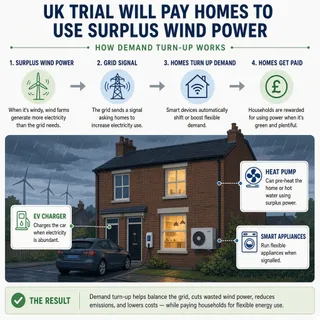
How uk demand turn-up trial work, typical output, costs and limits, and whether they have a future for UK homes, balconies and businesses.
The UK Demand Turn-Up trial will not pay every home to use surplus wind power, and it is not free electricity. It is a limited test, due to start in December 2026, of whether households and businesses will use more electricity when renewable output might otherwise be curtailed. In return, participating suppliers and flexibility companies would pass on a rebate of eligible Final Consumption Levies. Whether that is worth acting on depends on where the extra demand sits, whether you have spare controllable load that would not have run anyway, and a pence-per-kilowatt-hour figure that has not been published.
In practice a household would almost certainly join through an approved supplier or flexibility provider, not by applying for a public grant. The Carbon Trust, Arup, Ipsos and Technopolis have been appointed to deliver the programme. UKRI support for providers is described as up to £16 million, inside a wider programme announced as worth £20 million. That is funding for the trial, not a pot paid out as household rebates.
The consumption that counts has to be additional, or genuinely moved into the event window. Charging a car in an hour when it would have charged anyway should not qualify if the baseline is done properly. UKRI has said it is particularly interested in evidence involving vulnerable or fuel-poor households. That is a research aim, not a confirmed entitlement to a discount, and it is not a reason to assume the product will suit every prepayment meter.
The timetable, the partners and the pass-through duty come from the appointment notice dated 27 October 2026, not from a household tariff. Before you treat any later briefing as final, read that primary notice from UKRI or the delivery partners and check whether procurement documents have narrowed it. A recap can get the funding split right and still miss a market exclusion that decides whether your site can join.
What follows is the consumer-relevant core of that notice, as far as it has been set out. It is not a savings calculation, and it does not fill gaps the notice left open.
Admin, metering and the way a credit is shown on a bill sit in that unpublished set. “Must pass the benefit on” still leaves open whether a provider’s costs shrink what the customer sees. A smart meter is evidence of consumption. It is not membership of the trial.
Curtailment means generation is reduced because it cannot be used or moved to where it is needed. Two situations get bundled together in headlines about paying wind farms to stop, and they do not reward the same home.
Transmission-constraint turn-down is energy in the wrong place. Generation, often wind in Scotland and northern Britain, exceeds what a transmission boundary can carry south. The system operator pays plant inside the constraint to reduce output, and typically pays someone outside it to increase output so the system stays in balance. Extra demand on the constrained side of that boundary can cut how much wind must be turned down, because the energy is used before it has to cross the limit. Extra demand south of the limit does not open that path. It can increase the north-to-south transfer and, in a tight boundary hour, make the constraint harder rather than easier. A windy night in the north does not automatically become cheap power for a southern postcode.
A system-wide surplus is different. Nationally there is more available generation than demand, storage and export can take, even if the wires could move it. Wholesale prices can be very low or negative. Extra demand anywhere that is not itself behind another constraint can absorb that surplus and help keep plant online. The same hour can be both a national surplus and a locational constraint. Location of the extra demand may determine whether curtailment falls. This trial does not, on the material published so far, restrict itself to Scottish postcodes or to hours when a named boundary is binding. A national product that pays a southern home to use more may absorb energy in a low-price period without keeping a constrained northern wind farm on. Exact annual volumes and curtailment payments change with weather, outages and market conditions, so they should be read from a current NESO or Ofgem source rather than treated as a fixed household opportunity. Paying wind down can still be the cheaper system option when the full retail price of using the power is high. The alternative is not free electricity for everyone. It is demand in the right place, metered well enough to prove the response, at a total cost below the cost of turning generation off. A full battery, a full car, or a cylinder already at its maximum setpoint cannot absorb that energy, however windy it is outside.
Final Consumption Levies are policy costs recovered through electricity bills, on top of the wholesale element, network charges and the supplier’s own costs. When wholesale prices fall very low, or go negative, those other parts of the unit rate can still make extra consumption look expensive. Why UK electricity prices stay high is the point: a generator may then be paid to turn down because the full retail price of using the power is higher than the cost of curtailment.
To judge whether a levy-only rebate could be material, look at Ofgem’s default tariff cap cost stack, published with each cap period in the cap annexes, rather than at a single recycled penny figure. That stack separates wholesale energy, network charges and operating costs from a group usually labelled environmental and social obligation costs. Policy costs commonly discussed in that public stack include the Renewables Obligation, the Feed-in Tariff, Contracts for Difference supplier costs, the Capacity Market supplier charge, the Energy Company Obligation, the Warm Home Discount, and the Assistance for Areas with High Electricity Distribution Costs charge. Naming them shows where a Final Consumption Levy rebate would have to sit. It is not a statement that each one is eligible. The trial has not published the legal list.
The trial pence-per-kilowatt-hour figure is unpublished. Do not infer a saving from an old cap period, and do not treat a previous stack as this product’s rate. A levy rebate does not, on the announcement alone, remove network charges, standing charges, supplier operating costs or the wholesale element. Even a waiver of every policy cost in the stack would leave the rest of the unit rate in place unless the rules say otherwise. Until a provider publishes the rate, there is no honest household savings sum. That matters most where a higher bill cannot be absorbed. Being asked to buy extra electricity is only helpful if the net effect is clearly positive and easy to see. A product that needs a smart charger, a battery strategy, or comfort with remote control is a poor default for someone who cannot risk a higher bill if the event credit fails to appear. The trial’s interest in fuel-poor households is a reason to watch the consumer-protection design, not a reason to assume the offer will fit every home.
Customers should expect any discount to arrive through a participating supplier or flexibility company. The appointment notice requires those providers to pass the benefit through. It does not say every supplier must offer the product, and it does not say a smart meter alone enrols a home. Phase one is described as limited to selected flexibility markets and as excluding distribution system operator markets. That is narrower than “any flexibility product on the market”. A site already contracted to a local DSO service should not assume it can stack a turn-up payment on the same response. Turn-up is also the opposite of most household flexibility people have already been offered. The NESO Demand Flexibility Service, and similar turn-down products, ask you to use less at a tight time. A smart time-of-use tariff is a standing price shape set by the supplier’s wholesale costs, not a one-off curtailment event. Home EV charging schedules and heat-pump controls are the devices a turn-up instruction would have to override. A home battery cannot do turn-down reserve and turn-up absorption with the same kilowatt-hour at the same moment. Energy kept back for a later peak is not spare capacity for a surplus event. Geographic eligibility, domestic versus non-domestic entry, and whether EVs and home batteries are in phase one or only later are not confirmed. Until they are, the table below is a way to tell the products apart, not a menu of payments you can already claim.
Nothing in the consumer material confirms that an EV charger, a home battery, an immersion heater or a heat pump is in phase one, or that any region is in. The notes below are about which loads can physically take a defined window and be metered against normal use. They are not a shopping list, and they are not a reason to buy equipment before the rules and the discount are known.
An EV on a 7 kW home charger can take a meaningful amount of energy if the car is plugged in, not already full, and the session is allowed to start. That 7 kW figure is an ordinary charger rating, not a trial payment or a guaranteed session. Many home batteries hold only a few usable kilowatt-hours, and only the empty headroom on the day can absorb surplus power. Nameplate capacity is not the same as room on the afternoon the event is called.
Hot water and heat can store energy without looking like a battery on a schematic. An immersion heater can raise cylinder temperature only if the thermostat, mixer valve and any legionella setting allow it. A heat pump can preheat a building only if weather compensation, manufacturer lockouts and comfort limits permit a remote boost. Electrical input during preheat varies with outdoor temperature and heat loss, so no single kilowatt figure should be treated as typical trial performance. A cylinder or a house can only store so much heat before losses and overheating wipe out the point. Commercial and farm loads often have more room to move than a typical house. Cold stores, pumping, batch processes and thermal stores can run earlier or harder for a short window. They still need half-hourly or device-level evidence, and a provider willing to enrol them in the markets phase one actually allows. An industrial load and a domestic immersion heater are not the same product. Export limits, distribution constraints and battery cycle warranties still apply throughout. A trial does not waive them.
A two-hour event is an illustration for an ordinary home, not a published trial parameter. Event length, how often events occur, and any household saving per event are unknown. The sequence is still useful, because it is what installers and flexibility providers would have to orchestrate with smart energy management, and it fails in ordinary ways.
Before the window, the battery strategy is the reverse of many solar self-consumption settings. The battery may need to stop topping up from the roof, or sit at a lower state of charge, so it has room when the event starts. That can mean more grid import earlier in the day. If the event is cancelled, or the credit does not match the extra import, the customer sees a higher bill. Creating headroom is a cost unless the event completes and the baseline accepts it.
During the window, the useful response is specific. The EV starts a charge because it is at home and the charger schedule can be overridden. The immersion raises the cylinder, within its safety controls. The heat pump preheats if the building can take heat without overshooting. The battery charges into the space that was deliberately left. After the window, those devices should not keep running just because the signal was recent. A smart time-of-use tariff that already forces cheap overnight charging can block the whole sequence if the turn-up instruction cannot override it. Participation fails for dull reasons. The car is at work. The charger has no schedule interface. The cylinder is already at setpoint. The heat pump is locked to weather compensation. The inverter portal, the clamp meter and the device app disagree about what was used. Sub-metering of the charger, inverter, immersion or heat pump is likely to matter more than a whole-house smart meter reading alone, because the baseline has to separate event use from everything else in the house. If those devices were never confirmed as in-scope, none of this sequence is a phase-one offer.
A credible baseline is a defined answer to a simple question. What would this site have used if the event had not been called? Weather, occupancy, a regular overnight charge and a heat pump’s normal weather-compensation curve all change that answer. If customers or providers can flatten use just before an event and then claim the rebound as turn-up, the trial measures gaming rather than surplus absorption. “Additional or genuinely shifted” is the heart of the design, not a footnote.
Consumer protection is unfinished in public. Consent to share metering data, how to complain, and how a discount appears on a bill are not in the partner announcement. A household that opts in should be able to see which devices were controlled, which hours counted, and what was excluded as business as usual. Without that, a flexibility credit is hard to distinguish from a tariff change.
There is a real downside for people who treat this as bill support. Turn-up asks some customers to buy more electricity. If the net bill effect is unclear, or if the household has no flexible load, the product is a poor fit. It is also a poor fit for equipment that is already running flat out in the hours when surplus wind is likely. Automatic enrolment is unlikely. A home that can only respond by overriding comfort or by ignoring a safety setpoint should not be in the product at all.
Between the October 2026 appointment and phase one, the useful updates are operational. Those updates sit alongside the wider 2026 energy shake-up, which is not this trial’s unpublished rate. Watch which suppliers and flexibility companies are accepted, which markets phase one actually includes, and whether the exclusion of DSO markets is confirmed in the procurement documents rather than only in secondary briefings. Watch the legal list of eligible Final Consumption Levies, and whether the consumer result is a per-kilowatt-hour discount, a per-event credit, or something else. Also watch whether events are tied to a transmission constraint, to a system-wide surplus, or to both, because that decides whether a southern home’s extra use keeps any wind on.
A home already on a smart time-of-use tariff, or already offering turn-down through a product such as the NESO Demand Flexibility Service, may not be able to sell the same kilowatt-hour twice. Until a named provider answers the points below, there is no household savings case to calculate.
If those answers are vague, the sensible step is to wait. The trial may produce a useful product for some sites with spare, controllable load in the right place. It is not, on the notice published so far, a reason to change tariff, buy storage, or assume a windy month will cut the bill. If you are planning other home energy work anyway, book a free home survey rather than treating this trial as a reason to buy kit.
Solar comparison
Enter your postcode to assess your roof, compare solar options and connect with trusted UK installers.
Choose home, business or industrial, then enter your postcode. RoboMo maps the roof and ranks panel brands by fit.
1. Postcode Start the assessment for your property.
2. Pin the roof Mark the array on the map.
3. Compare RoboMo™ builds your options.
Battery ROI tool
Enter the day rate, off-peak rate and export rate. The calculator ranks batteries in the Kilowatts shop over 10 years. Home batteries also suit offices and small commercial sites.
Reading
The same building can need a different solar-and-battery design when its electricity demand occurs at different times.
Read article
East- and west-facing arrays can spread solar production across a longer part of the day.
Read article

A home battery stores daytime solar and releases it in the evening. Here's how time-shifting works, what happens when it empties, and how to size one properly.
Read article
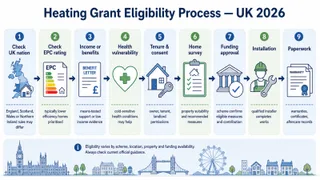
Being over 55 may help where a scheme considers vulnerability, health, low income or local council rules.
Read article
Write for Kilowatts.uk
Write it here under your own name. Sign in, put a profile up, and start a guide. Pay only if you want more links from your articles out to your own site.
Create a Kilowatts.uk account, or sign in if you already have one.
Put your name, photo and experience on a public author page.
Write a guide or a blog. Free authors can put one followed link to their own site in articles each month.
FAQ
Live help
Talk to RoboMo™ and get instant answers.
Live chat