
Founder & Renewable Energy Author, kilowatts.uk


Founder & Renewable Energy Author, kilowatts.uk
Article
East- and west-facing arrays can spread solar production across a longer part of the day.
East- and west-facing arrays can spread solar production across a longer part of the day. This short Kilowatts UK film is a companion to a real design question, not a sales pitch. The page below restates what the film teaches, then puts it in practical UK-home context so the article still stands if you cannot play the video.
"East- and west-facing arrays can spread solar production across a longer part of the day."
The episode title is “...”. The premise is simple: East- and west-facing arrays can spread solar production across a longer part of the day. On screen: time accelerating through seasons while a counter climbs. That is the whole point of the film. Two homes can look identical and still need different solar and storage designs if they use electricity at different times of day.
The spoken script is short on purpose. Each line is a design point, not filler. Don't solar panels need to face east? RoboMo: No, east and west can produce a longer generation window. Are clouds a problem? RoboMo: No, diffuse daylight can still produce electricity. And what about unused roof space? RoboMo: That can represent decades of forgone generation. Don't solar panels need to face east? RoboMo: No, east and west can produce a longer generation window. Are clouds a problem? RoboMo: No, diffuse daylight can still produce electricity. And what about unused roof space? RoboMo: That can represent decades of forgone generation. Read those lines as engineering, not marketing. The film is teaching you to size the system around measured demand rather than around how the house looks from the street.
A household load profile affects useful array size, battery sizing and expected self-consumption. Solar on the roof makes electricity when there is daylight. A home that uses most of its power while the sun is up can consume a lot of that generation directly. A home that stays quiet all day and then loads the evening — cooking, heating, an EV — needs somewhere to put surplus daylight energy, or it exports it and buys it back later. So the same roof, the same panels and even the same installer quote can still be the wrong design if the demand curve is different. The battery is not a fashion extra. It is how you move daytime generation to the hours when that particular house actually uses power.
You do not guess this from kerb appeal or from a neighbour’s system. In Britain the honest source is your own half-hourly smart meter data: when the house draws power, and how that lines up with daylight. If demand rises with the sun, a larger useful fraction of generation can be used on site. If demand spikes after sunset, storage or a timed overnight charge matters more than adding more panels for their own sake. An EV on the evening house is the same rule again. The roof may stay the same size. The battery, or the decision to charge off-peak, is what changes. Design follows measured demand, not roof size.
Pull a year of half-hourly import data if you can, not a single sunny afternoon. Mark when cooking, heating, laundry and any EV charging actually happen. Note whether those hours sit in daylight or after dark. Ask what happens to surplus midday generation: used in the house, stored, or exported. Ask what the house still buys after sunset. Those two numbers tell you more than a brochure array size. Then look at solar, battery and timed charging as one design, not three separate products. The film’s point is that the right mix depends on your load profile. A survey should start there.
Can two identical houses need different solar systems? Yes, if they use electricity at different times. Does an evening-heavy house need a battery more than a daytime-heavy house? Usually yes, because it cannot consume as much generation live. Does adding an EV change the roof? Not necessarily — it more often changes storage or when you charge. How do you know which pattern you have? Your smart meter, not the look of the house. None of that invents a grant, a price or a saving. It is the same teaching as the film: measure the home, then design around that demand.
Mo: Don't solar panels need to face east? RoboMo: No, east and west can produce a longer generation window.
Mo: Are clouds a problem? RoboMo: No, diffuse daylight can still produce electricity.
Mo: And what about unused roof space? RoboMo: That can represent decades of forgone generation. Mo: Don't solar panels need to face east? RoboMo: No, east and west can produce a longer generation window. / Mo: Are clouds a problem? RoboMo: No, diffuse daylight can still produce electricity. / Mo: And what about unused roof space? RoboMo: That can represent decades of forgone generation.
Watch the short, then look at your own half-hourly data before you treat two similar roofs as the same job. The film is a design lesson, not a product push.
If you want a second pair of eyes on that data, book a friendly Kilowatts UK survey — no pressure.
Solar comparison
Enter your postcode to assess your roof, compare solar options and connect with trusted UK installers.
Choose home, business or industrial, then enter your postcode. RoboMo maps the roof and ranks panel brands by fit.
1. Postcode Start the assessment for your property.
2. Pin the roof Mark the array on the map.
3. Compare RoboMo™ builds your options.
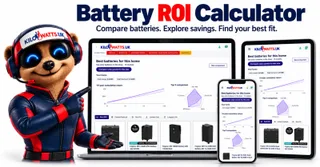
Battery ROI tool
Enter the day rate, off-peak rate and export rate. The calculator ranks batteries in the Kilowatts shop over 10 years. Home batteries also suit offices and small commercial sites.

Authorised UK partner
Choose a location, configure Flower Turbines and see estimated annual generation from location-specific wind data. No account required.
Open the designer and lay out turbines on your site.
1. Postcode Open the designer for your site.
2. Layout Place turbines in the space you have.
3. Forecast See estimated annual generation.
Write for Kilowatts.uk
Write it here under your own name. Sign in, put a profile up, and start a guide. Pay only if you want more links from your articles out to your own site.
Create a Kilowatts.uk account, or sign in if you already have one.
Put your name, photo and experience on a public author page.
Write a guide or a blog. Free authors can put one followed link to their own site in articles each month.
FAQ
Live help
Talk to RoboMo™ and get instant answers.
Live chat