


Home battery storage in Broadstairs
Published: 2026-10-12 18:38:26
Updated: 2026-10-13 00:50:54
Home battery storage in Broadstairs depends on usable kWh, salt-air siting and UK Power Networks paperwork. Backup is not automatic in a power cut.
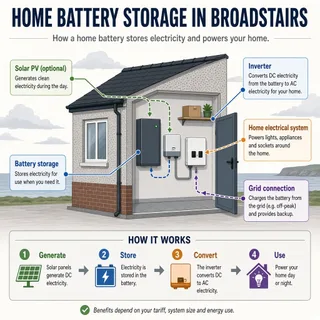
Home battery storage in Broadstairs
Home battery storage in Broadstairs from Kilowatts.uk in Broadstairs. Costs, roofs, planning and what to do next then compare a local system.
Home battery storage in Broadstairs
In Thanet the practical routes are a battery fitted with new solar PV, a retrofit onto panels that already work, or an AC-coupled battery with no solar. Which route is sensible depends on daytime export, evening use, where the kit can sit, and what the existing installation and any solar paperwork already say. Installed prices, bill savings and any grant position are site-specific and are not stated here. A useful quote itemises the electrical route, any backup hardware, network costs, coastal materials and the VAT treatment, rather than a single cabinet price.
A grid-tied battery is not a generator. Many systems shut down in a power cut so they do not energise the network. Backup, if it is offered at all, needs specified hardware and a defined set of circuits. It is not included merely because a battery has been ordered.
Fitting storage with new solar or adding it later
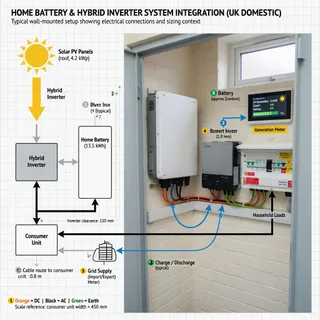
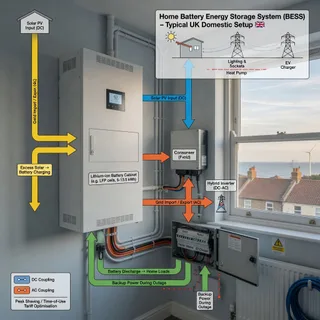
When panels are being installed anyway, storage is usually cleaner if the panels and battery share one hybrid inverter. There is one conversion path, one set of protection settings to agree, and the cable route can be designed once. That is a different job from hanging a second inverter beside a solar system that is already working. Retrofit is often AC-coupled. The battery has its own inverter and sits on the household AC supply next to the existing solar inverter. Some retrofits instead replace the solar inverter with a hybrid unit. That replacement can disturb generation metering, export measurement and any older tariff paperwork, so it should not be treated as a small add-on. A battery can only shift when stored electricity is used. That electricity is either solar that would otherwise have been exported, or electricity taken from the grid. A small array and low evening use can leave a large battery under-used. Usable capacity is set by the manufacturer’s depth-of-discharge and reserve settings, so the energy you can cycle is below the nameplate figure, and it falls further with age, temperature and how the system is cycled. Round-trip efficiency is below 100 percent because each charge and discharge loses some energy in conversion. No single Broadstairs size, efficiency or lifespan should be assumed from a brochure.
What the Thanet coast changes on site
Broadstairs sits on the north-east Kent coast. Housing is mixed: terraces, flats, bungalows and larger detached homes, some close to the sea and some in conservation areas. Outdoor wall space, meter position, cable routes and loft or garage access vary more than a generic UK brief assumes. Salt-laden air, wind-driven rain and corrosion affect external inverters, isolators, fixings and cable glands more than an inland install.
Coastal location does not ban batteries, and it does not make every indoor install exempt from warranty limits. Some manufacturer warranties restrict outdoor or coastal siting, or limit how the product may be used in a stated temperature and humidity band. The distance from the sea, the outdoor rating and any chemistry limits are product-specific. They have to be read from that product’s warranty PDF before equipment is ordered, not inferred from the town. If the only available wall is an exposed external wall and the warranty does not allow that site, that product is unsuitable even if the roof is fine for solar.
A worked check, not a claimed install, is a mid-terrace a few streets back from the Broadstairs front. The consumer unit is already full, the meter cupboard is shallow, and the only outside wall takes wind-driven salt. The roof may still suit panels. The battery still needs an indoor structural position inside the manual’s clearances and temperature range, with any short external run using glands and fixings specified for that exposure. An outdoor cabinet on the weather wall is closed if the warranty PDF excludes it. Indoor siting only helps if the room stays inside those limits, the structure can take the weight, and maintenance access is real. A long run of exposed cable is a poor substitute for a proper location.
Backup, power cuts and what storage will not do
In a power cut, a normal grid-tied battery will often switch off. It is designed to work with the network, not to island the house. Ordering storage does not buy whole-house cover, and it does not keep the solar inverter generating unless the design explicitly supports that. If blackout cover is the reason for the purchase, it has to be designed in: specified backup hardware, a transfer arrangement, and a short list of circuits the battery can actually support.
Runtime is unknown until the backed-up load and the usable kWh are known. It is often much shorter than a whole-house outage if only a few circuits are connected. The survey should separate power from energy. Stored kWh says how long a modest load might run. The inverter’s continuous kW rating says whether that load can run at all. A domestic cooker, a heat pump or an EV charge point can demand more power than many single-phase home battery inverters are intended to deliver, even when the battery label shows several hours of storage. A standard domestic battery should not be treated as a supply for those loads unless the design explicitly says so, and even then the duration may be brief.
Ask which circuits are on the backup path, what happens to solar during an outage, and whether the battery may charge from solar only, from the grid, or from both. Those answers change the equipment list. They are not a software setting added on the day of commissioning. Marketing that implies independence from the network is easy to over-read against a grid-tied datasheet.
Where a Broadstairs battery can physically go
The location check comes before the capacity conversation. Floor loading, manufacturer clearances, ventilation, indoor temperature range and a lawful cable route all have to work on that house. Terraces and small coastal homes often have a tight meter cupboard, a consumer unit with little spare way, and no garage. A loft can look convenient and still be wrong if temperature, access for maintenance or fire layout cannot match the product instructions.
Flats and rented homes usually need the freeholder’s or landlord’s consent, including consent for any cable through common parts. That is a property and lease issue, not an installer preference. Without consent and a lawful cable route, the job is often unsuitable even if the electrical design looks straightforward. Conservation-area status or a listed building can also change what may be fixed where. Permitted-development assumptions that sometimes apply to panels do not automatically settle the battery. Planning and building-regulation treatment should be checked for the actual property against the rules in force at the time, not copied from an older article.
Fire separation, detector placement, labelling, earthing and the consumer unit are part of the same job. They should follow the product manual, the current edition of BS 7671, and the building rules in force at install. Design practice for storage is also set out in the IET Code of Practice for Electrical Energy Storage Systems. A generic blog layout is not a specification. If the board is already full, or the earthing arrangement cannot accept the proposed inverter, the quote changes even though the battery cabinet itself has not changed.
UK Power Networks, G98, G99 and solar paperwork
Kent’s distribution network operator for this area is UK Power Networks. Adding generation or storage can require notification or an application before or at commissioning. In current UK practice that split is described by Engineering Recommendation G98 and Engineering Recommendation G99, with forms published through the Energy Networks Association. G98 is the simpler notification route. G99 is the application route used where the connection is larger or more complex, including where existing generation already uses part of the allowance. This article does not state a kilowatt threshold. Export limits, notification limits and the correct form must be taken from the current UK Power Networks connections guidance and the current ENA documents, not reused from memory or from this page. Those publications are updated. A blog cannot freeze them.
An existing solar system may sit under an older Feed-in Tariff arrangement, a Smart Export Guarantee arrangement, or neither. Ofgem publishes the current rules for both. The Feed-in Tariff is closed to new applicants, but an existing accreditation can still be affected if the generating equipment, the generation meter or the way export is measured is changed. Smart Export Guarantee payments depend on a suitable export meter and a contract with a licensed supplier. Storage can change how much is exported and when. It does not create a SEG contract by itself. A retrofit design should not be fixed until the existing inverter make, generation meter, export metering and any tariff paperwork have been read against that home’s documents and, where needed, the scheme administrator.
Commissioning paperwork and the DNO process are part of the install, not an optional extra. An export or generation limit agreed for the connection has to match the equipment that is actually fitted. If the proposal later changes (a different inverter, a hybrid instead of AC-coupled storage, or a new export limit), UK Power Networks may treat it as a different connection proposal. Where the job is being offered under the Microgeneration Certification Scheme, the relevant MCS battery guidance and the installer’s certification scope should be confirmed on the quote. This page does not certify a product, an installer or a connection. Warranty start dates, who registers the product, who submits the network notification, and any coastal exclusion should be written down before equipment is ordered. Workmanship terms are the installer’s terms. They should not be assumed to match a national scheme.
What a Broadstairs quote should itemise
Refusing a town-wide price is not the same as refusing a clear quote. Two Broadstairs homes with the same nameplate kWh can be different jobs once the hybrid or AC-coupled choice, the backup path, the network process and the coastal materials are priced. Ask for those lines before comparing cabinets. Any figure for savings, payback or a grant should be treated as outside this article. Eligibility and cost move with the property, the tariff and the rules in force, and they belong on a quote that has seen the site.
The quote should also say what is excluded. A battery-only price that assumes an empty consumer unit, an indoor wall and no DNO application will not describe a full terrace retrofit on the Thanet coast. VAT should be shown as the treatment the supplier is applying to that scope. It should not be copied from a general article.
When storage is a weak fit
Storage is more relevant where solar regularly exports during the day while the home uses more power in the evening, or where the household will actually operate a battery against a time-of-use tariff rather than merely having one installed. Fitting storage with new solar is the cleaner electrical design when panels are going in anyway. Retrofit suits a working array with spare export and a board and location that can take another inverter, once the paperwork has been checked. A battery with no solar only makes sense if the household will genuinely shift demand onto stored grid electricity. There is no solar self-consumption in that case.
It is a poor fit where there is nowhere safe for the weight and clearances, where the household uses very little electricity, or where the only goal is blackout cover and the chosen system has no backup path. Renters and most flats are often unsuitable unless consent and a cable route already exist. Homes that want backup of high loads usually cannot treat a standard domestic battery as a whole-house supply. Buying a larger kWh figure does not repair a missing location, a full consumer unit, a coastal warranty exclusion or an export pattern that was never there.
Before a survey, gather facts rather than a target kWh from a brochure. Bring the existing inverter make and model, recent generation meter readings, and any Feed-in Tariff or Smart Export Guarantee documents. Note whether the home is empty while the sun is on the roof, which indoor wall or floor is actually available, and whether a landlord or freeholder must agree. Decide whether backup is essential and which few circuits would matter if it is. If those answers are weak, the useful next step is still a survey, but one that treats location, UK Power Networks status and existing solar as design inputs, not as extras after the cabinet has been chosen.
Plan, Compare & Buy Renewable Energy Solutions
AI does the thinking.
You get the perfect solar match.
Use RoboMo™ to assess your property, compare available technologies and connect with trusted UK installers, suppliers and manufacturers.
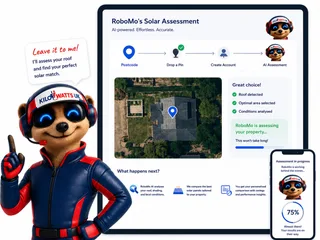
Simply enter your postcode, drop a pin on your roof, create your free account and let RoboMo™ analyse your property to find the best solar panels for your home.

You don't have to think
RoboMo™'s AI analyses your roof and does all the hard work.

Accurate & tailored
AI-powered assessment based on your roof, location, and conditions.

Best options, maximum savings
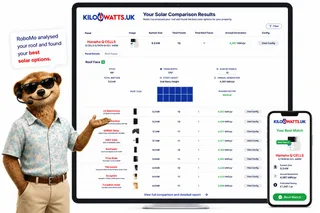
Compare top solar panels for the best performance and value.

Simple, fast & effortless
Provide a few details, sit back and watch your results unfold.
STEP 1
Choose Home, Business or Industrial
Enter your postcode to start your assessment.
STEP 2
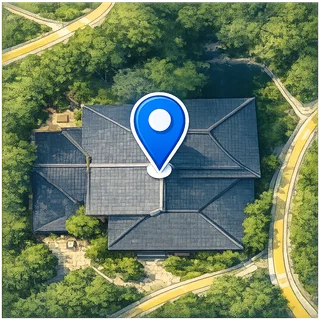
Drop a pin on your roof
STEP 3

Create your free account
STEP 4

Sit back and watch RoboMo™ work
RoboMo™ analyses your roof and builds your personalised solar comparison.

Step 1
Enter your postcode
Start designing your wind energy system in seconds.
Are you an installer, distributor or renewable energy business?
Kilowatts UK is expanding the Flower Turbines partner network across the UK.
Become A Flower Turbines PartnerKilowatts UK is an authorised representative
Flower Turbines
Compact vertical-axis turbines built for real UK sites, not just open farmland.
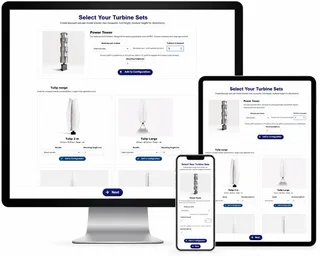
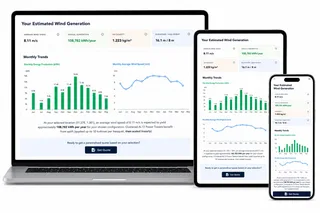
They start in light wind, sit in a small footprint, and are bird-safe by design. Cluster them as a bouquet and the group performs better together than the same turbines standing alone. Enter your postcode for a location-based generation estimate. Figures use area weather data and will differ if buildings, trees or hills sit in the way.
Starts in light UK wind
Built to generate in typical UK wind, not only open farmland.
Small rooftop or ground footprint
Compact towers for roofs, yards and tight sites.
Bird-safe slow rotation
Slow vertical-axis spin, bird-safe by design.
Bouquet clusters raise output
Grouped turbines outperform the same units standing alone.
STEP 2

Choose a location
STEP 3

Place your cluster
Tap the map where you want the turbine cluster to go.
STEP 4

Instant generation forecasts
Compare different turbine layouts and see annual generation forecasts instantly.
STEP 5

No commitment required
Explore different configurations before deciding whether to request a quotation.
Related articles

Mo's Mission Nominations
FAQ
Need Help? RoboMo's Got Answers
What does a home battery in Broadstairs actually do?
A home battery stores electricity for later use in the same home. It does not increase what the roof generates, and a grid-tied battery is not a generator. Capacity in kilowatt-hours is stored energy; the charge or discharge rate in kilowatts is how fast that energy can move. A larger kWh figure is not a faster charge and not a bigger backup load.
Can I add a battery to existing solar, or only with new panels?
The practical routes in Thanet are a battery fitted with new solar PV, a retrofit onto panels that already work, or an AC-coupled battery with no solar. New solar is often cleaner if panels and battery share one hybrid inverter. Retrofit is often a second inverter on the household AC supply, or a replacement of the existing solar inverter, which can affect metering and older tariff paperwork. Which route fits depends on daytime export, evening use, where the kit can sit, and what the existing installation and paperwork already say.
Will a battery keep the lights on in a power cut?
Many grid-tied systems shut down in a power cut so they do not energise the network. Ordering storage does not buy whole-house cover, and it does not keep the solar inverter generating unless the design explicitly supports that. Backup, if offered at all, needs specified hardware, a transfer arrangement and a defined set of circuits. Runtime is unknown until the backed-up load and the usable kWh are known, and a cooker, heat pump or EV charge point may demand more power than a single-phase home battery inverter is intended to deliver.
Does living on the Thanet coast change where a battery can go?
Salt-laden air, wind-driven rain and corrosion affect external inverters, isolators, fixings and cable glands more than an inland install. Coastal location does not ban batteries, and it does not make every indoor install exempt from warranty limits. Some manufacturer warranties restrict outdoor or coastal siting, or limit temperature and humidity. Those limits have to be read from that product’s warranty before equipment is ordered. The battery still needs a lawful position inside the manual’s clearances, weight and temperature rules, with suitable glands and fixings on any exposed run.
Can a battery be fitted in a terrace, flat or rented home in Broadstairs?
Location has to be settled before capacity. Terraces and small coastal homes often have a tight meter cupboard, a full consumer unit and no garage, and a loft can still be unsuitable if temperature, maintenance access or fire layout cannot match the product instructions. Flats and rented homes usually need the freeholder’s or landlord’s consent, including for any cable through common parts. Conservation-area or listed-building status can also change what may be fixed where. Planning and building-regulation treatment should be checked for the actual property against the rules in force at the time.
Do I need to tell UK Power Networks before a battery is commissioned?
Kent’s distribution network operator for this area is UK Power Networks. Adding generation or storage can require notification or an application before or at commissioning, described in current UK practice by Engineering Recommendations G98 and G99. This page does not state a kilowatt threshold. Export limits, notification limits and the correct form must be taken from current UK Power Networks guidance and current Energy Networks Association documents. If the proposal later changes, the network operator may treat it as a different connection.
Will a battery affect an existing Feed-in Tariff or Smart Export Guarantee?
An existing system may sit under an older Feed-in Tariff arrangement, a Smart Export Guarantee arrangement, or neither. The Feed-in Tariff is closed to new applicants, but an existing accreditation can still be affected if generating equipment, the generation meter or the way export is measured is changed. Smart Export Guarantee payments depend on a suitable export meter and a contract with a licensed supplier. Storage can change how much is exported and when, but it does not create a SEG contract by itself. Current rules are published by Ofgem and should be checked against that home’s documents.
What should a Broadstairs battery quote itemise?
Installed prices, bill savings and any grant position are site-specific and are not stated here. A useful quote should state whether the route is hybrid or AC-coupled and whether the existing solar inverter is retained or replaced, whether any circuits are backed up, and any UK Power Networks costs where they apply. It should also specify coastal glands, isolators and fixings, show the VAT treatment for that scope, and say who notifies the network, who registers the warranty and when the warranty starts. A cabinet-only price that assumes an empty consumer unit, an indoor wall and no network application will not describe every Thanet retrofit.