


Why Solar Can't Zero Your Standing Charge (UK Guide)
Published: 2026-09-30 04:33:27
Updated: 2026-10-04 01:55:54
Solar and a battery can push imported units to almost nothing, but a UK bill still carries a daily standing charge. Here's why, and how to compare tariffs properly.
The Line Solar Can't Zero: Standing Charges Explained
You check the app at midday. Solar is covering the house, the battery is holding steady, and the import figure is sitting at a satisfying 0.00 kW. Surely today costs nothing? Not quite. A UK electricity bill is built from two separate numbers: the units you import, charged per kilowatt-hour, and a daily standing charge for the connection itself, charged per day whether you import a single unit or none at all. Solar and a battery are extremely good at attacking the first number. They have no effect whatsoever on the second. That is the line solar cannot zero — and understanding it is the difference between an accurate expectation of your bills and a disappointed one. This guide explains what the standing charge actually pays for, why it behaves so differently from unit costs across a year, whether export payments can offset it, and how to compare tariffs on both numbers instead of just the headline unit rate.
"Mo: Barely imported anything today. So the bill's zero? — RoboMo: No. A daily standing charge applies however little you import."
A zero-import day is not a zero-cost day
Almost every domestic electricity tariff in the UK is priced in two parts. The first is the unit rate: a price per kilowatt-hour, multiplied by however many units you draw from the grid. The second is the standing charge: a fixed amount per day, applied automatically, regardless of consumption.
Solar generation and battery storage work directly on the unit side. A well-sized array feeding the house during daylight, with a battery absorbing the surplus and releasing it through the evening, can genuinely reduce imported units to a trickle on a good day — and on the very best days, to nothing at all.
What neither can do is switch off the clock. The standing charge is a time-based charge, not a volume-based one. Reduce your import to zero and the daily charge still lands. That is why a household can look at a perfect generation day, see no imported units, and still find a small amount accruing on the account. It is not an error, and it is not the solar underperforming. It is simply the other half of the tariff doing what it always does.
What the daily standing charge actually pays for
If you are buying no electricity, it is fair to ask what you are paying for. The answer is the connection rather than the commodity: the meter at your property, the service cable into the house, and the wider distribution and transmission network that stands ready to deliver power the moment you need it. Maintaining that infrastructure costs roughly the same whether your household pulls a great deal through it or almost none.
Alongside the physical network, the standing charge also carries a share of industry and supplier operating costs that are recovered on a per-customer basis rather than per unit. The effect is the same from your side of the meter: a charge that is proportional to the number of days you are connected, not to the number of kilowatt-hours you take.
It helps to think of it as a subscription to the grid. Your solar system reduces how much you order from the service. It does not cancel the subscription — and in most cases you would not want it to, because that grid connection is what covers you through a dark December week, a maintenance shutdown, or the day you add an EV charger and your demand profile changes overnight.
Two bars: one moves with the seasons, one never moves at all
The clearest way to picture a solar household's bill is as two vertical bars sitting side by side.
The units bar breathes. It shrinks dramatically from spring through to early autumn as generation climbs and the battery covers the evenings. It grows again through the darker months, when daylight hours are short and generation is genuinely modest. Weather, occupancy, heating choices and EV charging all push it up and down week by week. The connection bar does not breathe. It is the same height on the sunniest Saturday in June as it is on the wettest Tuesday in January. Across twelve months it stacks up as 365 identical blocks — a predictable, unavoidable annual figure that has nothing to do with how much electricity you used. This matters when you are estimating savings. If you model your future bills on a single bright summer day and simply multiply, you will overstate the benefit twice over: once by ignoring winter's shorter days, and again by leaving out a fixed annual cost that is entirely insensitive to your solar performance. Honest modelling looks at the whole year and keeps the two numbers separate.
Can export payments or a no-standing-charge tariff close the gap?
There are two legitimate routes that change the arithmetic, and both deserve a clear-eyed look.
The first is export. If you are on an export tariff, surplus generation that leaves the property earns a credit. Over a sunny stretch those credits can meaningfully offset — and in some households, exceed — the standing charge accruing over the same period. That does not remove the standing charge; it pays for it from another pocket. It is a perfectly reasonable way to think about your net annual position, provided you count it honestly across all twelve months rather than only the good ones.
The second is a tariff with no standing charge at all. These exist, and for a very low-import household they can look appealing. The trade-off is straightforward: the fixed costs still have to be recovered, so they are loaded into the unit rate instead. That structure rewards households that import almost nothing all year, and penalises those that still draw a significant amount through the winter, or charge an EV at home, or run a heat pump. The question is not which structure is better in the abstract — it is which one suits your actual annual import profile. There is one more consideration worth knowing: network costs vary by region, so standing charges are not identical across the UK. Two households on the same supplier's tariff in different parts of the country can see different daily figures.
A practical checklist for comparing tariffs on both numbers
Before switching, run a quote through this short sequence. It takes ten minutes and it is the single most useful piece of admin a solar household can do.
- Find your true annual import, in kilowatt-hours, from twelve months of meter readings or your in-home display history. Not a summer month multiplied by twelve. - Multiply that figure by the tariff's unit rate to get your annual units cost. - Multiply the standing charge by 365 to get your annual connection cost. - Add the two together. That total — not the headline unit rate — is what you are actually comparing between tariffs. - Subtract your expected export credits, if you have an export arrangement, to see your net annual position. - Repeat for a no-standing-charge option and see which total wins for your specific import volume. - Check whether the tariff has separate day and night rates, and whether your battery or EV charging is set up to use them. - Re-run the exercise if your circumstances change: an EV, a heat pump, or a new occupant can move your import figure enough to flip which tariff structure is cheapest. The principle behind all of it is simple. A low unit rate paired with a high standing charge can easily cost a low-import solar home more than a higher unit rate with a low standing charge. You cannot tell which is which by glancing at one number.
Follow-up questions solar households actually ask
Does a bigger battery eventually eliminate the standing charge? No. A larger battery reduces imported units further and can extend the run of zero-import days, but the daily charge is tied to having a connection, not to using it. Size the battery around your evening and overnight demand, not around an attempt to beat a fixed cost.
Could I just disconnect from the grid? Physically disconnecting is the only thing that ends a per-day connection charge, and for the overwhelming majority of UK homes it is a poor trade. You would be surrendering your winter backstop, your ability to charge cheaply overnight, and any export income, in exchange for removing a predictable fixed cost. Most households find the connection earns its keep.
Does it still make sense to fit solar if the standing charge remains? Yes — it simply means the savings come from the units side, which is where the majority of a typical bill sits anyway. The standing charge is a constant in both scenarios: with solar and without it. It never appears as a reason not to generate. What about cloudy British weather? Here is the genuinely useful fact: UK homes still generate useful solar power on overcast days. Panels respond to diffuse daylight, not just direct sunshine, so output drops on a grey day rather than stopping. A rain-streaked window does not mean a flat inverter — and on those days a battery charged earlier in the week is doing much of the work. Why did my bill arrive with a charge when the app showed nothing imported? Because the app is reporting units, and the bill is reporting units plus days. Both are correct; they are measuring different things.
Video transcript
Mo: Barely imported anything today. So the bill's zero? RoboMo: No. A daily standing charge applies however little you import.
Mo: If I'm buying no electricity, what am I actually paying for? RoboMo: The connection itself — meter, cables and network, billed per day, not per unit.
Mo: So across a whole year, that never goes away? RoboMo: Correct. Three hundred and sixty-five identical days — compare tariffs on both numbers, not just the unit rate. Mo: Barely imported anything today. So the bill's zero? RoboMo: No. A daily standing charge applies however little you import. / Mo: If I'm buying no electricity, what am I actually paying for? RoboMo: The connection itself — meter, cables and network, billed per day, not per unit. / Mo: So across a whole year, that never goes away? RoboMo: Correct. Three hundred and sixty-five identical days — compare tariffs on both numbers, not just the unit rate.
Wrapping up
Solar and storage are outstanding at doing one specific job: collapsing the units you buy from the grid. On a good day they can take that number to zero. What they cannot do is remove a charge that is measured in days rather than kilowatt-hours. Once you see a bill as two bars — one that moves with the seasons and one that repeats 365 identical times a year — the maths stops being surprising and starts being useful. You model savings honestly, you compare tariffs on the total rather than the headline, and you stop expecting a number that no domestic system connected to the grid can produce. That is not a limitation of solar. It is just knowing exactly which part of the bill you are buying down, and by how much.
Next step
If you'd like to see what your own two bars would look like — realistic annual import, honest seasonal generation, and the connection cost left visibly in place — a survey is the sensible starting point. No pressure, no projections built on a single sunny afternoon.
Plan, Compare & Buy Renewable Energy Solutions
AI does the thinking.
You get the perfect solar match.
Use RoboMo™ to assess your property, compare available technologies and connect with trusted UK installers, suppliers and manufacturers.
Simply enter your postcode, drop a pin on your roof, create your free account and let RoboMo™ analyse your property to find the best solar panels for your home.

You don't have to think
RoboMo™'s AI analyses your roof and does all the hard work.

Accurate & tailored
AI-powered assessment based on your roof, location, and conditions.

Best options, maximum savings
Compare top solar panels for the best performance and value.

Simple, fast & effortless
Provide a few details, sit back and watch your results unfold.

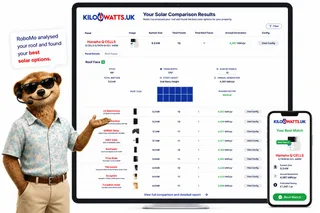
STEP 1
Choose Home, Business or Industrial
Enter your postcode to start your assessment.
STEP 2

Drop a pin on your roof
STEP 3

Create your free account
STEP 4

Sit back and watch RoboMo™ work
RoboMo™ analyses your roof and builds your personalised solar comparison.

Step 1
Enter your postcode
Start designing your wind energy system in seconds.
Are you an installer, distributor or renewable energy business?
Kilowatts UK is expanding the Flower Turbines partner network across the UK.
Become A Flower Turbines PartnerKilowatts UK is an authorised representative
Flower Turbines
Compact vertical-axis turbines built for real UK sites, not just open farmland.
They start in light wind, sit in a small footprint, and are bird-safe by design. Cluster them as a bouquet and the group performs better together than the same turbines standing alone. Enter your postcode for a location-based generation estimate. Figures use area weather data and will differ if buildings, trees or hills sit in the way.
Starts in light UK wind
Built to generate in typical UK wind, not only open farmland.
Small rooftop or ground footprint
Compact towers for roofs, yards and tight sites.
Bird-safe slow rotation
Slow vertical-axis spin, bird-safe by design.
Bouquet clusters raise output
Grouped turbines outperform the same units standing alone.
STEP 2

Choose a location
STEP 3

Place your cluster
Tap the map where you want the turbine cluster to go.
STEP 4

Instant generation forecasts
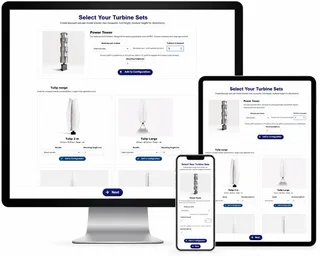
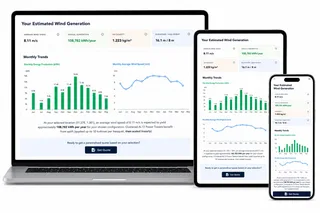
Compare different turbine layouts and see annual generation forecasts instantly.
STEP 5

No commitment required
Explore different configurations before deciding whether to request a quotation.
FAQ
Need Help? RoboMo's Got Answers
What is Why Solar Can't Zero Your Standing Charge (UK Guide) about?
You check the app at midday. Solar is covering the house, the battery is holding steady, and the import figure is sitting at a satisfying 0.00 kW. Surely today costs nothing? Not quite. A UK electricity bill is built from two separate numbers: the units you import, charged per kilowatt-hour, and a daily standing charge
Who is this video for?
UK homeowners and anyone comparing the renewable-energy options discussed in Why Solar Can't Zero Your Standing Charge (UK Guide).