


Commercial solar for hotels in the UK
Published: 2026-07-18 18:05:28
Updated: 2026-08-01 05:33:05
Find out commercial solar for hotels in the UK, including costs, what affects price, and how to choose an installer.
Commercial solar for hotels in the UK.
Commercial solar for hotels is usually a strong option where the hotel has usable roof space, high daytime electricity demand, a suitable grid connection, and long-term control of the building. It can reduce imported electricity, support carbon reporting, and improve resilience against energy price volatility, but the outcome depends on roof condition, self-consumption, DNO approval, planning constraints, installation cost, tax treatment, and disruption risk.
For most UK hotels, the main value comes from using solar electricity on site rather than exporting it. Kitchens, laundry equipment, chillers, ventilation, lifts, offices, leisure facilities, pool plant, conference spaces, daytime housekeeping loads, and daytime EV charging can all help absorb generation during the day.
A hotel solar project should not be judged on roof area alone. In real projects, the roof structure, shading, fire strategy, cable routes, metering arrangement, insurer requirements, access arrangements, guest disruption, and grid connection conditions can change the design and the financial case substantially. This guide is written for UK hotel owners, operators, asset managers, facilities managers, and finance teams comparing commercial solar panels for hotels, leisure sites, resorts, serviced apartments, and venues with accommodation.
Short summary for hotel owners and operators.
Commercial solar PV can suit independent hotels, hotel groups, leisure hotels, resorts, serviced apartments, aparthotels, conference venues, spas, and mixed-use hospitality sites. It is most attractive where electricity use is steady during daylight hours and the business expects to occupy, own, or control the building for long enough to benefit from the investment.
Typical UK commercial solar costs vary by system size and site complexity. Smaller commercial systems may cost around £900 to £1,300 per kWp, medium systems around £700 to £1,100 per kWp, and larger rooftop systems around £600 to £950 per kWp. A 50 kWp hotel system may cost roughly £45,000 to £70,000 before VAT, while a 100 kWp system may cost roughly £75,000 to £120,000 before VAT.
UK solar PV typically generates around 850 to 1,100 kWh per kWp each year. Southern England is often nearer the higher end, while Scotland and northern England are often nearer the lower end, although well-designed projects can still be viable across the UK. Hotel solar payback is often around 4 to 9 years, but generic payback figures should be treated carefully. The avoided electricity price, self-consumption rate, export tariff, DNO costs, roof works, finance structure, tax treatment, and maintenance allowance can all change the result. A simple early screening view is shown below.
Why hotels are often good candidates for solar.
Hotels often have a better load profile for solar than many other commercial buildings because they operate throughout the week and usually have a meaningful baseload. Even when rooms are not fully occupied, plant rooms, refrigeration, ventilation, security systems, IT, lighting, controls, lifts, and back-of-house areas still consume electricity.
Daytime demand is particularly important. Solar generation is highest when the sun is up, so sites with kitchens, laundries, spas, swimming pools, air conditioning, offices, conference facilities, restaurants, bars, gyms, or daytime EV charging usually have a stronger case than sites with low daytime use and mainly overnight demand.
Solar can also help hotels respond to client procurement questions. Corporate customers, public-sector bookings, event organisers, travel management companies, and tour operators increasingly ask for evidence of lower-carbon operations. Metered solar generation data can provide stronger evidence than broad sustainability statements. The main advantages are practical rather than cosmetic.
- Lower imported electricity during daylight hours
- Reduced exposure to future electricity price changes
- Better evidence for carbon and sustainability reporting
- Potentially improved use of roof space
- Support for EV charging and future electrification plans
- A visible investment in operational efficiency and sustainability
Solar panels rarely remove the whole electricity bill. Hotels still need grid electricity at night, during periods of low generation, and when demand exceeds solar output. Solar should normally be assessed as a bill-reduction and carbon-reduction measure, not as complete energy independence. Possible improvement in EPC and net-zero planning discussions, depending on the wider building strategy
How hotel solar PV works in practice.
A hotel commercial solar panel installation uses rooftop panels to generate direct current electricity. Inverters convert this into alternating current for use by the hotel. The electricity is normally used behind the meter, meaning it offsets grid imports before any surplus is exported.
The main design aim is usually to size the system so that a high proportion of generation is used on site. Exporting surplus electricity can still provide income through an export tariff or the Smart Export Guarantee, but export income is normally less valuable than avoiding imported electricity.
A typical hotel assessment looks at the following flow of energy and constraints. Solar generation: Panels produce electricity during daylight hours, with output varying by season, weather, roof angle, orientation, and shading. On-site consumption: Hotel loads use the solar electricity first where the system is connected correctly behind the relevant meter. Export control: Any surplus may be exported, limited, or stored depending on the grid connection and system design. Monitoring: Generation, import, export, and faults should be visible so the facilities team can spot underperformance. Maintenance: Panels, inverters, isolators, monitoring systems, and mounting should be inspected in line with the installer’s and manufacturer’s guidance. Standard grid-tied solar PV does not normally power the hotel during a power cut. Backup operation requires additional equipment, careful electrical design, suitable changeover and protection arrangements, and usually a different commercial case. Hotels that need resilience for lifts, refrigeration, life-safety systems, IT, or critical guest services should consider backup power separately from a standard solar PV proposal.
Costs and what affects the price.
Hotel solar panel installation cost in the UK is site-specific because commercial roofs are rarely simple. A desktop estimate can be useful at the early stage, but it should not be treated as a final price until surveys, structural checks, DNO requirements, insurer requirements, and access arrangements have been reviewed.
The supplied commercial cost ranges are a useful starting point. Small commercial systems can cost around £900 to £1,300 per kWp, medium systems around £700 to £1,100 per kWp, and larger rooftop systems around £600 to £950 per kWp. These ranges can move if the roof is difficult, the electrical works are complex, the installation must be phased around hotel operations, or the DNO requires additional studies or upgrades.
A hotel quote should separate the major cost areas rather than presenting a single unexplained total. For hotels comparing ownership, loans, leases, and PPA-style arrangements, a separate review of commercial solar finance can help keep capital cost, risk, and long-term savings assumptions clear.
- Panels and inverters
- Mounting system and roof fixings
- Scaffolding and access equipment
- Electrical works and cable containment
- DNO application and grid protection work
- Monitoring and metering
The table below gives a broad indication of what can affect the installed cost. Battery storage should normally be assessed separately. Commercial solar battery storage can improve solar self-consumption and help with evening loads or peak import management, but it adds cost, space requirements, fire safety considerations, and more complex maintenance. It is not automatically needed for hotel solar PV to make sense. Commercial solar installations usually attract 20% VAT. VAT-registered businesses may be able to reclaim VAT depending on their tax position, but this should be checked with an accountant or tax adviser. Tax treatment should not be assumed from a solar quote alone. Design, surveys, commissioning, and documentation Fire-stopping and labelling where required Operation and maintenance provision Any roof strengthening, roof repair, or enabling works Any out-of-hours working required to reduce guest disruption
Output, payback, and the importance of self-consumption.
UK solar PV typically generates around 850 to 1,100 kWh per kWp per year. A 50 kWp system may generate around 42,500 to 55,000 kWh annually, a 100 kWp system around 85,000 to 110,000 kWh, and a 250 kWp system around 212,500 to 275,000 kWh.
These figures are annual estimates, not guarantees. Output is higher from April to September and lower in winter. Cloudy weather reduces output, although panels still generate from daylight. Shading from chimneys, plant rooms, lift overruns, parapets, nearby buildings, trees, or roof furniture can reduce production and should be included in yield modelling.
The financial return depends less on headline generation and more on what the hotel does with that electricity. A smaller system with high self-consumption can outperform a larger system that exports too much at a low export price. The strongest feasibility models use half-hourly electricity data rather than annual bill totals. Half-hourly data shows when the hotel actually uses electricity, which makes it easier to size the system, estimate self-consumption, and decide whether storage or EV charging integration is useful. A hotel solar financial model should show these lines separately. Key financial variables include installed cost per kWp, annual generation, import electricity price, export price, DNO cost, roof strengthening cost, inverter replacement allowance, maintenance cost, finance cost, tax treatment, degradation, and how long the hotel expects to use the building. A structured solar payback review should make these assumptions visible rather than hiding them in one headline figure. For buyer-intent comparisons, a hotel should be cautious of quotes that show only a headline payback number without explaining the assumed import price, export price, self-consumption rate, and maintenance costs.
Roof, planning, and building constraints.
The roof is often the limiting factor in a hotel solar project. A large hotel roof may look ideal from satellite images but still have limited usable space once plant, vents, flues, roof lights, parapets, smoke vents, access routes, drainage paths, edge zones, and shaded areas are considered.
Roof age matters. If the roof is likely to need replacement within a few years, installing solar first can create avoidable removal and reinstallation costs. Roof warranties should also be checked before agreeing fixings, ballast, or penetrations.
Structural capacity must be confirmed. Flat-roof systems may use ballast, which adds load. Pitched-roof systems need suitable fixings and weatherproofing. Coastal, exposed, and high-rise hotel sites need careful wind-loading assessment, and older or fragile roof coverings may require specialist access planning. Planning permission is not always required, but it must be checked. Many rooftop commercial solar installations in England can fall under permitted development rights, subject to conditions. Listed buildings, conservation areas, National Parks, National Landscapes, visible roof slopes, and heritage settings can require a more detailed planning permission route. Rules differ across England, Wales, Scotland, and Northern Ireland, so local planning checks are essential. Hotels in historic buildings need early advice before assuming solar panels are not possible. Solar panels for a listed hotel, conservation-area hotel, or heritage hospitality venue may still be feasible in some cases, but the acceptable design may be smaller, less visible, or positioned on secondary roof areas, outbuildings, carports, or newer extensions. Building regulations and compliance should also be considered from the start. Electrical work must comply with BS 7671, structural adequacy must be addressed, and fire safety must be reviewed. The Construction Design and Management Regulations 2015 can apply to commercial projects, so health and safety planning is not just an installer formality.
Grid connection, export, and DNO approval.
Most hotel-scale solar projects need careful grid connection review. The Distribution Network Operator manages the local network and may need to approve the connection before installation, especially where the system is larger or export could affect the local network.
Very small systems may follow the G98 process, but many hotel projects use the G99 process. DNO response times can influence the programme, and export limits can affect the size and operation of the system.
Export limitation can sometimes allow a larger system where unrestricted export is not available. This equipment limits how much electricity is sent to the grid, allowing the hotel to use solar on site while staying within the agreed export capacity. It must be designed correctly and fail safely. Electrical design issues that often affect hotel projects include spare capacity at the main distribution board, transformer capacity, long cable routes, voltage drop, multiple meters, landlord and tenant supplies, and the location of inverters. Inverters should be accessible, secure, ventilated, and positioned where heat or noise will not affect guests. DNO approval for hotel solar is not just an administrative step. It can determine whether the proposed system can export freely, export only a limited amount, or needs additional protection equipment. Hotels should ask installers to explain the grid connection route clearly before committing to an installation date. Key grid questions include the following.
- Which DNO covers the hotel site?
- Is the proposal being submitted under G98 or G99?
- Is the system designed for full export, limited export, or zero export?
- Is there enough capacity at the point of connection?
- Are there multiple MPANs, meters, or supplies on site?
- Will protection settings, export limitation, or witness testing be required?
Could planned EV chargers, heat pumps, or kitchen electrification affect the connection strategy? Who owns the risk if the DNO response changes the system size, cost, or programme?
Government support, grants, and UK policy.
There is no single UK-wide grant that all hotels can use for solar PV. Support is often indirect, local, or time-limited rather than a simple national upfront subsidy.
The Smart Export Guarantee can provide payments for exported renewable electricity through participating suppliers. SEG rates vary, and export income is usually less valuable than using electricity on site, so it should be shown separately in the financial model. Ofgem provides information on the Smart Export Guarantee, and suppliers set their own export tariff terms.
Local authority and regional business grants sometimes support energy efficiency or decarbonisation projects. UK Shared Prosperity Fund programmes may also support local business energy projects in some areas, but availability changes by region and funding window. Hotels reviewing solar grants should check current local authority, Growth Hub, devolved administration, and regional business support sources before relying on grant funding. Tax treatment can also affect the commercial case. Companies may be able to use capital allowances, the Annual Investment Allowance, or full expensing where the rules apply. Business rates relief for eligible onsite renewable energy plant and machinery applies in England until 2035, but business rates rules can differ across UK nations. HMRC, local authority, and professional tax advice should be used for project-specific decisions. Hotel owners monitoring UK government support for solar should watch policy from DESNZ, Ofgem, HMRC, local authorities, devolved administrations, and electricity network reform. For hotels, the biggest practical policy issues are usually grid connection capacity, planning rules, tax treatment, export payments, business rates treatment, and local grant availability rather than domestic solar incentives. A cautious funding approach is to model the project without assuming grant support, then treat any confirmed grant or tax benefit as an improvement to the case rather than the only reason the project works.
Operational disruption during installation.
Hotel solar projects need more operational planning than many standard commercial roofs. The installer is working around guests, staff, deliveries, fire routes, car parks, kitchens, event spaces, and sometimes 24-hour operations.
Scaffolding, lifting equipment, roof access, and temporary exclusion zones can affect the guest experience if they are not planned carefully. Noisy work should be scheduled around check-in times, weddings, conferences, peak occupancy periods, restaurant service, and major events where possible.
Electrical shutdowns should be minimised and agreed in advance. Kitchens, lifts, laundry, refrigeration, IT systems, access control, fire alarms, building management controls, and leisure facilities can all be operationally sensitive. Some work may need to be completed out of hours, although that can affect cost. Hotel insurers should usually be notified before installation. Some insurers ask for details of equipment, installer accreditation, fire strategy, cable routing, inverter locations, roof access, isolation, and maintenance arrangements. Fire risk assessments should be updated after installation, especially where batteries are included. A practical hotel installation plan should cover the following. The best hotel solar installations are planned around the operation of the hotel, not simply around the installer’s preferred working pattern.
Solar with batteries, EV charging, and heat pumps.
Solar PV should be considered alongside wider hotel energy plans. A hotel planning EV chargers, heat pumps, electric kitchens, laundry upgrades, cooling upgrades, spa expansion, or major refurbishment may need a larger electrical strategy rather than a standalone solar quote.
Commercial EV charger installation can improve solar self-consumption where guests, staff, or fleet vehicles charge during daylight hours. Overnight charging does not directly use solar unless storage or smart tariff arrangements are involved. Charger loads can also trigger the need for supply upgrades, so load management should be assessed.
Heat pumps can increase electricity demand and may make solar more useful, but the seasonal match is imperfect. Commercial air source heat pump demand is often highest in winter, when solar generation is lower. Modelling should use seasonal data rather than assuming that solar will directly cover heating demand. Battery storage can help shift surplus solar into evening use, reduce peak import in some tariff structures, and support more controlled energy management. However, oversized batteries can produce poor returns. Batteries also require careful location, ventilation, access, fire risk assessment, maintenance planning, and insurer engagement. For hotels, batteries are most worth exploring where one or more of the following applies.
- Solar export would otherwise be high and low value
- Evening demand is significant and predictable
- The tariff includes high peak import charges
- The hotel has EV charging that can be coordinated with solar and storage
- The site has enough secure, ventilated space for battery equipment
- The fire and insurance case can be managed properly
A solar PV system can be designed to be battery-ready, but that does not mean a battery should be installed immediately. For some hotels, it is better to install solar first, monitor generation and demand, then assess storage using actual site data. The financial model shows a clear return after battery degradation and maintenance assumptions
Choosing a hotel solar installer.
A hotel should look for an installer that can deal with commercial design, grid applications, roof constraints, operational disruption, and documentation, not just panel installation. The cheapest quote can become expensive if it misses roof condition, structural limits, DNO issues, access costs, fire considerations, or guest disruption.
A good proposal should explain the assumptions behind the yield estimate. It should include shading losses, roof layout, inverter locations, cable routes, export assumptions, maintenance requirements, warranties, monitoring arrangements, and any exclusions. It should also show bill savings separately from export income.
Before committing, ask for the following information. A measured roof layout A structural review process Shading and yield assumptions A single-line electrical diagram DNO connection approach Fire and insurance considerations The hotel’s facilities team should receive clear handover documents, test certificates, DNO documentation, monitoring access, isolation information, labels, warranties, and operation and maintenance manuals. A solar system that is not monitored or maintained properly can underperform for long periods without anyone noticing. When comparing commercial solar installers for hotels, avoid judging proposals only by system size or total price. A smaller, better-designed system with realistic self-consumption assumptions may be more valuable than a larger proposal that assumes unrealistic export income or ignores roof constraints. Installation programme and disruption plan Monitoring and maintenance arrangements Warranty terms for panels, inverters, and mounting Evidence of relevant commercial solar experience Clear exclusions and assumptions Handover and aftercare process
When solar may not be suitable for a hotel.
Solar is not right for every hotel. It may still be possible in difficult cases, but the design, planning route, and economics need more scrutiny.
A project may be less suitable where the roof is heavily shaded, structurally limited, close to replacement, or restricted by heritage controls. It may also be weaker where the hotel has low daytime electricity use, a short lease, no landlord consent, limited electrical capacity, or a DNO export constraint that cannot be managed economically.
Listed hotels and hotels in conservation areas are not automatically excluded, but consent and visual impact become more important. In some cases, less visible roof areas, smaller arrays, carports, ground-mounted options, or alternative energy measures may be more realistic. The main warning sign is a proposal that ignores constraints. A reliable feasibility study should identify reasons not to proceed as clearly as reasons to proceed. Common red flags include the following. Payback shown without self-consumption assumptions No review of half-hourly electricity data No mention of DNO approval or export limitation No structural review process No allowance for access, scaffolding, or hotel disruption No consideration of roof age or warranty For some hotels, the right decision is not “no solar”, but “not yet”. Coordinating solar with roof renewal, refurbishment, EV charging, or electrical upgrades can produce a better long-term result. No fire strategy or insurer engagement Battery storage included without a separate business case Export income blended into savings without explanation No clear maintenance or monitoring plan
Data needed for a hotel solar feasibility study.
The quality of the early data strongly affects the quality of the design and financial model. Annual consumption alone is useful, but it is not enough for a robust hotel solar proposal.
Useful information includes 12 months of electricity bills, half-hourly data where available, MPAN details, current import tariff, any export tariff options, roof plans, roof age, roof warranty details, roof construction information, plant room locations, and details of any existing generation or backup systems.
The survey should also consider the main supply capacity, distribution boards, cable routes, planned refurbishments, EV chargers, heat pumps, seasonal occupancy patterns, conference and event loads, spa and pool loads, laundry arrangements, and any heritage or planning restrictions. Where half-hourly data is available, it should be used to test different system sizes. This helps avoid oversizing, improves self-consumption estimates, and gives a clearer view of whether a battery is worth assessing. A practical feasibility pack for a hotel should include the following. The better the input data, the more useful the quote. A hotel that provides full energy and roof information is more likely to receive comparable, realistic proposals.
Next steps for a hotel solar project.
A sensible first step is to gather energy data, roof information, and future electrification plans before requesting quotes. This makes installer proposals more comparable and reduces the risk of missing important constraints.
For a hotel with a suitable roof and strong daytime demand, commercial solar can be a practical long-term investment. For a hotel with roof, planning, lease, or grid constraints, the right answer may be a smaller system, a delayed installation after roof works, a battery review, or a broader commercial renewable energy strategy.
A robust next-step process usually looks like this. Collect bills, half-hourly data, MPANs, roof information, and planned electrical upgrades. Complete an initial desktop solar assessment using realistic yield and self-consumption assumptions. Check roof condition, structural requirements, access, and planning constraints. Review DNO connection route, export options, and electrical capacity. Compare proposals on net savings, risk, disruption, warranties, and aftercare, not only on price. Confirm tax, VAT, finance, and grant assumptions with the appropriate professional advisers. Plan installation around hotel operations, guest experience, fire safety, and insurer requirements. Monitor performance after commissioning and review maintenance at agreed intervals.
Plan, Compare & Buy Renewable Energy Solutions
AI does the thinking.
You get the perfect solar match.
Use RoboMo™ to assess your property, compare available technologies and connect with trusted UK installers, suppliers and manufacturers.
Simply enter your postcode, drop a pin on your roof, create your free account and let RoboMo™ analyse your property to find the best solar panels for your home.

You don't have to think
RoboMo™'s AI analyses your roof and does all the hard work.

Accurate & tailored
AI-powered assessment based on your roof, location, and conditions.

Best options, maximum savings
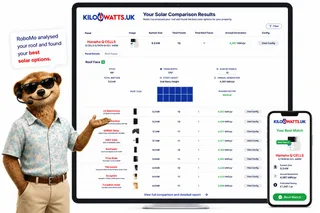
Compare top solar panels for the best performance and value.

Simple, fast & effortless
Provide a few details, sit back and watch your results unfold.
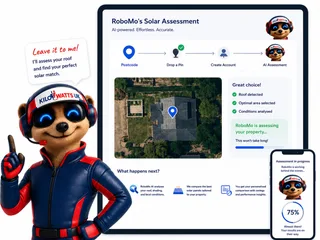
STEP 1
Choose Home, Business or Industrial
Enter your postcode to start your assessment.
STEP 2

Drop a pin on your roof
STEP 3

Create your free account
STEP 4

Sit back and watch RoboMo™ work
RoboMo™ analyses your roof and builds your personalised solar comparison.

Kilowatts UK is an authorised representative
Flower Turbines
Compact vertical-axis turbines built for real UK sites, not just open farmland.
They start in light wind, sit in a small footprint, and are bird-safe by design. Cluster them as a bouquet and the group performs better together than the same turbines standing alone. Enter your postcode for a location-based generation estimate. Figures use area weather data and will differ if buildings, trees or hills sit in the way.
Starts in light UK wind
Built to generate in typical UK wind, not only open farmland.
Small rooftop or ground footprint
Compact towers for roofs, yards and tight sites.
Bird-safe slow rotation
Slow vertical-axis spin, bird-safe by design.
Bouquet clusters raise output
Grouped turbines outperform the same units standing alone.
Step 1
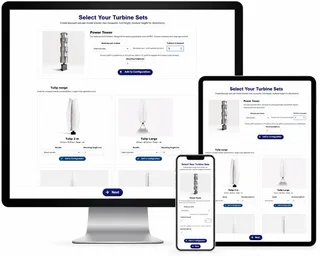
Enter your postcode
Start designing your wind energy system in seconds.
STEP 2

Choose a location
STEP 3

Place your cluster
Tap the map where you want the turbine cluster to go.
STEP 4

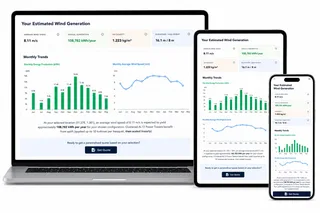
Instant generation forecasts
Compare different turbine layouts and see annual generation forecasts instantly.
STEP 5

No commitment required
Explore different configurations before deciding whether to request a quotation.
Related articles
Mo's Mission Nominations
FAQ
Need Help? RoboMo's Got Answers
Is commercial solar suitable for hotels in the UK?
Commercial solar can be suitable for many UK hotels, especially where the site has usable roof space, strong daytime electricity demand, a suitable grid connection, and long-term control of the building. Hotels with kitchens, laundries, chillers, leisure facilities, offices, conference spaces, pool plant, ventilation, lifts, or daytime EV charging often have a better solar business case because they can use more of the electricity on site.
How much do solar panels cost for a hotel?
UK hotel solar costs vary by system size and site complexity. Smaller commercial systems may cost around £900 to £1,300 per kWp, medium systems around £700 to £1,100 per kWp, and larger rooftop systems around £600 to £950 per kWp. As a broad guide, a 50 kWp hotel solar system may cost roughly £45,000 to £70,000 before VAT, while a 100 kWp system may cost around £75,000 to £120,000 before VAT. Final pricing depends on roof condition, access, electrical works, DNO requirements, structural checks, fire requirements, and disruption controls.
What is the typical payback period for hotel solar panels?
Hotel solar payback is often around 4 to 9 years, but it depends heavily on site-specific assumptions. The biggest factors are the hotel’s electricity import price, how much solar electricity is used on site, export tariff, installation cost, DNO costs, maintenance allowance, inverter replacement allowance, finance costs, tax treatment, and any roof or access works required.
How much electricity can a hotel solar PV system generate?
In the UK, solar PV typically generates around 850 to 1,100 kWh per kWp each year. A 50 kWp system may generate around 42,500 to 55,000 kWh annually, while a 100 kWp system may generate around 85,000 to 110,000 kWh annually. Actual output depends on location, roof orientation, roof pitch, shading, weather, system design, and equipment performance.
Why is self-consumption important for hotel solar?
Self-consumption is important because the biggest financial benefit usually comes from using solar electricity on site rather than exporting it. Export payments can provide income, but they are normally worth less than avoiding imported electricity. A well-sized system that matches the hotel’s daytime demand can produce a stronger return than a larger system that exports too much surplus power.
Do hotels need battery storage with solar panels?
Hotels do not always need battery storage for solar PV to make sense. Batteries can help shift surplus solar into evening use, reduce peak import in some tariff structures, and support better energy management, but they add cost, space requirements, maintenance needs, and fire safety considerations. Battery storage should be assessed separately using the hotel’s half-hourly electricity data, export levels, evening demand, tariff structure, and site constraints.
Can solar panels power a hotel during a power cut?
Standard grid-tied solar PV systems do not normally power a hotel during a power cut. Backup operation requires additional equipment, suitable changeover arrangements, protection systems, and careful electrical design. Hotels that need resilience for refrigeration, lifts, IT, life-safety systems, or essential guest services should assess backup power separately from a standard solar PV proposal.
Do hotels need DNO approval for solar panels?
Many hotel-scale solar projects need review or approval from the Distribution Network Operator before installation. Smaller systems may fall under G98, while many commercial hotel systems are handled under G99. The DNO may allow full export, require export limitation, request additional protection equipment, or affect the system size and programme. DNO approval should be checked early because it can materially affect the design and financial case.
Do hotels need planning permission for solar panels?
Planning permission is not always required, but it must be checked before installation. Many rooftop commercial solar installations in England may fall under permitted development rights, subject to conditions. Listed buildings, conservation areas, National Parks, National Landscapes, visible roof slopes, and heritage settings can require a more detailed planning route. Rules also differ across England, Wales, Scotland, and Northern Ireland, so local planning advice is important.
Can listed hotels or hotels in conservation areas install solar panels?
Listed hotels and hotels in conservation areas are not automatically excluded from solar, but visual impact, consent, and heritage considerations become more important. In some cases, a smaller or less visible array may be possible on secondary roof areas, newer extensions, outbuildings, carports, or other suitable locations. Early planning and heritage advice should be taken before assuming solar is either impossible or straightforward.
What roof checks are needed before installing solar on a hotel?
A hotel roof should be checked for condition, age, warranty restrictions, structural capacity, wind loading, shading, access, drainage, roof lights, plant, vents, parapets, smoke vents, and safe maintenance routes. If the roof is likely to need replacement soon, it may be better to coordinate solar after roof works to avoid removal and reinstallation costs.
Will solar panel installation disrupt hotel guests?
Solar installation can disrupt hotel operations if it is not planned properly. Scaffolding, lifting equipment, exclusion zones, deliveries, roof access, noise, and electrical shutdowns can affect guests, staff, events, kitchens, lifts, laundry, refrigeration, IT systems, and leisure facilities. A good installation plan should schedule work around occupancy, events, service times, fire routes, parking, and agreed shutdown windows.
Can solar panels work with hotel EV chargers?
Solar can work well with hotel EV chargers where guests, staff, or fleet vehicles charge during daylight hours. This can improve solar self-consumption and reduce imported electricity. Overnight EV charging does not directly use solar unless battery storage or smart tariff arrangements are involved. EV chargers can also increase site load, so grid capacity and load management should be assessed alongside the solar design.
Can solar panels work with hotel heat pumps?
Solar panels can support a hotel’s wider electrification strategy, including heat pumps, but the seasonal match is not perfect. Heat pump demand is often highest in winter when solar generation is lower. Hotels planning heat pumps should model solar, heating demand, grid capacity, and seasonal electricity use together rather than assuming solar will directly cover heating demand throughout the year.
Are there grants for hotel solar panels in the UK?
There is no single UK-wide solar grant available to all hotels. Support is often local, regional, time-limited, or linked to business decarbonisation programmes. Hotels should check local authority schemes, Growth Hubs, devolved administration support, UK Shared Prosperity Fund programmes, and current business energy grants. It is usually safer to model the project without grant funding and treat any confirmed support as an improvement to the business case.
Can hotels earn money from exporting solar electricity?
Hotels can potentially earn export income through an export tariff or the Smart Export Guarantee, depending on supplier terms and metering arrangements. However, export income is usually less valuable than using solar electricity on site to reduce grid imports. A solar financial model should show avoided import savings and export income separately.
What data is needed for a hotel solar feasibility study?
A useful hotel solar feasibility study should include 12 months of electricity bills, half-hourly electricity data where available, MPAN and supply details, current tariff information, roof plans, roof photos, roof age, roof warranty details, structural information, electrical drawings, plant room locations, cable route options, occupancy patterns, seasonal demand, and future plans for EV chargers, heat pumps, kitchens, laundry, or refurbishment.
How should hotels compare solar installer quotes?
Hotels should compare solar proposals on design quality, assumptions, savings, risk, disruption, warranties, aftercare, and maintenance rather than price alone. A good quote should explain yield assumptions, shading losses, self-consumption, export assumptions, DNO route, roof layout, structural review, inverter locations, cable routes, access needs, monitoring, maintenance, warranties, exclusions, and handover documentation.
When might solar not be suitable for a hotel?
Solar may be less suitable where the roof is heavily shaded, structurally limited, close to replacement, or restricted by heritage controls. It may also be difficult where the hotel has low daytime electricity use, a short lease, no landlord consent, limited electrical capacity, or a DNO export constraint that cannot be managed economically. In some cases, the right decision is to delay solar until roof renewal, refurbishment, EV charging, or electrical upgrades are coordinated.