


A 4kWh Home Battery You Can Take With You: Inside the PowerNet Solid-State Plan
Published: 2026-11-21 17:02:57
Updated: 2026-11-21 09:03:37
Could PowerNet’s detachable 4 kWh solid-state battery serve UK homes and campervans? See what Australia’s pilot covers and what buyers still need to know.
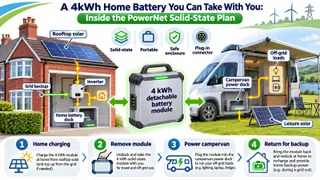
PowerNet’s detachable 4 kWh home battery is an Australian pilot
PowerNet is a detachable 4 kWh solid-state battery module that Clutch Industries is developing through an Australian manufacturing pilot. The idea is to combine modules for home storage and take one away to power compatible equipment in a campervan or at an off-grid site. A UK launch and installed price remain unconfirmed. Buyers would need the module’s usable capacity and its continuous and peak power ratings to work out what it could run and for how long. Australian Renewable Energy Agency funding announcement
The Australian Renewable Energy Agency (ARENA) is contributing A$6.77 million to the A$19.35 million project in Coburg North, Victoria. The pilot line will assemble cells into packs with battery management, power electronics and physical protection. The finished packs will be tested before deployment. ARENA lists 13 December 2029 as the scheduled project end date. A UK launch timetable remains unconfirmed. ARENA PowerNet project record
What could a detachable 4 kWh battery run?
The 4 kWh figure describes stored energy. Continuous power, measured in kW, determines how much equipment can run at once. The peak output and how long the system can sustain it determine whether it can handle the surge when a pump or compressor starts. To estimate runtime, divide the energy available to your appliances by their average power draw. If the specification gives usable energy at the battery terminals, allow for inverter losses and any reserve you plan to keep.
Suppose a battery delivers 3 kWh at its AC output after conversion losses and after allowing for a reserve. A fridge, router and lights drawing an average of 300 W between them would run for about 10 hours without recharging. The fridge compressor can draw much more power briefly at start-up, so check the inverter’s surge rating and how long it can sustain that output.
Solid-state cells use a solid electrolyte to carry ions between the electrodes. If you plan to move the module regularly, check the finished pack’s weight, dimensions, operating temperature range and approved mounting arrangements. Look for pack-level test results and handling instructions that cover your proposed use, such as in a vehicle or an unheated outbuilding.
Where could a removable battery make sense in the UK?
A removable battery makes most sense when you regularly need stored electricity in two places. A household could use several modules to store surplus rooftop solar and take one on campervan trips. A farm or small business could move a module between a main building and an off-grid work area. Check that the modules left behind have enough energy and power to cover demand while one is away.
Overview
Estimate how often you would move the module and whether both sites tend to need it at the same time. If it would spend most of the year at home, compare the cost of equipping both sites with the cost of a fixed home battery and a separate portable unit sized for the trips. If you live in a flat, check with the building manager or freeholder about siting and mounting before sizing the system.
What would a UK installer check before fitting PowerNet?
If you already have solar panels, give the installer your inverter make and model, details of any existing battery, and photos of the consumer unit and proposed battery location. Ask them to confirm that the inverter supports the exact module and its battery management system. If the design uses a separate battery inverter on the AC side, the quote should show where it would sit and what cabling, protection and isolation it would need.
For a grid-connected installation in Great Britain, the installer should check which G98 or G99 process applies with the local distribution network operator. This depends on the proposed inverter arrangement and the generation and storage already connected at the property. If the design relies on an export limit, ask how it would be applied and what connection process the network operator requires. Energy Networks Association distributed generation guide
If you need backup, ask which circuits would stay live in a power cut and how much energy and power would be available with a module away. Get the manufacturer’s shutdown, disconnection and refitting instructions before planning to remove a module regularly. Ask whether the remaining modules can keep supplying the house while you remove one and whether removal interrupts backup.
Could you control PowerNet remotely?
ARENA lists Victron Energy as a project partner. Victron documents remote monitoring, alerts and control for its own compatible equipment. PowerNet’s remote functions remain unconfirmed. If you plan to use the system at a second home or farm building, check whether you could see the battery’s charge level, receive fault alerts, change charging schedules and adjust the minimum reserve remotely. ARENA PowerNet project record · Victron Remote Monitoring manual
At handover, ask the installer to demonstrate the local controls. Check whether charging schedules and backup reserve settings still work if broadband or mobile data drops, how you would know the connection was lost and who can change the settings.
What could PowerNet cost and is it worth waiting for?
PowerNet’s UK installed price remains unconfirmed. A quote would need to cover equipment at both locations, any additional inverter, electrical work and backup circuits. Check who would service it in the UK, whether the warranty covers regular removal and use away from home, and what restrictions apply to transport or storage.
Use half-hourly electricity data, if available, to estimate how much demand you could shift. If you charge with surplus solar, compare the value of the imports you would avoid with the export income you would give up. If you charge off-peak, subtract the cost of charging from the value of the peak-rate imports you would avoid. In both cases, use the energy that reaches your appliances after round-trip losses to calculate the avoided imports. Use those figures to estimate battery payback once you have an installed quote.
If you regularly need power at two sites, wait for a UK specification that confirms usable capacity, continuous and peak output, module weight, supported equipment and how to remove the module. If you need storage or backup sooner, use the Kilowatts.uk comparison tools and installer directory to compare available systems. For a home installation, you can also book a free energy survey. Give each installer the same usage data, tariff and list of essential circuits so you can compare quotes on the same basis.
Solar comparison
Compare solar for your property
Enter your postcode to assess your roof, compare solar options and get quotes from UK installers.
- Free postcode start
- Home, business and industrial
- RoboMo™ maps your roof
See which panels fit your roof
Choose home, business or industrial, then enter your postcode. RoboMo maps the roof and ranks panel brands by fit.
1. Postcode Start the assessment for your property.
2. Pin the roof Mark the array on the map.
3. Compare RoboMo™ builds your options.

Battery ROI tool
See what a battery saves on your bill
Enter the day rate, off-peak rate and export rate. The calculator ranks batteries in the Kilowatts shop over 10 years. Home batteries also suit offices and small commercial sites.
Reading
Sources and further reading

Australia is backing a pilot line for PowerNet modular batteries. See the 4 kWh concept, project timetable and why a UK launch is not established.
Read article
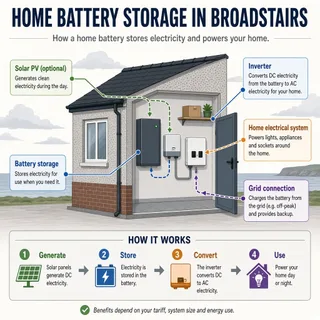
Home battery storage in Broadstairs depends on usable kWh, salt-air siting and UK Power Networks paperwork. Backup is not automatic in a power cut.
Read article
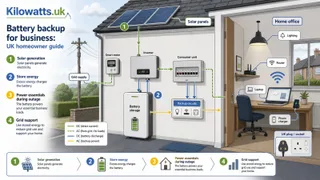
Can a home battery work during a power cut in the UK? A home battery can work during a power cut in the UK, but only if it has the right setup.
Read article
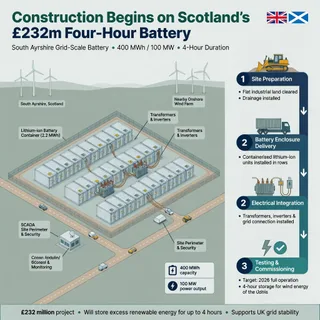
Construction has started on the 350MW Kilmarnock South battery after CIP's investment decision. Four hours is intraday balancing, not a windless week.
Read article
Mo's Solar Mission
Mo's Mission Nominations
Garlinge Primary School and Nursery
Garlinge Primary School and Nursery is a foundation primary school on Westfield Road in Margate, Kent, for children aged 3 to 11. It is m...
St Luke's Church of England Primary SchoolSt Luke's Church of England Primary School is a voluntary controlled Church of England primary school on Jubilee Road in Formby, Merseysi...
Comberbach Nursery and Primary SchoolComberbach Nursery and Primary School is a primary academy on Mather Drive in the village of Comberbach, near Northwich in Cheshire, for...
Locations
Solar installation near you
Write for Kilowatts.uk
Got a trade and something worth saying?
Write it here under your own name. Sign in, put a profile up, and start a guide. Pay only if you want more links from your articles out to your own site.
Register
Create a Kilowatts.uk account, or sign in if you already have one.
Author profile
Put your name, photo and experience on a public author page.
Start creating
Write a guide or a blog. Free authors can put one followed link to their own site in articles each month.
FAQ
Need Help? RoboMo's Got Answers
Can I buy the PowerNet battery in the UK?
PowerNet is being developed through an Australian manufacturing pilot. A UK launch date and installed price remain unconfirmed.
What could a 4 kWh PowerNet module run, and for how long?
Runtime depends on how much energy reaches your appliances and their average power draw. If a module delivers 3 kWh after conversion losses and allowing for a reserve, appliances averaging 300 W could run for about 10 hours without recharging. Check the continuous output for appliances running together and the peak output and its duration for equipment with a start-up surge.
Could I take a PowerNet module from my home to my campervan?
That is one of the intended uses. Before planning around it, check the module’s weight, compatible equipment at both sites, approved vehicle mounting and the manufacturer’s disconnection and refitting procedure. If other modules stay at home, check how much usable energy and power they can provide while one is away.
Would PowerNet work with my existing solar panels and inverter?
Compatibility would depend on whether your inverter supports the exact module and its battery management system. Give your installer the inverter make and model and details of any existing battery so they can check whether a separate battery inverter is needed. For a grid-connected installation in Great Britain, ask the installer to confirm the applicable connection process with your local distribution network operator.
Could PowerNet keep my fridge and lights on during a power cut?
That would depend on whether the installed system supports backup and which circuits are wired to stay live. Ask what power and runtime you could expect with one module away. If you plan to remove modules regularly, check whether disconnection interrupts the backup supply.
Could I monitor or control PowerNet from my phone?
PowerNet’s remote features remain unconfirmed. If remote access matters to you, check whether the system can show battery charge, send fault alerts and let you change charging schedules or backup reserves. Ask which settings keep working if the internet connection drops.
What should I include when comparing PowerNet with other battery options?
Compare the total cost of equipping both sites, including any extra inverter, electrical work and backup circuits. Check who would service the system in the UK and whether the warranty covers regular removal and use away from home. If you would move the module only occasionally, compare that total with the cost of a fixed home battery and a separate portable unit.
Live help
Need help right now?
Talk to RoboMo™ and get instant answers.