


Construction Begins on Scotland’s £232m Four-Hour Battery
Published: 2026-10-07 00:23:11
Updated: 2026-10-06 17:23:45
Construction has started on the 350MW Kilmarnock South battery after CIP’s investment decision. Four hours is intraday balancing, not a windless week.

Construction Begins on Scotland’s £232m Four-Hour Battery
How kilmarnock south battery work, typical output, costs and limits, and whether they have a future for UK homes, balconies and businesses.
Kilmarnock South: the 350MW/1,400MWh commitment
Kilmarnock South is a 350MW/1,400MWh lithium-ion battery in South Ayrshire. Construction has started after Copenhagen Infrastructure Partners took a final investment decision. Four-hour storage here means 1,400MWh of nameplate energy divided by 350MW of rated power. CIP has committed more than €270 million, given in the announcement as approximately £232 million of grid-scale capital, with commercial operation targeted for the first quarter of 2028. Noriker Power developed the project and is to manage construction. Shell Energy Europe holds a long-term optimisation agreement. This is not a home battery, a tariff or a figure a household can treat as a quote.
Those claims come from CIP’s final-investment announcement for Kilmarnock South, as carried in the construction-start reports. That sponsor package is the primary public source for the euro commitment, the sterling conversion, the 2028 target, Noriker’s construction role and the Shell agreement. The summary relied on here does not publish a planning reference, an exchange-rate fixing date or a contract price, so none of those is stated. The £232 million figure is the announcement’s own conversion of more than €270 million. It is not a domestic price per kilowatt-hour, a grant or an all-in cost a later reader can lift into a quote.
Finance, a construction start and a named optimiser are stronger signals than another planning consent. Electricity is not on the system yet. Nothing in the public material sets a household export limit, a retail tariff or a domestic battery size. Revenue terms under the Shell agreement have not been disclosed, so there is no basis for inferring a floor price, a tolling fee or a capacity-market contract.
How the 350MW and 1,400MWh rating should be read
The published specification is a power rating and a nameplate energy rating together. 350MW is the maximum rate at which the plant is designed to charge or discharge. 1,400MWh, often written as 1.4GWh, is the nameplate quantity of energy stored. Divide energy by power and the duration at full rated output is four hours. That is the whole of the arithmetic the headline supports. It cannot supply 1,400MW for an hour, because 1,400MWh is stored energy, not a generator rating. It also cannot hold 350MW for much longer than those four hours at the stated nameplate. In practice, usable energy is often lower than nameplate once state-of-charge limits, inverter rating and thermal limits are applied. None of those limits has been published for this plant, so usable megawatt-hours, round-trip efficiency and any augmentation plan should be treated as unknown.
Overview
The same reading applies when an installer quotes a smaller home battery in kilowatts and kilowatt-hours. Duration is only energy divided by power if the equipment can actually deliver that power across the window. Nameplate kilowatt-hours are not automatically the energy available every day. A useful quote separates inverter power from usable energy, then says what the warranty excludes.
What four hours can and cannot do for Scottish wind
A four-hour battery is built for intraday work. It can take energy when supply is high and demand or export capacity is tight, then release it later the same day, if it is connected in the right place and dispatched to do so. Four hours is longer than many early British grid batteries, which were often sized for one-hour or two-hour bursts. It is not a store for a week of low wind, and a large megawatt-hour figure does not by itself make the plant long-duration storage. Duration is the hours at full power. Whether a particular scheme or policy document classes four hours as long-duration is a definition question, not something this project settles.
The constraint this plant is said to address is physical as well as commercial. Scottish wind is often limited because southbound transmission, including the Scotland–England boundary often called B6 in network discussion, cannot always accept the full output. That is a transfer limit on existing circuits. It is not removed by siting a battery in South Ayrshire. The National Energy System Operator can manage the overflow in the Balancing Mechanism by instructing plant to turn down, and sometimes by instructing demand or storage to take power. Those are dispatch instructions and payments. They are not the same thing as building a new circuit, which would raise the physical transfer capability.
A battery only helps with the slice of the problem that matches its connection, its spare headroom and the instructions it receives. Once it is full, further wind still needs a path south, local demand or another store. Four hours can move energy inside a day. It does not add an interconnector, cover a prolonged weather pattern or replace network reinforcement. If the market pays the battery to do something else, it may not be sitting full of constrained wind. No quantified curtailment reduction has been published for Kilmarnock South, so none should be assumed. A plant of this scale is also a transmission-scale connection, not a household distribution application.
How Kilmarnock South compares with other UK batteries
CIP has described Kilmarnock South as its longest-duration UK battery asset. That wording should stay attached to CIP. It is a statement about the sponsor’s portfolio, not an independent ranking of every operating, consented or proposed battery in Britain. Four hours is clearly longer than the one-hour and two-hour plants that made up much of the early British fleet. It does not follow that no other UK project has a longer published duration, or that this one is already the largest store of energy on the system. A fair comparison uses duration and status, not a single megawatt-hour headline. Pillswood in East Yorkshire was reported at commissioning as roughly 98MW and 196MWh, about two hours, and it is an operating plant. Minety in Wiltshire is an earlier battery in the 100MW class and has been discussed as a much shorter-duration plant than four hours. Exact energy ratings can differ by phase, so those examples are anchors, not a census. Multi-day storage is a different design job again.
Overview
Status matters as much as duration. An operating two-hour battery is already available to the system. Kilmarnock South is financed and under construction, with a 2028 target that can still move. A consented scheme with no final investment decision is weaker again. Mixing those stages into one league table of Britain’s batteries overstates what any single announcement proves.
Why final investment decision is the milestone that matters
Planning permission shows that a project was acceptable in planning terms. It does not show that anyone will fund the containers, the transformers, the connection works or the construction team. Across Britain, consented storage capacity and financed storage capacity are not the same list. That is an industry pattern, not a counted failure rate, and it should not be turned into a precise percentage.
Final investment decision is the point at which the sponsor commits capital on stated terms. Here that commitment is paired with a construction start and with Shell Energy Europe as optimiser. Together those facts make Kilmarnock South materially stronger than a speculative capacity announcement. They do not remove construction risk, commissioning risk, connection risk or the chance that the 2028 commercial-operation window moves. A date in an investment announcement is a target, not proof that the asset is available to the system.
Noriker’s role is development and construction management. Shell’s role is commercial optimisation under a long-term agreement. Those are specialist grid-project functions. They are not a domestic installer warranty, a home energy-management product, or a promise that retail bills will fall by a stated amount. Readers who want the primary wording should go to CIP’s Kilmarnock South investment announcement itself. This explainer does not add a URL, a planning reference or an exchange-rate date that the summary does not securely establish.
What is still unpublished before 2028
Commercial operation is not expected until the first quarter of 2028. Between now and then the project still has to be built, connected and commissioned. Those stages slip on grid projects for reasons that have nothing to do with the headline capacity. An engineer comparing this plant with an operating battery would also want specification items that the announcement does not give.
Several of those gaps change what can be claimed now. Industry figures for typical lithium batteries must not be pasted onto this project as if they were its performance. The Shell agreement gives a route to market. It does not publish price, availability targets or how risk is split.
Until those points are published, Kilmarnock South is a funded construction project with a clear nameplate rating, not a measured operating asset. Anyone tracking it should separate the 2028 target from commissioning evidence, and separate CIP’s portfolio wording from a national duration ranking.
What this changes for homes and business sites
For a homeowner, a farm or a factory, the useful lesson is how to read a battery quote, not how to copy a 350MW layout. Ask for power and usable energy separately. Ask what duration that implies at the inverter rating, not only at a marketing nameplate. Ask what warranty limits exclude, including state of charge and cycle conditions. A South Ayrshire grid battery does not change a premises’ distribution-network application, export limit or tariff. A 350MW transmission-scale plant is also a poor template for a G98 or G99 conversation on a small site.
This plant is a poor guide to cost. The commitment of more than €270 million, stated as approximately £232 million, is project capital at grid scale. It says nothing about grants, payback or eligibility, and it should not be divided into a domestic price per kilowatt-hour. Those questions depend on the site, the tariff and the equipment actually specified. No bill saving should be inferred from a national storage headline. A factory or larger site needs its own commercial battery storage assessment, not a scaled-down reading of this plant.
If the question is whether four-hour storage has a job on the British system, the honest answer is yes, within limits. It can shift energy inside a day where the connection and the market support that dispatch, including some constrained Scottish wind if it is actually instructed to charge. It does not cover multi-day low wind, it does not raise the southbound transfer limit the way a new circuit would, and it does not remove the need to know who built the cells, how much energy is usable, and on what commercial terms the asset will run. Households weighing their own equipment can book a free survey.
Plan, Compare & Buy Renewable Energy Solutions
AI does the thinking.
You get the perfect solar match.
Use RoboMo™ to assess your property, compare available technologies and connect with trusted UK installers, suppliers and manufacturers.
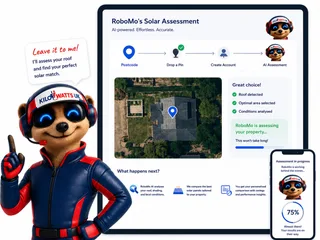
Simply enter your postcode, drop a pin on your roof, create your free account and let RoboMo™ analyse your property to find the best solar panels for your home.

You don't have to think
RoboMo™'s AI analyses your roof and does all the hard work.

Accurate & tailored
AI-powered assessment based on your roof, location, and conditions.

Best options, maximum savings
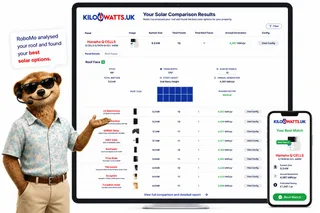
Compare top solar panels for the best performance and value.

Simple, fast & effortless
Provide a few details, sit back and watch your results unfold.
STEP 1
Choose Home, Business or Industrial
Enter your postcode to start your assessment.
STEP 2

Drop a pin on your roof
STEP 3

Create your free account
STEP 4

Sit back and watch RoboMo™ work
RoboMo™ analyses your roof and builds your personalised solar comparison.

Step 1
Enter your postcode
Start designing your wind energy system in seconds.
Are you an installer, distributor or renewable energy business?
Kilowatts UK is expanding the Flower Turbines partner network across the UK.
Become A Flower Turbines PartnerKilowatts UK is an authorised representative
Flower Turbines
Compact vertical-axis turbines built for real UK sites, not just open farmland.
They start in light wind, sit in a small footprint, and are bird-safe by design. Cluster them as a bouquet and the group performs better together than the same turbines standing alone. Enter your postcode for a location-based generation estimate. Figures use area weather data and will differ if buildings, trees or hills sit in the way.
Starts in light UK wind
Built to generate in typical UK wind, not only open farmland.
Small rooftop or ground footprint
Compact towers for roofs, yards and tight sites.
Bird-safe slow rotation
Slow vertical-axis spin, bird-safe by design.
Bouquet clusters raise output
Grouped turbines outperform the same units standing alone.


STEP 2

Choose a location
STEP 3

Place your cluster
Tap the map where you want the turbine cluster to go.
STEP 4

Instant generation forecasts
Compare different turbine layouts and see annual generation forecasts instantly.
STEP 5

No commitment required
Explore different configurations before deciding whether to request a quotation.
Related articles

FAQ
Need Help? RoboMo's Got Answers
What is Kilmarnock South, and has construction actually started?
Kilmarnock South is a 350MW/1,400MWh lithium-ion battery in South Ayrshire. Construction has started after Copenhagen Infrastructure Partners took a final investment decision, with commercial operation targeted for the first quarter of 2028. Noriker Power developed the project and is to manage construction, and Shell Energy Europe holds a long-term optimisation agreement. Electricity is not on the system yet, and a target date is not proof the asset is already available.
What does a four-hour, 350MW/1,400MWh battery rating mean?
350MW is the maximum rate at which the plant is designed to charge or discharge. 1,400MWh is the nameplate quantity of energy stored, so at full rated output the duration is four hours. It cannot supply 1,400MW for an hour, and it cannot hold 350MW for much longer than those four hours at the stated nameplate. Usable energy, round-trip efficiency and any augmentation plan have not been published, so they should be treated as unknown.
Will this battery stop Scottish wind being curtailed or replace new power lines?
A four-hour battery can shift energy inside a day if it is connected in the right place and dispatched to charge and discharge. It does not raise the southbound transfer limit the way a new circuit would, and once it is full further wind still needs a path south, local demand or another store. No quantified curtailment reduction has been published for Kilmarnock South, so none should be assumed. It is also not a store for a week of low wind.
Is this Britain’s largest or longest-duration battery?
CIP has described Kilmarnock South as its longest-duration UK battery asset. That is a statement about the sponsor’s portfolio, not an independent ranking of every operating, consented or proposed battery in Britain. Four hours is longer than many early one-hour and two-hour British grid batteries, but other projects can have different durations and statuses. An operating plant is already available to the system; this one is financed and under construction, with a 2028 target that can still move.
Does the £232 million figure tell me what a home battery should cost?
No. CIP has committed more than €270 million, given in the announcement as approximately £232 million of grid-scale capital. That is the announcement’s own sterling conversion, not a domestic price per kilowatt-hour, a grant or an all-in cost a household can lift into a quote. It says nothing about grants, payback or eligibility. A home or business quote depends on the site, the tariff and the equipment actually specified.
What should a homeowner ask for in a battery quote instead of copying this project?
Ask for inverter power and usable energy separately, and for the duration that implies at the inverter rating rather than only a marketing nameplate. Ask what the warranty excludes, including state-of-charge and cycle conditions. A South Ayrshire transmission-scale plant does not change a premises’ distribution-network application, export limit or tariff, and it is a poor template for a small-site connection conversation. No household bill saving should be inferred from this national storage headline.
Why does a final investment decision matter more than another planning consent?
Planning permission shows a project was acceptable in planning terms. It does not show that anyone will fund the equipment, connection works or construction team. A final investment decision is the point at which the sponsor commits capital, and here it is paired with a construction start and a named optimiser. That is stronger than a speculative capacity announcement, but it does not remove construction, commissioning or connection risk.
What is still unknown before the 2028 target?
The cell supplier, usable energy after operating limits, round-trip efficiency and any augmentation plan have not been published. Revenue terms under the Shell agreement have not been disclosed, so there is no basis for inferring a floor price, a tolling fee or a capacity-market contract. Planning reference and exchange-rate fixing date are also not established in the summary used here. Until commissioning evidence exists, this is a funded construction project with a clear nameplate rating, not a measured operating asset.