LinkedIn profile for David Coleman David Coleman
Founder & Renewable Energy Author, kilowatts.uk


LinkedIn profile for David Coleman David Coleman
Founder & Renewable Energy Author, kilowatts.uk
Article
We may earn a commission if you buy through these links, at no extra cost to you.
How to choose solar extension cables and MC4 leads in the UK: connector compatibility, 4mm² vs 6mm², voltage drop by length, UV-rated PV cable and DC safety.
An extension lead lets you put a solar panel in full sun while the power station, battery or inverter stays dry and shaded. It sounds simple, but the wrong lead can waste a noticeable share of a small panel's output, fail to fit, or create a hot joint. This guide covers what UK buyers should check: connector compatibility, cable size, voltage drop, length, outdoor rating and safety.
It is written for portable panels and plug-in kits. It is not a guide to wiring a fixed rooftop solar system: that work should be designed and installed by a qualified electrician (see the safety section below). You can also read more about Combine Solar Panels &.
How we wrote this: the technical guidance is based on standard electrical calculations and published product specifications. Product details and prices are from EcoFlow UK's and Renogy UK's product pages as of 9 Nov 2026. We have not tested these products, and nothing here is a review.
MC4 is the single-pole DC connector used on most solar panels: one male and one female connector per panel, which click together and lock. The design came from Multi-Contact, now Stäubli, and many other makers sell connectors described as "MC4 compatible".
Two connectors that physically click together are not automatically a good pair. The contact pressure, plating and seal depend on the exact design, and a poor contact adds resistance, which turns into heat at the joint. Connector makers, including Stäubli, advise against mating their connectors with another manufacturer's. In practice:
At the other end, portable power stations rarely take MC4 directly. EcoFlow, for example, uses XT60/XT60i solar inputs, and other brands use Anderson or DC barrel connectors. Use the adapter cable the station's maker lists for your model.
Solar cable is sold by the cross-sectional area of the copper: 2.5mm², 4mm² and 6mm² are the common sizes. Thicker cable has lower resistance, so less of your panel's output is lost as heat on the way to the battery or inverter. For short portable runs, the current a cable can safely carry is rarely the limit. Voltage drop is what matters.
The calculation is simple. For a run of length L metres (one way), the cable resistance is about 2 × L × 0.0175 ÷ area (mm²) ohms. The 2 covers the positive and negative conductors, and 0.0175 is the resistivity of copper at 20°C. Multiply by the current to get the volts lost. Warm cable in summer sun has somewhat higher resistance, so treat these figures as a best case.
Example 1: one small portable panel. EcoFlow UK lists its 160W Lightweight Portable Solar Panel at a maximum-power voltage of 18.8V and 8.7A at standard test conditions. With that current:
| Extension length (one way) | 2.5mm² | 4mm² | 6mm² |
|---|---|---|---|
| 5m | 0.61V (3.2%) | 0.38V (2.0%) | 0.25V (1.3%) |
| 10m | 1.22V (6.5%) | 0.76V (4.0%) | 0.51V (2.7%) |
| 15m | 1.83V (9.7%) | 1.14V (6.1%) | 0.76V (4.0%) |
Example 2: two larger panels in series (illustrative). Two panels of about 31V and 13A each, wired in series, give roughly 62V at 13A. Over a 10m run, 4mm² loses about 1.1V (1.8%) and 6mm² about 0.8V (1.2%). Over 20m, the losses are 3.7% and 2.4%.
Two lessons follow. First, low-voltage single panels lose proportionally more, so keep their runs short. Second, higher voltage (panels in series) cuts losses for the same power, provided the total stays within the input limits (see below). A common design aim is to keep DC voltage drop to about 1–3%. If 4mm² puts you above that, step up to 6mm² or shorten the run.
Two practical checks go with a bigger cable. MC4 connectors come in versions for different cable sizes, so a 6mm² cable needs 6mm²-rated connectors. Any adapter or lead at the power-station end is part of the circuit too: a thin adapter lead can cancel out the benefit of a thick extension.
Buy the length you need rather than the longest available. Coiled spare cable still adds resistance. If you must run further, it is usually better to raise the system voltage than to keep adding thin cable, but only within limits: You can also read more about UK government solar panel scheme 2026.
Panel cabling lives outdoors for years, so ordinary flex, speaker wire or automotive cable is the wrong choice. Look for dedicated PV cable made to BS EN 50618 (often marked H1Z2Z2-K). It is designed for the UV, ozone, moisture and temperature conditions solar cabling sees, and is rated for DC solar voltages.
Solar panels produce voltage whenever light falls on them, and you cannot switch a panel off. Treat the cabling as live in daylight.
Check that the connectors match your panel and your power station or inverter before you order. Prices are from each brand's UK store as of 9 Nov 2026 and change often.
For choosing the panel itself, see our portable solar guide.
They often physically fit, but connectors from different manufacturers are not necessarily tested to work together, and a poor mated contact can overheat. Connector makers, including Stäubli (maker of the original MC4), advise against mating connectors from different manufacturers. Use matching connectors on both sides of each joint where you can.
For most portable and small plug-in kits, 4mm² PV cable is fine for short runs. Choose 6mm² for longer runs or higher currents, where voltage drop at 4mm² would exceed about 2–3%. Check that your MC4 connectors are the version made for your cable size.
There is no single limit. Loss rises with length and current and falls with cable size and system voltage. For a single portable panel at about 19V, a 5m extension in 4mm² cable loses about 2%, but a 15m extension loses about 6%. Keep low-voltage runs short, or use thicker cable.
Not under load. Switch off or disconnect the solar input at the power station or inverter first, or cover the panel, then separate the connectors. Unplugging a DC connector while current is flowing can draw an arc and damage the contacts.
For a portable panel charging a power station, using a ready-made extension lead from the panel or station maker is a plug-together job. For fixed installations, including roof arrays and any system connected to your home's wiring, the DC cabling, isolation and connection should be designed and installed by a qualified electrician to BS 7671.
Solar comparison
Enter your postcode to assess your roof, compare solar options and get quotes from UK installers.
Choose home, business or industrial, then enter your postcode. RoboMo maps the roof and ranks panel brands by fit.
1. Postcode Start the assessment for your property.
2. Pin the roof Mark the array on the map.
3. Compare RoboMo™ builds your options.
Battery ROI tool
Enter the day rate, off-peak rate and export rate. The calculator ranks batteries in the Kilowatts shop over 10 years. Home batteries also suit offices and small commercial sites.
Reading
Compare UK solar panel quotes for 2026: see 2kW to 6kW costs, yearly savings of £350 to £1,000, and a typical payback of 9 to 15 years before choosing.
Read article
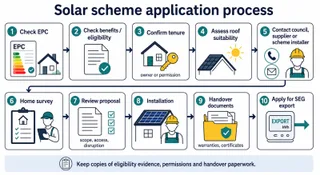
There is no single government solar panel scheme for every UK home in 2026. Help comes through retrofit schemes, supplier obligations, councils and devolved programmes.
Read article
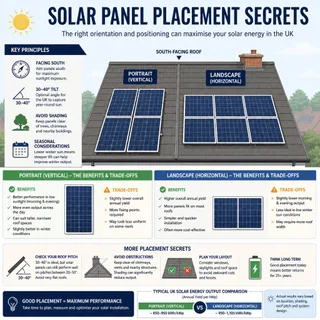
Discover the key strategies and technical insights for optimal solar panel placement.
Read article
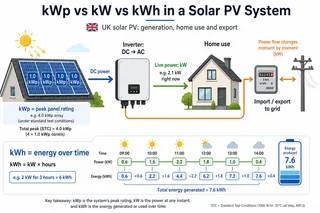
A guide to solar panel peak power and how kWp differs from actual generation.
Read article
Solar panels
Write for Kilowatts.uk
Write it here under your own name. Sign in, put a profile up, and start a guide. Pay only if you want more links from your articles out to your own site.
Create a Kilowatts.uk account, or sign in if you already have one.
Put your name, photo and experience on a public author page.
Write a guide or a blog. Free authors can put one followed link to their own site in articles each month.
FAQ
Live help
Talk to RoboMo™ and get instant answers.
Live chat