LinkedIn profile for David Coleman David Coleman
Founder & Renewable Energy Author, kilowatts.uk


LinkedIn profile for David Coleman David Coleman
Founder & Renewable Energy Author, kilowatts.uk
Article
Octopus, CATL and Ampace are exploring smart home batteries, including sodium-ion technology. The agreement has no confirmed product price or UK launch date.
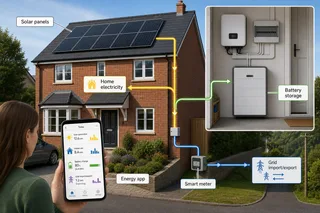
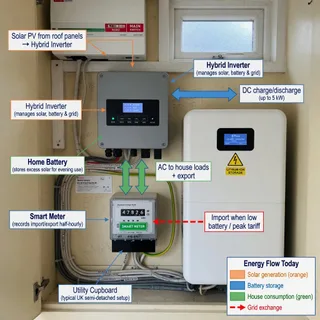
Illustration of a home energy system; it does not depict a product or installation announced in this article.
Published 5 November 2026. This article covers the collaboration announced on 3 November, rather than a newly available battery product.
Octopus Energy, CATL and Ampace are exploring a new generation of connected home batteries. Sodium-ion technology is among the possibilities, alongside battery hardware designed to work with energy software and tariffs.
For a UK household, the announcement is a development to watch. It does not yet provide a model, installed price or delivery date that can be compared with a current battery quote.
The Octopus announcement of 3 November 2026 describes a Memorandum of Understanding to explore collaboration on home storage. It combines battery chemistry and engineering with software, tariff and flexibility services, initially looking at European markets.
Sodium-ion is named as an area of research and development. The announcement does not confirm the chemistry of a particular future retail model, or establish that an existing Octopus battery range will use sodium-ion cells.
A home battery needs decisions about when to charge, when to discharge and how much reserve to keep. Those decisions depend on the home's consumption, solar output, prices and equipment limits. Better coordination can be useful even when the physical battery chemistry is familiar.
For an owner, the control arrangements deserve the same attention as the capacity figure. Ask which settings remain under household control, what happens if the internet is unavailable, and which services depend on a particular energy supplier or subscription.
The name of a chemistry is not a warranty, an installed-cost calculation or a safety assessment for a complete system. A useful comparison needs a defined product and its certification, usable capacity, power rating, operating conditions and support terms.
Claims about cheaper batteries or longer life should be assessed against the final supplied system. Until a model has published specifications and commercial terms, it is not possible to calculate whether this collaboration would improve the payback period for a particular UK home.
No model-specific usable capacity, continuous power rating, installed price, warranty or UK delivery timetable is given. There is also no named product specification that would let an installer confirm compatibility with an existing inverter at a particular property.
That makes this an agreement to explore opportunities, rather than a reason to assume a new battery can be ordered now. A future product launch should be checked separately, with its own specification sheet and UK installation requirements.
There is no universal answer. If a household needs storage now, compare systems with written prices, installation designs and support available today. If the purchase is optional, keep the announcement on a watch list and review it when the companies publish an actual product.
In either case, ask for a calculation using the household's own consumption and tariffs. Include usable storage, charging and discharging power, losses, warranty limits and any subscription costs. A larger headline capacity does not, by itself, establish a better financial outcome.
Installation location also needs attention regardless of brand. Our home battery rules guide explains the enclosure and placement questions to discuss with an installer. A promising chemistry cannot remove the need for a suitable site design.
Solar comparison
Enter your postcode to assess your roof, compare solar options and get quotes from UK installers.
Choose home, business or industrial, then enter your postcode. RoboMo maps the roof and ranks panel brands by fit.
1. Postcode Start the assessment for your property.
2. Pin the roof Mark the array on the map.
3. Compare RoboMo™ builds your options.
Battery ROI tool
Enter the day rate, off-peak rate and export rate. The calculator ranks batteries in the Kilowatts shop over 10 years. Home batteries also suit offices and small commercial sites.
Reading
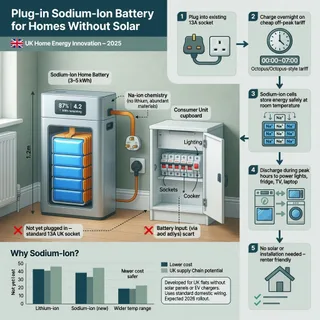
A plug-in sodium-ion battery for homes without solar is in development, not on sale. UK grid rules may still block a simple wall-socket connection.
Read article

A battery without solar buys cheap overnight units for peak use. Payback depends on your tariff spread, not on generation.
Read article
Octopus Flux and Intelligent Octopus Flux are domestic battery storage tariffs that price import and export by time of day, not a free battery.
Read article
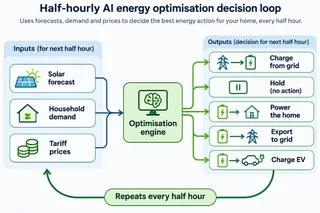
Discover how SolarMind uses AI to optimise solar panels, home batteries and EV charging, and whether it could help reduce your energy bills.
Read article
Write for Kilowatts.uk
Write it here under your own name. Sign in, put a profile up, and start a guide. Pay only if you want more links from your articles out to your own site.
Create a Kilowatts.uk account, or sign in if you already have one.
Put your name, photo and experience on a public author page.
Write a guide or a blog. Free authors can put one followed link to their own site in articles each month.
FAQ
Live help
Talk to RoboMo™ and get instant answers.
Live chat